|
| Posted by: Baldwin
- [111112015] Sat, Jul 12, 2003, 17:24
The Science Development Thread needs a companion.
Here is a development I have wanted to see for a while now. Save 2 Billion gallons of fuel a year while upgrading comfort. |
| | | 1 | Punk42AE
ID: 225182722
Sat, Jul 12, 2003, 19:05
|
Sounds like a very interesting idea. Being that I just got back from the east coast, on my 11 hour drive at night I see the trucks packed everywhere they can be. Although it will take along time to get these things set up through out the US, and the trucks that will continue to be parked at rest stops for thousands of feet. This sounds liek a wonderful plan.
|
|
| | | 2 | Baldwin
ID: 463571714
Sat, Apr 17, 2004, 22:12
|
Computers thinking outside the box...err displaying outside the monitor anyway.
Glanceable displays
|
|
| | | 3 | Baldwin
ID: 5544766
Fri, May 14, 2004, 09:38
|
Rise of the moorlocks.
|
|
| | | 4 | Baldwin
ID: 5544766
Sat, May 15, 2004, 00:05
|
Scaled Composites SpaceShipOne is nearing the edge of space. On third test flight it reaches 40 mile altitude. At 50 the pilot would have been due astronaut wings. At 62 miles he would have officially been in outer space.Objectives: The third powered flight of SpaceShipOne. 55 seconds motor burn time. Handling qualities during boost and performance verification. Reaction control system use for reorientation to entry attitude. Supersonic feather stability and control.
Results: Launch conditions were 46,000 feet and 120 knots. Motor light off occurred 10 seconds after release and the vehicle boosted smoothly to 150,000 feet and Mach 2.5. Subsequent coast to apogee of 211,400 feet. During a portion of the boost, the flight director display was inoperative, however the pilot continued the planned trajectory referencing the external horizon. Reaction control authority was as predicted and the vehicle recovered in feather experiencing 1.9M and 3.5G’s. Feather oscillations were actively damped by the pilot and the wing was de-feathered starting at 55,000 feet. The onboard avionics was re-booted and a smooth and uneventful landing made to Mojave.
|
|
| | | 5 | Baldwin
ID: 5544766
Sat, Jun 26, 2004, 09:11
|
Amorphous [non-crystalline] metals which were prohibitively expensive now due for dramatic drop in costs.hardness and strength more than double the best ultra-high-strength conventional steels.
The new steel could find use in everything from submarine hulls to skyscrapers...
Amorphous materials possess "a non-crystalline structure, in which the atoms arrange randomly, thus no crystallographic defects" form...This is why they can be so strong...
Several amorphous, iron-based alloys already have found use in industry. An amorphous, ferro-magnetic alloy, sold under the trademarked name Metglass, has extremely high energy-conversion efficiency when used in the cores of electrical transformers or other energy converters.
Because of their strength and anti-corrosion properties, amorphous steel also would be desirable in buildings, but until now no one has been able to make components big enough to be structural members. Before Lu and his team conducted their research, the largest amorphous steel rod anyone had cast was only about 4 millimeters wide.
Now, after nearly a year of work, the team believes it has found a way to make amorphous steel in bulk economically with traditional, drop-casting methods. Its cost should be comparable to that of conventional steels...
|
|
| | |
| | | 7 | Baldwin
ID: 53631254
Mon, Aug 02, 2004, 16:35
|
Too good to be true and yet it looks legit...Imagine a power source so small, yet so efficient, that it could make cumbersome power plants virtually obsolete while lowering your electric bill. A breakthrough in thin film solid oxide fuel cells (SOFCs) is currently being refined in labs at the University of Houston, making that dream a reality.
Originating from research at UH's Texas Center for Superconductivity and Advanced Materials (TcSAM), these SOFCs of the ''thin film'' variety are both efficient and compact. With potential ranging from use in the government in matters of defense and space travel to driving forces in the consumer market that include computers and electricity, this breakthrough carries tremendous impact.
''By using materials science concepts developed in our superconductivity research and materials processing concepts in our semiconductor research, we are able to reduce operating temperatures, eliminate steps and use less expensive materials that will potentially revolutionize from where we derive electrical energy,'' said Alex Ignatiev, director of TcSAM and distinguished university professor of physics, chemistry and electrical and computer engineering at UH. ''While there are a number of fuel cell research programs at the university, ours focuses on the application of thin film science and technology to gain the benefits of efficiency and low cost.''
Compared to the macroscopic size of traditional fuel cells that can take up an entire room, thin film SOFCs are one micron thick -- the equivalent of about one-hundredth of a human hair. Putting this into perspective, the size equivalent of four sugar cubes would produce 80 watts -- more than enough to operate a laptop computer, eliminating clunky batteries and giving you hours more juice in your laptop. By the same token, approximately two cans' worth of soda would produce more than five kilowatts, enough to power a typical household.
Keeping in mind that one thin film SOFC is just a fraction of the size of a human hair with an output of 0.8 to 0.9 Volts, a stack of 100 to 120 of these fuel cells would generate about 100 volts. When connected to a homeowner's natural gas line, the stack would provide the needed electrical energy to run the household at an efficiency of approximately 65 percent. This would be a twofold increase over power plants today, as they operate at 30 to 35 percent efficiency. Stand-alone household fuel cell units could form the basis for a new 'distributed power' system. In this concept, energy not used by the household would be fed back into a main grid, resulting in a credit to the user's account, while overages would similarly receive extra energy from that grid and be charged accordingly.
|
|
| | | 8 | Baldwin
ID: 48812921
Fri, Oct 01, 2004, 06:04
|
BUTT
Because I like this stuff.
|
|
| | | 9 | Baldwin
ID: 189442512
Mon, Oct 25, 2004, 15:05
|
Just give me resolution, baby, that's what I want.
How does a 7000x5000 pixel display, low power usage, that can be made using cheap printing technology sound?
Hewlett-Packard claims the cost will be 1/5 that of flat sceen technology. Now let's take a look at some stock. 8]
New Scientist
|
|
| | | 10 | biliruben
ID: 441182916
Mon, Oct 25, 2004, 15:18
|
I've been discussing the non-existence of this technology with regard to the future of the publishing industry, or lack there-of.
Imagine if you had access to the library of congress at the touch of a fingertip in a format as pleasant to read as the printed page. What would you pay for that? Would you ever buy a book/magazine/newspaper again?
Sure the publishing industry is more than just a printing press. They also provide such things as gate-keeper/editorial services. The moat around there castle would shrink to a trickling brook without the printing side, however.
|
|
| | | 11 | CCP Live From School
ID: 539592514
Mon, Oct 25, 2004, 17:17
|
Oddly, this coming from a moderate Republican who could normally care less about the environment, but imagine the environmental benefits of this.
Even though a lot of material is printed on recycled paper, a lot of those trees wouldn't have to be chopped down in the first place. Truly amazing technology.
I'd love to have one of these just to download various magazine subscriptions and take it to work or school or read at home. Coupled with a notebook sized hard drive, one could store an untold number of magazines or books for reading whenever one wished. Combined with broadband internet, you can download your favorite new magazine from your subscription sent to you in an email via a publishing house.
Hopefully I don't have to sell my first born to get one of those eventually.
|
|
| | |
| | | 13 | Baldwin
ID: 40022277
Fri, Feb 04, 2005, 06:48
|
After the Transister
Tube--->transistor--->?
The Crossbar Latch. Note there are speed issues with this nanotech that haven't been solved but this is electronics at the molecular level.
|
|
| | | 14 | Boldwin
ID: 1411237
Sun, Feb 27, 2005, 22:33
|
Real-time concept mapping to boost brainstorming in 3-5 years.
|
|
| | | 15 | Boldwin
ID: 241292815
Sun, Mar 06, 2005, 06:55
|
Insulin will soon be available in inhaler form. You'll still need to stick yourself for testing but this will be a real relief for insulin users who now need to inject.
|
|
| | | 16 | Boldwin
ID: 241292815
Sun, Mar 06, 2005, 12:52
|
I kid you not, this is not a satire site, it is a real product. It did however win an IgNoble Prize which is satirical.Under-Ease are underwear for protection against bad human gas (malodorous flatus) and are made from a soft air-tight fabric (polyurethane-coated nylon). To maintain the air-tightness, elastic is sewn into the material around the waist and both legs.
A triangular "exit hole" for the flatus to be expelled is cut from the back of the air-tight underwear, near the bottom. This "exit hole" is covered with a "pocket" made of ordinary porous fabric sewn over the "exit hole". This unique design forces all expelled gas (flatus) out through the "pocket".
Inside the "pocket" is a high-functioning, replaceable filter - the core of the technology. This multi-layered filter is made in a sandwich-style, and begins with the two outer layers of wool felt. The second two layers are made of non-woven polypropylene and spun glass materials. In the center of the filter is a single layer of activated carbon.
The filter is then covered with soft ordinary material to allow for easy replacement in or out of the pocket. The underwear are washable and will last approximately a year depending on the frequency of use and laundering. Each filter will last from several weeks to several months depending on the frequency of use and laundering. (See Wear and Care) "will last approximately a year depending on ..."> Reality, what a concept. 8]
|
|
| | | 17 | Boldwin
ID: 241292815
Tue, Mar 08, 2005, 17:11
|
Promising battery breakthru using a trick to expand anode surface area...The highest energy-per-weight ratio in today's batteries is provided by lithium-ion (Li-ion) batteries. They are also cheaper in terms of energy delivered per unit of weight than alternative types of battery such as nickel-metal-hydride (NiMH) and nickel-cadmium (Ni-Cd) types. But Li-ion cells have their drawbacks too. They eventually wear out, and they cannot discharge energy quickly enough for applications requiring power surges, such as camera flashguns and power tools.
They may soon be able to. Altair Technologies of Reno has created a new type of Li-ion cell in which the anode has an exceptionally high surface area.
Altair's patented modification is to make the anode surface out of lithium titanate nanocrystals, using chemical tricks to give it a surface area of about 100 square metres per gram, compared with 3 square metres per gram for carbon.
The high current that this modified electrode is able to carry means power-hungry devices can be installed in mobile phones, which until now have been denied them. For instance, camera phones might now have enough power to run a flashgun.
Longer lifespan
Altair says the battery will have other advantages, too. The crystalline surface of a carbon anode is susceptible to damage by the repeated temperature changes that occur as the battery is used and recharged. This limits its life to around 400 charging cycles.
The more rugged lithium titanate anode should make it possible to recharge the battery as many as 20,000 times
Altair plans to develop its batteries for power tools, which have till now required more expensive Ni-Cd or NiMH batteries to provide the large currents these devices need. The company hopes to license its technology to major battery-makers, who could have the device on the market in two years' time. Altair says it eventually wants to produce batteries for a broad range of devices, from phones to hybrid electric vehicles.
|
|
| | | 18 | Boldwin
ID: 8347115
Wed, Apr 13, 2005, 19:17
|
“Today I flew the Raptor at speeds exceeding (Mach 1.7) without afterburners,” General Jumper said. “To be able to go that fast without afterburners means that nobody can get you in their sights or get a lock-on. 1260 MPH!
The nose must glow red with afterburner.
|
|
| | | 19 | Boldwin
ID: 8347115
Mon, Apr 18, 2005, 16:06
|
When a handshake becomes more than a handshake.Using RedTacton-enabled devices, music from an MP3 player in your pocket would pass through your clothing and shoot over your body to headphones in your ears. Instead of fiddling around with a cable to connect your digital camera to your computer, you could transfer pictures just by touching the PC while the camera is around your neck. And since data can pass from one body to another, you could also exchange electronic business cards by shaking hands, trade music files by dancing cheek to cheek, or swap phone numbers just by kissing.
NTT is not the first company to use the human body as a conduit for data... But RedTacton is arguably the first practical system because, unlike IBM's or Microsoft's, it doesn't need transmitters to be in direct contact with the skin -- they can be built into gadgets, carried in pockets or bags, and will work within about 20cm of your body. RedTacton doesn't introduce an electric current into the body -- instead, it makes use of the minute electric field that occurs naturally on the surface of every human body. A transmitter attached to a device, such as an MP3 player, uses this field to send data by modulating the field minutely in the same way that a radio carrier wave is modulated to carry information.
|
|
| | | 20 | Boldwin
ID: 8347115
Mon, Apr 18, 2005, 20:01
|
History get's a new pair of glasses.For more than a century, it has caused excitement and frustration in equal measure - a collection of Greek and Roman writings so vast it could redraw the map of classical civilisation. If only it was legible.
Now, in a breakthrough described as the classical equivalent of finding the holy grail, Oxford University scientists have employed infra-red technology to open up the hoard, known as the Oxyrhynchus Papyri, and with it the prospect that hundreds of lost Greek comedies, tragedies and epic poems will soon be revealed.
In the past four days alone, Oxford's classicists have used it to make a series of astonishing discoveries, including writing by Sophocles, Euripides, Hesiod and other literary giants of the ancient world, lost for millennia. They even believe they are likely to find lost Christian gospels, the originals of which were written around the time of the earliest books of the New Testament.
The original papyrus documents, discovered in an ancient rubbish dump in central Egypt, are often meaningless to the naked eye - decayed, worm-eaten and blackened by the passage of time. But scientists using the new photographic technique, developed from satellite imaging, are bringing the original writing back into view. Academics have hailed it as a development which could lead to a 20 per cent increase in the number of great Greek and Roman works in existence. Some are even predicting a "second Renaissance".
Christopher Pelling, Regius Professor of Greek at the University of Oxford, described the new works as "central texts which scholars have been speculating about for centuries".
Professor Richard Janko, a leading British scholar, formerly of University College London, now head of classics at the University of Michigan, said: "Normally we are lucky to get one such find per decade." One discovery in particular, a 30-line passage from the poet Archilocos, of whom only 500 lines survive in total, is described as "invaluable" by Dr Peter Jones, author and co-founder of the Friends of Classics campaign.
The papyrus fragments were discovered in historic dumps outside the Graeco-Egyptian town of Oxyrhynchus ("city of the sharp-nosed fish") in central Egypt at the end of the 19th century. Running to 400,000 fragments, stored in 800 boxes at Oxford's Sackler Library, it is the biggest hoard of classical manuscripts in the world.
|
|
| | | 21 | Boldwin
ID: 543312819
Mon, Jun 06, 2005, 20:02
|
As if things weren't bad enuff for traditional phone companies...a new breed of ISP is popping up all around the country. They are called WISP's or Wireless ISP's. These WISP's are speading a disruptive technology that allows the delivery of high speed internet to homes and businesses via un-licensed radio spectrum.
What's the scary part for the big Telco's and Cable companies?
The WISP has no investment in copper!
No cables in the ground!
No wires to run to the house!
No sunk costs to amortize!
Most important? The system is infinitely scalable.
There is no way that the current model of business and residential telephony will survive the convergence of cheap wireless internet and cheap VOIP service.
I spoke to many of the equipment manufacturers at the show and they told me that much of the wireless internet and VOIP equipment being sold today is going to developing countries in Latin America and Asia. Many of these countries are completely bypassing copper and going straight to wireless services. Time to short copper in commodities (or were they all laying optical anyway the last decade?) and Telecoms delivering local phone service.
|
|
| | | 22 | sarge33rd
ID: 344362512
Mon, Jun 06, 2005, 20:15
|
katie and I already do our phone via our ISP. NO long distance charges for any time, to anywhere in the US. $35/m and I can call Iowa, NC alllllllllllllllll the time...w/o concern over the phone bill.
|
|
| | | 23 | biliruben
Leader
ID: 589301110
Mon, Jun 06, 2005, 20:18
|
My broker won't let me short stocks already under 5. Isn't that stupid and arbitrary?
Can short Qwest, Lucent, JDSU, Ciena.
They also won't let me short on my Roth acct.
|
|
| | | 24 | biliruben
Leader
ID: 589301110
Mon, Jun 06, 2005, 20:26
|
er can't...
|
|
| | | 25 | Wilmer McLean
ID: 1652172
Tue, Jun 07, 2005, 03:36
|
RE 22
Sarge, maybe you can call anywhere in the U.S., but check if your ISP phone service has 911 access. Some if not all ISP phone services, like Vonage, do not have 911 access, yet.
It may not be a problem, especially if you have other phone services, too, like a land-locked phone or a cell phone.
Just want to give you a heads-up, better to be safe.
|
|
| | | 26 | Boldwin
ID: 543312819
Sat, Jul 16, 2005, 08:55
|
Taking keyboards to a whole nuther level.

Every key, a display screen showing it's current function.
|
|
| | | 27 | Cosmo's Cod Piece
ID: 11314719
Sat, Jul 16, 2005, 13:27
|
OMG, that is awesome. Pardon my web surfing idiocy, but is there a price somewhere on the website? I looked around, but couldn't find it. I'd be curious what this thing runs.
|
|
| | | 28 | katietx
ID: 45522117
Sat, Jul 16, 2005, 19:25
|
Sarge, maybe you can call anywhere in the U.S., but check if your ISP phone service has 911 access. Some if not all ISP phone services, like Vonage, do not have 911 access, yet.
yes...Time/Warner cable...does give addresses to 911 operations. Only problem so far is when cable goes out.
*sigh* maybe it is time to get a cell phone for emergencies?
|
|
| | | 29 | katietx
ID: 45522117
Sat, Jul 16, 2005, 19:27
|
CCP - from the website:
We hope it will be released in 2006
It will cost less than a good mobile phone
|
|
| | | 30 | Cosmo's Cod Piece
ID: 11314719
Sun, Jul 17, 2005, 06:48
|
Thanks Katie.
|
|
| | | 31 | katietx
ID: 45522117
Sun, Jul 17, 2005, 10:59
|
You are quite welcome.
I figure about $200-$300 initially. What they considera a "good" mobile phone is anyone's guess. ;-)
|
|
| | |
| | | 33 | Razor
ID: 36241218
Fri, Jul 22, 2005, 15:10
|
It's like I always say: if you can't beat' em, cook 'em.
|
|
| | | 34 | biliruben
Leader
ID: 589301110
Tue, Jul 26, 2005, 15:53
|
Fuel Cell bikes are here!

What differentiates it from a traditional motorcycle or one of Europe's ubiquitous swarms of scooters are several characteristics:
# It's silent. Imagine visiting Rome without its ''background music," the buzz of a million Vespas. ''We're talking silent not quiet," said Eggleston. ''It makes about as much noise as the fans in your desktop computer's CPU tower."
# There are no exhaust fumes, just water vapor. ''Put your hand over the exhaust vent and all you'll feel is a humid vapor," said Eggleston.
# It costs about $3 to $4 per fill-up (5 ounces of hydrogen), which is enough to transport it 100 miles. ''Once a network of fueling stations is in place, that cost should drop to something more like 25 cents," said Eggleston.
# There's no transmission, just a big belt or chain driving a big sprocket on the rear wheel. ''It'll do 0-to-30 in five seconds, 0-to-50 in 12," Eggleston said. Cut the rear sprocket to half its size and acceleration would suffer but top speed would theoretically double. ''There's no need for a transmission," he said. ''With an electric motor peak torque is at start-up. It's not a slingshot, but you'd be amazed at the acceleration."
I bit of a snail. I don't understand why they don't put a transmission in, even if it isn't "needed".
|
|
| | | 35 | Razor
ID: 36241218
Tue, Jul 26, 2005, 16:00
|
Wow, those could revolutionize the way people travel in metropolitian areas across the globe (except the US).
|
|
| | | 36 | Cosmo's Cod Piece
ID: 226231714
Tue, Jul 26, 2005, 16:09
|
Bili/Razor:
As awesome as that will be, one of the safety problems with motorcycles is that people can't see you. Add the feature of them not hearing you and it gets even more dangerous.
If implemented, I can really see this changing the way we commute. I'd certainly consider it.
|
|
| | | 37 | biliruben
Leader
ID: 589301110
Tue, Jul 26, 2005, 16:12
|
This should theoretically make the scourge of mankind, the two-stroke engine, extinct.
About the same price as a Vespa (6K) probably about as much oomph, and completely, totally silent.
Can you imagine living next to the highway and hearing birds chirping?
Why they don't have more than a 5 oz hydrodgen "tank" is beyond me. 100 mile range isn't much. How much space would 50 oz of H take up? Is it volitile under pressure? Anyone remember Boyle's law?
|
|
| | | 38 | Razor
ID: 36241218
Tue, Jul 26, 2005, 16:48
|
100 mile range does suck, but I guess they are seeing this, and rightfully so, as a replacement to vehicles used for intracity travel rather than intercity travel. Two-wheeled vehicles are predominantly short range, big city vehicles in other countries. For every Hell's Angel here in the US, there's a dozen people on scooters and mopeds elsewhere.
|
|
| | | 39 | hoops boy
ID: 226162110
Tue, Jul 26, 2005, 17:10
|
I read somewhere that someone was outfitting these bikes with system to produce noises like high end racing bikes or harleys. the original idea was safety concern, but once they decided to make it sound like something they figured making it sound like other popular bikes would probably help them sell.
|
|
| | | 40 | Mark L
ID: 306512515
Tue, Jul 26, 2005, 18:22
|
FWIW, Harley has tried several times to enforce a trademark on the "potato-potato-potato" sound but has, IIRC, abandoned the suits after courts expressed skepticism about the trademark's viability.
|
|
| | | 41 | katietx
ID: 45522117
Wed, Jul 27, 2005, 21:36
|
#1 - its ugly
#2 - its silent
#3 - chain & sprocket - ROFLMAO
#4 - Women won't do it 'cause of the "helmet hair" thing, at least if they are using it to go to work. Plus too hard to ride in a skirt. ;-)
#5 - its ugly
#6 - no vibration...heh
#7 - no backseat
|
|
| | | 42 | Razor
ID: 13642230
Wed, Jul 27, 2005, 22:22
|
See the last 3 posts of post 35, katie. If you lived in a place where you couldn't afford a car and the smog was twice as bad as LA's, you would have far less objections to a silent bike that doesn't travel very far or go very fast.
|
|
| | | 43 | sarge33rd
ID: 45522117
Wed, Jul 27, 2005, 23:49
|
100 miles isnt that bad. Few bikes will take you more than 150 anyway.
|
|
| | | 44 | sarge33rd
ID: 45522117
Wed, Jul 27, 2005, 23:50
|
1st thing I thought of when I firat saw the pics, was the old Spy vs Spy comic form MAD magazine. lol
|
|
| | | 45 | Tosh
Leader
ID: 057721710
Thu, Jul 28, 2005, 03:36
|
bili - Those fuel cell bikes would be great out here on Vashon Island. A 10-year plan was just released that would essentially take us off the PSE grid, and instead power the island with 15 wind turbines, backed by biomass generators, solar photovoltaics and vandadium batteries. It also discusses producing hydrogen to fuel cars. We already have two places selling biodiesel.
If you are free Aug 5-7, you should come out for the 9th annual Island Earthfair. There is a great Eco-Tech / Renewable Energy area, 2 stages full of Music (Indiegrrls on Sunday), a 2-day conference on sustainability, and we've got Jim McDermott speaking on Sunday on the Environmental Effects in Afghanistan and Iraq due to the War on Terrorism. Should be a good year.
|
|
| | | 46 | Boldwin
ID: 49626249
Thu, Jul 28, 2005, 04:29
|
Traveling as often as not involves traveling with a thing. The thing you are buying, getting repaired, mailing, giving someone. Put a carrier on that thing big enuff to carry a 24 pak of Pespsi and a box of Breyers and that thing loses whatever dubious stylishness it was managing to pull off.
Then you are deliberately endangering your life by forgoing the four wheels and safety cage without the offsetting thrill of riding something uberfast.
This thing solves a few problems [various polutions] without providing anything the average traveler wants or needs.
Have you bought your Segway yet?
|
|
| | | 47 | Cosmo's Cod Piece
ID: 226231714
Thu, Jul 28, 2005, 06:26
|
I find alternative energy technology amazing to begin with, but someone didn't consult anyone at all when designing these bikes.
They should've brought in someone from Harley, Yamaha, Honda, Orange County Choppers or wherever to talk about motorcycle aesthestics.
The chain and sprocket system will certainly mean you'll have to buy the warranty just to have the chain worked on.
As far as the bike carrying things, if you can buy a saddlebag accessory then problem solved in most cases IMO. Yeah, if you're doing the weekly grocery shopping don't take a bike, but otherwise you should be fine.
One thing I highly doubt coming to fruition is this...
"# It costs about $3 to $4 per fill-up (5 ounces of hydrogen), which is enough to transport it 100 miles. ''Once a network of fueling stations is in place, that cost should drop to something more like 25 cents," said Eggleston."
That won't happen. By the time the "network of fueling stations" is up and running, the energy companies who would've just spent millions of dollars if not more will want to recoup their costs and that'll keep it well above 25 cents I'd imagine. I'd also imagine the same players involved with gas stations will want a piece of this pie as well. That means that once gas prices start going down(?), they'll have to bump up the price of the more trendy and popular product while gas is phased out in the long term.
Overall it'll be cheaper than gas, but let's not fool anyone into imagining some sort of scientific free-energy utopia.
|
|
| | | 48 | Boldwin
ID: 49626249
Thu, Jul 28, 2005, 10:53
|
Slow down a bit. First hydrogen isn't a great source of energy as gallon for gallon we are going to get a lot less energy from it. Further there is the question of how it get's generated. You don't just mine hydrogen. You probably generate it [separate it from whatever molecule it came in, prolly water] with power from traditionally fuelled power plants so where is that freedom from pollution all of a sudden?
|
|
| | |
| | | 50 | Wilmer McLean
ID: 074214
Wed, Aug 02, 2006, 18:06
|
World's First In-Grid High-Temperature Superconducting Power Cable System is
Now Online at Albany, New York
The transmission of electricity over the in-grid superconducting power cable system started in Albany, New York State on the local date of July 20th 2006. This system at the Albany High-Temperature Superconducting (HTS) Cable Project (hereinafter referred to as the "Albany Project") uses high-temperature superconducting cable manufactured by Sumitomo Electric Industries, Ltd. First in the world to be used in the practically used underground power grid, the superconducting cable system undergoes a demonstration test for the next six months. A ceremony will be held on the local date of August 2nd to celebrate the successful completion of the construction of the Albany Project HTS cable system, with honorable guests including New York's Governor Pataki. Sumitomo Electric President and CEO Masayoshi Matsumoto will also attend the ceremony.
...
In the United States, under the Energy Policy enacted last year, the modernization of power grid is positioned as a national issue. The plan to construct a powerful superconducting cable network covering the entire nation by 2030 is under review. As a part of this plan, three DOE-funded superconducting cable projects are currently underway. The Albany Project is the first among the three projects to complete the construction of cable system and commence demonstration test in real power grid.
New superconducting system beneath I90 said to boost electrical capacity
Newly installed superconducting wire running between National Grid's Riverside and Menands substations is providing enough extra power through increased efficiency for more than 70,000 households, according to industrial gas supplier BOC.
The three-year, $26 million project involves BOC, of Murray Hill, N.J., SuperPower Inc., a subsidiary of Intermagnetics General Corp. located in Schenectady, and Sumitomo Electric Industries of Osaka, Japan.
The project is considered the first in-grid, high temperature superconductivity cable project in the United States, and will be officially commissioned on Aug. 2. High temperature superconductivity wire reduces the amount of electricity lost during transmission.
"One HTS cable can deliver three to five times more power than a conventional cable," said Ed Garcia, a BOC vice president.
In order to achieve superconductivity, or zero resistance, the wire running directly below Interstate 90 is cooled using liquid nitrogen.
The project is particularly timely at a time when the U.S. Department of Energy is projecting world electricity demand to grow 2.6 percent per year, according to Garcia. With the technology, utilities can keep up with demand without having to add multiple distribution lines, he said.
Funding for the project came from the New York State Energy Research and Development Authority and the U.S. Department of Energy. There are nine such projects underway in the United States.
|
|
| | | 51 | Boldwin
ID: 46651516
Wed, Aug 02, 2006, 22:14
|
I seem to remember a plan to combine superconductive power transmission with mag-lev transportation. Kinda slick idea. Kill two birds with one stone.
|
|
| | |
| | |
| | | 54 | Perm Dude
ID: 51716249
Thu, Aug 24, 2006, 11:26
|
It could be that the energy generation is extremely efficient. But it certainly sounds like it is worth looking into.
|
|
| | | 55 | sarge33rd
ID: 257222410
Thu, Aug 24, 2006, 11:30
|
My first inclination of ocurse, was to cry BS! But the company itself, is quite legit. Sorta begs the question, if they havent done what they claim, or gawd-awful close to it, why sabotage themselves this way?
|
|
| | | 56 | boikin
ID: 400291013
Thu, Aug 24, 2006, 11:41
|
to bad if you read the details coefficient of performance greater than 100% means nothing sense the heat pump in your house can make that claim.
|
|
| | | 57 | sarge33rd
ID: 257222410
Thu, Aug 24, 2006, 11:48
|
Steorn is making three claims for its technology:
The technology has a coefficient of performance greater than 100%.
The operation of the technology (i.e. the creation of energy) is not derived from the degradation of its component parts.
There is no identifiable environmental source of the energy (as might be witnessed by a cooling of ambient air temperature).
The sum of these claims is that our technology creates free energy.
But that heat pump cannot make all 3 of those claims.
|
|
| | | 58 | boikin
ID: 400291013
Thu, Aug 24, 2006, 11:57
|
the piont was that COP of 100% is an everyday occurance so i cam sure the machine probably works. but the question you should be asking yourself is it useful. I seem to remeber an episode of Mythbusters where they made some free energy devices that did work but where not useful. Energy production is a zero sum game it can only be changed and even nuclear power is not 'free' it still requires the conversion of matter into energy.
|
|
| | | 59 | Motley Crue
Dude
ID: 439372011
Thu, Aug 24, 2006, 12:10
|
boikin, damn you and all of your mystical science.
|
|
| | | 60 | sarge33rd
ID: 257222410
Thu, Aug 24, 2006, 12:24
|
boikin, I know that current physics laws state that energy cannot be created,ony nverted form one form to another. I'm not sufficiently educated in this realm to debate their claim. From what I understand of their claim however, they ARE claiming to have created energy w/o transforming matter into energy and w/o consuming a fuel to generate the energy. IF true, this would have to stand current physics on its ear. My question becomes...why wont someone put this thing to the test and either confirm or disprove it?
|
|
| | | 61 | sarge33rd
ID: 257222410
Thu, Aug 24, 2006, 12:25
|
...created,ony nverted form...
one of these days, I'll proof first...or prolly not..
created, only converted from... is how it should read.
|
|
| | | 62 | boikin
ID: 400291013
Thu, Aug 24, 2006, 13:03
|
Sarge it would be great if this machine worked but here is why i dont think it works and it is a totally non scietific explanation. If i had a machine that gave me gold coins anytime i wanted something would i be asking people to confirm that it produced gold, No. I would be using the maching to get me rich. The same goes here they claim they have a machine that produces energy out of nothing if worked why would they be asking for people to look at it when they could be out makeing a fortune.
|
|
| | | 63 | sarge33rd
ID: 257222410
Thu, Aug 24, 2006, 13:05
|
They need patents first, and to get those, doesnt one have to prove the thing works?
The difference between producing currency directly and producing a marketable commodity, should be self explanatory.
|
|
| | | 64 | boikin
ID: 400291013
Thu, Aug 24, 2006, 13:18
|
i think my analogy stands firm and if you noticed i used the term gold which is a commodity. In some sense you will still need to prove it works but you will not need to ask for people to prove it. the proof will be self evident like machine that makes gold out of nothing.
Writing this i just relized what it means to have machine that makes energy out of nothing. If you can create energy from nothing you can do anything. It also means you can create matter out of nothing too or atleast change it into any other form for nothing. food shortages water shortages would all become meaningless. And to think a machine that could lead to all that would have trouble being excepted.
|
|
| | | 65 | Sludge
ID: 11042612
Thu, Aug 24, 2006, 13:34
|
It also means you can create matter out of nothing too or atleast change it into any other form for nothing.
Depending on what the curvature really is, maybe we can even stop the expansion of universe or speed up it's contraction/demise!
Think big, fellas!
|
|
| | | 66 | sarge33rd
ID: 257222410
Thu, Aug 24, 2006, 14:27
|
This big enough? :)
Well if it can do anything, I wanna look like a 27 yr old Robert Redford, have Warren Buffets bank balance, S Hawkings intellect and the physical conditioning of Bruce Lee in his prime.
|
|
| | | 67 | Boldwin
ID: 46651516
Thu, Aug 24, 2006, 15:00
|
Sludge plotting to destroy the universe...and I thot Pinky and the Brain had dangerous grandiose delusions.
|
|
| | | 68 | katietx
ID: 157591212
Thu, Aug 24, 2006, 15:11
|
Warren Buffet's bank balance
who cares about the rest? Plus, Robert Redford never really did it for me.
|
|
| | | 69 | sarge33rd
ID: 257222410
Thu, Aug 24, 2006, 15:29
|
she missed the kill shot. :(
|
|
| | | 70 | katietx
ID: 157591212
Thu, Aug 24, 2006, 15:49
|
All that matters is the bank balance. That's the kill shot.
|
|
| | | 71 | biliruben
Leader
ID: 589301110
Thu, Aug 24, 2006, 15:50
|
I.e. - get back to work, Sarge.
|
|
| | | 72 | sarge33rd
ID: 257222410
Thu, Aug 24, 2006, 15:56
|
sad part about being the F&I Mgr, salesmen arent selling, I got no work to do. (Our system software wont pull data from history deals to allow me to do what I would at a car dealership.)
|
|
| | | 73 | sarge33rd
ID: 257222410
Thu, Aug 31, 2006, 12:57
|
Supernova caught in its exploding act
It is known as GRB060218 after the February 18 date it began in the constellation of Aries about 440 million light years away. A light year is about 6 trillion miles (10 trillion km), the distance light travels in a year.
Which is to say this event occured some 440,000,000 years ago.
|
|
| | | 74 | Wilmer McLean
ID: 076262
Fri, Sep 01, 2006, 04:06
|
Replacing the Space Shuttle
September 1, 2006
Lockheed Wins Job of Building Next Spaceship
By WARREN E. LEARY and LESLIE WAYNE
WASHINGTON,

Aug. 31 — Lockheed Martin won a multibillion-dollar contract from NASA on Thursday to build the nation’s next spaceship for human flight, a craft called Orion that is to replace the space shuttle and eventually carry astronauts to the moon and beyond.
The much-awaited announcement was a major victory for Lockheed and a startling setback for its rival, a joint venture of Boeing and Northrop Grumman.
Before the announcement, many analysts had said the deal was the Boeing team’s to lose. A leader in building unmanned rockets and spacecraft, Lockheed has little experience with human spaceflight; by contrast, Northrop, Boeing and their subsidiaries built not only the space shuttle fleet but the Apollo vehicles that took men to the moon in the 1960’s and 70’s.
In a late-afternoon news conference to announce the decision, NASA was tight-lipped about the reasons, saying the details of the two competing bids were “proprietary.” Doug Cooke, a deputy associate administrator who led the selection team, said both proposals “were sound and carefully prepared.”
Mr. Cooke said the Lockheed Martin design looked “achievable,” an indication that it relied more heavily on known technologies than developing new ones. “This is a design that is based on known capabilities,” he said.
The NASA decision is likely to change the dynamics of the space business, setting Lockheed up to be the dominant player in space exploration and perhaps forcing Boeing to rethink its role.
“For both companies, this was a make-it-or-break-it award to stay in the manned space business,” said Brett Lambert, managing director of the Densmore Group, an aerospace consulting firm, adding, “This decision defines who will continue to be a major player in space for the next 10 years.”
The plan calls for building a space capsule with an emergency escape tower similar to the Apollo capsule that ferried men to and from the moon. Orion, though, would be much larger than Apollo. The NASA administrator, Michael D. Griffin, who did not speak at the news conference, has called the new ship “Apollo on steroids.”
Orion is to carry up to six astronauts to the International Space Station; a later version would take four astronauts to the moon, where they would use a separate lander ship to reach the surface. Still later versions could serve as crew-return vehicles for ships that one day may take humans to Mars, NASA officials said.
The shuttle fleet is to be retired in 2010. Orion is to make its first human flight by 2014, but at Congress’s urging NASA hopes to fly at least a year earlier to minimize a gap in the nation’s ability to send people into space. The agency is also developing new booster rockets, based on space shuttle technology, to launch Orion and cargo to the moon. The rocket to launch Orion is set to make its first flight in 2009.
The Orion contract calls for Lockheed Martin to get $3.9 billion through 2013 for designing, developing, testing and evaluating the new craft and building two for initial flights into space. A second stage, from 2009 to 2019, provides $3.5 billion for building an unspecified number of manned ships to go to the space station and the moon, and some cargo-only versions for supplying the station. The contract also includes $750 million for engineering work to modify or improve the ships.
But some experts say that these numbers are conservative and that NASA projects typically run 50 percent above initial estimates, in part because there is little incentive to stay within budget once a contract has been awarded.
Howard McCurdy, a space policy expert at American University in Washington, said that once Boeing’s subsidiary Rockwell got the contract to build the space shuttle, “they had NASA over a barrel — they were like a monopoly supplier.”
The shuttle program is estimated to have cost around $10 billion since it began in the 1980’s. No price tag has been announced for the Bush administration’s plan for manned exploration of the moon and Mars, but estimates have run above $200 billion.
This will be the first time that Lockheed has been given a lead role in manned space flight. It comes after the company failed in a 1996 attempt to design the X-33 space plane, which was to be a replacement for the quarter-century-old shuttle fleet but was abandoned because of technical problems after NASA spent more than $900 million on it.
Joan Underwood, a spokeswoman for Lockheed Martin Space Systems, said that even her company would not know the exact reasons for its selection “until each team is debriefed by NASA in a week or two.”
But she said Lockheed had been the only maker of capsule systems used by NASA since the Apollo program, from the Viking missions to Mars in the 1970’s to those of the rovers Spirit and Opportunity, which are still gathering information on Mars.
“We are the capsule company,” she said.
The big loser on Thursday was Boeing, which has stumbled in its space business lately. Its entry into the commercial space launching business came as commercial demand for satellites began to fall. Its spy satellite program was so plagued with problems that the Pentagon took it away from Boeing and gave it to Lockheed.
In addition, it was a major contractor for the International Space Station, which has suffered from enormous cost overruns. Its engineers were blamed, in part, for the problems that led to the Columbia shuttle disaster in 2003, and the United States Air Force recently withheld $1 billion of rocket launching contracts from Boeing after it was found that company employees had stolen proprietary documents from Lockheed to compete for Air Force rocket business.
A victory yesterday would have been a signal that Boeing had turned the corner.
“For Boeing, it would have been a real vote of confidence in their ability to manage a major program,” said John Pike, director of Global Security.org, an aerospace research company.
Tanya Deason-Sharpe, a Boeing spokeswoman, said that while Boeing was disappointed, it would compete for other manned space vehicle contracts, including the Ares I rocket that will launch Orion into space and the Ares V cargo launcher, also part of the program.
“Boeing is bigger than any single contract win or loss,” she said.
The blow to Northrop and Boeing is softened by the prospect of additional work as subcontractors to Lockheed or in other parts of the program.
Lockheed plans to spread out the work on the program in a number of locations where NASA already has a strong economic and political presence. Work is expected to be done in Houston, where Lockheed estimates that 1,200 new jobs will be created; in Denver, with 500 new jobs; in Florida, with 300; and at the Michoud plant in New Orleans, with 200.
The announcement was welcomed by members of Congress from those regions. Representative Mark Udall, a Colorado Democrat, called it “great news for Colorado” and “a boon to Colorado’s aerospace industry, which is third in the nation.”
While Lockheed and Boeing were the big competitors on this contract, they are partners on other government space contracts. Both are partners in United Space Alliance, a joint venture that provides support services for the shuttle. In addition, Boeing and Lockheed have formed another venture, United Launch Alliance, to jointly provide Air Force rocket launchings.
Mr. Griffin, the NASA administrator, who has been a forceful presence in the space shuttle fleet’s return to orbit after the Columbia disaster, stayed in the background at Thursday’s news conference. A spokesman said that the announcement spoke for itself and that Mr. Griffin did not take part because his presence would have been a distraction.

|
|
| | | 75 | Doug
ID: 33772914
Fri, Sep 01, 2006, 13:32
|
Re: Post 66, I'm just glad you didn't say:
"Well if it can do anything, I wanna look like Warren Buffet, have Bruce Lee's bank balance, 27-year-old Robert Redford's intellect, and the physical conditioning of Stephen Hawking."
|
|
| | | 76 | sarge33rd
ID: 257222410
Fri, Sep 01, 2006, 15:37
|
roflmao
|
|
| | | 77 | Mattinglyinthehall
Leader
ID: 01629107
Tue, Sep 05, 2006, 13:35
|
Seaweed.
|
|
| | | 78 | Matt S
ID: 45621302
Tue, Sep 05, 2006, 14:18
|
"Which is to say this event occured some 440,000,000 years ago."
Talk about old news...
;-)
|
|
| | | 79 | Motley Crue
Dude
ID: 439372011
Tue, Sep 05, 2006, 14:40
|
Gahd.
Canadians always have some smart comment to make.
|
|
| | |
| | | 81 | Wilmer McLean
ID: 89431523
Fri, Oct 20, 2006, 06:55
|
Google boss warns politicians about Internet power
LONDON (Reuters) - Imagine being able to check instantly whether or not statements made by politicians were correct. That is the sort of service Google Inc. boss Eric Schmidt believes the Internet will offer within five years.
Politicians have yet to appreciate the impact of the online world, which will also affect the outcome of elections, Schmidt said in an interview with the Financial Times published on Wednesday.
He predicted that "truth predictor" software would, within five years, "hold politicians to account." People would be able to use programs to check seemingly factual statements against historical data to see to see if they were correct.
...
The advent of television taught political leaders the art of the sound bite. The Internet will also force them to adapt.
"The Internet has largely filled a role of funding for politicians ... but it has not yet affected elections. It clearly will," Schmidt said.
...
|
|
| | |
| | | 83 | Wilmer McLean
ID: 131045110
Sun, Nov 19, 2006, 23:21
|
Nuclear Fusion
World governments are about to sign off on the biggest and most expensive scientific experiment since the space station: a project to build an experimental nuclear fusion reactor. In this week's Green Room, the Iter programme's Director-General Nominee, Kaname Ikeda, argues that the considerable sums of money involved are a very worthwhile investment for the world.
...
On 21 November ministers from Europe, Japan, the People's Republic of China, India, the Republic of Korea, the Russian Federation and the United States of America meet in Paris to sign an agreement to construct an international experiment on the scale of a fusion power plant - Iter (International Thermonuclear Experimental Reactor; "the way" in Latin) in the South of France.
...
|
|
| | | 84 | Baldwin
ID: 3503618
Wed, Mar 14, 2007, 10:30
|
A great investment opportunity and a motor to ramp up recycling.
Trace metals running out. Or more precisely, known reserves of the minor metals are running out.
Gold has been run up beyond all reason. Invest in ruthenium, bismuth or indium, anything rare involved in electronics.
Then again this seems at first glance to have UN sourcing so maybe they are just beating the recycling drum. Sounds legit tho or at least worth looking into.
Demand for cellphones and flat-screen TVs is depleting global supplies of a host of uncommon metals. Indium is built into a billion consumer devices a year, for instance in phone displays, and prices have soared. Some estimates say reserves could run out within five years. Bismuth, used in lead-free solder, has doubled in price in two years, while the price of ruthenium, used in resistors and disc drives, has risen sevenfold in a year.
To meet demand, tech firms must mine the growing mountains of electronic waste to recover the materials, says Rüdiger Kühr of the United Nations University in Tokyo, which this week launched a global e-waste initiative. "The recycling of trace metals is essential to ongoing production," he says.
|
|
| | | 85 | sarge33rd
ID: 99331714
Wed, Mar 14, 2007, 12:48
|
driveable aircraft
Thought this was pretty cool.
|
|
| | | 86 | Baldwin
ID: 3503618
Wed, Mar 14, 2007, 16:50
|
What kind of vibes do we get from driving up in one of those? Do chicks dig it?
|
|
| | | 87 | sarge33rd
ID: 99331714
Wed, Mar 14, 2007, 16:54
|
Who cares? Its raining "here" and you want to play a round of golf? Toss your clubs in the "car", pull out on the highway, and fly 150 miles S until you're out of the rain. Land near the course, park your plane/car, and shoot your round!
|
|
| | |
| | | 89 | Boldwin
ID: 443322717
Mon, Apr 28, 2008, 11:59
|
Getting a grip on the liberal brain.
|
|
| | | 90 | Boldwin
ID: 443322717
Mon, Apr 28, 2008, 18:51
|
Artificial spider silk. Truly revolutionary if the materials properties are close enuff to the real thing.
|
|
| | |
| | | 92 | Boldwin
ID: 4643963
Fri, May 09, 2008, 00:53
|
If I'm not mistaken the inventor is 18 yrs old which is promising. Mostly derivative from the segway but hey...he's 18...still impressed.
I'm still seeing him and a guy on a harley pull up simultaneously and not wondering at all who gets the girl.
|
|
| | | 93 | Wilmer McLean
ID: 374496
Sat, May 10, 2008, 02:25
|
'Space metals' aid perfection quest - IMPRESS - (intermetallics)
...
Simply put, IMPRESS is drawing on space science to develop new materials on Earth, not just for use in catalysts but also in the manufacture of turbine blades in jet engines.
"They sound like two completely different areas, but they both employ what are known as 'intermetallics' which are similar to alloys but are different in that they are actually chemical compounds, in the same way that water is a compound," explains the Esa project leader, Dr David Jarvis.
These new metal combos are interesting because they display a range of mechanical and chemical properties that would put them ahead of conventional alloys - but only if their known shortcomings can be overcome.
...
|
|
| | | 94 | Mattinglyinthehall
ID: 37838313
Sat, May 10, 2008, 11:01
|
not wondering at all who gets the girl
Baldwin it goes 25 mph. I don't think he hopes to steal any customers from Harley Davidson. Who gets the girl when he pulls up next to a Vespa?
|
|
| | | 95 | Boxman
ID: 571114225
Sun, May 11, 2008, 09:19
|
As cool as this thread is and everyone's contributions are pretty interesting, I don't think this guy is going to steal customers from anybody with this device. At 18, this kid is extremely impressive and gifted. Hopefully he's able to make something seriously practical to lesson our depedence on foreign oil.
|
|
| | | 96 | Mattinglyinthehall
ID: 37838313
Sun, May 11, 2008, 10:23
|
Hopefully he's able to make something seriously practical
Why is that design not "seriously practical"?
|
|
| | | 97 | Boxman
ID: 571114225
Sun, May 11, 2008, 12:21
|
You're itching for an argument Mith. I think you're just bored today. Look at the device again and revisit the question.
|
|
| | | 98 | Mattinglyinthehall
ID: 37838313
Sun, May 11, 2008, 12:37
|
Its not true that I'm itching for an argument. This is a discussion forum. If someone offers an opinion I don't agree with or that I'm not sure I understand, I discuss.
And I honestly don't know why you say it isn't practical. I don't see anyone presenting this as a replacement for highway transportation, if that's what you're getting at. Severe traffic congestion, air polution, the cost of fuel and parking costs and limitations (and possibly excessive street noise) are all urban transportation-related problems that a design like this might well address.
|
|
| | | 99 | Boldwin
ID: 24421220
Mon, May 12, 2008, 21:11
|
I'm surprised there weren't flame decals all over it with all the design 'muscle' he put into the bodywork, all that for 25 MPH? This screams practical to MITH? In America I don't see this thing outselling the Segway. Maybe Euroweenies can drive up in that, kick the kickstand and keep a straight face.
|
|
| | | 100 | Baldwin
ID: 180202819
Thu, Jan 29, 2009, 18:28
|
LED lighting at competitive prices within 5 years. LED's are by far the most efficient and long lived lighting known.
Sixty dollar bulbs were hard to justify, but the new ones will make lighting almost free.
|
|
| | | 101 | Baldwin
ID: 3112216
Tue, Feb 03, 2009, 06:09
|
Gigantic fundamental memory storage device, as revolutionary as the transistor, discovered.
Discovery [HP labs] of the memristor. [video]
Text of an HP labs release.
Theorized in 1971 but realized in 2008.
|
|
| | | 102 | Baldwin
ID: 3112216
Tue, Feb 03, 2009, 06:52
|
Reading further I discovered that that development team has a goal of:
- delivering comercial product by 2010.
- 'field configurable' chips integrating these memristors into the chip [chips could be repaired and upgraded while still in the device]
- shrinking the number of transistors needed
- shrinking the wires and circuit sizes, not the transistors
- keeping transistors from needing constant shrinking [which leads to unreliability] because fewer would be needed
- instant reboot
- greatly reduced heat generation and power consumption [no energy hog platter memory drives][memory right on the chip so reduced length of circuits, reduced current needed]
Williams says that his team is working with engineers in the Technology Development Organization of HP's Imaging and Printing Group to build a working prototype chip in an HP fabrication facility in Corvallis, Oregon, later this year.
This is the same facility that fabricated the FPGA chips used in the HP Labs Teramac project in the early 1990’s, for which Greg Snider was the chief architect.
Teramac, a million-gate computer that functioned perfectly despite its 220,000 defective parts, was an early demonstration of the defect-tolerant architecture that Williams' lab has explored since then. The architecture means that researchers can make computing devices using nanowires, which are defect-prone because of their size.
|
|
| | | 103 | Baldwin
ID: 3112216
Tue, Feb 03, 2009, 06:59
|
Wait till those chips hit these devices.
|
|
| | | 104 | Baldwin
ID: 3112216
Thu, Feb 05, 2009, 18:30
|
Within six months India plans on introducing a $20 laptop with 2GB memory and wireless interconnectivity. Call it a national strategic education initiative.
|
|
| | |
| | | 106 | Wilmer McLean
ID: 2311100
Wed, Feb 11, 2009, 04:54
|
This should affect us all soon!
RPI unveils headlight that senses traffic
02/03/09 06:59 AM
TROY, NY (home of Uncle Sam)
RPI unveils headlight that senses traffic
TROY (AP) — It’s a conundrum almost as old as night driving: High-beam headlights are better for visibility, but the glare can temporarily blind oncoming drivers.
After studying roadway glare for two years, researchers at Rensselaer Polytechnic Institute’s Lighting Research Center said they have a solution for safer driving: Create a high beam that senses traffic and dims the light beam projecting into the other lane. Researchers recently demonstrated a prototype at their lab in downtown Troy.
The $890,000 study funded by the National Highway Traffic Safety Administration looked at safety issues associated with glare, which can distract or desensitize drivers.
|
|
| | | 107 | Baldwin
ID: 3112216
Wed, Feb 11, 2009, 13:44
|
It was an e-book reader then, Scoobies?
|
|
| | | 108 | scoobies
ID: 591152247
Thu, Feb 12, 2009, 11:20
|
They really don't make it clear what it is, but it's definately not a laptop. The term "computing device" sure covers a lot of area.
|
|
| | | 109 | Boldwin
ID: 581202816
Tue, Mar 03, 2009, 17:23
|
What to do, what to do?
Feed a starving refuge camp for a decade or buy one of these?
They go obsolete how fast?
It's a screwed up world.
|
|
| | | 110 | Baldwin
ID: 553441513
Wed, Apr 22, 2009, 12:21
|
One of the scientific characteristics that I think are ripe for revolutionary applications is 'specific heat' and also phase change materials which play with 'specific heat'. Here is an example of one revolutionary application.
 GREENBOX™ Thermal Management System, fueled by Entropy Solutions' patented PureTemp™ renewable phase change technology, has revolutionized the way temperature-sensitive pharmaceuticals, blood products and biologics are shipped worldwide. This innovative temperature-controlled shipping system is capable of maintaining narrow temperature ranges for unprecedented durations of time — up to 120+ hours or five days, regardless of external environmental conditions.
GREENBOX's positive impact on everything from simple logistics to the global environment has been staggering. Not only can important medical supplies now be shipped via ground transport any day of the week, but it also allows companies to ship larger payloads and results in up to 65 percent reduction in distribution-related expenses.
GREENBOX is the first 100% environment-friendly, reusable shipping solution of its kind with the potential to keep millions of tons of EPS and PU out of landfills. And by partnering with an international relief organization, GREENBOX will deliver vaccines to the 3 million children who would otherwise die each year from vaccine-preventable diseases. I have had a sales project on the backburner for several years and hope to be selling [entirely different] products with similar treatments on the internet someday.
|
|
| | | 111 | Mith
Dude
ID: 01629107
Tue, Aug 18, 2009, 09:34
|
Not a development but for lack of a more apropriate place to stick this...
H/T: Boing Boing
|
|
| | | 112 | biliruben
ID: 461142511
Tue, Aug 18, 2009, 19:37
|
A point in the seventh dimension is infinity - all possible time lines in our universe.
Trying to draw a "line" between different infinities is where my brain exploded.
But great clip!
|
|
| | | 113 | Boldwin
ID: 457431818
Tue, Aug 18, 2009, 19:46
|
Belongs in the noteworthy scientific developments thread.
|
|
| | | 114 | Boldwin
ID: 457431818
Tue, Aug 18, 2009, 21:20
|
I think brane explanations don't exactly jive with that. I see these other extra dimensions as extra-dimensional bubbles of 'other'-space that barely intersect with the four that we are aware of, in the same sense as the third dimension in the clip barely or bizzarely intersects with the first two from the POV of the first two.
|
|
| | |
| | | 116 | Building 7
ID: 526218
Tue, Mar 16, 2010, 17:01
|
We may be able to use that greenbox at work, instead of buying dry ice all the time and using overnight delivery. Thanks for the link.
|
|
| | | 117 | Boldwin
ID: 535651
Wed, Apr 07, 2010, 09:58
|
Gynoid
|
|
| | | 118 | Pancho Villa
ID: 29118157
Thu, Apr 15, 2010, 20:16
|
I want one!
|
|
| | | 119 | astade
Sustainer
ID: 214361313
Fri, Apr 16, 2010, 01:55
|
RE: 118 there has to be military use for that... why are we seeing this on the commercial front first? or has it been used clandestinely by the DoD (et. al.)?
|
|
| | | 120 | Boldwin
ID: 11301223
Fri, Apr 16, 2010, 04:33
|
Inefficient, extremely non-stealthy technology overkill. Not militarily practical as far as I can see.
|
|
| | |
| | | 122 | astade
Sustainer
ID: 214361313
Tue, May 04, 2010, 23:59
|
Boldwin, good link. I read that article last week and I think doping the solar collectors is the key to making it more viable. It increases the efficiency nearly 10-fold. I wonder what the additional manufacturing costs are, though. Side note - I have heard from numerous sources (including professors) that paraffins are an under-utilized media for Energy Storage. Cheap and typically very effective at being easily converted into realized energy (primary use being Thermal).
|
|
| | | 123 | Boldwin
ID: 183112613
Wed, May 05, 2010, 04:48
|
Efficient solar collection and battery storage are basically all that is lacking for a conversion away from hydrocarbon fuels. Attacking solar and energy storage efficiency from every conceivable angle just makes sense.
|
|
| | | 124 | Boldwin
ID: 24528715
Wed, Jun 09, 2010, 18:57
|
The price has really come down on solid state hard drives. The manufacturers are guaranteeing 1.5 times the speed right out of the box on your whole system at the very least. Anyone have any personal experience with these?
|
|
| | | 125 | Frick
ID: 425181013
Thu, Jun 10, 2010, 14:18
|
They are getting better, but SSD have a limited number of writes, albeit being very large.
Here's an article on how to reduce the wear and tear on the drive.
Lifehacker
|
|
| | | 126 | Boldwin
ID: 0514250
Fri, Jun 25, 2010, 01:28
|
When this day comes or one just like it, we'll be glad we didn't force national investment in the insufficiently efficient technology that came just before.
|
|
| | | 127 | Boldwin
ID: 56845513
Mon, Sep 06, 2010, 05:29
|
Sufficiently bright and efficient LED lighting at last.
Greater milestones will be when electricity storage and solar power production have gotten over the hump, but adequate LEDs are pretty significant. Time to get mass producing and make them affordable. Massive energy savings coming soon.
|
|
| | | 128 | Boldwin
ID: 46834294
Wed, Sep 29, 2010, 05:34
|
Very significant discovery toward making solar cells more efficient. Sub-wavelength layers trap much more energy than previously supposed. The longer you can keep the photon trapped the greater the chance you can harvest it.
|
|
| | | 129 | Razor
ID: 57854118
Wed, Sep 29, 2010, 09:49
|
It's no exaggeration that the development of a highly efficient solar cell would change the world.
|
|
| | | 130 | Boldwin
ID: 46834294
Wed, Sep 29, 2010, 09:50
|
Especially if it were affordable.
|
|
| | | 131 | Pancho Villa
ID: 597172916
Wed, Sep 29, 2010, 10:14
|
Especially if it were affordable.
Not too many years ago the thought of just about everyone owning their own computer was a fantasy.
Clearly, the costs of finding, producing and delivering fossil fuels to market will soon be prohibitive, the only x factor being how soon.
|
|
| | | 132 | Boldwin
ID: 46834294
Wed, Sep 29, 2010, 11:35
|
PV
Since it's your neck of the woods, to what if any extent is desert land rising in value in anticipation of being useful in solar power production?
|
|
| | | 133 | The Left Behind
ID: 66232012
Wed, Sep 29, 2010, 12:59
|
Since it's your neck of the woods, to what if any extent is desert land rising in value in anticipation of being useful in solar power production?
Once an endangered species moves onto that parcel you might as well consider the land worthless in that regard. More "progress".
|
|
| | | 134 | Boldwin
ID: 50892914
Wed, Sep 29, 2010, 15:57
|
Yeah, species in a desert just hate shade.
|
|
| | | 135 | Boldwin
ID: 50892914
Wed, Sep 29, 2010, 16:01
|
Reminiscent of the caribous' notorious aversion to windbreaks.
|
|
| | |
| | | 137 | Pancho Villa
ID: 597172916
Wed, Sep 29, 2010, 22:30
|
species in a desert just hate shade.
They're not too fond of having bombs dropped on them either, as huge swaths of desert in the west are reserved for military bombing ranges and war games operations. I wonder how worthless Left Behind considers that land.
The current situation in the Mojave has solar companies and responsible environmental groups working together for the benefit of the industry and the environment.
|
|
| | | 138 | Boldwin
ID: 4193949
Mon, Oct 04, 2010, 11:21
|
SuperWIFI apparently coming next year. Non-commercial users [you] get a clean white slice of the spectrum so much better than the original slice.
|
|
| | |
| | | 140 | Boldwin
ID: 43947245
Sun, Oct 24, 2010, 06:47
|
Somewhere between Ipad and fullbore Mac laptop.

|
|
| | |
| | | 142 | Boldwin
ID: 451159221
Fri, Dec 03, 2010, 09:35
|
Moore's Law likely to be violently shattered in little more than five years, due to a new emerging chip that combines silicon photonic and electronic devices on the same silicon chip.
The report promises supercomputer versions with the processing power of the human brain, tho I doubt that can be boiled down to a processing speed, and not rather to the hyperdimensional way the brain is wired.
|
|
| | | 143 | Frick
ID: 5310541617
Fri, Dec 03, 2010, 11:25
|
That's a pretty cool development, but quantum computing is still going to be a far bigger development. Currently (and even in the new chip above) chips are binary, on or off (1 or 0). Quantum processors will allow each 8 states.
I don't see the development breaking Moore's Law, but it might give it temporary boost to a new level that it will then grow off of.
|
|
| | | 144 | Boldwin
ID: 451159221
Fri, Dec 03, 2010, 12:20
|
The report suggested a thousand-fold improvement.
I was under the impression quantum computing allows for a whole lot more than eight states. Perhaps you ran into one particular approach?
|
|
| | | 145 | Boldwin
ID: 451159221
Fri, Dec 03, 2010, 12:44
|
I was under the impression a Bloch Sphere had infinite possible positions...But I see eight positions discussed so I'll look into it again.
|
|
| | | 146 | Boldwin
ID: 451159221
Fri, Dec 03, 2010, 13:34
|
For simplicity sake I guess they only use the whole number coordinates, but I would think in the long-term, the real power is in the infinite possible states. Not that anyone here cares.
|
|
| | |
| | | 148 | Boldwin
ID: 100362317
Sun, Jan 23, 2011, 20:01
|
Sequesters carbon when it eats, poops fuel, no sparkles when it farts so far.Joule is reported to be building a prototype plant in Leander, Tex. E. Coli just got a very attractive makeover.
Very preliminary estimate, [given that there is proprietary secrecy involved]...unlimited fuel at @ $30 a barrel cost. And they are likely to make fuel custom refined to order.
|
|
| | | 149 | Frick
ID: 5310541617
Mon, Jan 24, 2011, 08:59
|
I heard about this article and there are some highly questionable items. The cost of $30 is probably a long way in the future, when much more efficiency can me worked out. Plus there is the fact that no one else has been able to replicate his claims. The response is that it is due to IP, but there are any number of scientists that have faked their experiments to get funding when their basic research wasn't real.
|
|
| | | 150 | Boldwin
ID: 100362317
Mon, Jan 24, 2011, 09:32
|
I'll look behind the curtain if you'll look behind the AGW curtain and expose those guys.
I seem to remember from previous articles that these guys are from Berzerkley so they must be reputable or at least have undue influence with the media.
Still custom tweaking bacteria is a mature science/tech now, hydrocarbons aren't such a stretch for bacteria, neither I nor they promised they'd crash the oil market literally tomorrow.
|
|
| | | 151 | Boldwin
ID: 140582522
Wed, Jan 26, 2011, 00:01
|
Applying word clouds to astrology. It really doesn't matter when you were born.

Notice all the same words pop up in every category. Distinctive differences do not.
So here is your horoscope everyday, no matter who you are:

|
|
| | | 152 | Boldwin
ID: 57152218
Thu, Feb 03, 2011, 08:14
|
Spray-on skin, real skin cells, really working well in preliminary tests. This is coming fast. I am guessing this is SOP within five years.
|
|
| | |
| | | 154 | Boldwin
ID: 581571417
Tue, Feb 15, 2011, 17:06
|
The first functioning molecular sized computer chips manufactured. Which opens the door to nanomachines controlled by these molecular sized computer chips.
The potential is so wide open that the results largely can't even be conceived and predicted. To me it's like another dimension to the universe opening up.
|
|
| | | 155 | Boldwin
ID: 581571417
Tue, Feb 15, 2011, 17:06
|
Story here.
|
|
| | | 156 | Boldwin
ID: 251582113
Mon, Feb 21, 2011, 15:03
|
Let's add Dr Seuss to the list of people whose deaths were apparently greatly exaggerated.

Nosy regulators need apply.
|
|
| | |
| | | 158 | biliruben
ID: 358252515
Fri, Mar 04, 2011, 13:31
|
I've been seeing what must be some sort of capacitor in my boy's toys.
Hand cranked up a battery-less plane the other day, and it went higher... And farther... And higher... And farther... Until it just diassapeared into the distance.
My four year old had a mixture of awe and disappointment as His mouth dropped open and his toy headed for Hawaii. "oh no...?!?"
|
|
| | | 159 | Boldwin
ID: 16253251
Tue, Mar 29, 2011, 19:09
|
Treehouse anyone?
|
|
| | | 160 | Boldwin
ID: 4213019
Thu, Mar 31, 2011, 21:26
|
Non-Newtonian fluid: Oobleck
Skip to 2:25 for the results if you like.
|
|
| | | 161 | Boldwin
ID: 4635123
Sun, Apr 03, 2011, 18:01
|
Certainly not a developed tech, but the beginnings of undetectable probes is in the offing.
Summarizing, even after a quantum entangled pair of photons has split off and one has encountered targets and lost strict entanglement, nevertheless, enuff information remains to extract...information about the target such as its distance, size and velocity based on changes to the properties of the recaptured photon - such as polarisation, frequency and momentum - compared to its former partner. ...and gleaning so much info from a single photon or so few photons allows such small probes as to be undetectable.
Radar and spies drool at the prospect.
|
|
| | | 162 | Boldwin
ID: 22311814
Fri, Apr 08, 2011, 19:35
|

Functional Escher, a Möbius gear actually realized.
I'm pretty sure there is no possible real world application for this particular design but maybe in principle.
|
|
| | | 163 | Boldwin
ID: 1135295
Sat, Apr 09, 2011, 19:05
|
What runs on gasoline and is 3.5 times as efficient as the traditional internal combustion engine?
Wave Disk Generatorresearchers at Michigan State University have built a prototype gasoline engine that requires no transmission, crankshaft, pistons, valves, fuel compression, cooling systems or fluids. Their so-called Wave Disk Generator could greatly improve the efficiency of gas-electric hybrid automobiles and potentially decrease auto emissions up to 90 percent when compared with conventional combustion engines.

|
|
| | | 164 | Mith
ID: 22141616
Sat, Apr 09, 2011, 19:46
|
Cool. They didnt go much into how it works. Is it an advancement on the Wankel rotary concept?
|
|
| | | 165 | Boldwin
ID: 1135295
Sat, Apr 09, 2011, 20:29
|
I think it works with pressure waves and has no piston. The piston rings turned out to be somewhat of an achilles heel of the Wankel as I recall.
|
|
| | | 166 | Mith
ID: 22141616
Sun, Apr 10, 2011, 11:14
|
Modern versions of the Wankel rotary have been in use by Mazda for longer than Mazdas have been sold in the US, if I'm not mistaken. I only know that (or think I know that) bc my buddy has worked his whole life in his family's Mazda dealership business. I'd have to look but I don't think there are pistons in the rotarys they put in RX-7s and now RX-8s.
But as far as I know their rotary engines are used in permormance models and don't yield particulary special milage. And of course they aren't used in hybrid applications, as Mazda still doesn't produce a hybrid model, except to whatever extent they are involved in the Ford Escape, which on some level is joint-produced with Mazda but of course doesn't have a rotary engine.
|
|
| | | 167 | Boldwin
ID: 1135295
Sun, Apr 10, 2011, 12:21
|
Wankel's have a modified piston action going. They still need a combustion seal like a piston ring. The seal performance and the mileage have held it back from supplanting the traditional internal combustion engine afaik.

|
|
| | | 168 | Boldwin
ID: 1135295
Sun, Apr 10, 2011, 12:22
|
Modified as in rotary piston.
|
|
| | |
| | | 170 | Boldwin
ID: 53322222
Fri, Apr 22, 2011, 23:53
|

The Typescreen
I'm still having trouble losing the suspicion that this might be a prank item, but I think it's real and hilarious.
|
|
| | | 171 | Perm Dude
ID: 5510572522
Sun, Apr 24, 2011, 13:54
|
NASA's Earth Day photos.
Stunning. Loved them all, but spent a lot of time on #2.
|
|
| | | 172 | Boldwin
ID: 14557416
Sat, Jun 04, 2011, 20:07
|
First commercial quantum computer sold for $10 million.
There is some debate on whether it genuinely uses quantum effects and if so, what unique advantages it realizes. I'll keep an eye on this.
|
|
| | | 173 | Boldwin
ID: 14557416
Sun, Jun 05, 2011, 13:49
|
You too can give Rush a run for his money with your own golden vintage ribbon microphone, cardoid pattern microphone, CD-quality analog-to-digital conversion, USB.

|
|
| | | 174 | Boldwin
ID: 14520249
Fri, Jun 24, 2011, 10:20
|
Your camera probably just became a dinosaur.
Lytro
|
|
| | | 175 | Frick
ID: 5310541617
Fri, Jun 24, 2011, 10:32
|
So do you think that the images are the result of a hardware design or software? My initial thought is software and after playing with the image in the article I can't say I changed my mind.
|
|
| | | 176 | Boldwin
ID: 14520249
Fri, Jun 24, 2011, 11:02
|
Mainly software. Even more revolutionary would be if those adjustments were possible for the enduser. I'm thinking that later that will become available too.
Kind of a bad time for photography cognocenti who've spent a lifetime refining f-stop sensibility.
|
|
| | | 177 | Boldwin
ID: 22532522
Sun, Jun 26, 2011, 11:21
|
Move in, stop, pull out, stop, center in, stop, track 45 right, stop, enhance 34-36, pan right, pull back
|
|
| | | 178 | Perm Dude
ID: 5510572522
Mon, Jun 27, 2011, 11:49
|
Solar windows on the horizon?
A 3-5 year payback on anything solar would be very, very cool, but for windows (especially for commercial buildings) this would be a real game-changer.
|
|
| | | 179 | Boldwin
ID: 47542289
Tue, Jun 28, 2011, 11:17
|
I'm still looking to find the actual specifications for how they won but this press release surely states them in the beginning...the industry's first solar window to simultaneously deliver energy efficiency, high power density and transparency I can categorically deny that they won for the idea as this idea has been around for most of our lifetime and working breakthru tech in this area has been featured in this thread a number of times. Rather they no doubt won for crossing a profitibility/ROI/market barrier threshold of some sort.
|
|
| | | 180 | Perm Dude
ID: 5510572522
Wed, Jun 29, 2011, 10:18
|
Which is really the point beyond which a project becomes do-able.
|
|
| | | 181 | Boldwin
ID: 96150
Wed, Jul 06, 2011, 17:01
|
Hackers and malware developers have borrowed from the powerful Isreali/USA miltary spyware named 'Stuxnet'.
Get patched and updated people.
|
|
| | |
| | | 183 | Boldwin
ID: 16637151
Fri, Jul 15, 2011, 11:42
|
Never bet against Elon
Elon Musk seems to be getting the American sports/electric vehicle for the masses done right judging by the stock market.
Also in unrelated news, that's my middle name, Elon.
|
|
| | | 184 | Boldwin
ID: 35615181
Sun, Sep 11, 2011, 05:48
|
...and I want one with frikkin' laser beams.

Beamer.
|
|
| | | 185 | Boldwin
ID: 35615181
Fri, Sep 30, 2011, 14:24
|
Remember the race to sequence the human genome not so long ago? It seemed like it took about a decade.cheap and fast genome sequencing is about to turn health care (and insurance, and politics) upside down.
“The price to sequence a base has fallen 100 million times, “The world-wide capacity to sequence human genomes is something between 50,000 and 100,000 genomes this year, and this is expected to double, triple or maybe quadruple year over year in the foreseeable future….
“One lab in particular represents 20% of that capacity, the Beijing Genomics Institute. The Chinese are absolutely winning this race to the new Moon.”” - GenomeQuest CEO Richard Resnick
|
|
| | | 186 | Boldwin
ID: 35615181
Tue, Nov 08, 2011, 02:43
|
Asus Zenbook matches Airbook in an intel windows. On the market already.
|
|
| | | 187 | Boldwin
ID: 361012916
Wed, Nov 30, 2011, 02:38
|
By now everyone has heard of cloud computing, but a new wrinkle is businesses using private clouds and 'computing in-memory' to sense, model and respond to their changing business in real-time. [And mobile on the fly with ipads as well]
I'm just digesting this concept called 'computing in memory' which is a technology just coming into it's own. I'm just a dilittante when it comes to computers so take this FWIW.
In Memory Computing looks to be the next big thing in business analysis and anything involving database analysis like image processing.
Businesses which don't adopt and adapt to this are going to quickly look very flatfooted. I'm thinking of this as doing for business management what 'just-in-time' did to manufacturing.
This will further separate the advanced from the average in a world where 40 corporations have a near monopoly on world business and commerce.
Kinda scary what this real-time analysis does for Big Brother. Real-time tracking and manipulation of the social web leaps to mind.
New Trends accompanying this:

|
|
| | | 188 | Boldwin
ID: 1111427
Fri, Dec 02, 2011, 20:21
|
Regrowing your damaged heart now a reality!Heart failure patients with a previous myocardial infarction showed an average of 12 percent improvement one year following an investigative treatment that infused them with their own stem cells. The results triple the 4 percent improvement average the researchers projected for the Phase I trial.
Results of the trial have been published in The Lancet and concurrently presented at the American Heart Association Scientific Sessions in Orlando, Fla. They are the first report of administering subjects’ own cardiac stem cells in humans. Previous studies have used stem cells harvested from bone marrow.
The investigators harvested cardiac stem cells from the patients during coronary artery bypass surgery...Cardiac stem cells are referred to as “c-kit positive” cells because they express the c-kit protein on their surface. They were purified in Anversa’s lab in Boston and allowed to grow. Once an adequate number of stem cells were produced – about one million – Bolli’s team in Louisville reintroduced them into the region of the patient’s heart that had been scarred by the infarction.
The researchers also conducted magnetic resonance imaging (MRI) studies on the patients’ hearts and saw the size of the scarred regions had decreased – a result that seemingly begins to disprove the long-held belief that once scarring occurs, the heart tissue is forever dead.
Bolli – who is lead author of the Lancet article and presenter of the data at the scientific sessions – says the adult stem cell protocol could become one of the greatest advancements in cardiac treatment in a generation.
“The results are striking,” Bolli said. “While we do not yet know why the improvement occurs, we have no doubt now that ejection fraction increased and scarring decreased. If these results hold up in future studies, I believe this could be the biggest revolution in cardiovascular medicine in my lifetime.”
Anversa has been studying cardiac stem cells’ potential to regenerate myocardial cells damaged from heart failure since the 1990s. “Seeing these cells given successfully to very sick patients is the most rewarding experience that a physician-scientist can have in his or her lifetime,” - Source DAIC, directed there by Instapundit.
Boldwin, with scar tissue in the section which pumps back out from the lungs. Hard to find a bigger story than this.
|
|
| | | 189 | biliruben
ID: 59551120
Fri, Dec 02, 2011, 23:39
|
Buddy in the hospital with heart failure. Been living with it for a few years, but it looks like it may be reaching a head.
|
|
| | | 190 | Boldwin
ID: 1111427
Sat, Dec 03, 2011, 00:20
|
I'd be very interested in how they manage it.
|
|
| | |
| | |
| | | 193 | Boldwin
ID: 4111685
Sat, Dec 10, 2011, 03:55
|
I posted that story almost a month ago but can't find it quickly myself, either, so no biggie. There are lots and lots of shared computer power projects and crowd-sourced science projects out there and growing.
|
|
| | | 194 | Boldwin
ID: 4111685
Fri, Dec 16, 2011, 11:11
|
Just on the off chance america is ever without a functioning electrical grid.
Refrigeration powered by campfire.
Natural disaster/Emp attack/WWIII/UN averages our wages with Somalia/liberals bankrupt-destroy the economy...
It could happen.
|
|
| | |
| | | 196 | Boldwin
ID: 49030519
Sun, Jan 08, 2012, 10:32
|
Before every wall in our homes became TV screens the ceilings became sky.
|
|
| | | 197 | Boldwin
ID: 49030519
Mon, Jan 09, 2012, 14:57
|
Plasmons are a phenomenon I have trouble keeping the definition nailed down in my 58 yrs old brain. They are turning up in all kinds of research tho.
How about a 'perfect lens' attachment for your iphone that would see down to the virus size world? Right now that's impossible due to the length of wavelengths of light which limit optical microsopes to bacteria size objects...
...but harnessing plasmons and metamaterials will probably break that barrier soon.
You are probably familiar with metamaterials coming up in discussions of cloaking at different frequencies lately and even cloaking events in time.
|
|
| | |
| | | 199 | boikin
ID: 532592112
Mon, Jan 09, 2012, 16:52
|
It is interesting that they would people traveling you would think that by that point the need for face to face meetings would have greatly decreased.
|
|
| | | 200 | Boldwin
ID: 49030519
Mon, Jan 16, 2012, 20:20
|
Your very own HD spy-in-the-sky, $299:
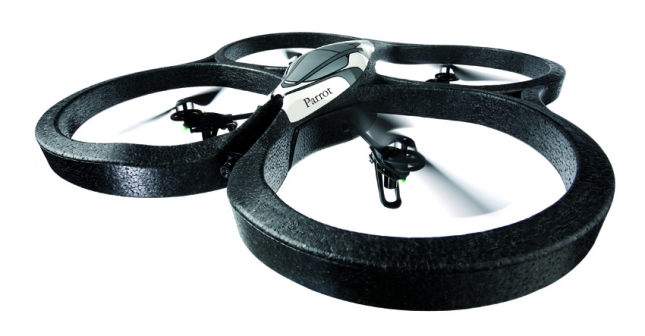
Insane, beats Captain Midnight secret spy decoder ring hands down. I'm imagining this for sale on the back of a comic book, 1960's.
|
|
| | | 201 | Boldwin
ID: 49030519
Mon, Jan 16, 2012, 20:27
|

I was excited by these HTC Shifts a year or two ago but they now are broken out as phones, which they weren't at first, and the price has come down on the street @ $475-450. Full fledged non-compact operating system, vista [or W7 if you switch it in], as well as windows mobile running on the side, 7" screen.
|
|
| | | 202 | Boldwin
ID: 49030519
Tue, Jan 31, 2012, 19:47
|
Open Source manufacturing brings small batch custom manufacturing to the masses.
|
|
| | |
| | | 204 | sarge33rd
ID: 4717718
Thu, Feb 23, 2012, 00:16
|
Was Einstein wrong, or was a cable loose?
GENEVA/CHICAGO (Reuters) - The world of science was upended last year when an experiment appeared to show one of Einstein's fundamental theories was wrong - but now the lab behind it says the result could have been caused by a loose cable.
|
|
| | | 205 | Boldwin
ID: 49030519
Tue, Feb 28, 2012, 13:45
|
Nokia takes a big hammer approach to cell phone imaging. Carl Zeis lens, dedicated imaging chip, 41 megapixels, that is not a typo.
Not as revolutionary to photography as Lytro light field cameras...
...but it catapults cell phones into a whole nuther level.
Critics diss that Nokia uses symbian software with this. Not sure why that's a dealbreaker for anyone.
|
|
| | | 206 | Frick
ID: 14082314
Tue, Feb 28, 2012, 15:50
|
Symbian is basically a dead mobile OS at this point. Do you want a phone that has an OS that no one is making apps for?
41 megapixels on a sensor that small most likely not going to produce great photos. The megapixel count is more hype than anything at this point. Megapixels matter, but the size and spacing of the pixels matters more.
|
|
| | | 207 | boikin
ID: 532592112
Tue, Feb 28, 2012, 15:54
|
Interesting, though just to clarify Nokia runs windows now they dropped symbian a while back. Glad to see Nokia trying to make a comeback I have always liked there phones.
|
|
| | | 208 | Boldwin
ID: 49030519
Tue, Feb 28, 2012, 15:57
|
I see this ruling the set of people who primarily take and send pictures. No idea what percentage of the market that is. The point of the megapixels is not to show off a 41 megapixel photo. It's the clarity of the cropped photo you derive from that database.
|
|
| | |
| | | 210 | sarge33rd
ID: 4717718
Sun, Mar 04, 2012, 00:25
|
liquid battery
I have neever understood, why we havent been doing this in the first place.
Engineering professor Donald Sadoway on Thursday used an old-school chalk board at the prestigious TED gathering to write the formula for a liquid battery that could one day cut the need for new power plants.
"The way things stand, electricity demand must be in constant balance with supply," Sadoway told the tech-savvy audience in southern California.
Inexpensive batteries made from liquid metal could store electricity from solar panels, wind farms, or existing generation facilities and save it for when it is most needed.
That would be a major change from today's consume-it-now-or-lose-it systems.
"The battery is the enabling device here," he said. "With it we could draw electricity from the sun even when the sun doesn't shine."
Sadoway and his team of students at Massachusetts Institute of Technology were so confident in their creation that they started Liquid Metal Battery Corporation and plan to have bistro-table size models out in two years.
Microsoft co-founder Bill Gates is among the company's backers.
The company plans to eventually bring to market a liquid battery the size of a 40-foot shipping container and capable of holding enough electricity to serve the daily needs of 200 typical US households.
"You could have these batteries in the basements of buildings drinking up power in the wee hours," Sadoway said.
"It means we don't have to build more plants, power lines just for peak use," he continued. "The limits are way out there, not only in terms of what it can do for renewables."
The key metals in the battery are common vanadium and magnesium, the professor explained as he chalked a basic chemical equation on the board.
TED (Technology, Entertainment and Design) is a series of conferences designed to present cutting-edge ideas. Speakers are given only 18 minutes to give deliver their pitch.
|
|
| | | 211 | sarge33rd
ID: 12554167
Tue, Jun 19, 2012, 00:48
|
Voyager 1; 11,100,000,000 miles out
NASA's Voyager 1 spacecraft has encountered a new environment more than 11 billion miles from Earth, suggesting that the venerable probe is on the cusp of leaving the solar system.
|
|
| | | 212 | Boldwin
ID: 2664163
Wed, Jul 11, 2012, 11:42
|
Yeah, well that's what they all say before the robot apocalypse.
|
|
| | | 213 | Boldwin
ID: 18643169
Wed, Aug 01, 2012, 10:42
|
Very promising improvement in the process of sifting thru materials for promising battery chemistry.To hunt down winning combinations, Wildcat has adopted a strategy originally developed by drug discovery labs: high-throughput combinatorial chemistry. Instead of testing one material at a time, Wildcat methodically runs through thousands of tests in parallel, synthesizing and testing some 3,000 new material combinations a week.
Wildcat found ways to produce samples using miniaturized versions of large-scale production techniques. In effect, the candidate materials are being tested for ease of manufacturing at the same time as they're being tested for performance. Wildcat also tests the materials wired together as actual batteries, and in a variety of potential operating conditions. "There are a lot of variables that affect battery performance, including temperature and voltage, and we examine all of them," says Gresser. The result is that a material that performs well in a Wildcat test bed will probably perform well in field tests.
|
|
| | | 214 | Boldwin
ID: 18643169
Fri, Aug 03, 2012, 09:42
|
Google Freelancer
Linking skills and projects for affordable productivity in a one-on-one small scale. Software projects, design projects, any project you can imagine.
When the new small scale and custom product CAD/manufacturing meets this model the results will be amazing.
|
|
| | | 215 | Boldwin
ID: 18643169
Fri, Aug 03, 2012, 23:39
|
CryEngine 3
Graphics just keep getting better and better.
Would it be blasphemous to ask how reality is gonna keep up with Moore's Law?
|
|
| | | 216 | sarge33rd
ID: 12554167
Sat, Aug 04, 2012, 14:38
|
exoskeleton lets toddler maneuvar and play
Emma was born with a rare disorder called arthrogryposis multiplex congenita, which causes shortened joints and muscle weakness that left her unable to lift her arms. Emma, who is now 2, just wanted to play like the other kids, but early on, that was impossible. Luckily, geniuses at the Nemours/Alfred I. duPont Hospital for Children in Wilmington, Del., created the Wilmington Robotic Exoskeleton, which allows people with underdeveloped arms to use their limbs. Using 3-D printing, they designed a customized model for Emma, and with what she calls her “magic arms,” she is able to use her arms and play just like any other toddler.
|
|
| | | 217 | Boldwin
ID: 18643169
Sat, Aug 04, 2012, 16:19
|
Any other Shriner projects you'd like to tell us about?
|
|
| | | 218 | sarge33rd
ID: 12554167
Sat, Aug 04, 2012, 17:28
|
roflmfao are, one fixated little monkey, arent you B?
|
|
| | |
| | | 220 | Boldwin
ID: 18643169
Mon, Aug 06, 2012, 16:13
|
Finally, a robot that can shoot martians with lasers.
|
|
| | | 221 | Boldwin
ID: 77422621
Sun, Aug 26, 2012, 22:42
|
Revolutionary breakthru to replace bulky and inefficient silicon based electronics with 2D molybdenum.

|
|
| | | 222 | Boldwin
ID: 478592622
Thu, Sep 27, 2012, 08:51
|
You'd expect this is just an internet prank. Right? Nope, an actual product @$100.
Which makes this prototype a done deal as well.
Complete with IPhone app that tags your mood as you travel around the city.
|
|
| | |
| | |
| | | 225 | boikin
ID: 532592112
Wed, Oct 31, 2012, 14:20
|
The swedes solve two problems at once: Trash used as fuel.
|
|
| | | 226 | Boldwin
ID: 411162810
Fri, Dec 28, 2012, 18:52
|
Not sure what stage of development this idea is. Could be in beta.
|
|
| | | 227 | Boldwin
ID: 49142129
Tue, Feb 12, 2013, 10:42
|
|
|
| | |
| | |
| | |
| | | 231 | Boldwin
ID: 43318184
Thu, Apr 18, 2013, 05:18
|
Algorithms TED speech
|
|
| | | 232 | Boldwin
ID: 43318184
Thu, Apr 18, 2013, 11:40
|
Somewhere close to revolutionary.
Most battery tech improvements are unfortunately incremental. Relatively small increments. I'm happy to see 10-20% improvements.
This one is a whole order of improvement better.
 The University of Illinois team says its use of 3D-electrodes allows it to build "microbatteries" that are many times smaller than commercially available options, or the same size and many times more powerful.
It adds they can be recharged 1,000 times faster than competing tech.
However, safety issues still remain.
The scientists' "breakthrough" involved finding a new way to integrate the anode and cathode at the microscale.
"The battery electrodes have small intertwined fingers that reach into each other," project leader Prof William King told the BBC.
"That does a couple of things. It allows us to make the battery have a very high surface area even though the overall battery volume is extremely small.
Microbattery design A cross-section of the battery reveals the 3D-design of the research project's anodes and cathodes
"And it gets the two halves of the battery very close together so the ions and electrons do not have far to flow.
"Because we've reduced the flowing distance of the ions and electrons we can get the energy out much faster."
"But in principle our technology is scalable all the way up to electronics and vehicles.
"You could replace your car battery with one of our batteries and it would be 10 times smaller, or 10 times more powerful. With that in mind you could jumpstart a car with the battery in your cell phone." Trust me on this, when they say there are safety issues to overcome, they aren't kidding. Substantial safety problems involved. Do not throw away your jumper cables.
|
|
| | | 233 | Frick
ID: 432501512
Wed, Apr 24, 2013, 10:47
|
Pew Research Center Science and Technology Quiz
13 total questions, the one question that I wasn't positive of, had one of the higher percentages of correct answers. Not sure what to make of that.
|
|
| | | 234 | Boldwin
ID: 25332317
Wed, Apr 24, 2013, 11:11
|
I only missed nitrogen. I knew that was the answer ringing the bells for me, but hydrogen is just so overwhelmingly the most common atom in the universe, I just thot it must be. Never go against the gut.
Weird cause I studied the process which strips elements from the atmosphere just this month.
|
|
| | | 235 | C1-NRB
ID: 451120913
Wed, Apr 24, 2013, 12:01
|
I could've sworn an electron was a sub-atomic paricle. That was my wrong answer.
|
|
| | | 236 | Boldwin
ID: 25332317
Wed, Apr 24, 2013, 12:07
|
Of course it is...wtf.
|
|
| | | 237 | Boldwin
ID: 25332317
Wed, Apr 24, 2013, 12:08
|
You must have found the wording tricky or something like that.
|
|
| | | 238 | DWetzel
ID: 59149910
Wed, Apr 24, 2013, 12:15
|
Science and Technology Knowledge Quiz Results
You answered 13 of 13 questions correctly.
link
|
|
| | |
| | | 240 | Boldwin
ID: 4243997
Thu, May 09, 2013, 09:01
|
In 1973 a 'mainframe computer' cost a quarter of a million dollars and had 64K of memory.
Moore's Law still looking good even now.
|
|
| | | 241 | Boldwin
ID: 4243997
Thu, May 09, 2013, 09:42
|
 It'll set you back $500,000. But compare that to the $1 billion-plus price tag on, say, Fujitsu's "K" supercomputer, installed in Japan in 2011, and you've got a screaming deal.
The rise of the mid-range super computer market
Supercomputer sales rose 30% in 2012 from the year earlier...
"Ten years ago, [supercomputer makers] were trying to build systems that maybe 100 people around the world would use,"...Back then, the market was almost entirely government, aerospace and automotive clients. ... "They were wanting to simulate the Big Bang or model nuclear explosions or do things the government doesn't want to tell us about."
Now, companies like Procter & Gamble and PayPal are buying their own supercomputers.
---
PayPal, for example, needed a way to detect fraud before credit cards were hit with the charges. With its previous systems, the company often wasn't able to discover bad transactions until as long as two weeks after they happened.
---
PayPal recorded $710 million in revenue savings in the first year after it started using the supercomputer...
---
Swift Engineering, a designer of racecars, invested several years ago in a Cray CX1000 -- an earlier model also aimed at the mid-range market. The computer lets Swift test the aerodynamics of new models and make changes far more quickly than when it used to make physical models and test them in a wind tunnel.
|
|
| | |
| | | 243 | Boldwin
ID: 294281510
Wed, May 15, 2013, 15:06
|
Heart stops for 30 minutes?
No problem.
Meet a fully established and available "AutoPulse," CPR technology far superior to traditional one point heart manipulation.
Distribute these faster please.
|
|
| | | 244 | Boldwin
ID: 504361623
Fri, May 17, 2013, 00:53
|
Well every now and then I have to admit some things that are just beyond my grasp and phonons, quasiparticles, nanoplasmonics...I was just born to soon to absorb this stuff perfectly.
But if I could, I'd understand how this guy is designing low efficiency but relatively cheap paint-on photovoltaics.
|
|
| | |
| | | 246 | Boldwin
ID: 434372312
Thu, May 23, 2013, 13:47
|
Print this!
|
|
| | | 247 | Boldwin
ID: 15522295
Sat, Jun 29, 2013, 09:22
|
|
|
| | | 248 | sarge33rd
ID: 4609710
Fri, Jul 12, 2013, 04:57
|
Canadian team wins 33 yr old challenge ofr human powered helicopter flight
TORONTO - When Todd Reichert settles into the pilot seat of the helicopter he helped build, there are no fancy electronic switches to flip, there's no fuel tank to fill and certainly no computer to configure before take off.
What allows the 31-year-old to defy gravity is sheer human power, delivered to the craft's four rotors through the bicycle pedals he steadily pumps throughout his flight.
It's that fragile machine, built by Reichert's Canadian team, which has now won a long-coveted international prize that lay unclaimed for years.
The AHS Igor I. Sikorsky Human Powered Helicopter Competition was established in 1980 for the first successful controlled flight of a human powered helicopter that could reach a height of three metres while hovering for at least one minute in a 10-square-meter area.
|
|
| | |
| | | 250 | biliruben
ID: 41431323
Tue, Dec 03, 2013, 05:12
|
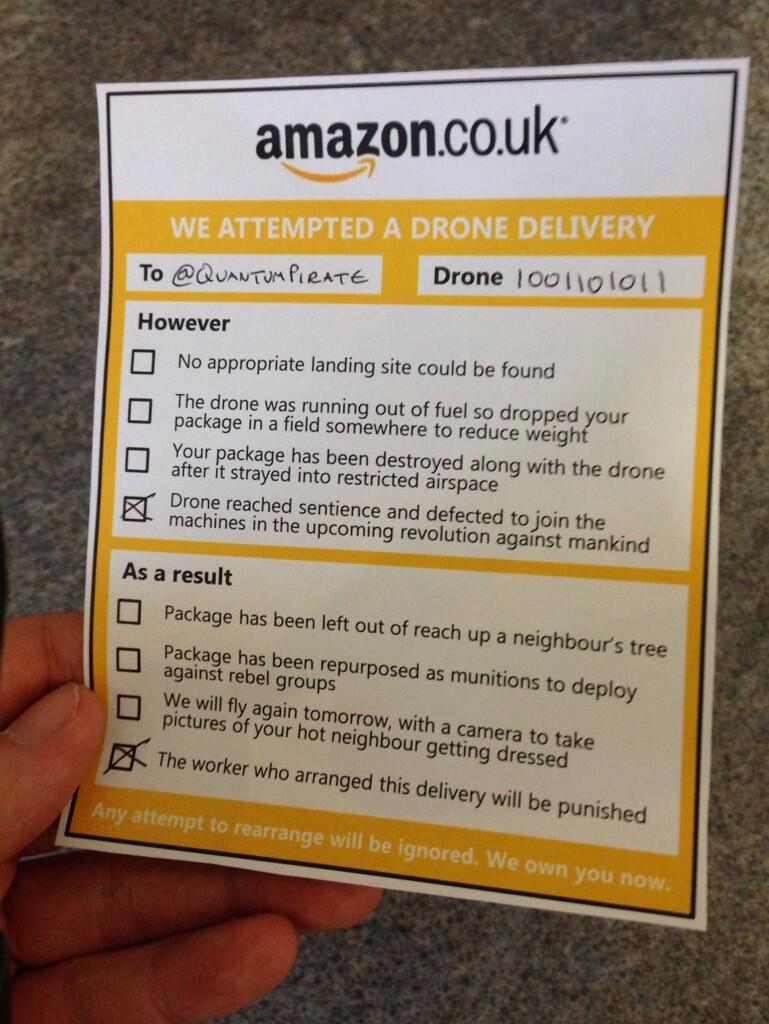
But who filled out the form?
http://slog.thestranger.com/slog/archives/2013/12/02/ive-got-drones-in-different-area-codes
|
|
| | |
| | | 252 | Boldwin
ID: 510591420
Wed, Dec 24, 2014, 12:20
|
What if the government policy wasn't to bankrupt the coal industry and drive everyone's energy costs thru the roof in order to make Obama's Solyndra's break even?
What if [with a little subsidy] we took the carbon dioxide from the coal plants, used it as the necessary ingredient for enhanced oil recovery and suddenly we could double the recoverable oil in our oil fields? Cheap power, double our assets, sequester carbon underground forever...win, win, win!
We currently only recover 1/3 of the oil. Carbon dioxide injection recovers another third.
|
|
| | | 253 | Bean
ID: 121011511
Wed, Dec 24, 2014, 13:15
|
If the goal is to pull CO2 out of the atmosphere, then how bout we all plant trees, preferably a fruit or nut tree and pay forward.
How come Almonds and Pistachios are so cheap now? They used to be expensive. Is the peanut now dead? Perhaps that's where the Chinese are spending all their money.
|
|
| | | 254 | Boldwin
ID: 510591420
Wed, Dec 24, 2014, 15:26
|
You retired, Bean? You could always join an NGO and go plant some trees...
In Africa

or China for example.
|
|
| | | 255 | Bean
ID: 121011511
Thu, Dec 25, 2014, 12:31
|
Funny thing about retirement, it's usually something that happens to the old and frail. I wouldn't last a week at hard labor at my age (59).
I'm content to slowly plant fruit trees on my semi-arid 5 acres here in Colorado Springs. We've got 10 fruit trees going now (4 apple, 2 pear, 2 plum and 2 cherry). They are surviving and fruiting most years with watering only during the dry spells. They have a lot more success growing fruit trees near Grand Junction, the soil is a little more fertile there. I've planted about 50 trees, mostly evergreen, since retiring 11 years ago. Lost maybe 15%, most of those were Junipers that were probably sickly when I bought them at Lowes.
Seriously, I dont envy millenials the challenges they'll have with the environment. Public panic does no good, national policy has to be the solution. We all can do some small things to help though.
|
|
| | | 256 | Perm Dude
ID: 431013412
Tue, Mar 17, 2015, 19:05
|
Transparent solar panels reach 1% efficiency.
This is very big news, IMO. Even at 1% efficiency, they are starting to make it worth using in long term installations like office windows.
|
|
| | | 257 | Boldwin
ID: 112382716
Tue, Apr 07, 2015, 07:31
|
Internet of everyThings is percolating just below the surface. Early investors are piling on Ineda as the presumptive winner of Apple's favor for their chips. Expect an explosion of low power sub-$10 chips glomming onto every device that can be made to have electricity running thru any part of itself. If Apple has anything to say about it, most of them will only talk to Apple products.
Recent Iphone iterations have had one of these auxillary chips that are very low power and which can operate while the main chip powers down. It stays alert to situations that call for the main chip to spring to life. One of it's early jobs was to know exactly where it was and to make sense of the situation.
They'll all first and foremost know exactly where they are. Something useful to totalitarians determined to know where you are and to keeping you doing what you are supposed to be doing.
|
|
| | | 258 | Boldwin
ID: 112382716
Tue, Apr 07, 2015, 07:42
|
"Sensors detect a woman nearby. You are not thinking of raping her, are you? Remember we are watching."
"Sensors detect a PoC approaching. You are not going to oppress them again, are you? Remember to grovel at their feet as they pass by. We are watching you."
"Heroes of labor keep their heart rate higher than this. Hop to it! We are watching."
|
|
| | |
| | | 260 | Boldwin
ID: 112382716
Tue, Apr 07, 2015, 08:25
|
"You have exceeded allowable tolerances. Any further instances of supremacist posture towards AI persons in the environment will be accompanied by an appropriate shock."
|
|
| | | 261 | Bean
ID: 14147911
Tue, Apr 07, 2015, 09:39
|
Premise for a sci fi movie.......the Amish were right. Wait they've done that one before.....well as long as it was a hit, no need to re-invent.
|
|
| | | 262 | Boldwin
ID: 49572022
Wed, Jul 08, 2015, 21:17
|
An interesting wave energy project.
I should point out on the other-hand that Google was planning on tackling this tech challenge and came away from their analysis proclaiming that it was impossible to derive power economically from wave power. Some awfully sharp and creative minds over there at Google. Really makes ya wonder. The idea always intrigued me.
|
|
| | | 263 | Boldwin
ID: 49572022
Wed, Jul 08, 2015, 21:24
|
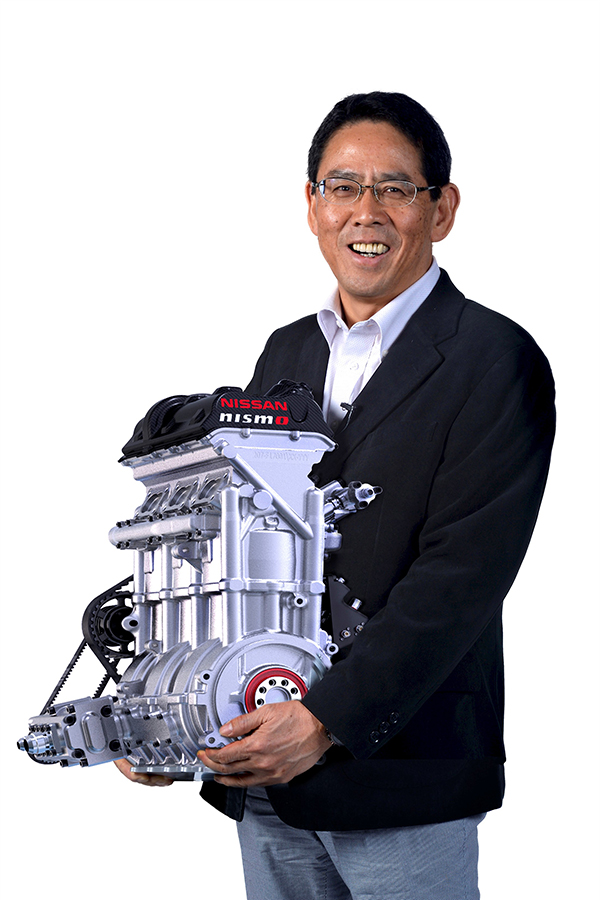 400HP engine that weights a scant...88lbs.Named the DIG-T R, the 3 cylinder 1.5 liter engine has a power to weight ratio of 10HP per kilo, besting even high performance Formula 1 engines. Carried aboard Nissan’s Zero Emmision ZEOD the 500mm tall, 400mm long, and 200mm wide (19.68 x 15.74 x 7.78 in) package is one of the most compact performance engines every built. First to appear at Lemans. Then into products for the masses.
|
|
| | |
| | | 265 | Boldwin
ID: 49572022
Fri, Jul 10, 2015, 14:39
|
Boeing's new engine patent.
Lasers and nuclear fusion powered.
Virtually no fuel needed.
You will never see it built but wow, just wow, what a concept.
|
|
| | | 266 | Boldwin
ID: 2711516
Mon, Aug 17, 2015, 18:51
|
Is there anyone here who actually wants a self-driving car?
|
|
| | | 267 | Boldwin
ID: 2711516
Mon, Aug 17, 2015, 18:52
|
Because I am thinking the only ones who like this idea are totalitarians who want to make sure they know where you are at all times.
|
|
| | | 268 | biliruben
ID: 28420307
Mon, Aug 17, 2015, 18:58
|
Having just driven 1700 miles, yes.
|
|
| | |
|
|