|
| Posted by: sarge33rd
- [148422311] Sat, Oct 08, 2005, 16:33
but at least I'm not contributing to the downfall of our economy.
Wally-world
EMPTY DOWNTOWNS. This happens in three different but related ways. First, there's the clobbering of Main Street: Wal-Mart moves in on the edges of towns, and the much smaller downtown merchants, unable to match its prices, soon go under. Second, there's the miserable wage and benefits package offered by Sam Walton's creation. And third, there's Wal-Mart's purchasing strategy, which seems to be about buying American-made products only as a last resort -- to the point that today Wal-Mart, by itself, is China's eighth-largest trading partner! (emphasis added)
and some people wonder why I rail against sam waltons behemoth.
|
| | | 1 | Stuck in the 60s
Dude
ID: 274132811
Sat, Oct 08, 2005, 20:54
|
This whole thing started shortly after WWII when the first A&P nosed out the first mom&pop grocery. Wal-Mart is just the logical extension.
I guess we've all heard the story about the Wal-Mart supplier who, after saying he couldn't lower his prices any further without losing money, was told to go to China and open a facility there.
Trouble is that most folks, especially those on the financial edge, will shop wherever it's cheapest. It's hard to blame them.
So I'm for firebombing the Wal-Marts as a public service.
Don
|
|
| | | 2 | sarge33rd
ID: 670916
Sat, Oct 08, 2005, 22:17
|
Had a gal come in last week to try and buy a car. Been with wally-world for 6 or 7 years. Scheduled for 31 hrs/wk, every week.
Couldnt get her a car loan, because she doesnt make enough money, and when I talked the lender into waiving their normal minimum income requirements provided wally-world would confirm her weekly schedule, wally world wouldnt do that. When the lender contacted the store, they said that this person is carried as part-time only and is not promised any hours at all. No verification of employment, no car loan. Way to take care of your employees wally.
Like I said, I may pay an extra 50 cents for something somewhere else, but at least that somewhere else will confirm an individuals employment. Easily worth my 50 cents to NOT send it to the walton vault.
|
|
| | | 3 | Pancho Villa
ID: 197552915
Sun, Oct 09, 2005, 11:27
|
Bought a car on Friday, which was necessitated by being rear-ended a couple of weeks ago by a pick-up hauling a backhoe. My car was considered a total loss, as it went from being a sedan to a compact in the accident.
I visisted the local Subaru dealer with every intention of buying a used Outback. Room enough for most of my business needs, yet economical. The elderly salesman was very knowledgeable and helpful, and explained that there weren't many used Subarus because owners keep them and give them to their kids instead of trading them in. I was all set to buy an '05(17,000 miles) for almost $23,000, when, on my third visit, the sales guy suggested I look at some similar-type vehicles.
I test drove a nice used Mazda wagon and a brand new Suzuki Forenza, as well as some larger vehicles, including a used '02 Grand Cherokee that I really liked.
After my third visit, I asked the salesman to put together his best offers on the Subaru, Mazda, Suzuki and Jeep and get back to me with out-the-door price. I didn't hammer him with any pricing games other than that, keeping in mind Sarge's comments about commission margins and my own daily experience in the world of sales and customers who nickel and dime you to death. I wanted this old guy to feel good about the sale as well as myself.
He called me back on Thursday evening and laid out the final four as to price, warranties, reputation, reliability and value. Because of the incentives involved in buying new, I drove out of the dealership on Friday in an '06 Suzuki Forenza Wagon with 100,000 mile/7year warranty. Total price - $17,059. Paid cash. Had my heart set on a Subaru, but the Suzuki deal was too sweet.
Bottom line - Good car buying experience facilitated by a low pressure salesman who test drove about 8 cars with me, and didn't tell me each one was the greatest vehicle ever built. I hope he's still there when I buy my next car.
|
|
| | | 4 | biliruben
ID: 531202411
Sun, Oct 09, 2005, 11:32
|
Nice to hear, PV. All except the difficulty finding used Outbacks. That was my first, burgeoning thought for replacing my wife's ancient Honda. Suzuki's have that low-quality image ingrained in my brain from their Samuri roll-over fiasco last decade. I don't know if it's deserved or not.
|
|
| | | 5 | sarge33rd
ID: 670916
Sun, Oct 09, 2005, 16:59
|
On his behalf PV, let me say thanks for being an honest customer who A) knew what they wanted, needed and why, B) played the "game" fairly.
|
|
| | | 6 | Perm Dude
Dude
ID: 030792616
Sun, Oct 09, 2005, 17:16
|
Wal-Mart considers "full-time workers" those who work 34 hours a week, except when it comes to benefits. Only a little over half their workers get health insurance through the company, and at their average pay, nearly all their workers fall under the poverty line (qualifying them for welfare in many cases, which is what Wal-Mart wants. To push off benefits onto the taxpayers).
|
|
| | | 7 | sarge33rd
ID: 670916
Sun, Oct 09, 2005, 18:54
|
And that PD, is but one of a many reasons, the only time I set foot in Wally-Wprld, is to take shiit back that got bought there. Clerk asks whats wrong with it that I;m returning it...my answer is consistent. "It got bought here, and I dont spend ANY of my money with the walton clan. Ever."
|
|
| | | 8 | bibA
Sustainer
ID: 261028117
Mon, Oct 10, 2005, 12:22
|
I too NEVER shop at Walton's. Either their stuff is cheap in more ways than one, or they are charging as much or more for decent quality items.
We all know that their practices have ultimately caused many smaller manufacturing businesses in the U.S. to fail, and that many mom and pop stores have gone out of business because they couldn't compete. The ironic thing is that so many of the people who have lost jobs due to Walmart have ended up going to work for them. I would imagine at lower wages for the most part.
I guess it is capitalism at work. And that even tho manufacturers in the Orient are doing well due to the low wages that the U.S. can't compete with is bad for us domestically, that many are lifted out of poverty in these other countries.
|
|
| | | 9 | sarge33rd
ID: 148422311
Mon, Oct 10, 2005, 12:49
|
maybe right bibA. Perhaps we are to lift the residents of Peking out of poverty, and drive ourselves into it in the process. Only thing I can say for certain, I care more about an Austinites ability to buy a car, than I do someone living in China.
|
|
| | | 10 | biliruben
ID: 531202411
Mon, Oct 10, 2005, 12:51
|
You might do well to spend a few bucks on a Berlitz course, and open up a Ford dealership in Biejing.
High risk, high reward.
|
|
| | | 11 | sarge33rd
ID: 148422311
Mon, Oct 10, 2005, 13:39
|
no thanks biba. I'd miss this country too much if I lived overseas. (Debated for a very long time when I got out of active army, staying in Europe and taking a European "out".)
|
|
| | | 12 | Madman
ID: 114321413
Sat, Oct 15, 2005, 11:12
|
Could you explain, sarge, why helping impoverished Chinese while improving our own standard of living is somehow unworthy?
For the record, the best information that we hvae indicates that Chinese manufacturing employment has collapsed even worse than it has here. See Paul Solman's seventh and final report for the Newhour with Jim Lehrer: But manufacturing is becoming more and more mechanized -- in China like everywhere else. In fact, between 1995 and 2002, China lost 15 million manufacturing jobs, compared with a loss of 2 million manufacturing jobs in the US.
In Foreign Affairs, Drezner cites an Alliance Capital Management study which says something similar: there has been a 15% decrease in manufacturing employment over the same time period. Don Boudreaux made similar points this past winter. Data from China is notorious difficult to come by, and even more difficult to verify. But this is the best indication that I've seen, and it mirrors the world-wide collapse in manufacturing employment that seems plausible.
With all of that said, you will likely enjoy JibJab's Big Box Mart. I, of course, see the economic arguments as erroneous to misguided to incorrect, but it's a well done piece that seems to fit your mythological approach on this subject.
|
|
| | | 13 | Perm Dude
Dude
ID: 030792616
Sat, Oct 15, 2005, 12:24
|
Man, normally you're dead-on with economic arguments, but I've never seen you make one in which both parts of your piece are so slippery:
helping impoverished Chinese while improving our own standard of living
Since factories are state-owned, are you now advocating a Communist economy? Or are you now saying that those who make part-time wages is a real standard of living improvement?
|
|
| | | 14 | sarge33rd
ID: 670916
Sat, Oct 15, 2005, 12:44
|
are you serious MM????
How can it possibly be in our nations best interest, for person to hold full-time jobs w/o benefits, which pay so poorly, that those same employees are on welfare rolls? Drawing food stamps, title XIX medical, low income heating assistance? Do you honestly pretend to defend the practice of pushing employment costs off to the taxpayer?!?!?!?!?!?!?!?
That you find an article which dissents with your anti-humane economic views "erroneous and misguided", for some odd reason, fails to surprise me in the least.
|
|
| | | 15 | Madman
ID: 43410119
Mon, Oct 17, 2005, 14:55
|
PD -- both sides of my argument are backed by almost 200 years of economic theory and empirical evidence. What is so slippery?
What publicly owned factories in China are you citing? I thought the argument brought by human rights activists was that wages in private factories that feed Wal-Mart were lower than wages in state owned facilities? Regardless, the point is the rather obvious one that many millions of Chinese workers are living at or below subsistence in crippling conditions in rural regions. From what I have read, there is no shortage of willing escapees from those conditions. For them, shipping more jobs to China represents an improvement, either directly through opportunity or indirectly via reduced competition for scarce resources.
This is the basic free-trade argument advanced by Krugman and virtually every economist for 200 years.
sarge 14 -- do realize that you are denigrating the lifestyle of one of my uncles. You may pretend to hold the moral high ground by looking after his best interests, but he claims to actually enjoy working at Wal-Mart. They, in turn, have facilitated his transition into retirement and give him an opportunity to supplement his Soc. Sec. check.
I suppose that you will criticize Wal-Mart for dumping his health care onto the rest of us (he's on gov't provided Medicare). Or is it moral for Wal-Mart to "dump" his costs onto us in Medicare, but not in Medicaid? And all of this is a very poor description because in reality, it is not the US companies which are doing anything, but the employees of the companies. He could buy private insurance either through Wal-Mart or otherwise, but really, why should he?
We used to encourage welfare to work transition support such as low-income heating, etc. Now you are attacking these very programs. Are you suggesting that we do not provide assistance for people who can't find more productive uses for their time?
I suspect that you are arguing that companies shouldn't hire workers unless they are guaranteed to get a substantially higher degree of productivity from them than what Wal-mart does. You don't specify *how* Wal-Mart should go about getting more productivity from their workers than they do, so I will suggest a simple way: they could workers with machines. Keep in mind that you want Wal-mart to pay wages high enough to not just pay for each worker's own healthcare, but also high enough so that they will be able to afford the health care of those on Medicare, Medicaid, and the costs shifted from the uninsured. You also want them to earn enough to provide for the Social Security payments made to uber-millionaire retirees.
Therefore, let's presume that Wal-Mart engages in the pay-raising renovations you require of them. Of those currently working for Wal-Mart, they will cull through and try to keep the best. They may also try to hire workers from other firms, and they will then fire the remainder so that they can go on full government assistance. Wonderful. Actually, if we are lucky, maybe they will all scrounge up some part-time minimum wage work in a small factories somewhere. Wal-Mart's real error here was not in providing these people jobs, but in providing so many of them that they became a focus for attack.
And you call me inhumane. That you find a post which dissents with your anti-humane economic views "erroneous and misguided", for some odd reason, fails to surprise me in the least.
|
|
| | | 16 | Perm Dude
Dude
ID: 030792616
Mon, Oct 17, 2005, 15:04
|
Jeez, what a mess. Madman, sarge is not arguing against those programs, but against companies which engage in pay practices which forces people into those programs.
He could buy private insurance either through Wal-Mart or otherwise, but really, why should he? Here is the standard conservative argument. I suppose he should simply draw upon his four months worth of earnings that he has in his savings account to do so, eh?
Your argument seems to be that which was used to argue against slavery: "What will those poor people do if suddenly freed from their masters?" What, indeed?
|
|
| | | 18 | Perm Dude
Dude
ID: 030792616
Mon, Oct 17, 2005, 15:30
|
Absolutely. The presence of Wal-Mart drives away many options in an area, and internal options (that is, working their way up the company) is a nearly-closed option as well, since they do not even allow workers to work full-time hours.
You know that I'm all about options and opportunities. Wal-Mart isn't as far as its workers are concerned.
|
|
| | | 19 | Madman
ID: 43410119
Mon, Oct 17, 2005, 15:33
|
PD 16 -- Sarge's argument is the one rooted in paternalistic anti-slavery arguments. "What will these poor people do if big corporations aren't around to take care of them?" What, indeed?
My argument is rooted in the inherent capabilities of all mankind. The living conditions of the working poor will continue to improve over the next hundred years, just as they have improved for the last hundred years. This will continue because companies and entrepreneurs will continue to discover new ways to improve the lives of customers, and the implemention of these discoveries will require manpower.
These government programs exist for good reasons: to ameliorate the harsh living conditions of the working poor. To suggest that companies not hire workers in such conditions is preposerous. Similarly, to suggest that companies refrain from hiring workers until and unless they are sufficiently productive so that they can subsidize the remainder of those in the economy is likewise preposterous.
If you want to keep people down, keeping the doors of employment closed to them is a surefire way to do it.
|
|
| | | 20 | Madman
ID: 43410119
Mon, Oct 17, 2005, 15:37
|
For the record, I deleted my 17; PD's 18 was in response to it. Sorry about that, but I wanted to rephrase, although perhaps I shouldn't have.
PD 18 -- Wal-Mart also ATTRACTS many options. In many ways, it simply shifts downtowns. Just as there are cases of downtown destruction because Wal-Mart arrives, there are cases of downtown destruction because Wal-Mart leaves.
As to the allegation that Wal-Mart doesn't hire full-time employees, I have no ready facts, but that strikes me as suspicious.
|
|
| | | 21 | Perm Dude
Dude
ID: 030792616
Mon, Oct 17, 2005, 15:51
|
It's kind of the point, Madman. They hire large numbers of workers (some are even legal now, I hear), keeping their hours below full-time levels. In some cases, however, they required workers to put in extra time "off the clock" which is why there are now at least 40 wage suits against Wal-Mart (they are seeking class action status). Even full-time workers average less than $10/hour.
They are also anti-union, but the efforts they have taken to keep union organizers away from their employees is worthy of another thread, IMO.
It's worth taking a look at Fast Company's piece on Wal-Mart. Also, WGBH did a good Wal-Mart show.
|
|
| | | 22 | Madman
ID: 43410119
Mon, Oct 17, 2005, 16:30
|
One of the following statements cannot be true:
since they do not even allow workers to work full-time hours. ...
Even full-time workers average less than $10/hour.
I suspect it is the latter. Low wages in retail are not uncommon and relate to the productivity points I made before.
|
|
| | | 23 | Madman
ID: 43410119
Mon, Oct 17, 2005, 16:31
|
Aargh. I meant that I suspected that the second statement is true and the first false, ergo my suspicion in 20.
|
|
| | | 24 | Perm Dude
Dude
ID: 030792616
Mon, Oct 17, 2005, 16:54
|
Madman, according to Wal-Mart, they consider a worker who works 34 hours/week to be "full time."
|
|
| | | 25 | Madman
ID: 114321413
Mon, Oct 17, 2005, 17:32
|
PD -- the typical definition of a part-time worker is someone who works between 1 and 34 hours in a week. Wal-Mart's definition is pretty much standard fare, as far as economic definitions go. I'm not sure that I'd read as much into their definition as you are without additional information that they are somehow abusing that definition.
|
|
| | |
| | | 27 | sarge33rd
ID: 148422311
Mon, Oct 17, 2005, 17:34
|
Perhaps it would assist MM< if he read the article in the link. Katie and I have decided to support Costco, 100%. If they have what we seek, we'll be buying it there. Why? Becausse after 8 yrs on the job (as cited by the article I linked), a cashier at Costco makes more than a dept mgr at wally-world with 10 yrs on the job. That Coostco employee, also earns retirement benefits.
What I would have MM, is an employer who pays his/her employees in return for the work they do. Wally world rakes in HUGE profits, yet they share none of it with the people charged with the day-to-day generation of those profits. What I would have MM, is an employer who contributes to the welfare of the local community, not strip mines it. Or is the iodea of responsible citizenship on the part of the corporation, simply too alien for you to wrap your mind around?
|
|
| | | 28 | sarge33rd
ID: 148422311
Mon, Oct 17, 2005, 17:38
|
If you want to keep people down, keeping the doors of employment closed to them is a surefire way to do it.
I would agree with that. I would go further though, and add that gross and deliberate under compensation is tantamount to doing the same.
|
|
| | | 29 | sarge33rd
ID: 148422311
Mon, Oct 17, 2005, 17:47
|
Lets take all the supposition and ideology out of the argument MM. You simply tell me,
A) How is beneficial, to pay employees so little, the qualify for and depend upon public assistance to meet living expenses? (This is not a transitional phase. Wally world pays only the sr store management, sufficiently to meet living expenses. everyone else (dept heads included) are paid very poorly.)
B) How is it beneficial, to buy products from foreign markets, contributing to the cessation of domestic production, lower per capita domestic income and thus reduced per capita buying power?
C) How is it beneficial in a competitive free-market, for one supplier/provider, to become the sole provider/supplier?
|
|
| | | 30 | Perm Dude
Dude
ID: 030792616
Mon, Oct 17, 2005, 18:02
|
Madman, until recently, they were (by calling "full-time" 28 hours a week). But even 34 hours a week is not full time. They have had many slaps (court cases, Labor Department rulings, etc) to get incrementally and grudgingly better, but they still are either on the line or just on the illegal side of it across a range of wage and employment issues.
This is not a company which demonstrates good faith in either its employment, buying, or community practices.
|
|
| | | 31 | biliruben
Leader
ID: 589301110
Mon, Oct 17, 2005, 18:07
|
Beneficial? I can name a few heirs it is beneficial to. Oddly though, not the stock holders. Th P/E was around 70 in 1999, and it's now 15. Their earnings growth has chugged right along since then, but the price of the stock has ceased to reflect that. I wonder if bad press might be a reason for some of that?
As far as A) goes, as an advocate of universal, goverment-funded health care, I would actually support a move from employee health-plans to (among other, more important reasons) allow US companies to compete on an even playing field with international competitors.
B) Again, beneficial for whom? As noted, rural Chinese suffer in a significantly deeper poverty than anyone in America could ever imagine.
I'm not sure what you mean by C, sarge. Are you saying that in some rural communities, Walmart is in a non-competitive situation? There are obviously competitors on a larger stage.
|
|
| | | 32 | Perm Dude
Dude
ID: 030792616
Mon, Oct 17, 2005, 18:10
|
Obviously, however, welfare was never intended to be the universal health care you'd advocate. Indeed, time limits imposed during the glorious "Contract on America" era gives Wal-Mart employees a time limit on that health care.
|
|
| | | 33 | biliruben
Leader
ID: 589301110
Mon, Oct 17, 2005, 18:14
|
Certainly not, PD. Our social services are sorely lacking.
My point was that the goverment picks up the tab on many things that benefit Corps (and subsequently employees as well); not all of them bad. Transportation infrastructure, defense to lower the risks of doing business, and a myriad of social services.
|
|
| | | 34 | sarge33rd
ID: 148422311
Mon, Oct 17, 2005, 18:16
|
as for (A) bili, I dont see where any retailer of mass consumables here in the US, is much in competition with foreign companies. I think this phase of the competition, is either more or less confines to high-cost goods and/or mnufacturing.
(B) While I too hold concerns for the welfare of foreign citizens, it is IMHO, the responsibility of domestic employers to ensure stability within the domestic arena. It is not for ex, the Covert families obligation to ensure decent wages for Chinese farmers. Only for their own employees. Same for wally-world. While charitable works and concerns are necessary, they should not be used as an excuse for keeping your own domestic workforce in poverty.
(C) Regarding my point "C" above. I do iondeed refer to the rural markets. Where wally worlds have sprung up in cities with populations of 30k or more, the surrounding communities (radius perhaps 100 miles) consisting of towns of 400 and often fewer, have seen local gracers close. (necessitating upto 100 mile drives for groceries) I've seen countless small town pharmacy/general stores close. Leaving communities with no immediately available prescription filling service, no local source for expendle goods. (needle, thread, gasoline, etc etc etc.)
|
|
| | | 35 | biliruben
Leader
ID: 589301110
Mon, Oct 17, 2005, 18:31
|
C) True enough. They play the game well, and perhaps not by the rules, though they would certainly win anyway, due to economies of scale. Sadly, I think if it weren't Walmart, it would be some other, perhaps slightly less cut-throat and more employee friendly, big-box throwing their weight around. Main street died due to exploitation of the general truths inherent in the capitalist system. I applaud your shopping at a competitor. I do the same if I can and am happy to pay a bit more if I have the option (which I usually do in a big city like Seattle - both economically and geographically).
B) I wasn't talking about Charity. I was trying to nudge you in a direction you need to go, if you:
1) believe the capitalist system is swell (which I don't), and
2) you realize that the world is getting rapidly smaller. Transportation costs and immigration policy are the two main reasons why we can't directly compare the employment opportunities of unskilled Chinese with unskilled Iowans, and those issues will continue to decline in importance, for better or worse.
|
|
| | | 36 | sarge33rd
ID: 148422311
Mon, Oct 17, 2005, 20:41
|
That the world is "shrinking" is not in question. A mere 150 years ago, the Pony Express was our quickest means of communication between StLouis and San Francisco. A short 100 years ago, saw the industrial revolution hitting full stride and mass production was becoming feasible for any number of commodities. Only 50 years ago, air travel was a luxury few could afford. Today, its not uncommon to find flying to be cheaper than driving. With these declines in travel/communication times, comes a need I think, to "assimilate" the worlds cultures toward a more unifying ideology.
Still, the Chinese farmers plight, or the plight of the African tribesman, is a concern to me only to the extent that that individual is not being allowed an opportunity at fulfillment. There economic independence, is not my obligation. Rather, I believe that I am more obliged to help my neighbor and he in turn to help his, and the next to do the same. This would (in a rosey world) ultimately involve an ever increasing "circle" untill eventually all were encompassed. IMHO, Wally-world is like a vacuum. It sucks an area dry, keeping all it can, while returning as little as possible. To continue using Costco (as mentioned in the header article) they on the other hand actually PAY their employees. Those who work at Costco, can afford to uy a home, a car, washer/dryer when they need one. Tires for their car if one goes out, etc etc etc. Wally world on the other hand, well....their employees apparently arent supposed to own cars, since only management makes enough money to buy one. If they wont pay their people sufficiently to buy a $200/month car, then they also arent paying enough to allow them to buy a washer/dryer, or refrigerator, or home. I find such, to be reprehensible, when ownership then retains the per centages of profit dollars which they obviously do. (In my minds eye, wally world is the classic example of pure capitalism run amok. Greed becomes the driving force and the end result is an ever widening gap between the "haves" and the "have nots".)
|
|
| | | 37 | Seattle Zen
ID: 178161719
Mon, Oct 17, 2005, 21:23
|

Actually, the Pony Express end of the line was St. Joseph, MO just across the river from Kansas. See, the horse union boycotted slave states.
|
|
| | | 38 | sarge33rd
ID: 670916
Mon, Oct 17, 2005, 22:09
|
LOL THX SZ. Admittedly, its been a very long time since I studied the Pont Express.
|
|
| | | 39 | Boldwin
ID: 49626249
Tue, Oct 18, 2005, 07:06
|
See, the horse union boycotted slave states
Unlike Walmart...or Walmart shoppers.
|
|
| | | 40 | Madman
ID: 43410119
Tue, Oct 18, 2005, 09:02
|
Th P/E was around 70 in 1999, and it's now 15. Their earnings growth has chugged right along since then, but the price of the stock has ceased to reflect that. I wonder if bad press might be a reason for some of that?
I'm not a Wal-Mart analyst, but this sort of thing doesn't surprise me. Many stock prices in the late 1990s reflected higher-than-realistic estimates for future growth (or, alternatively, lower than realistic discount rates). Wal-Mart has saturated America, and has either found on-the-ground competition or other difficulties expanding their operations overseas. As you noted, being big is hardly an innovation for Wal-Mart, and there are competitors out there in the international arena.
sarge27 and the initial article fall into the trap of assuming one-size can fit all. It doesn't surprise me at all that a company like CostCo can co-exist alongside a Wal-Mart. Different people are different, and different employees are different. It's not clear to me, however, that if you forced CostCo's pay structure onto Wal-Mart that everything would simply be hunky-dory. I suspect that Wal-Mart is hiring lower skilled labor and in niche markets, like my uncle.
As to sarge29-A, I still don't see your argument. We have public assistance programs set-up designed to help people who also are working poor. That is the *point* of the program. To claim that the government's role is somehow worthy but that corporations shouldn't be hiring workers in that category is a bit mind-numbing.
The sad fact of the matter is that there are a number of workers with very low skills. Some companies like Wal-Mart (and a large number of retailers, I might add) employ a large number of those workers. The result is that they have low wages. We provide public assistance to these people as a societal responsibility to help care for them. We don't restrict their employment opportunities because we have a work ethic in this country that suggests work helps self-esteem, builds job skills (i.e., proof that you can follow instructions and show up on time, etc.), and to the extent possible, we would like to minimize the degree to which people are dependent upon government.
29B -- this is just plain wrong. The theory of comparative advantage suggests that BOTH trading partners end up relatively richer. In this case, Americans have either more products or cheaper products. In either case, this means they have MORE buying power, not less. This is the 200 year history I referred to earlier.
29C -- biliruben 35 is a very solid response, except for the fact that Iowans are actually among the best educated Americans. The brain flight from Iowa is staggering. Substitute unskilled Arkansans instead. ;)
The only other comment I will make is that the official wage rate differential between Wal-Mart and, say, CostCo likely overstates the wage differential experienced in practice, precisely because of government programs. If Wal-mart were to raise the wages of their employees by $1 an hour across the board, it is not at all clear that their employees would benefit. It is possible that the existence of government benefit programs results in the observable bifurcation that Sarge is complaining about because of very high implicit marginal tax rates in that income category through EITC take-backs, Medicaid cutoffs, etc. (at one time it was estimated that the implicit marginal tax rate exceeded 100% in some low income ranges) To the extent that this is the case, one response is to blame Wal-Mart, specifically. Another is to realize that this was going to happen regardless, but now you just have a singular face to put on the employers that we always knew would "take advantage" of that situation.
|
|
| | | 41 | sarge33rd
ID: 670916
Tue, Oct 18, 2005, 09:20
|
my theory of business is simple MM...if you cant sell a product at a fair price and provide a fair wage for your employees and simultanmeously make a fair profit...then you're in the wrong business. None of those goals, is mutually exclusive to the others. wally world however, doesnt even begin to operate under such a theorem. Their motive is simple...take, take, take...and keep it...all.
I know full well why those govt programs are there. One thing is for certain, they are NOT there, with the intent of pushing employment costs off the employer and onto the taxpayer.
|
|
| | | 42 | biliruben
Leader
ID: 589301110
Thu, Oct 20, 2005, 17:03
|
Yglesias shreds George Will's, shall we say, incomplete view of the world:
In every major car-making country, auto workers get health care. The difference is that in every major car-making country besides the United States there's a systematic government policy in place trying to make sure that everyone gets health care. This is good policy. Those other countries feature better health outcomes and lower per capita expenditures than does the USA. They also have more competitive car industries than we have.
America's private sector welfare state is, indeed, breaking down. But our public sector one isn't breaking down. It's being bankrupted as a matter of deliberate public policy by officials who want to wreck it in order to better afford tax cuts for extremely wealthy individuals. This is also destroying our car industry and it's all very outrageous. But to pretend that nefarious "globalization" is responsible for it all is absurd. Universal health care is a staple of much more trade-dependent countries than the United States. Nothing is stopping us from doing it except the George Wills of the world.
|
|
| | | 43 | Madman
ID: 114321413
Thu, Oct 20, 2005, 17:51
|
But our public sector one isn't breaking down.
We have one of the most nationalized health care industries in the world. We specifically spend more on health care for our elderly, per capita, than any industrialized country spends per capita for their entire healthcare system. And here I'm talking the direct costs only and choosing to ignore the indirect costs of Medicare's pricing policies.
Yglesias' "shredding" of Will only survives if you ignore those rather inconvenient facts.
Furthermore, by having a privatized corporate health insurance company, we force industries that don't take care of the health of their workers to pay the full brunt of that negligence. It therefore should not be a surprise that we are shipping relatively unhealthy and dangerous jobs overseas, or eliminating them entirely. If you would like to get rid of those incentives, go right ahead. But pretending that this would be some sort of improvement is a real stretch.
|
|
| | | 44 | Madman
ID: 114321413
Thu, Oct 20, 2005, 17:54
|
Furthermore, by having a privatized corporate health insurance company Ugh. That should read ...
Furthermore, by having a privatized corporate health insurance system ...
What should be clear to everyone is that in a nationalized health care system, dangerous and personally unhealthy industries are subsidized at the expense of safer and healthier ones. Exactly why Yglesias glorifies such a thing, I cannot fathom.
|
|
| | | 45 | Madman
ID: 114321413
Thu, Oct 20, 2005, 18:08
|
We have one of the most nationalized health care industries in the world.
Actually, I should clarify this comment. When viewed as a % of GDP, our governmental expenditures in healthcare are competitive with the entire industrialized world. I shouldn't have phrased it in the manner I did.
Secondarily, and the statistic I was thinking of when I wrote that, the American consumer is essentially as insulated and protected from healthcare costs than *any* nation in the world. 85% of your health care costs are paid by someone else. That data suggests at least a good portion of the reason why our utilization is also higher.
|
|
| | | 46 | sarge33rd
ID: 670916
Thu, Oct 20, 2005, 20:24
|
85% of your health care costs are paid by someone else.
Not sure where you get that idea. As long as katie stays employed at B&N, a bit less than 2/3 of our costs is pd by B&N. She quits there, and we go onto my group at work (which btw is the same company as B&N has but with diff coverages) and 3 things happen;
1) Our monthly premium will triple.
2) Our deductibles will double
3) Our co-pay, will triple.
I'm quite comfortable in saying, NOBODY is paying 85% of our anything for us.
|
|
| | | 47 | Madman
ID: 114321413
Thu, Oct 20, 2005, 21:58
|
I'm quite comfortable in saying, NOBODY is paying 85% of our anything for us. It's from offline 2005 OECD data.
|
|
| | | 48 | Madman
ID: 114321413
Thu, Oct 20, 2005, 22:00
|
Oh, I think I misunderstood your point. No, it doesn't count premium contributions to your health insurance. That's 85% of your actual health care costs for which someone else is the middle man.
But your premiums aren't counted, just as tax payments made by Canadians don't count for them.
|
|
| | | 49 | sarge33rd
ID: 670916
Thu, Oct 20, 2005, 22:23
|
If we go to my employers health plan, the premium jumpst to somewhere around $547/mnth for the two of us. I cant remember, the last time I saw anything close to $6500 in health costs for the year. (Nor can I recall a decade where I'd have had something appraoching $65,000 in costs.) May very well, say to hell with it, and go without. Just follow wally-worlds model, put us on public health care.
|
|
| | | 50 | Madman
ID: 114321413
Thu, Oct 20, 2005, 23:26
|
sarge -- again, premium payments and public taxes aren't part of that calc.
As I pointed out above, Medicare is one of the costliest healthcare programs in the world. This is above and beyond the 10% fraud rate, the cost-shifting to private healthcare, etc.
If we put you on public healthcare, you may save the $6500 in health costs for the year, but then you'll pay $6500 in taxes, or something very similar (in reality, you would probably save just a tiny bit of money on average every year, but the government and therefore you would be exposed to more risk).
Some argue that standardization would create tremendous efficiencies and reduce paperwork. That standardization is entirely independent of who bears the ultimate financial responsibility.
|
|
| | | 51 | sarge33rd
ID: 670916
Fri, Oct 21, 2005, 00:05
|
sarge -- again, premium payments and public taxes aren't part of that calc.
Yea, I caught that. That it isnt included, is frankly beyond belief. Premiums are paid, "in lieu" of direct costs. Thats part of the theory behind insurance. Dont count the premiums? What costs are being counted. Not counting taxes paid by the citizen? Bet they count the bills paid by the govt. And just where did the govt get the money? Oh yea, from the taxes paid by the citizens. IOW, I can make the nrs say whatever I want, if I set the criteria for what goes into the formula.
ie, Minn Vikings 5-0! The NFL has decided to not count points scored against the Minnesota Vikings. Hence, they are now undefeated and are the top ranked team in the league.
f we put you on public healthcare, you may save the $6500 in health costs for the year, but then you'll pay $6500 in taxes...
No I wont. Not if "someone else" is paying 85% of my costs. I'll only pay 15%. A bit under a grand.
|
|
| | | 52 | Madman
ID: 114321413
Fri, Oct 21, 2005, 13:04
|
Oh yea, from the taxes paid by the citizens. IOW, I can make the nrs say whatever I want, if I set the criteria for what goes into the formula.
In a public system, the public pays taxes and the government pays the benefits.
In a private system, the public pays premiums and the insurance company pays the benefits.
If you ignore the taxes in the public system, then you have to ignore the premiums paid in the private system.
The calculation is 85% of the *costs* of healthcare. I.e., the salaries paid by doctors, the cost of getting an MRI, the cost that dr's incur by doing business, etc.
When you go to the doctor for an office visit, let's say it costs $100. Let's say you have a $15 PCP copay. That means you paid 15% and the insurance company paid 85%.
You want the calcuation to include the premium you paid. In that event, you'd pay probably $90 in premium to the insurance company to cover the $85 in costs AND the possibility that costs would be higher. In other words, you are out $105, perhaps, but now you've purchased two products: (1) physician services, and (2) insurance services.
In the case of a public system, let's say the exact same event happens -- a $100 office visit. You might have the exact same copay, meaning you'd have the exact same 85% coverage. If you include taxes in the calc, then taxes would pay the remainder of $85. Your total costs would be $100 and by definition, you would have paid 100% of your costs, but now you've only purchased one product.
This is why the accounting DOES and SHOULD focus strictly on the actual costs of healthcare and who bears the direct burden for those costs.
Incidentally, the major reason why there is cost-sharing in public systems isn't because of copays or taxes. It's because there is virtually *no* purely public system. There are always health services that aren't covered through traditional government plans, or maybe you just don't want to wait for your heart bypass surgery (as in Canada).
Lastly, if you are going to criticize the data, I'd actually agree with you for entirely different reasons. Cross-country comparisons are always extremely difficult. The OECD does its best to standardize data, but the task is arguably impossible. For example, the OECD CT scanner data are entirely misleading because we don't have public reporting in this country. Etc. But as I said, all of that is a different argument.
|
|
| | | 53 | Wilmer McLean
ID: 199412419
Thu, Oct 27, 2005, 04:47
|
Wal-Mart: The High Cost of Low Price (Documentary)
Everyone has seen Wal-Mart's lavish television commercials, but have you ever wondered why Wal-Mart spends so much money trying to convince you it cares about your family, your community, and even its own employees? What is it hiding?
WAL-MART: The High Cost of Low Price takes you behind the glitz and into the real lives of workers and their families, business owners and their communities, in an extraordinary journey that will challenge the way you think, feel... and shop.
Sarge, I think this documentary will interest you.
|
|
| | | 54 | Boldwin
ID: 49626249
Thu, Oct 27, 2005, 06:44
|
but now you've purchased two products: (1) physician services, and (2) insurance services - Madman
In the case of a public system...but now you've only purchased one product. - Madman
I was wondering how you managed to compact doctor services and government bureaucracy into one entity?
|
|
| | | 55 | Tree
ID: 34948274
Thu, Oct 27, 2005, 06:51
|
Wal-Mart memo sparks criticism
Wal-Mart's (WMT) effort this week to improve its public relations by offering new health insurance options for its workers took a hit Wednesday with the release of an internal memo recommending the company consider changes that would "dissuade unhealthy people from coming to work at Wal-Mart."
Wal-Mart's Memo Blurs Its Message on Benefits
"I don't think the DNA of Wal-Mart has changed at all," said HSBC Securities analyst Mark Husson, returning Wednesday from an analyst meeting at Wal-Mart headquarters in Bentonville, Ark. "It's like a religious cult — it has a low-cost gospel to bring to the country and sees it as a divine duty to do that and nothing is going to get in its way. It will do what it has to do and say what it needs to say to get there."
|
|
| | | 56 | sarge33rd
ID: 670916
Thu, Oct 27, 2005, 08:38
|
interesting link Wilmer. Thank-you. Hadnt heard of this before, but sure wish I had. Contemplating now, the potential ramifications to my job secuurity, if I were to host a screening........
|
|
| | | 57 | Wilmer McLean
ID: 221102923
Thu, Jan 12, 2006, 19:09
|
January 12, 2006
Maryland Bill on Wal-Mart Health Care Spending Advances
By THE ASSOCIATED PRESS
Filed at 3:23 p.m. ET
ANNAPOLIS, Md. (AP) -- Maryland's Senate voted Thursday to enact a first-in-the-nation requirement that Wal-Mart Stores Inc. spend more on employee health care despite the governor's veto of the legislation. The measure, touted as a money-saver for Medicaid, now goes to the House for a vote.
At least 30 state legislatures are considering similar bills.
The Democratic-controlled Senate voted 30-17 to overturn a veto of the so-called Wal-Mart bill last summer by Republican Gov. Robert Ehrlich. The measure now heads to the House, where the prospects of a three-fifths vote required to overturn vetoes was less certain, though Democrats control that chamber as well.
Supporters of the bill said Bentonville, Ark.-based Wal-Mart, the world's biggest retailer, unfairly costs taxpayers money by spending less than 8 percent of payroll on health care. The bill requires all companies with more than 10,000 employees to spend that much or give the state the difference. Currently, only Wal-Mart would meet the criteria in Maryland.
Critics called it a dangerous precedent that ultimately would cost Maryland jobs.
The veto override has been one of the session's most intensely lobbied, with business groups taking out print ads supporting a veto and labor groups rallying and taking out their own ads siding with supporters.
The decision is being closely watched by labor unions and legislatures around the country, with unions pursuing similar legislation this year in more than 30 states.
The unions contend that some large, profitable companies shift health insurance costs to workers, taxpayers and other businesses. They are proposing legislation, like the Maryland bill, that would require big employers to dedicate a percentage of their payroll to health care benefits. The unions have said the states they will focus on include Colorado, Connecticut and Washington.
|
|
| | | 58 | Madman
ID: 43410119
Fri, Jan 13, 2006, 08:48
|
Yeah, Wilmer, the Maryland Senate has gone off the deepend (yesterday, they over-rode a governor's veto of that bill).
To illustrate why this is crazy ... the bill says that B >= .08*P, where B = health benefit spending, and P is the size of payroll.
In other words, P<=12.5*B.
Which is a CAP on the amount of money Wal-Mart is allowed to spend on workers! Unbelievable.
Further, if actual benefit spending comes in less than 8% of payroll, the entire difference gets shipped to the state. You can write this in terms of the "payroll cap" language, as well. Specifically, for every dollar that actual payroll exceeds the Maryland payroll cap (of 12.5*benefits), Wal-Mart gets fined 8 cents (or 8%).
The legislature may not have intended to implement a payroll cap, but that's what they just did.
As a pragmatic matter, I suspect that Wal-Mart's response will be a mixture of the following:
a) lower pay increases and increase benefits. There is some other mix that might be attractive to employees;
b) Trim benefits per person and institute internal requirements for employees to enroll in Wal-Mart's benefit plans, thereby increasing aggregate health expenditures. Employees who don't fully value currently offered benefits might still stay, or they could offer small pay increases to compensate for the larger per-employee benefit cuts;
c) Negotiate *higher* admin fee rates with their current MD insurance carrier. This carrier, in turn, will offer Wal-Mart lower rates in other states, effectively wiping out the entire impact of this law. I suspect you could design this so that the employees in MD wouldn't pay any of the higher costs.
d) Tighten sick-day requirements so employees stay home when sick. This will likely lead to greater medical utilization, and Wal-Mart, as a self-insured entity, will directly pay higher healthcare costs. The savings, of course, is on the back-end since they'll have to pay for less vacation time. It's unclear whether workers would absorb this loss without a corresponding pay increase;
e) Trim other benefits, increase per-employee health benefits. This is the generalization of (d). Whether employees would accept this dollar for dollar is unclear.
f) The obvious: fire some workers and replace either with non-payroll capital expenditures, or workers located out of state. (i.e., locate supervisors in Alexandria, and have them travel x hours a week to supervise stores in MD).
All of these possibilities are restricted insofar as Wal-Mart still has to offer an attractive wage and benefit package while maintaining efficiency. Therefore, they likely won't escape ALL of the increased costs associated with this plan, but as you can see from the above list, they have a plethora of options. The real danger for Wal-Mart is if all states were to suddenly do something like this, and then jack the benefit minimum up (or, correspondingly, the payroll maximum).
There is some minimum value that is so large that Wal-Mart won't be able to escape at all. At that point, Wal-Mart will have to cease its current hiring practices, reorganize, and compete in the market for higher skilled workers.
But I think it is exceptionally bizarre and sad to see a legislature declare that Wal-Mart is paying their workers too much, relative to offered health benefits.
|
|
| | | 59 | Stuck in the 60s
Dude
ID: 274132811
Fri, Jan 13, 2006, 09:26
|
I like the Maryland legislature's stance!
Maybe Wal-Mart will decide that operating in Maryland is costing too much money and close its stores.
Maybe Wal-Mart will then move those stores to China so that the Chinese can begin to consume the products they make.
Maybe Wal-Mart will then be so impressed by the money it's saving on health-care costs that it will move all its stores to China to take advantage of the savings.
Wal-Mart preys on retirees who are forced back into the workplace by medical costs no longer covered by former employers who were pledged to do so. This breach of contract (because in many cases unions gave up wage increases in exchange for a corporate promise to cover future health-care costs) is tolerated by a corporate welfare state whose only concern is tax breaks for the rich and connected.
Don
|
|
| | | 60 | Madman
ID: 43410119
Fri, Jan 13, 2006, 10:06
|
Wal-Mart preys on retirees ... and so the answer is to take the jobs away from the retirees? (in your previous post, you expressed hope that they would close their stores) How does that make the retirees better off?
|
|
| | | 61 | sarge33rd
ID: 24037109
Fri, Jan 13, 2006, 10:11
|
All of these possibilities are restricted insofar as Wal-Mart still has to offer an attractive wage and benefit package...
How can they "still" do something, they havent done yet in the first place?
|
|
| | | 62 | Madman
ID: 43410119
Fri, Jan 13, 2006, 11:41
|
sarge33rd -- Wal-Mart's wage and benefits package is attractive enough for tens of thousands of workers to accept it as their best offer. Some people have limited opportunities, are in life transitions, or want some part-time work to augment other incomes.
|
|
| | | 63 | sarge33rd
ID: 24037109
Fri, Jan 13, 2006, 11:48
|
Some people have limited opportunities...
Limits created by the monstrosity that IS wally-world.
|
|
| | | 64 | Perm Dude
Dude
ID: 030792616
Fri, Jan 13, 2006, 11:56
|
I think that's largely true. In many areas Wal-Mart actually limits the opportunities. Monopolistic opportunities are only a choice between take it or nothing--we certainly can't read into the fact that thousands work there that they are both happy with their compensation and have made real job choices.
|
|
| | | 65 | The Treasonists
ID: 57225913
Fri, Jan 13, 2006, 12:50
|
How about this:
If you don't like Walmart...DON'T SHOP THERE
If you don't like your job or benefits at Walmart....DON'T WORK THERE
|
|
| | | 66 | Perm Dude
Dude
ID: 030792616
Fri, Jan 13, 2006, 12:52
|
Well, Sarge doesn't shop there.
Many people, however, have no choice for the work, particularly when a Wal-Mart comes into an area and other work opportunities dry up.
|
|
| | | 67 | sarge33rd
ID: 24037109
Fri, Jan 13, 2006, 13:54
|
TY PD.
Treasonists, the last time I bought anything in a wally-world, was pre 1993. Since then, the only time I've set foot in wally-world, was to take shit back that my wife had bought there.
|
|
| | | 68 | Madman
ID: 43410119
Fri, Jan 13, 2006, 14:51
|
we certainly can't read into the fact that thousands work there that they are both happy with their compensation and have made real job choices.
And why not? Even if the worst (and wildest) of the predictions were true -- that Wal-Mart drives out other wonderfully productive and high paying retail jobs, and that they are killing small town shopping areas that otherwise would be thriving -- you can move. The choice to stay and work for Wal-Mart IS a choice in and of itself.
|
|
| | | 69 | Perm Dude
Dude
ID: 030792616
Fri, Jan 13, 2006, 14:55
|
It's only a choice if you are choosing between options. Moving isn't much of an option for very many people.
In an extreme case, it's like saying slaves are happy with their lot.
We've been over this before, but conservatives tend to wildly overstate the choices available to the working poor in a wide number of areas.
|
|
| | | 70 | Madman
ID: 43410119
Fri, Jan 13, 2006, 15:05
|
Moving isn't much of an option for very many people.
They see the local benefits to be greater than the costs of moving.
That says nothing about my point.
Perhaps the greatest damage that modern liberalism has done to the poor and minorities over the past 30 years has been to instill in them this sense that their plights are hopeless. Once this belief is instilled, it doesn't matter whether they have choices and chances or not. Just plain sad.
|
|
| | | 71 | Madman
ID: 43410119
Fri, Jan 13, 2006, 15:06
|
Ugh. I should have said, "They see the local benefits to be greater than the benefits of moving."
|
|
| | | 72 | Perm Dude
Dude
ID: 030792616
Fri, Jan 13, 2006, 15:17
|
It's more than just seeing local benefits being greater. It's recognizing the barriers to change. You go ahead and tell a family making $15000 a year to move to a place that pays them better, and don't forget the security deposit, first & last month's rent, moving expenses, and so on. I'd be anxious to get their reaction. You might be suprised to hear that these people don't have six months of living expenses in cash as the "experts" counsel.
Liberals didn't instill anything by speaking the truth. The poor are less mobile than the affluent. Perhaps the greatest damage conservatives have done is to wish away all social problems by insisting that people now don't mean to be racist or sexist so those problems must not exist anymore.
|
|
| | | 73 | sarge33rd
ID: 24037109
Fri, Jan 13, 2006, 15:34
|
Choice? They "choose" to be under paid and recieve no benefits? Sure MM, and moving across country is free too. Nobody has to pay new deposits on utilities, or rent and security. We all have in the backyard, a stock truck capable of holding our entire lifes accumulations, so that we can "just move" on a whim.
The "right" is so self righteous it is absolutely appaling at times.
|
|
| | | 74 | Boxman
ID: 580371311
Fri, Jan 13, 2006, 15:37
|
Madman: "Perhaps the greatest damage that modern liberalism has done to the poor and minorities over the past 30 years has been to instill in them this sense that their plights are hopeless."
Going going gone!
I would like to add that I think this is partially deliberate. Less personal money equals more dependance on big government. While we have two degrees of liberal parties now (instead of one liberal and one conservative party), the Democrats are still winning the race to big government with Bush hot on their heels.
If one is more dependant on the government, then who are they going to support? Democrats who want national healthcare, etc., that's who.
I'd love to see the poor get empowered. But I guarentee you that there are some leftists (maybe even some right-wingers too) that would rather play the Poor/Race Card and get votes than do something meaningful.
Politicians still need the issues to get voter turnout. I believe that right there has halted some progress in this country.
Labor unions are slowly going the way of the Dodo bird and Social Security is coming to crunch time to being fixed (either voluntarily or forcefully via BK on the program), so what does the Democratic party have as a voter base if labor unions are KO'd and Social Security safety doesn't drive the elderly into a froth?
Abortion and the evil corporations who hurt the poor. Scare the "little" people into voting. The more "little" people, the bigger the voting block.
One of the most exciting economic statistics I've seen recently is that home ownership amongst minorities is at an all time high. I will bet that strikes the fear of God into some tax and spend liberals. I would doubt the new homeowners want higher taxes or no tax breaks now that they have property taxes, a mortgage and utility bills to pay seperate from rent.
Those new home owners will now probably think twice now instead of hitting the feeder bar like a hampster whenever a lefty or a righty wants a new expensive program.
|
|
| | | 75 | biliruben
Leader
ID: 589301110
Fri, Jan 13, 2006, 15:42
|
One of the most exciting economic statistics I've seen recently is that home ownership amongst minorities is at an all time high. I will bet that strikes the fear of God into some tax and spend liberals.
Damn straight it does. My fear is that they will have trouble keeping their homes when their I/O ARMs who's risks were not adequately explained adjust and their mortgage payments double.
|
|
| | | 76 | Madman
ID: 43410119
Fri, Jan 13, 2006, 15:46
|
PD -- your continue to speak platitudes that aren't addressing what I am saying. Yes, poor people have more limited opportunities (Madman 62). But working for Wal-Mart is still a choice. It's all a matter of degree. And you don't have to jump ship and plant your flag somewhere else. There are many ways that migration occurs in practice.
Regardless, your model that suggests Wal-Mart comes to town, wipes out all other businesses (somehow the wiping out of the other businesses takes place despite not having access to fixed labor), and then takes advantage of that fact by cutting wages just doesn't seem to happen in practice.
A much more plausible possibility is that Wal-Mart comes to town, giving people an extra opportunity that they wouldn't have otherwise had. Some businesses die out, but others conglomerate around the increased traffic pull from the existence of the Wal-Mart.
The net effect is that rural towns with Wal-Marts die and stagnate more slowly than rural towns without Wal-Marts.
|
|
| | | 77 | Boxman
ID: 580371311
Fri, Jan 13, 2006, 15:46
|
Madman #68: I'd be curious to see Target/Wal-Mart/K-Mart/Sears have their benefit and compensation packages compared right next to each other and see just how "great" things are without Wal-Mart.
I'm not naive so I don't think Wal-Mart is doing this great community service, but take the Wal-Mart out of the projects or the inner city and see how many of those people get jobs.
Sarge: People can also elect to go to school and improve their lot in life so they don't have to work at Wal-Mart. I'm confident that people with marginal incomes would qualify for grants, scholarships, and financial aid that would pay for a 2 year or 4 year degree.
|
|
| | | 78 | Perm Dude
Dude
ID: 030792616
Fri, Jan 13, 2006, 15:47
|
But I guarentee you that there are some leftists (maybe even some right-wingers too) that would rather play the Poor/Race Card and get votes than do something meaningful
Absolutely. And, as Stanley Crouch put it recently, often the arguments are no longer about the "Haves" vs "Wants." It's about the "Haves" vs. "Want Mores."
Labor unions are certainly down but I have absolutely no doubt that workers are not going to stop trying to organize for rights, despite businesses being much more agile (and willing to go the extra mile, as Wal-Mart does, to quash union activity).
One of the most exciting economic statistics I've seen recently is that home ownership amongst minorities is at an all time high. I will bet that strikes the fear of God into some tax and spend liberals.
Only the liberals in your mind. And I should remind you that the "Tax and Spend" party is currently in power and driving up the deficits to unheard of levels.
If you want to fix the political problems, or even to address them, the first step is an honest assessment of what's going on. Republicans have shown themselves to be outspending any Democrat, with no end in sight.
|
|
| | | 79 | sarge33rd
ID: 24037109
Fri, Jan 13, 2006, 15:47
|
Tax and spend liberals???? roflmao
Rep controlled Cngress and a Rep Administration, which has yet to NOT pass a spending bill. Sort of stuck on those old cliches even though they've been proven wrong arent you?
Again,the sheer arrogance of the right, will never cease to amaze me.
|
|
| | | 80 | sarge33rd
ID: 24037109
Fri, Jan 13, 2006, 15:48
|
wrong Box (re 77) Not if you're a caucasian male you wont. Even if you do, so you get help with your tuition and books. Who puts food on the table then? Pays the electric bill? Puts clothes on the kids backs?
|
|
| | | 81 | Perm Dude
Dude
ID: 030792616
Fri, Jan 13, 2006, 15:51
|
Boxman, there really aren't too many Wal-Marts in the inner cities or near projects. Their size requirements mean that they almost always are farther out.
Not all, of course, but very few are in the hearts of big cities.
|
|
| | | 82 | Boxman
ID: 580371311
Fri, Jan 13, 2006, 15:56
|
Biliruben: "My fear is that they will have trouble keeping their homes when their I/O ARMs who's risks were not adequately explained adjust and their mortgage payments double."
Mine too. That isn't the only risk. My wife and I recently had our property tax increase by $70 per month and there was no vote on it. Stick that amount to someone clinging onto their first home without a vote and you'll have people selling.
One crackpot theory I have is a silver lining to the looming real estate bubble. Suppose the market adjusts 20% downward. You've got those I/O ARM people paying boo-koo interest rates and now it's a net negative tangible asset factoring in the loan amount.
The "good" part to that is I think you'll see more marginal families rolling the dice and taking the chance on their first home because they just became more affordable. A 200k house is now 160k because of the bubble bursting. That's a lot of savings to a first time buyer. Maybe they sneak into that good neighborhood with the good schools, cops, and park district.
Will some fail in the long run because of the payments and career instability? You bet, but that happens all the time. Even if 5 out of 10 succeed and escape poverty because of it, then it's a worthwhile event in my opinion.
|
|
| | | 83 | Boxman
ID: 580371311
Fri, Jan 13, 2006, 15:58
|
Perm Dude #78: You should know this by now. Liberals are Tax & Spend, Republicans are just Spend. ;)
Sarge #80: Night school. Go to class around work.
|
|
| | | 84 | Madman
ID: 43410119
Fri, Jan 13, 2006, 16:04
|
PD 81 -- I wouldn't be so quick to write of Wal-Mart's in poor areas, at the least. One story.
If you want to fix the political problems, or even to address them, the first step is an honest assessment of what's going on. Republicans have shown themselves to be outspending any Democrat, with no end in sight.
And exactly how can you type this with a straight face? You do remember Al Gore's medicare Rx plan, yes? What about Kerry's healthcare plans? Virtually every rational economist I heard suggested that Kerry's plan was to increase spending basically as much as Bush wanted to cut taxes.
And don't forget Social Security, where if you threaten Bill Gates' retirement, or cutting into how easy for moderately well-to-do to transfer assets to kids to hide behind Medicaid, Democrats in Congress start raving about destroying Social Contracts and the like.
Yes, Bush's budgets have increased spending. Yes, they have spent a bazillion on defense in the War, and in an uncontrolled approach to homeland security. But the expenditures on healthcare and education are dwarfed by what Democrats have wanted.
I hate to tell you this, but Bill Clinton is no longer in office and having to work with a Republican Congress.
|
|
| | | 85 | sarge33rd
ID: 24037109
Fri, Jan 13, 2006, 16:05
|
I did that. Worked fulltime, worked part-time in the Army Reserves, drilling 3xmonth because of my Active Duty experience, and went full time to night scholl while pulling a 4.0 GPA. That all got busted up by thislittle thing called desert Shield/Desert Storm. When we came home, ownership at my former employer had changed and my job had been eliminated. New job, didnt allow the flexibility to attend night school. (Work schedule varied from week to week and that made attendance random at best.)
It just isnt that easily fixed. You folks on the right think you have all the answers, straight out of a nice, neat little box. Truth is, life isnt nice and neat. It throws curveballs, fastballs and LOTS of knucklers at you. Until you figure that oput, you'll continue to preach in your best self righteous tone.
|
|
| | | 86 | Boxman
ID: 45081315
Fri, Jan 13, 2006, 16:14
|
Sarge: Not sure what we did to deserve that tone (it's a message board), but I'll respond anyway.
"You folks on the right think you have all the answers, straight out of a nice, neat little box."
Pun intended there? :)
Life does throw curveballs at us. ALL of us.
In your situation, you still had choices and you made your choice which you had every right to do.
What I'm trying to say is that if people don't like working at Wal-Mart (I can respect why.), then there are options to eventually get out of there.
Sarge #77: "Not if you're a caucasian male you wont."
What's that supposed to mean?
|
|
| | | 87 | Perm Dude
Dude
ID: 030792616
Fri, Jan 13, 2006, 16:15
|
Virtually every rational economist I heard suggested that Kerry's plan was to increase spending basically as much as Bush wanted to cut taxes.
The difference is that Bush also wanted to increase spending. And has. And Kerry's plan on Iraq would have drastically reduced current and future costs. Or did your rational economists neglect to include that, as well as Bush's spending, in their equations.
In any case, Kerry isn't President, so what we have to go on are actual Democratic and actual Republican spending habits to compare.
|
|
| | | 88 | Perm Dude
Dude
ID: 030792616
Fri, Jan 13, 2006, 16:16
|
I hate to tell you this, but Bill Clinton is no longer in office and having to work with a Republican Congress.
And you see what we have gotten now that your wish came true? Is it everything you dreamed?
|
|
| | | 89 | Madman
ID: 43410119
Fri, Jan 13, 2006, 16:25
|
It just isnt that easily fixed. You folks on the right think you have all the answers, straight out of a nice, neat little box.
No, actually it's quite the reverse. We do NOT know the answer. All I am saying is that the LEFT shouldn't pretend that IT has the answer.
And yes, I understand that it is darned hard sometimes. Life does throw you crap. But personal accountability, personal responsibility, and personal control are critical to long-run prosperity of both individuals and groups.
Remember, *I* was the one who said that there were a plethora of ways that people dealth with situations. I have no clue how any single family should deal with an employment problem. And it is precisely this humility that prevents me from using the government to impose my ideas on everyone else.
And it's better to have more choices than fewer. Fundamentally, it is without doubt that Wal-mart represents an increase in choices in the aggregate, because it more efficiently delivers goods and services to people, freeing up other resources to be employed in different ways.
And, notably, *this happens* on an *individual level*. If it didn't, then unemployment would have continued to increase ever since tractors drove people from family farms.
Yes, the transition can be terribly painful. And yes, the transition hits different people differently, some more so than others.
But Wal-Mart couldn't go into these towns, unless they were getting people to voluntarily work for them. Frequently, they hire the poorest and least skilled among us; the most difficult to employ. And for this, they are excoriated.
So, here's my solution. For everyone who believes Wal-Mart has captured some pseudo-slave labor, you have a wonderful business opportunity. Simply go into a town with a Wal-Mart and pay better wages. Given your premisses, this would destroy Wal-Mart because you'd hire away their workers. (Lucky for you, people won't migrate TO your town, since you know that the poor wouldn't go to where there are new job ops.)
And maybe you don't want to do it yourself. But if so, they you need to explain why Target, Costco, Kmart, etc., aren't doing it successfully. Or why the supposedly higher paying jobs that Wal-Mart took away disappeared.
You guys have all the answers because you understand the poor. So what is your explanation for all of this?
|
|
| | | 90 | sarge33rd
ID: 24037109
Fri, Jan 13, 2006, 16:27
|
re 86...what it means Boxman, is that as a caucasian male, there is virtually no program out there to help. If you're not a minority race, or a minority religion or crippled (handicapped), then assistance is not forthcoming.
I use myself as an example, because its what I know. I put in 40 hrs wk at work, I put in 20-24 hrs 3 out of 4 weekends with the military, I went to night school 5 nights week for 3 1/2 hrs every night, and did so for 2 years. Then a knuckler came in low and fast. Iraq invaded Kuwait. BOOM! Game over.
That was the knuckler in my case. In someone elses case, it was something else but equally disruptive. Thats the point. It isnt as easy as "go to school". It isnt as easy as "relocate". It isnt as easy as "dont work there".
|
|
| | | 91 | sarge33rd
ID: 24037109
Fri, Jan 13, 2006, 16:35
|
You might want to take another look at Costco. They pay well, they stock a sound inventory and they have benefits for their workers. They also sell at deep discounts. I shop Costco, I avoid wally-world like it has the plague.
|
|
| | | 92 | Boxman
ID: 45081315
Fri, Jan 13, 2006, 16:41
|
I also know that I DO NOT know all the answers. Please don't ever think that I see myself as one of those know-it-alls. What I know is that the American people by themselves have solved more problems than our government has.
I understand where you're coming from about night school. My wife did it for 18 months for grad school and in the fall I'll be able to identify with that too because I'll be in grad school. It stinks. You don't see your family and when you do you've got homework. Fun, fun, fun. Even worse, I'll be in night school when our two future children are growing up. How fun is it? It's not.
For us white guys, there are things to help. I know your legitimate gripe about how grants/scholarships are skewed towards minorities. I wish we lived in a country where questions about race, sex, and religion didn't exist on forms. I just don't see why any of that matters. That's where progressive liberals who usually champion civil rights can help. Start asking the question about why should race on forms even matter? We all bleed red and deal with the same crap.
Anyway, people can still get student loans. Those don't discrimate, or at least they didn't when I went to college.
|
|
| | | 93 | sarge33rd
ID: 24037109
Fri, Jan 13, 2006, 16:42
|
They didnt exist when I got out of HS.
|
|
| | | 94 | sarge33rd
ID: 24037109
Fri, Jan 13, 2006, 16:57
|
And it's better to have more choices than fewer. Fundamentally, it is without doubt that Wal-mart represents an increase in choices in the aggregate, because it more efficiently delivers goods and services to people, freeing up other resources to be employed in different ways.
Your furst sentence I agree with. The second, is just flat wrong. Wally-world does NOT increase resources through efficiency. It signs contracts with vendors, then cuuts its prices. Now it goes back to its vendors (who have since invested in ramping up production to meet the new demands of the wallyworld contract) and demands concessions. The suppliers have little choice. They need that contract, so they cut margins. Now they lose in profitability. Same thing with haulers to get the goods to their centers.
You need to take a really close look at the way wally world functions. They pass employment costs onto the taxpayer, the ruin per capita incomes, then when they're the only game in town, they slash benefits, wages, hours and hire illegals. Hell of a company to hold up on a pedestal and proclaim, "be like these guys."
The only folks who want to be like those guys, are the greedy bastards that have led this country toward the ruination we face as a nation.
Yes, the government IS the answer. It is essentially the governments role, to ensure the urvivability of the nation. Our current economic trends (declining middle class, growing poverty, countless without health care) is as great if not more a threat to national security, than Osama Bin Ladin can even dream of being.
|
|
| | | 95 | Perm Dude
Dude
ID: 030792616
Fri, Jan 13, 2006, 17:09
|
Frequently, they hire the poorest and least skilled among us; the most difficult to employ. And for this, they are excoriated.
That's not even close to the truth. I'm sure you know it, but you've chosen to deal with this issue in cheap shots like that one.
Wal-Mart is being nailed for a lot of reasons (including it's illegal actions in worker treatment). No one has taken them to task for hiring difficult-to-employ workers.
|
|
| | | 96 | The Treasonists
ID: 57225913
Fri, Jan 13, 2006, 17:58
|
I don't think Walmart should be required to pay any health insurance. Where did this God-given right to health insurance come from anyways?
If you have little education and no skills, you should be grateful anyone is hiring your ass. And I'm sure many Walmart employees are grateful.
|
|
| | | 97 | Perm Dude
Dude
ID: 030792616
Fri, Jan 13, 2006, 18:00
|
Let's do away with salary, too. I'm sure they'll be happy to have a warm clean place to go 26 or fewer hours per week.
|
|
| | | 98 | sarge33rd
ID: 24037109
Fri, Jan 13, 2006, 18:10
|
Do a little research treasonists, into the labor practices of the first 30 yrs or so of the 1900's. THAT, is where the practice of health insurance, overtime, vacation etc originates. THAT, is where we will go, if we dont "force" the issue.
wally-world, frankly represents all the worst aspects of capitalism run amok. And IMHO, (take offense if need be), I believe supporters of wally worlds business practices are amongst the worst of the capitalists (that is to say self serving sob's) around.
I mean c'mon. Wake up. How many 7 digit fines does it require, before you start thinking that just maybe, that isnt such a grand company afterall?????
|
|
| | | 99 | Perm Dude
Dude
ID: 030792616
Fri, Jan 13, 2006, 18:36
|
I do find it a little off putting (and this is reflected in my tart posting above for which I apologize) that the problem is the workers themselves, who either lack the gumption or self-imposed barriers to mobility to get ahead.
It's like there's a huge elephant in the room and they are trying to avoid talking about what it's doing, instead concentrating on people who seemingly won't move their family away from their hometowns into other rooms, or refuse to get other jobs, like cleaning up elephant poop.
|
|
| | | 100 | sarge33rd
ID: 24037109
Fri, Jan 13, 2006, 19:04
|
but PD, it is their fault. If they hadnt taken that crappy job, they'd have the funds to move to a different city and hold a real job. I mean hell, MM is a smart guy and he as much as said so above.
(You really are very intelligent MM. Just in this, I think you're looking only at the numbers on a page and not at the people and their reality.)
|
|
| | | 101 | sarge33rd
ID: 2511422414
Fri, Jan 13, 2006, 21:30
|
unionize, and we'll close the store
how walmart really works
even after closing, walmart damages the community
walmarts history of "union busting"
Wal-Mart's History of Unionbusting
Nearly 200 workers will lose their jobs simply because Wal-Mart has chosen to shut its doors in Jonquière rather than negotiate fair and decent terms of employment.6 Wal-Mart's announcement sends a clear message to its employees worldwide: unionize and you will lose your job. Wal-Mart is developing a habit of closing down unionized sections of its workforce. When 11 meat cutters at a Texas Wal-Mart voted to form a union in 2000, the company suddenly eliminated meat-cutting positions in all of its stores nationwide, an illegal but effective move that stopped union organizing dead in its tracks.7
Yea, just the way I want my kid to grow up and treat people.
|
|
| | | 102 | Madman
ID: 114321413
Fri, Jan 13, 2006, 23:28
|
PD 95 -- if Walmart hired higher skilled labor that got paid more and demanded a higher proportion of their salary in healthcare benefits, they wouldn't be in trouble today in most circles.
Nearly 200 workers will lose their jobs simply because Wal-Mart has chosen to shut its doors in Jonquière
You guys can't have this both ways. It can't be bad for Walmart to enter towns AND bad for them to leave town. Either giving these people jobs was good, or closing the stores was good. Make up your minds.
|
|
| | | 103 | Perm Dude
Dude
ID: 030792616
Sat, Jan 14, 2006, 00:18
|
I think you and I are describing different circles. I tend to think in terms of Justice Department investigations, and (my biggie) opportunities. Wal-Mart will, quite literally, shut down opportunities for its own workers, ironically, keeping workers from the opportunities they need to move up. At Ahnold once said at a speech before he ran for office, "It's hard to pull yourself up by your bootstraps if you have not boots."
Your description of higher-skilled labor goes hand-in-hand with unionization. Wal-Mart has taken a very hard stance against that.
Finally, Wal-Mart has exposed a large hole in the health care system, which is the reliance upon employer-provided plans as the basis for nearly all care coverage for working people. They've said that since they cannot complete with welfare (!) they aren't going to provide it. While I agree with you that a workforce with a better bargaining position might be able to negotiate that (and other) benefits (not mind you, individual workers), the flip side is that if the company can do away with it than it will. And Wal-Mart is in that better position.
This forces health care for those workers to be provided by the taxpayers. Surely this isn't what you're shooting for? Fewer real opportunities, health care costs shifted to you and me, predatory and illegal employment practices?
|
|
| | | 104 | Seattle Zen
ID: 91152620
Sat, Jan 14, 2006, 01:31
|
Madman: I have no clue how any single family should deal with an employment problem. And it is precisely this humility that prevents me from using the government to impose my ideas on everyone else.
Ha, you have less humility as Terrell Owens and none the charm. Your "ideas" of letting a corrupt set of politicians subsidize big box stores like Wal-Mart at the expense of everything else are unfortunately being imposed all over this country.
You guys can't have this both ways. It can't be bad for Walmart to enter towns AND bad for them to leave town.
Actually, we can. Wal-Mart is famous for opening regular sized stores in neighboring towns of less than 5,000 people, which decimated all local retail establishments. Then they will close these stores upon completion of a mega store in the area's population center. The residents of the small towns surrounding the pop. center now must drive to that city to purchase anything, increasing our dependence on foreign oil and making a mockery of capitalism.
Sarge re: post 101. You linked to a paper on a site named "larouchepub.com". Sure fire way to make yourself look foolish. There are many well written and researched articles exposing Wal Mart that do not quote Exaulted Leader Larouche.
|
|
| | | 105 | Stuck in the 60s
Dude
ID: 274132811
Sat, Jan 14, 2006, 07:43
|
Re: Sarge 94
Wally-world does NOT increase resources through efficiency. It signs contracts with vendors, then cuts its prices. Now it goes back to its vendors (who have since invested in ramping up production to meet the new demands of the wallyworld contract) and demands concessions. The suppliers have little choice. They need that contract, so they cut margins. Now they lose in profitability. Same thing with haulers to get the goods to their centers.
This is the single most important element of the Wal-Mart rape of the American lifestyle.
If Wal-Mart simply entered into its contracts, then lived with the contracts, all might be well -- or at least acceptable. But the concessions demand the sort of soul-stripping cuts that prevent anyone but Wal-Mart from making a reasonable profit (and enjoying the lifesyle that comes with a middle-class existence).
Don
|
|
| | | 106 | sarge33rd
ID: 24037109
Sat, Jan 14, 2006, 12:44
|
re 104: I just did a quickie google search on the subject, and culled 3 or 4 links off the 1st page of returns. Perhaps I should have been a bit more discerning. :)
|
|
| | | 107 | Madman
ID: 114321413
Sat, Jan 14, 2006, 12:56
|
Actually, we can. Wal-Mart is famous for opening regular sized stores in neighboring towns of less than 5,000 people, which decimated all local retail establishments. Then they will close these stores upon completion of a mega store in the area's population center. The residents of the small towns surrounding the pop. center now must drive to that city to purchase anything, increasing our dependence on foreign oil and making a mockery of capitalism.
And so why doesn't local retail bounce back, in your world?
In my world, as I said before, small town retail is dying already. Wal-Mart comes in and essentially picks which small towns will decline the least. This is why Dumas and McGehee both fight so hard to get a Supercenter ... and why when Wal-Mart leaves both, residents will simply travel to Pine Bluff and Monticello.
What has destroyed the retail in Dumas and McGehee, therefore, wasn't the introduction of Wal-Mart, or even the withdrawal of Wal-Mart after the fact. It was the underlying economic reality that people are moving from small towns into bigger localities, while at the same time retail outlets need to become bigger to compete effectively. The net result is that remaining residents in small towns are travelling more to shop.
At any rate, SZ, it's nice to see that we are at least partially on the same side on this one. Specifically, we both view the closing of Wal-Marts as bad things for communities. This would be in contrast to sarge's position, and possibly others here.
PD -- This forces health care for those workers to be provided by the taxpayers. Uh, well, no, it doesn't force anything. At one time, liberals supported healthcare for the working poor. The fact that many corporations that hire lower-skilled labor was a necessary feature of such support. Liberals who now view this as a problem need to look in the mirror, because they effectively ignored it when they forced these sorts of programs through.
Also, I think it is important to keep in mind that Maryland hasn't required that Wal-Mart provide more health care benefits. It has only required that Wal-Mart PAY for more health care benefits. There is a HUGE difference in between those two goals.
Lastly, I will also note that one reasonable possibility is that Wal-Mart will TRIM per employee benefits. Again, this is because the bill requires AGGREGATE expenditures to increase, not per worker. Right now, Wal-Mart shifts an even greater fraction of the health care cost of their workers to other employers. This obviously doesn't have to be the case. One solution? Trim employee benefits, but make them virtually free for the employee AND dependents. This will increase the take-up rate to something much, much greater than the 52% Wal-Mart now sees. If you design this right, the net effect can be greater expenditures on health care, greater employee satisfaction (you are now giving them something for free, and being generous with dependent coverage), and avoid the Maryland tax.
Notably, Wal-Mart may HAVE to do something like this. As I understand it, they are close to the 8% target set by Maryland at the moment. If they enrich benefits at all, it may encourage employees to sign up at a higher rate. This could quickly blow through the 8% target. Therefore, it may be in Wal-Mart's best interests to change the other determinants of an employee's health care coverage decision (like job descriptions) rather than directly increasing the benefits. Of course, if you do that, you may end up with too many employees being covered, again exceeding the 8% goal. Ergo, a reduction in per employee benefits.
|
|
| | | 108 | Perm Dude
Dude
ID: 030792616
Sat, Jan 14, 2006, 13:02
|
I'm not a fan of the Maryland bill--I think consumer choice and information is a better way to go (though this opens them up to criticism in "certain circles" but you have to take the bad with the good.
Uh, well, no, it doesn't force anything
Well, if the employer isn't paying for health care, and the employee is poor, what little health care they get will come at the expense of government programs. Which you must agree actually exist. You can't both chide liberals for putting in working poor healthcare help programs and chide me for pointing out that Wal-Mart employees utilize such programs.
|
|
| | | 109 | sarge33rd
ID: 24037109
Sat, Jan 14, 2006, 13:11
|
At any rate, SZ, it's nice to see that we are at least partially on the same side on this one. Specifically, we both view the closing of Wal-Marts as bad things for communities. This would be in contrast to sarge's position, and possibly others here.
Right. I view the existance of wallyworld as bad for people everywhere. (Unless your last name is walton)
|
|
| | | 110 | bibA
Sustainer
ID: 261028117
Sat, Jan 14, 2006, 15:03
|
and even Bill doesn't shop there
|
|
| | | 111 | Stuck in the 60s
Dude
ID: 274132811
Sun, Jan 15, 2006, 07:59
|
With the industrial revolution came large numbers of relatively poor people working for small numbers of exceedingly rich people. The poor people were needed because the last thing the rich folks wanted to do was work in their own substandard facilities. Since there were no rules, the rich did what they always do -- figured out a way to pay the poor enough so they could eat (and therefore return to work) but not enough to interfere with profits.
Eventually, the colossal arrogance of employers who refused to remedy the most basic inequities created by this new division of labor, created the conditions that made possible the emergence of labor unions.
Over time, the colossal arrogance of unions created a backlash from workers unable to understand why union workers should make $40 an hour performing the same sort of monotonous, repetitive tasks for which non-union employees were paid close to minimum wage.
The pendulum continues to swing.
Globalization, unconcerned with anything unrelated to profits, is obliterating the American middle class as corporation strive to eliminate fixed costs -- the most significant of which is labor.
So in some senses we're back to the beginning. When the arrogance of the rich -- which always prevents them from sharing the wealth -- finally alienates enough of the poor, the pendulum will swing again -- this time in favor of labor. But globalization has ensured that the process will take quite a while.
In the meantime, welcome to Wally World.
Don
|
|
| | | 112 | Crabs?
ID: 18043159
Sun, Jan 15, 2006, 11:13
|
Show of hands......
How many people still shop at K mart?
Wally World was so packed, you couldn't find a spot to park. So I drove down the street(1 1/2 miles) to K mart. I parked next to the doors(but not in the handicap places)and no one was there. The store looked bare. Is K mart like that everywhere our just around my area?
|
|
| | | 113 | Perm Dude
Dude
ID: 030792616
Sun, Jan 15, 2006, 12:05
|
Might be just your area, Crabs. Although we have a KMart & Wal-Mart right across the street from each other, and (like yours) the Wal-Mart is packed and the KMart is eerily quiet. But there's plenty of stuff at our K-Mart, and a wide selection.
|
|
| | | 114 | Seattle Zen
ID: 91152620
Sun, Jan 15, 2006, 13:16
|
I have never been in the Wal Mart in my area. The only time I shopped there was when I had the displeasure of living in South Carolina.
I don't even know where the K Mart is around here.
Big Box stores are despicable. Buy local, my friends.
|
|
| | | 115 | soxzeitgeist
ID: 199531715
Sun, Jan 15, 2006, 14:44
|
And so why doesn't local retail bounce back, in your world?
Right. And what world are you in exactly, mad? Where *just like that*, the small businesses put out of commission by WalMart pop right back up.
Never mind that the arrival of WM forced most of them into bankruptcy when they couldn't compete, which in all likelihood forced those mom and pop owners to liquidate their inventories, fixtures and sell real property. Do you honestly believe that those folks have the seed money or credit to just pick up where they left off?
You're right that small town retail faces an uphill battle - and it is exacerbated by the very activity that you're defending. And while it's pure marketing and business genius by WM, it's also a totally blinkered and callous view that allows them to examine only their bottom line and ignore the greater damage that their model does to society.
Of course WalMart beats the competition in every market they enter, but then what percentage of the population stops to consider the overall effect that saving 33 cents on a pack of disposable diapers has?
Are they just exploiting loopholes better than anyone else? Yes. Does that make it right? No, and eventually they'll have to pay the real costs of being irresponsible for as long as thay have been.
|
|
| | | 116 | sarge33rd
ID: 2511422414
Sun, Jan 15, 2006, 19:50
|
Our local Target, Costco and K-Mart, are every bit as busy and packed as is wally world.
|
|
| | | 117 | Madman
ID: 43410119
Mon, Jan 16, 2006, 09:39
|
Of course WalMart beats the competition in every market they enter, but then what percentage of the population stops to consider the overall effect that saving 33 cents on a pack of disposable diapers has?
When the industrial revolution hit agriculture, would it have been wise to refuse to buy from farmers utilizing fertilizer and tractors? The overall effect of improved productivity is GOOD for the economy, and most definitely good for our children. The only complication -- if there is one -- is with the transition to that better state.
As to your other point, sox, in my world, small business in small towns are essentially doomed to ever-decreasing standards of living ... unless a locus of traffic like a Wal-mart or other big traffic hog comes to town. They are doomed not because of Wal-Mart, but because of computerization, the internet, and cheaper and faster and safer travel.
PD -- Well, if the employer isn't paying for health care, and the employee is poor, what little health care they get will come at the expense of government programs. Or other employers, which is where Wal-Mart likely "free-rides" the most.
You can't both chide liberals for putting in working poor healthcare help programs and chide me for pointing out that Wal-Mart employees utilize such programs. It is this second point that I have a problem with. Like Matthew Yglesias said ... if you want programs for the working poor, then you shouldn't criticize companies that provide jobs for the working poor. Furthermore, if you narrowly tailor benefits to the poorest of the poor and then take those benefits away immediately if they get a job, then you'll create a terrible poverty trap.
If you're going to have healthcare for the poor, which we do, then you're going to have to pay for the healthcare of many working poor. That's just about all there is to it. Maybe the state should consider alternative subsidy arrangements if the employee has a job, but that's not the question at issue here. Maryland is trying to build on the premiss that Wal-Mart is somehow foregoing its social responsibility here. And it is that subtext that I am arguing most vehemently against.
|
|
| | | 118 | Perm Dude
Dude
ID: 030792616
Mon, Jan 16, 2006, 09:51
|
Again, I'm not arguing the Maryland bill. I'm arguing against Wal-Mart's stated objective to have taxpayers fund the healthcare of their workers. To allow such a thing is a trap itself, and only comes about as a result of Wal-Mart's monopolistic practices.
I'm not trying to micromanage Wal-Mart either. I think they are a slimy company and don't knowingly do business with them (as a Commission of my town's Planning Commission I also see what Wal-Mart does in their dealings with local government, and it ain't pretty there, either). I simply don't agree that it's in the best economi interest of ourselves or our children to do so.
|
|
| | | 119 | sarge33rd
ID: 24037109
Mon, Jan 16, 2006, 10:03
|
I have long argued, against making any real of quantity of your purchases, from the internet vs from a local provider. Yes, you can save $18 on that mobo buying via online. Yes, you can save $12 on that graphics card. Big deal. That local businessman who yu arent spending that $30 with, now isnt shopping at your place of business either. He too is making his purchases online. How long, before both of you are out of jobs? Before neither of you, has the positive cash flow to make your mortgage payments? When you send yur consumer dollars out of town, out of state and in some cases, out of country, it absolutely can NOT be seen as good, for you or your neighbor. There is just no way to convince me that sending my money to India, will prove in the longrun to be beneficial for the gal who runs the beauty salon down the street from us.
|
|
| | | 120 | Boxman
ID: 380381610
Mon, Jan 16, 2006, 12:57
|
Sarge: #119. I too argue against it for a different reason. I think it promotes debt. Your local guy is happy to take cash and usually a check. The 'net, from my experience anyway, is 99% credit card.
There is one thing about online commerce that won't ever be better than face-to-face sales is that when you buy a car/frig/washer/dryer/PC/or most other big ticket items, you want to SEE it.
Online shopping is great for research. I recently redid my entire kitchen and I shopped online at the retailer before I made any purchases. I then went into the retailer with printouts of what I wanted and then just compared it to other models in the store.
My experience has been that this retailer (Best Buy) doesn't have all of the available models for sale actually on the floor. Just whatever is new, popular, or on sale, not necessarily the "best" product.
Sarge & Perm Dude: Economies evolve and grow. We're obviously a service economy now. What would you have done to Wal-Mart? Should we stop innovation in the markets just so we can hang on to old ways of doing things? Growth is painful, but it is still growth.
|
|
| | | 121 | Perm Dude
Dude
ID: 030792616
Mon, Jan 16, 2006, 13:01
|
Screwing your workers is not "innovation" Boxman.
First thing I would do for Wal-Mart: Have them follow the law. And when they are found violating the law again I would slap them, very hard, with real fines.
|
|
| | | 122 | sarge33rd
ID: 24037109
Mon, Jan 16, 2006, 13:01
|
wallyworld is not an "innovation". Its corrupt, its power grabbing and its bad for the overall economy.
|
|
| | | 123 | Boxman
ID: 380381610
Mon, Jan 16, 2006, 13:09
|
Sarge & Perm Dude: Innovation in a sense that Wal-Mart is the one-stop-shop for anything you need. The market no longer wanted higher priced goods from 15 different stores.
Obviously if they've violated labor laws, then they deserve punishment.
What would you rather have?
15 stops on a Saturday afternoon or 1?
A $200 errand bill or a $125 errand bill?
Be honest. ;)
Also, if you guys boycott Wal-Mart, that's great it's your right as a free citizen of this country. I would like to know what the single mother of three thinks of Wal-Mart now that she can shop at one spot at a cheap price for diapers and baby food and school supplies.
Mom and Pop stores are great, just not as great for poor people.
|
|
| | | 124 | sarge33rd
ID: 24037109
Mon, Jan 16, 2006, 13:11
|
and wally world, ensures that the poorest (their employees) stay that way. yea for them.
saving $.35 on a box of pampers, makes no real diff in the household. None at all.
|
|
| | | 125 | Sludge
ID: 14411118
Mon, Jan 16, 2006, 13:16
|
saving $.35 on a box of pampers, makes no real diff in the household. None at all.
Did you really just write that?
|
|
| | | 126 | Boxman
ID: 380381610
Mon, Jan 16, 2006, 13:17
|
35 cents on one package of diapers is a lot to someone making the poverty level of money in a year because it's not just 35 cents in diapers. It's a dollar on this, 50 cents on that, 10 dollars on a DVD player. It adds up.
It's like people who put plastic on their windows in the winter or turn down the thermostat. What does it save? 5%, 10% if you do both? But it adds up.
It's pretty elitist and arrogant to deny the poor or marginal families a place to shop to buy affordable goods just to subsidize the corner store that they couldn't afford to shop at anyway. Poor kids have just as much right as your kids and mine to have things like clothing and toys. I'm not saying Wal-Mart should be knighted by the Queen Of England, but what I AM saying is not everything they do is evil.
|
|
| | | 127 | sarge33rd
ID: 24037109
Mon, Jan 16, 2006, 13:26
|
re 125...yes I did. Because its true. The $10 "saved" by shopping wallyworld, leaves town, and in most cases, leaves the state. Taking that money out of your local economy, simply increases your dependence upon that lone supplier. And what happens when they become "the only game in town"? The former shop owners, take their remaining monies, and they leave.
re 126: Explain to me then, how it is a good thing, for money from "here", to leave "here" and thereby reduce the availble funds for growth and development "here"?
|
|
| | | 128 | Boxman
ID: 380381610
Mon, Jan 16, 2006, 13:43
|
The majority of funds spent for "growth and development" are spent by corporations and our government.
If corporate profits increase via low cost region manufacturing and Wal-Mart type operations then that equates to more corporate profits. More corporate profits leaves more funds for growth and development and then when that corporation is taxed it gives our government more funds as well.
At the same time, Wal-Mart does provide the marginal families with an affordable place to shop and those unfortunate people couldn't afford Ma & Pa anyway. Why deny them the ability to buy essential goods for their kids?
"The $10 "saved" by shopping wallyworld"
Take an earner who makes $6.50 an hour for 40 hours a week. That's $260 per week. Factor in rent, a car, and other cost of living expenses and that $10 per WEEK (Lowball figure in my opinion if that person does all their shopping at Wal-Mart.) is pretty significant. At $40 per month that's like getting the phone bill for free just for shopping at Wal-Mart. That DOES help a poor family.
|
|
| | | 129 | Perm Dude
Dude
ID: 030792616
Mon, Jan 16, 2006, 13:49
|
I don't think there is any question that the cheap prices at Wal-Mart are a benefit to the poor (including the working poor). I read a statistic that about a third or Wal-Mart's customers don't have checking accounts, so I'm guessing the cheaper prices, particularly on staple items, are definitely a plus for those people.
What's not clear is that the employees or the immediate areas around the Wal-Marts are as fortunate in the medium or long-term. Certainly the lack of healthcare or long term progress (i.e., promotional opportunities) don't bode well for communities which have decided to invest their economic futures with Wal-Mart.
|
|
| | | 130 | sarge33rd
ID: 24037109
Mon, Jan 16, 2006, 13:58
|
let me rephrase Boxman...the $10/wk saved, is meaningless when you consider that where you used to work, you got health insurance and now working for wallyworld...you dont. That $10 saved, is more than eaten up by your increased medical costs. (amongst other things.)
And I absolutely cannot fathom, why you seem to argue so vehemently, on behalf of a monopolistic concern.
|
|
| | | 131 | Boxman
ID: 380381610
Mon, Jan 16, 2006, 14:01
|
You and I can agree that Wal-Mart is not the place for a 40 year upward moving career. Wal-Mart isn't designed for that. I'm sure there are "success" stories of somebody working there in High School, going to college at night, and becoming a manager or whatever.
It's like the fast food jobs my buddies had in high school. It's not meant as a career. It's meant to be a job. Big difference.
I would have to think that because of the increased commerce and volume of sales that locals who enact a local sales tax reap the rewards and the states who have sales taxes reap the benefits as well.
Wal-Mart employs how many per store? 40? I don't know. It's gotta be a big number. Take the Wal-Mart out of there and it's economically impossible for all 40 to get jobs.
Wal-Mart employment attracts those who most likely wouldn't have employment anyway for various reasons.
|
|
| | | 132 | Perm Dude
Dude
ID: 030792616
Mon, Jan 16, 2006, 14:05
|
Like the illegal immigrants.
Wal-Mart's ability to pull out and keep gainfully employed those otherwise unemployable people has been vastly overstated. I don't doubt that their entry-level jobs do bring out some, but mostly it's a shifting of jobs from other companies.
I don't think, on the question of opportunity, that you can have it both ways, unless you are arguing that Wal-Mart is a good economic idea for a particular locale because of it's ability to attract otherwise unemployed people into low-paying dead-end jobs where their healthcare is covered by the taxpayers.
|
|
| | | 133 | Boxman
ID: 380381610
Mon, Jan 16, 2006, 14:06
|
Sarge: Wal-Mart is not a monopoly. Numerous competitors have been mentioned in this discussion. They are the biggest kid on the block, but they are NOT a monopoly.
In urban or near-urban neighborhoods there just aren't opportunities for the uneducated. That's where McDonalds and Wal-Mart step in. Again, they aren't saints, but it is a place to work and it beats hanging out on the street corner.
Wal-Mart DOES offer health insurance as stated earlier in this thread. I'm willing to guess that Wal-Mart health insurance is cheaper than Ma & Pa given that Wal-Mart can provide an insurance company with a huge customer base.
|
|
| | | 134 | Sludge
ID: 14411118
Mon, Jan 16, 2006, 14:17
|
re 125...yes I did. Because its true. The $10 "saved" by shopping wallyworld, leaves town, and in most cases, leaves the state. Taking that money out of your local economy, simply increases your dependence upon that lone supplier. And what happens when they become "the only game in town"? The former shop owners, take their remaining monies, and they leave.
That's not the scope of your statement. The scope of your statement was the household. That money saved will make a difference in that household.
|
|
| | | 135 | sarge33rd
ID: 24037109
Mon, Jan 16, 2006, 14:40
|
No Sludge, it doesnt "make a difference" to that household. Its like shrubs tax cuts for the poor. $114 more in tax refund, makes no diff when its spread out over a year by reduced withholdings. Thats $9.50 month. That amount of money, leaves the broke, still broke.
I have often times in the past, made the somewhat rhetorical statement: "If $10 more or less is going to break me...then I'm already broke." That, is what I mean by the comment.
|
|
| | | 136 | katietx
ID: 361132147
Mon, Jan 16, 2006, 17:55
|
Wal-Mart employs how many per store? 40? I don't know. It's gotta be a big number. Take the Wal-Mart out of there and it's economically impossible for all 40 to get jobs.
Its a LOT more than 40 per store. At B&N (where I used to work), we had 35 on the payroll. Most were 20 hrs/wk or less. At 20 hrs you could get benefits, after 1 year of employment.
Retail sucks, whether you are just entering the job market or not. Pay is low - this is true for virtually ALL retail. Hours are horrible, benefits are generally pretty bad. Retail mgrs don't make much money as a general rule. What they are looking for is the end result of the year. This does equate to sales totals, but only as it relates to man hours. The higher the yearly sales and lower the man hours used, the larger the bonus is to the mgr.
Walmart (and the like) can work more employees part time, pay less, generate basically the same amount of sales and thus mgrs make more money in the end.
Can those 40 folks find other jobs? Of course they can! Especially with any kind of retail experience. I could walk into just about any retail establishment tomorrow and get a job as an Asst. Mgr. or less. Would I? Only if it was the last resort for putting food on the table.
No matter what retail market you work, (and I have worked in more than one) the pay sucks, hours suck, benefits suck and you are treated like a slave. Be 5 min. late twice and you are likely to loose your job.
I have had friends that worked at Walmart and Target long term. Unless you have a college education, the likelyhood of advancing into a management position is slim to none.
|
|
| | | 137 | Boxman
ID: 10016165
Tue, Jan 17, 2006, 06:54
|
Katietx: "Can those 40 folks find other jobs? Of course they can!"
I highly doubt that. With people making minimum wage, you're talking about unfortunate folks who couldn't afford a lengthy commute to work or rely on public transportation to get there. Therefore, they are limited to a specific geographic area. A 16 year old is not going to drive three towns over after getting out of school and a 70 year old making extra money in retirement will not drive three towns over. Their education also limits them to the kinds of jobs they can apply for.
If open jobs existed like how you implied in #136, then this country would have literally full employment and not 5% unemployment.
|
|
| | | 138 | Perm Dude
Dude
ID: 030792616
Tue, Jan 17, 2006, 08:30
|
I don't think that you can both say the people who work there are unemploayble elsewhere and that they have the mobility to change jobs.
|
|
| | | 139 | Crabs?
ID: 18043159
Tue, Jan 17, 2006, 09:10
|
I believe people are SHEEP!
Owning retail stores in the past, it's hard to get people to change there routine, and shop new places. Walmart has become a part of American life, and it will take alot to change it now. I have to admit I'm a sheep too, when it comes to Walmart. Planning a family vacantion, I told the wife, if we miss anything, "we'll just stop by a Walmart and get it on the way." I found myself waiting in a line for gas at walmart, when right next door for the SAME price I could of went to a Shell station were no one was. I starting thinking what a sheep. I had become a SHEEP! and thats what Walmart counts on, people like me. And I know I not alone!
|
|
| | | 140 | Boxman
ID: 570471615
Tue, Jan 17, 2006, 09:20
|
Perm Dude: "I don't think that you can both say the people who work there are unemploayble elsewhere and that they have the mobility to change jobs."
Where did I say that? If that's what you came with then either I made a typo or didn't communicate myself properly.
Education, realistic commuting ability, and age extremes all factor in to either the unemployable or mobility factor.
|
|
| | | 141 | Perm Dude
Dude
ID: 030792616
Tue, Jan 17, 2006, 09:23
|
You're right, Boxman, I was confusing your argument with the classic conservative argument on this issue, as put forth by Madman, that workers if they feel exploited can simply move their families to areas with better paying jobs.
I'm not convinced that Wal-Mart employs all (or even many) unemployable people. The sheer number of workers puts the lie to that, IMO.
|
|
| | | 142 | Perm Dude
Dude
ID: 030792616
Tue, Jan 17, 2006, 09:40
|
Global Insight study.
Commissioned by Wal-Mart, it doesn't address some of the larger concerns (such as local business disruption, and it doesn't really compare Wal-Mart employment benefits with its competitors). There also might be some methodology with the employment, as pointed out by David Neumark's paper (pdf), which estimates a 2-4% reduction in retail employment in a particular county in which Wal-Mart opens.
|
|
| | | 143 | Boxman
ID: 570471615
Tue, Jan 17, 2006, 09:41
|
Perm Dude: "I'm not convinced that Wal-Mart employs all (or even many) unemployable people. The sheer number of workers puts the lie to that, IMO."
No doubt in my mind about the "all" portion of that statement. I think you're correct in that regard. For instance, the manager with 10 years of retail experience plus 3 years of management experience is probably qualified for something bigger or better. The kid working thru college is most likely qualified for something else too.
Just a question to you, think about the last time you went to a Wal-mart and did the employees there really meet your description?
I was at one last weekend and honestly some were probably employable elsewhere but some of them realistically aren't employable for something better than what they've got already.
|
|
| | | 144 | Perm Dude
Dude
ID: 030792616
Tue, Jan 17, 2006, 09:42
|
I meant to point out in 142 that Wal-Mart's own study indicates some net jobs created but estimates a displacement of between 53 to 253 workers. In other words, they believe some new workers but mostly workers coming from other companies (most likely other retail).
|
|
| | | 145 | sarge33rd
ID: 2511422414
Tue, Jan 17, 2006, 09:45
|
exactly PD. They re-employ, the previouosly employed, but at lower wages and less benefits. How is that "good" for anyone other than the walton family?????
|
|
| | | 146 | Perm Dude
Dude
ID: 030792616
Tue, Jan 17, 2006, 10:06
|
Boxman, many of the employees at my local Wal-Mart are the retirees. Officially, they are not part of the unemployment figures like those who aren't looking for work (the unemployable who are discouraged from looking). I really don't go into Wal-Mart anymore, but other than a large percentage of elderly I never noticed any difference in the types of workers from Wal-Mart as opposed to, say, KMart or local groceries.
|
|
| | | 147 | Perm Dude
Dude
ID: 030792616
Tue, Jan 17, 2006, 11:08
|
I didn't see this above, but the Maryland legislators voted to overide the Govenor's veto of the Wal-mart bill.
Very short-sighted, IMO.
|
|
| | | 148 | Perm Dude
Dude
ID: 030792616
Tue, Jan 17, 2006, 11:36
|
Another pretty good piece on Wal-Mart. Much shorter than the others :)
The last section of the piece is worth quoting in full:
Medicaid as a job benefit
In September, the Suffolk County legislature passed a law requiring big-box stores to pay a greater share of their employees' health insurance costs. This law and similar ones proposed around the country — often referred to as "Wal-Mart tax" bills — respond to the concern that retail workers are relying heavily on state-funded insurance programs because their wages aren't sufficient to pay the premiums on company-sponsored health plans.
Michael Hicks, an economist at the Air Force Institute of Technology in Ohio, tested that theory and found that for every new Wal-Mart store, roughly 16 Medicaid cases are added to that county's rolls. In a second study, he concludes that, on average, every new Wal-Mart worker costs a state an average of about $900 in new Medicaid costs.
But advocates of "Wal-Mart taxes," take note: Hicks says his conclusions are "policy-neutral." In other words, such laws are unwarranted because, even if Wal-Mart costs states money for Medicaid programs, the company also adds to county and state revenues through property and sales taxes. These costs and benefits can cancel each other out. (In a parallel policy recommendation, Hicks says Wal-Mart also doesn't deserve tax subsidies as incentives for opening new stores.)
And that extra $900 in Medicaid costs per employee? that's not limited to Wal-Mart, Hicks writes. That figure "is consistent with other studies of the Medicaid costs per low-wage worker across the United States."
All companies that pay their employees low wages — in the retail sector and elsewhere — increase the burden on government safety net programs.
|
|
| | | 149 | soxzeitgeist
ID: 199531715
Wed, Jan 18, 2006, 07:36
|
All companies that pay their employees low wages — in the retail sector and elsewhere — increase the burden on government safety net programs.
Which brings into much clearer focus the unflagging and generally conservative support for tax subsidies and other incentives for "big box" stores. The stores (read:large corporate interests) put further strain on an already overburdened system, which is attacked from within by the Right-leaning majority (read:lackeys of those same corporate interests) who underfund social program budgets.
Yay! The dismantling of the New Deal, the War on Poverty and every other playing-field-leveling program that the Right abhors. Finally with a GOP majority in both houses and the Executive, those advances (which took a couple of generations to take root) can be rolled back in less than a decade.
|
|
| | | 150 | Seattle Zen
ID: 91152620
Thu, Jan 19, 2006, 12:21
|
WA is considering following MD's lead by passing similar legislation.
The measures would force companies with more than 5,000 employees to spend at least 9 percent of their total payroll costs on health care benefits.
The story linked is awful, I guess this bill was proposed last year and failed and doesn't look like it has much momentum this year either. Too bad.
|
|
| | |
| | | 152 | Stuck in the 60s
Dude
ID: 274132811
Tue, Feb 07, 2006, 16:23
|
Of course people will work for Wal-Mart, despite the lack of meaningful health insurance.
The question is: what were their other options?
All companies are now making health insurance more expensive and some are eliminating it altogether.
Don
|
|
| | | 153 | Boxman
ID: 371178
Tue, Feb 07, 2006, 16:30
|
Shouldn't we run those people thru the ringer too then for supporting an "evil" corporation?
|
|
| | | 154 | sarge33rd
ID: 480323118
Tue, Feb 07, 2006, 16:50
|
no BM, it only indicates how pervasive shrubs destruction of the middle class economy has become.
|
|
| | | 155 | Wilmer McLean
ID: 596481918
Wed, Jul 19, 2006, 19:58
|
July 19, 2006
Judge Overturns Wal-Mart Health Care Law
By THE ASSOCIATED PRESS
Filed at 6:45 p.m. ET
BALTIMORE (AP) -- A first-of-its-kind state law that would have required Wal-Mart Stores Inc. to spend more on employee health care in Maryland is invalid under federal law, a judge ruled Wednesday.
The state law would have required non-governmental employers with 10,000 or more workers to spend at least 8 percent of payroll on health care or pay the difference in taxes. The measure was directly aimed at Bentonville, Ark.-based Wal-Mart, which has been under attack by critics who say that its inadequate health care plans are forcing some employees to rely on state-funded plans.
U.S. District Judge J. Frederick Motz decided that the Maryland Fair Share Health Care Fund Act would have hurt Wal-Mart by requiring it to track and allocate benefits for its Maryland employees in a different way from how it keeps track of employee benefits in other states. Motz wrote that the law ''imposes legally cognizable injury upon Wal-Mart.''
Motz cited the federal Employee Retirement Income Security Act, which he said pre-empts ''any and all state laws insofar as they may now or hereafter relate to any employee benefit plan.''
''My finding that the act is pre-empted is in accordance with long established Supreme Court law that state laws which impose health or welfare mandates on employers are invalid under ERISA,'' Motz wrote in his 32-page opinion.
Wal-Mart Chief Executive Lee Scott said the ruling meant businesses would not have to contend with different standards in different states for health coverage.
''The thing that we find encouraging is that there is going to be consistency, that the federal government is going to be the control point on health insurance and these kinds of issues, so that commerce itself, businesses, will be able to have one set of standards that they work against,'' Scott said during an appearance on the Rev. Al Sharpton's syndicated radio show.
Kevin Enright, a spokesman for the Maryland attorney general's office, said the state would appeal to the 4th U.S. Circuit Court of Appeals in Richmond, Va.
...
|
|
| | | 156 | sarge33rd
ID: 2464896
Wed, Jul 19, 2006, 20:27
|
'The thing that we find encouraging is that there is going to be consistency, that the federal government is going to be the control point on health insurance and these kinds of issues, so that commerce itself, businesses, will be able to have one set of standards that they work against,'' Scott said during an appearance on the Rev. Al Sharpton's syndicated radio show.
Interesting choice of words. "...the federal governemnt is going to be the control point on health insurance..."
Isnt this something you conservatives rail against Hillary for?
...will be able to have one set of standards that they work against,''
Right. The standard of providing adequate benefits, is one which wally-world is only too happy to work against.
|
|
| | | 157 | BIZMANONE
ID: 46231521
Wed, Jul 19, 2006, 20:45
|
Are these employees being forced to work at Wallmart? If working at Wallmart is so bad then they should find themselves better jobs. If on the other hand they are not qualified for better jobs then most of society should be happy these under qualified unskilled workers have a job period.
|
|
| | | 158 | sarge33rd
ID: 2464896
Wed, Jul 19, 2006, 20:55
|
c'mon. How many times does the same ground have to be covered? wally world comes in,. dries up the other biz in town and jobs that paid half decent go away. wally world underpays but is the only game left in town.
its seems to be the mantra of the self-absorbed pretty much disgusting to listen to anymore right wing....be glad you have a job. and get the fvck off welfare you lazy bstrd.
Of course, if the jobs paid a hald decent wage, maybe the workers COULD get off welfare.
|
|
| | | 159 | Perm Dude
ID: 566181910
Wed, Jul 19, 2006, 20:55
|
In some areas Wal-Mart has driven away other low-skill jobs. In others they have not. But I think, by an large, the people who work at Wal-Mart don't do so by choice.
|
|
| | | 160 | Electroman
ID: 44651412
Wed, Jul 19, 2006, 21:55
|
I stuck it to Wal-Mart a couple of years ago. My sister-in-law bought us a patio set as a house warming present. She got it at wal-mart. My wife went with her in our VW Jetta. Being that it was two women who were there, one of the employees brought it out and put it in the car. He forced something in, and cracked my windshield. At first they said that they had no responsibility in the action, but we had reported it with the employees name. To make the story short, I didn't get the low priced jobber windshield, I got genuine VW. Cost them over 800$.
|
|
| | | 161 | BIZMANONE
ID: 46231521
Wed, Jul 19, 2006, 21:59
|
PD
That's my point. Many of the Wallmart workers don't choose to work for a company with few benefits and low pay (who would?) but they do not have the job skills for advanced employment opportunities in most cases. Maybe we should be talking about the educational system in this country. If all of the potential Wallmart workers could find better employment some place else then Wallmart would be forced into paying a higher wages and benefits.
Don't hate the player hate the game.
|
|
| | | 162 | sarge33rd
ID: 2464896
Wed, Jul 19, 2006, 22:01
|
when they are the only game in town, having run the other local biz OUT of biz, what choice is there? Relocating, isnt free.
|
|
| | | 163 | Perm Dude
ID: 566181910
Wed, Jul 19, 2006, 22:29
|
Any company which deliberately breaks labor laws time after time after time, against people without much choice in the labor market, deserves a little hate, BIZ.
Even the unskilled should have a chance at advancement.
|
|
| | | 164 | sarge33rd
ID: 2464896
Wed, Jul 19, 2006, 23:22
|
re 160...you really shoulda stuck it to em. Returned the unit there, got a refund and gone to Target. Or better yet, your local family owned retailer and bought from them.
|
|
| | | 165 | BIZMANONE
ID: 46231521
Thu, Jul 20, 2006, 03:22
|
Sarge
I think the biggest point you and PD miss is that low income families (under 30k per year) are the main customers of Wallmart. These are folks that cannot afford higher prices or food comes off the table and in many cases this cheap food comes from Wallmart. This is a big circle jerk if you raise prices and increase benefits do you really help those that are less fortunate. You are more than willing to pay an extra .50 per item but how does that hurt the typical Wallmart shopper?
Take the fight in the other direction and be willing to pay another $5000 per year in taxes and then we can just have a full government health care system.
|
|
| | | 167 | Wilmer McLean
ID: 596481918
Thu, Jul 20, 2006, 05:11
|
Just an aside:
Hillary Clinton Feels Heat Over Wal-Mart Ties (beware - a CommonDreams.org link)
Published on Sunday, March 12, 2006 by the Associated Press
by Beth Fouhy
NEW YORK -- With retailer Wal-Martunder fire for its labor and healthcare policies, one Democrat with ties to the company, Senator Hillary Rodham Clinton, has started feeling her share of the political heat.
Clinton served on Wal-Mart's board of directors for six years when her husband was governor of Arkansas. And the Rose Law Firm, where she was a partner, handled many of the Arkansas-based company's legal affairs.
Hillary Clinton had kind words for Wal-Mart as recently as 2004, when she told an audience at the convention of the National Retail Federation that her time on the board "was a great experience in every respect."
But in recent months, as the company has become a target for Democratic activists, she has largely steered clear of any mention of Wal-Mart. And late last year, Clinton's reelection campaign returned a $5,000 contribution from Wal-Mart, citing "serious differences with current company practices."
As Clinton sheds her Arkansas past and looks ahead to a possible 2008 presidential run, the Wal-Mart issue presents an exquisite dilemma: how to reconcile the political demands she faces today with her history at a company many consumers depend upon but many Democratic activists revile.
"The interesting question is not just Hillary Clinton's history at Wal-Mart, but why it's delicate for her to talk about Wal-Mart," said Charles Fishman, author of "The Wal-Mart Effect," a book on the company's impact on the national economy. "Plenty of Democrats denounce Wal-Mart, but there are also plenty of people who need it, love it and rely on it."
In 1986, when Wal-Mart's founder, Sam Walton, tapped Clinton to be the company's first female board member, Wal-Mart was a fraction of its current size, with $11.9 billion in net sales.
Today, Wal-Mart is the world's largest retailer and largest private employer, with over $312 billion in sales last year and 1.3 million employees in the US alone. But recently, the company has drawn intense scrutiny for its labor practices -- from its wages to the lack of affordable health coverage for employees, to its stiff resistance to unionization.
Throughout the 1980s, both Bill and Hillary Clinton nurtured relationships with Walton, a conservative Republican and by far Arkansas' most influential businessman.
Among other things, Hillary Clinton sought Walton's help in 1983 for Bill Clinton's so-called Blue Ribbon Commission on Education, a major effort to improve Arkansas' troubled public schools. The overhaul became a centerpiece of Clinton's governorship.
And Wal-Mart's Made in America campaign, which for years touted the company's sales of American products in its stores, was launched after Bill Clinton persuaded Walton to help save 200 jobs at an Arkansas shirt manufacturing plant. The Made in America campaign has virtually vanished in recent years, as the company's manufacturing has gradually moved overseas -- another point of criticism by many Wal-Mart critics.
The Clintons also benefited financially from Wal-Mart. Hillary Clinton was paid $18,000 each year she served on the board, plus $1,500 for each meeting she attended. By 1993 she had accumulated at least $100,000 in Wal-Mart stock, according to Bill Clinton's federal financial disclosure forms that year.
Wal-Mart has little to say about Hillary Clinton's board service, and will not release minutes of the company's board meetings during her tenure.
Lorraine Voles, Clinton's communications director, turned down a request for an interview with the senator.
Still, details have come to light over the years.
Bob Ortega, author of "In Sam We Trust," a history of Wal-Mart, said Clinton used her position to urge the company to improve its gender and racial diversity. Because of Clinton's prodding, Walton agreed to hire an outside firm to track the company's progress in hiring women and minorities, Ortega said.
Clinton proved to be such a thorn in Walton's side that at Wal-Mart's annual meeting in 1987, when shareholders challenged Walton on the company's lack of female managers, he assured them the record was improving "now that we have a strong-willed young lady on the board."
Clinton was particularly vocal on environmental matters, pressing the company to boost its sale and use of recycled materials and other "green" products.
Still, critics say there was little tangible change at Wal-Mart during Clinton's tenure, despite her apparent prodding.
"There's no evidence she did anything to improve the status of women or make it a very different place in ways Mrs. Clinton's Democratic base would care about," said Liza Featherstone, author of "Selling Women Short: The Landmark Battle for Worker's Rights at Wal-Mart."
Back to your regularly scheduled debate.
|
|
| | | 168 | sarge33rd
ID: 2464896
Thu, Jul 20, 2006, 08:00
|
re 165... No, I dont is that point at all. (see thread title) I refuse to shop wally-world, regardless of price. Those that do shop there, are only hurting themselves n the longrun. The moeny leaves town and the jobs dont pay well enough to provide family sustenance.
|
|
| | | 169 | Mattinglyinthehall
ID: 374522815
Thu, Jul 20, 2006, 08:20
|
low income families (under 30k per year) are the main customers of Wallmart
And with the number of American jobs they force overseas and local employers (who often pay more than Wal-Mart) they force out of business, they make sure there will be plenty of folks who need every bit of that .50 savings.
Pretty good racket, huh?
The worst of it comes when a store that has sucked most of the private businesses out of a community is no longer able to maintain its thin profit margins, so it packs up and leaves. Often, what were once thriving townships that were reduced to Wal-Mart dependant money machines for the giant corporation, supplying both the employees and shoppers, are then left with nothing.
The local businesses where they used to shop and work have been driven out and the corporate employer that replaced them left without a second thought when it couldn't meet its profit goals. What's left?
|
|
| | | 170 | sarge33rd
ID: 575352217
Thu, Jul 20, 2006, 10:25
|
8 yrs in the auto biz, Killeen, Austin, Sioux City, Paris...all with large Wal-Marts. Not once have I seen a Wal-Mart employee buy a car, Only once, have I seen a Wal-Mart employee qualify for auto financing and they didnt like the payment quoted, so they didnt buy.
I refuse, adamantly, to shop at a store that refuses to pay its people sufficiently, to shop at my store. (A posture I probably wouldnt hold so strenuously to, if I worked for a Ferrarri dealer or similar luxury item retailer.)
|
|
| | | 171 | C.SuperFreak
ID: 413282610
Thu, Jul 20, 2006, 10:45
|
One benefit I do see about Walmart is it creates a lot of convenience parking for those monster motorhomes. It's a good thing the Wallymart parking lots are so big cause these motorhomes need the room for their 3 slideouts. Granny or Grandpa are usually catching a little R&R - resting and restocking.
I've been to Walmart a couple of times. I try to avoid it, but the cost of shampoo and soap and toothpaste and apirin always lures me. Waiting in line seems to take about 8yrs off my life.
|
|
| | | 172 | Perm Dude
ID: 19639209
Thu, Jul 20, 2006, 10:49
|
Re #165: I certainly don't miss the point (indeed, as I have pointed out elsewhere in this forum, a full 10% of Wal-Mart customers don't even have checking accounts).
But there is a long-term problem with squeezing prices so that people can buy the 40 ounce jar of pickles for 25 cents less. And we're not seeing any upward mobility of the workers, and dampened mobility of those in the Wal-Mart areas. We see increases in social services as a result of Wal-Mart employees suddenly needing assistance to survive.
I'm not denying that there are some positive benefits of having a Wal-Mart in the area. I'm denying that those positice benefits outweigh the negative ones.
Most of this was spelled out very early in this thread.
|
|
| | | 173 | The Treasonists
Donor
ID: 171572711
Thu, Jul 20, 2006, 11:55
|
I refuse, adamantly, to shop at a store that refuses to pay its people sufficiently, to shop at my store.
So, if the store pays anybody at minimum or near minimum wage, you refuse to shop there. This would pretty much rule out the following stores:
grocery store
mall store
all restaurants
strip center store
hair-cutting place
electronics store
gas station
clothing store
Pretty much all stores. So, basically you do no shopping.
|
|
| | | 174 | katietx
ID: 56658617
Thu, Jul 20, 2006, 12:02
|
RE: #173 - predominately true with a few exceptions. I've worked retail(both management and slave labor) and I can tell you that even at the management level the pay pretty well sucks.
I will take exception to a degree with the hair salons. Most times the person "rents" his/her station from the shop owner; or a percentage is paid. A good hairdresser makes more than a decent living.
Restaurants? You might need to rethink that one. A full service restaurant doesn't pay a decent hourly wage, but an efficient, friendly waitperson can make very good money in tips. Granted McDonalds and the like should be stepping stones for average workers, not a career at the cash register.
|
|
| | | 175 | sarge33rd
ID: 575352217
Thu, Jul 20, 2006, 12:18
|
Grocery stores;
Generally pays at minimum wage for part-time HS workers. Pretty much everyone else, is 15-25% or more above minimum wage.
Mall Stores:
Depends on the store. SOme pay commission to sales people, and I go out of my way to shop those stores. Truth be told, I detest shopping and engage in the practice only when absolutely necessary.
Restaurants:
katie and I tip rather well. Those who serve us our wants, I see to it they get paid for doing it well.
strip center store:
right. your point?
hair cuts:
katie cuts mine.
electronics store:
when I need something, I prefer to buy it from a local retailer vs online, even if it means paying 10-15% more for it. That online vendor afterall, isnt driving here from OR to buy a bike from my store.
Gas Station:
most these days are self-serve and pay at the pump. Many, arent "manned" at all.
clothing store:
I doubt if in the past year, I've spent $200 on clothes. As I said above, I hate shopping.
|
|
| | | 176 | Electroman
ID: 44651412
Thu, Jul 20, 2006, 17:23
|
Costco vs Walmart
I don't know if this has been posted before, kind of a long thread, but it is an interesting article.
|
|
| | | 177 | sarge33rd
ID: 575352217
Thu, Jul 20, 2006, 17:29
|
Indeed EM, that very topic has been brought forward before. And COSTCO,is a store I'll support with my business. Unfortunately, the nearest one is 70 miles away. So it'll be a once every 3rd month or so kind of thing.
|
|
| | | 178 | Electroman
ID: 44651412
Thu, Jul 20, 2006, 17:32
|
I'm addicted to the store. The prices are low, and you don't suffer with inferior quality.
|
|
| | | 179 | sarge33rd
ID: 575352217
Thu, Jul 20, 2006, 17:34
|
Nor do the employees suffer with inferior wages, inadequate health care, etc etc etc
|
|
| | | 180 | Electroman
ID: 44651412
Thu, Jul 20, 2006, 17:39
|
Here in the part of Canada where I live, there is not that much competition against Wal-Mart. Is Target and Kohls considered competition? I have been to Kohls, and liked the store, never been to Target.
|
|
| | | 181 | sarge33rd
ID: 575352217
Thu, Jul 20, 2006, 17:57
|
Target is much like wally-world really. Except their employment practices arent quite so dirty and under-handed.
|
|
| | | 182 | C1-NRB
ID: 5131158
Thu, Jul 20, 2006, 18:01
|
Target has developed the occasional SuperTarget with food, produce, etc. but it hasn't made any headway in the one-stop shopping mass market that Wal-Mart controls.
Kohls is akin to JCPenney more than Wal-Mart.
Interesting history lesson:
Back in the 1980's mall anchor stores faced a crossroads. They could try to compete directly with Wal-Mart or they could turn it up a notch and compete as upper middle class mall stores- Dillard's, Foley's, etc. JCPenney chose the higher road; Sears and Montgomery Ward's went after Wal-Mart and Target.
20 years later Sears has (belated) begun to revamp their image toward the high end because Wal-Mart almost put them under. Montgomery Ward's folded. Sears has a long way to go because the Dillard's and Foley's of the world went up another notch when JCPenney stuck their toe in that market.
As it stands now, JCPenney holds a comfortable niche. It is a couple of steps above Wal-Mart, but not so far as to price itself out of the market for better-than-Wal-Mart clothing.
|
|
| | | 183 | BIZMANONE
ID: 46231521
Thu, Jul 27, 2006, 03:05
|
This should make all of you socialists happy.
The City of Chicago just decided that big box stores must pay at least $10.00 per hour with another $3.00 per hour in benefits for a total package of $13.00 per hour even for part time employees.
This will or should stop Wallmart, Target, Kohle's, Home Depot, etc. etc. from opening new stores in Chicago or expanding into Chicago. Not sure yet if it only effects new stores or those already up and running.
In my oppinion they are forcing prices up for a huge group of poor in Chicago who have limited shopping options (many without transpertation)and can't get to the burbs to go shopping. They have probably also taken jobs from those most in need of a job.
Maybe we should make the minimum wage $30 per hour and really show those capitalist pigs.
|
|
| | | 184 | katietx
ID: 56658617
Thu, Jul 27, 2006, 12:31
|
The City of Austin just enacted a very similar proposal. It used to be that the $10.00, plus medical benefits, only applied to select companies who bid/did business with the city. The new proposal encompasses minority and small businesses as well.
At first glance this doesn't seem outrageous since it would only apply to city bids. However, when you look at the number of very small businesses who can get a good start by doing work for city government, this will put many minority shops right out on the street.
In Texas, workman's comp is not required for businesses with less than 50 employees. Of course, the City of Austin requires workman's comp for those businesses who wish to do city work. Workman's comp in TX is outrageous!
I'm not sure how any of this will apply to the big-box stores. But, I would imagine that the city does have contracts with the likes of Sam's and Costco. I doubt seriously that either pays all their workers a minimum of $10/hr.
As an addendum...when I worked in Austin at Barnes & Noble, we did have institutional accounts with various city organizations, i.e. District Attny's office, DPS, schools, etc. So, all workers at B&N should now be getting $10 an hour? LMBO - I'll have to check next time we visit. Also, wondering about UT - I KNOW they have contracts with the city.
What a can of worms.
|
|
| | | 185 | sarge33rd
ID: 575352217
Thu, Jul 27, 2006, 13:03
|
UT as a college, would be a not-for-profit organization, yes? Most likely then, exempted.
I for one, wouldnt even want to try living in Chicago for 30 days on $10 hr/net, let alone gross.
|
|
| | | 186 | Boxman
ID: 0614268
Thu, Jul 27, 2006, 13:40
|
I live in the suburban area of Chicago and work near O'Hare Airport and it would not surprise me one bit if Wal-Mart and Target up and left the city or raised prices at those specific stores such that any gains in earnings will be eaten up by higher prices. Given that these individuals probably don't have reliable transportation I would guess that much of their shopping is done at these stores and will just give the Walton's their paychecks right back when they buy groceries.
Instead of using union tactics that helped facilitate the destruction of Ford and the American manufacturing industry in general, wouldn't it be better for them to get educated in the first place and have a "real job"?
Mayor Daley is having a baby over this and the City Council did a rare "in your face" by passing this.
|
|
| | | 187 | Perm Dude
ID: 4967279
Thu, Jul 27, 2006, 13:47
|
Education is, I think, the key to getting ahead. But so is an ability to save money. Paying low wages and making workers obtain their health care by going on public assistance is not the way to get ahead.
|
|
| | | 188 | Boxman
ID: 0614268
Thu, Jul 27, 2006, 13:52
|
True Perm Dude, but these people because of their low income can qualify for education grants and scholarships.
|
|
| | | 189 | sarge33rd
ID: 575352217
Thu, Jul 27, 2006, 13:54
|
And their "low income", is as much due to corporate greed as any other singular cause.
|
|
| | | 190 | Boxman
ID: 0614268
Thu, Jul 27, 2006, 14:16
|
Sarge: Point? Would you want caps placed on corporate profits? Just how deep does your socialism run?
|
|
| | | 191 | sarge33rd
ID: 575352217
Thu, Jul 27, 2006, 14:31
|
I'll actually agree with the right that minimum wage is largely inconsequential on the whole and would hurt small business. I'd rather we legislate things so that after 5 yrs, it owuld be illegal to continue payiong somneone minimum wage. THAT is the problem.
IOW, you can live fine with a 40' boat vs a 62' one. You're employees would rather drive a Neon than their Schwinn.
|
|
| | | 192 | boikin
ID: 400291013
Thu, Jul 27, 2006, 14:40
|
Sarge it would be nice to mandate pay raises as it is it is totally unfair to be working there for 5 yrs and not get raise or nothing more than $.10 every few months. the problem is if you inforce a mandatory payraise the compaines will just examine the cost of training a new employee to that of keeping an old one.
|
|
| | | 193 | sarge33rd
ID: 575352217
Thu, Jul 27, 2006, 18:35
|
In that case, we need what every republican everywhere considers to be a dirty word....STRONGER UNIONS.
|
|
| | | 194 | sarge33rd
ID: 575352217
Thu, Jul 27, 2006, 18:47
|
Fella came in the other day to buy a bike. 7 years maintenance man at...you guessed it...wally-world. $1100/m gross pay, for 34 hrs/wk. No vacation time, no benefits. 7 years on the job, $7.43/hr gross income. Capitalism at its finest eh boys?
|
|
| | | 195 | BIZMANONE
ID: 46231521
Fri, Jul 28, 2006, 19:27
|
Was this guy being held hostage by Wally-World? Why is he being forced to work at a dead end job for an extended period of time? Does he have a work ethic problem? Your beef should be with the educational system in this country and not with Wallmart. Wallmart should be a place of employment for teenagers, part timers, and the semi retired.
Don't blame ANY of the companies paying minimum wage. Everybody makes what they are worth and they are the ones that decide that worth.
Life will give what you ask of it if you are willing to put in the effort. The exception is that some people have been screwed up for life by their parents but once again this is not Wallmarts fault.
|
|
| | | 196 | sarge33rd
ID: 575352217
Fri, Jul 28, 2006, 19:35
|
*cough*bullshit*cough*
|
|
| | | 197 | Boxman
ID: 54622265
Fri, Jul 28, 2006, 22:51
|
My favorite bumper sticker reads, "Piss Off Liberals: Go To Work & Be Happy".
|
|
| | | 198 | sarge33rd
ID: 2464896
Fri, Jul 28, 2006, 22:56
|
and why would that piss off anyone? Cept maybe the republican owner of the company hwo will spend the next 5 hrs trying to figure out how it is he's paying you minimum wage, demanding extra productioon, and you're still happy. Come to think of it. I like that idea! Wont take long, you republican business owners will put yourselves into the looney bins in total confusion as to how it could be.
|
|
| | | 199 | rockafellerskank
ID: 180352016
Mon, Oct 02, 2006, 17:29
|
I have no idea how sarge33rd could miss this story
Wally to increase PT'ers
I'm usually fairly easy-going, middle of the road, but jayzus!
Wal-Mart executives say they embraced the new policies for a large number of their 1.3 million workers to better serve customers, the newspaper said.
*cough* BULL *cough* CHIT *cough*
|
|
| | | 200 | sarge33rd
ID: 257222410
Tue, Oct 03, 2006, 11:05
|
being one of the more willing to bash wally-world, I'll actually applaud them for an article I recently read , where they were under verbal attack for their new health plan.
Apparently, a $1000 deductible is offensive to many. Yet when coupled with the published monthly premium of $11 for the employee....its a deal I'd LEAP at taking. My employer, wants $598/m to insure katie and I, $198/m just for me, with a $500 ded 80/20 Preferred Provider plan. (Ded waived at participating providers.)
Lets see, 98 x 12 = 2376/yr with a 20% co-pay...
or
132 yr, plus the ded = 1132/yr.
Could someone explain to me, how putting 1200/yr back in the employees pocket, is a bad thing?
|
|
| | | 201 | sarge33rd
ID: 257222410
Fri, Oct 13, 2006, 15:56
|
Wal-Mart ordered to pay $78M
PHILADELPHIA (Reuters) -- A Pennsylvania jury said on Friday that Wal-Mart Stores Inc., the world's largest retailer, must pay $78.47 million in damages to current and former Pennsylvania employees for forcing them to work "off the clock" or during rest breaks.
Gotta love it.
|
|
| | | 202 | R9
Leader
ID: 02624472
Mon, Oct 16, 2006, 14:56
|
Part of Wal-Mart's problem, is that just raising the salaries of all their lower-rung employees by 2-3$/hour would be enough to put the company in the red. Their profit margins are very low, and their high profits are created by mass volume (quantity), not quality.
So while I despise them for their labor practices, their methods of choice that got them this far (and this big) have forced their hand. They can't afford these lawsuits, and they can't afford to pay their employees more. We all agree that Walmart's products usually suck, or are the same as anyone else's, just a tad cheaper. If they have to raise the price of their crap to pay their employees more, who the hell would shop there?
The breaking point will come sooner rather then later, and one has to wonder how the government will handle it. On one side will be all the owners of the mom-and-pop stores who have been suffering for so long, wanting to see the beast die. On the other will be local, state and fed governments who recognize that walmart is now a huge employer in some of their cities, and them going under would be disastrous for their local economies. (Heck, some towns now only have a movie theater, gas station, and walmart. Thats it.)
|
|
| | | 203 | boikin
ID: 59831214
Mon, Oct 16, 2006, 15:03
|
i dont think 78 million will put them under R9, but really well put on ups and downs of a walmart break down.
|
|
| | | 204 | Frick
ID: 345202714
Mon, Oct 16, 2006, 15:23
|
I don't think R9 was saying the 78M would put them under, raising wages for all of their employees by $2-$3 would.
I will disagree with the local governments comment. The local governments need to at what the cost is for all of the medical insurance they're underwriting by Wal-Mart not using "full-time" employees and letting the state pick up their medical expenses. I doubt that many localities have a net positive after they have given Wal-Mart tax breaks to come in a build (granted this is not true of all locations, but is true in many.)
|
|
| | | 205 | boikin
ID: 59831214
Mon, Oct 16, 2006, 15:31
|
Frick i think he was on the right track about the community dependence on walmart. walmart does not use dissimilar processes than its competitors when it comes to insurance, the only difference is that it lets its employess know how to use the system. secondly it is extremely difficult to measure the effect of walmarts on local economy besides jobs. how much each year does someone save by shopping at walmart and how does the spending of the extra savings help other business?
|
|
| | | 206 | Perm Dude
ID: 45921611
Mon, Oct 16, 2006, 15:47
|
There have been a number of economic studies directed at "big box" stores, some of them are linked to above.
The raising of their employees wages (people who themselves are Wal-Mart customers) would cause a rise in prices. But given Wal-Mart's competitive advantage anyway that is no real burden.
|
|
| | | 207 | boikin
ID: 59831214
Mon, Oct 16, 2006, 15:52
|
Why should wal-mart raise their wages? If people are willing to work for the given amount why raise there rates? If you have to equally qualified machanics to work on your car do you go to the more expensive one?
|
|
| | | 208 | Perm Dude
ID: 45921611
Mon, Oct 16, 2006, 16:04
|
First, they should be in compliance of all labor laws. There are currently a large number of lawsuits against them (last time I checked, at least 30) for violating labor and wage laws, and every year brings another multi-million dollar fine for the hiring of illegals, sex discrimination, union-busting, requiring off-clock hours, and so on.
Do you think Costco is hurt because they pay better wages?
Given that many workers have no other real options (and, a Wal-Mart in an area actually reduces work options), saying that "people are willing to work" for that amount is a joke. What options do people have? No work at all, or work part-time for less than minimum sometimes, with no chance of advancement and forced to go on welfare so your kids can get checkups?
|
|
| | | 209 | Perm Dude
ID: 45921611
Mon, Oct 16, 2006, 16:06
|
And let me be clear: Until Wal-Mart gets serious about following the law, their whining about not wanting to pay realistic wages to their own employees is just that: Whining.
Don't forget that Wal-Mart is increasing their percentage of part-time workers, so there is no evidence that their overall labor costs will rise even if they raised wages for their workers.
|
|
| | | 210 | R9
Leader
ID: 02624472
Mon, Oct 16, 2006, 16:14
|
One of my economics classes has been discussing Walmart ad-nauseam, hence my 'interest' on the topic. Many of the discussions focused on how Walmart is no longer just an economic powerhouse, but also a social system unto itself, and thus studies that haven't considered both aspects are lacking.
When a town's main place of employment is Walmart, the question of 'why does Joe Blow choose to work there' is moot. He doesn't choose, it really is the only place for him to work. Worse still, he has nowhere to go after gaining experience there. I worked at Canadian Tire for two years as a part-time student job. I certainly wasn't planning a career at CT. But, Montreal has a ton of other options for someone like myself, even more so after I get an education. But picture Joe Blow, fresh out of High School, starts working there, meets a girl, starts a family... and now has nowhere to advance to. Can't quit the job because of family needs, can't move because of lowly pay, can't go get an education for the same reason... and Joe Blow is forced to not only work there, but SHOP there to afford his lower-class standard of living.
Certainly this isn't only Walmart's problem. But our capitalistic society says bigger and successful companies is good; now here is one so big and successful that it alters the way the masses live. Is that good? Is this the goal of the Free Market system?
Just making Walmart pay their employees more isn't going to change much. They'll either go out of business or find some weak way to adapt. (More illegal workers perhaps?) If their influence is diminished, someone else will eventually fill the gap, because the $$$ rewards are there. (Target and Kmart I imagine would have no problem taking over.)
And no, I certainly have no solutions to offer for these problems. If I did, I'd be chatting with UN leaders, not here. :p
|
|
| | | 211 | boikin
ID: 59831214
Mon, Oct 16, 2006, 16:17
|
PD if there worker practices are so unfair why do the workers just not quit? i usually see mcdonald hiring down the street. Maybe if in middle school they showed videos of stories of what happens when you do not graduate or do not care about learning and you have to work the rest of your life in Walmart kids would bother to get an education and walmart would be force to pay more to attract workers. I think you sould fight the flawed system not the ones who make the system work for them.
for the record i disapprove of walmart but mostly on the grounds that i beleive it is unfair for cities to bow down to all there wishes, give them tax breaks and other incentives that they would never give to other business.
|
|
| | | 212 | Perm Dude
ID: 45921611
Mon, Oct 16, 2006, 16:33
|
PD if there worker practices are so unfair why do the workers just not quit?
As noted above, there are fewer options for those workers.
While many like to think that people freely choose to work at places (like Wal-Mart, but anywhere, really) and that they have the freedom and perfect knowledge to make changes based upon perceived or actual shortcomings. But there are barriers to change and options and knowledge are more limited. Certainly those with better options would never have started at Wal-Mart, thereby increasing the percentage of workers there who have no options.
The lack of a union to protect worker rights also means that those forced to stay have little voice, collectively, against policies which cut their hours and keep their wages and advancement possibilities stagnant.
The belief that workers can just take other jobs is based upon the fiction that capitalism retains its assumptions for the workers at that level.
pd
|
|
| | | 213 | boikin
ID: 59831214
Mon, Oct 16, 2006, 16:45
|
So in other words Walmart pays there employees to much? If they have not choice but to work at walmart and walmart has more job applicants than open jobs then it is their responsiblity to pay more for their works and hire more people. I did not know walmart was in the welfare business. As for the not being able to change jobs the only employee of walmart that i know change jobs becuase he did not like his walmart job.
|
|
| | | 214 | R9
Leader
ID: 02624472
Mon, Oct 16, 2006, 16:53
|
As for the not being able to change jobs the only employee of walmart that i know change jobs becuase he did not like his walmart job.
One example out of the millions of Walmart employees is neither statistically relevant or an indicator of anything. You need to think bigger boikin. Consider all the workers at a Walmart out in bum****, Cowland, who have a Walmart, a gas station and a diner. Walmart's tactics (and not just Walmart, but all big-box stores) encourage a reduction in local economic development, rather then encourage it.
I did not know walmart was in the welfare business.
They aren't. But many economists and sociologists who chime in on the subject argue that any company as big and powerful as Walmart (like Microsoft) has a social responsibility to the communities and countries that it operates in. Other economists argue that is the pervue of the government, and deny that Walmart should be forced to do anything.
In the end it seems to come down to goals. The more socialist people want to see what is better for the people; the more capitalistic people want to see what is best for the business. There has to be middle road, but nobody has stepped up to the plate to provide one.
|
|
| | | 215 | boikin
ID: 59831214
Mon, Oct 16, 2006, 17:08
|
I relize an example of one is not statistically important, just that i relize that socio-econmist put little value into economic theory.
the problem with your cowtown example is this if there is only a diner a walmart and gas station then who in the world does walmart sell there products too?
i also do not see that sociologist and economist have different goals they have the same goals just different methods. sociolist believe in the minupulation of society to benefit society where is economist believe the mulipation of the "invisible hand" to benefit society.
|
|
| | | 216 | sarge33rd
ID: 76442923
Mon, Oct 16, 2006, 18:15
|
Think boikin...throughout the midwests for ex, are hundreds upon hundreds of small towns with a population under 400. A single "super wally world", brings in shoppers from a 50 mile radius. Why? Because the alternative is a 100 mile drive to a "city", complete with malls and everything.
|
|
| | | 217 | boikin
ID: 59831214
Tue, Oct 17, 2006, 13:51
|
so sarge before wally world got there they had not jobs right? or did they work for a mom and pop shop that did not give them health care either.
|
|
| | | 218 | sarge33rd
ID: 23947178
Tue, Oct 17, 2006, 13:53
|
Small town grocers, who pd better than wally-world were there. Small town pharmacies, who pd better, were there. Any nr of small businesses were in place, and then gone when a wally-world showed up nearby.
|
|
| | | 219 | The Treasonists
Donor
ID: 171572711
Tue, Oct 17, 2006, 14:08
|
Those cheap prices at Wal-Mart are just ruining everything. If Wal-Mart lowers the price of something for you, is this:
A. Good
B. Bad
|
|
| | | 220 | Perm Dude
ID: 0926178
Tue, Oct 17, 2006, 14:28
|
It isn't really that simple. If gas prices rise, is that good or bad? Both, I'd say.
Same for WalMart's prices. It is good because consumers can find items cheaper. But if they depress wages in a community and cause a larger burden on social services, then it is also bad.
The cost of services such as health insurance, whether paid for by Wal-Mart or by taxpayers, will have to be paid one way or another. The question is: Should Wal-Mart customers bear the cost, or should taxpayers who have nothing to do with Wal-Mart bear the cost?
If you are even 10% of the libertarian you claim to be, you would be appalled at anyone considering the second option. But that is what is going on.
|
|
| | | 221 | The Treasonists
Donor
ID: 171572711
Tue, Oct 17, 2006, 14:35
|
No libertarian would advocate that everyone should have health insurance. That is a socialist or communist position.
|
|
| | |
| | | 223 | boikin
ID: 59831214
Tue, Oct 17, 2006, 14:41
|
sarge please do not compare hitachi to phillips, that is like saying look the ford is cheaper than the BMW. Of coarse it is.
|
|
| | | 224 | sarge33rd
ID: 23947178
Tue, Oct 17, 2006, 15:09
|
I dont see Hitachi as a "top line" brand.
|
|
| | | 225 | The Treasonists
Donor
ID: 171572711
Tue, Oct 17, 2006, 15:09
|
Let's see, I need to buy something at the store.
First, I need to check the wage plans of the employees at the various stores I may visit, and only then decide which store to go to.
|
|
| | | 226 | sarge33rd
ID: 23947178
Tue, Oct 17, 2006, 15:15
|
Why not? I try and spend on "big ticket items", where the employees get pd well enoough to shop where I work. I also try and support those stores, where it isnt upto my tax money, to provide medical for their employees. The problem with that is what precisely?
|
|
| | | 227 | The Treasonists
Donor
ID: 171572711
Tue, Oct 17, 2006, 15:30
|
I have no problem where ever you want to shop Sarge. Why would I even care? The average person is not going to analyze wage plans at stores where they're fixin' to shop.
What is with this apparent God-given right to health insurance. Where did that come from. Certainly not the Constitution. If the government has to give something free to everybody, there are more important things than health insurance. Let's start with food. Clothing....come on, people have to have clothing. These are more important than health insurance. Why are you not upset that Wal-mart does not buy their employees food. You can die from not eating. You will not necessarily die from no health insurance.
|
|
| | | 228 | leggestand
Leader
ID: 451036518
Tue, Oct 17, 2006, 15:43
|
I try and spend on "big ticket items", where the employees get pd well enoough to shop where I work.
It is financially beneficial to you to pay a little bit more, because on the back end, who you buy from can have the ability to buy from you. That rationale is monetarily driven, and I completely agree with that rationale. I don't have this same motivation, so, I will not spend more money if I don't have to you. You can spend $5-$X more as it could possibly allow you to make $100-$X at your occupation. Your net income goes up, even though you would spend more on the front end. For me, my front end is the end result, so, if I spend an extra $5, I can't make it up later.
Basically, the question is, you have a motivation to not shop at Wal-Mart, but what is mine?
|
|
| | | 229 | Perm Dude
ID: 0926178
Tue, Oct 17, 2006, 15:57
|
I will post again after I stop LMAO that someone would believe basic health care is somehow optional. What's next: Wages are optional now, too?
Libertarians believe that the cost of workers should be paid for by the companies doing work for them, and then borne by the consumers of that company's products/services. If the effect of hiring a worker (or bringing in workers through the opening of a business) is to pass along the costs of the workers to the general population, this would be a huge no-no.
Although Treasonists would have us believe we can simply wish away the undesirable costs of some workers (by calling them "communistic") those costs don't go away by just repeating some magic words.
Indeed, let's say the workers have no health care right, and in working for Wal-Mart they don't get health care (still with me, Treasonists?). Health care costs, as the occur, are covered by the worker, either out of pocket or through whatever insurance they can obtain privately on the part-time low wages Wal-Mart offers. When those cost exceed the ability to pay, the costs are paid for by local and state governments through charity programs to offer very basic health care costs (because, unlike Treasonists, most governments realize that health care is life care, and we do, indeed, have a God-given right to life).
So, under Treasonist's plan, workers don't have the right to get health care from their employer, but their health care costs are underwritten by people who have intention of setting foot into a Wal-Mart.
Great economic planning. It is a wonder there aren't more libertarians in Washington. Wait! I forgot, they can't get there.
|
|
| | | 230 | sarge33rd
ID: 23947178
Tue, Oct 17, 2006, 15:57
|
The fact that wallyworld employees, cant afford to buy a house. They dont help pay property taxes. (for the most part.) They dont get health benefits, and derive state funded assistance. That funding, comes from your tax dollars.
|
|
| | | 231 | sarge33rd
ID: 23947178
Tue, Oct 17, 2006, 16:00
|
Then too, when you buy your appliance form Johnsons Appliance Center vs the discount store...Mr Johnson lives, works and banaks in the local community. Those profits, are respent right there. wallyworld, pays substandard wages which leaves their employees unable to effectively contribute to the local economy and then ships the profit dollars out of town, out of county and out of state. In fact, as Chinas #3 trade partner, I'd say alot of money ends up somewhere relatively near Peking.
|
|
| | | 232 | leggestand
Leader
ID: 451036518
Tue, Oct 17, 2006, 16:27
|
The fact that wallyworld employees, cant afford to buy a house. They dont help pay property taxes. (for the most part.)
So? Lots of people can't buy a house. Houses aren't sitting vacant throughout most of the US. And for the houses/condo's that may be vacant, they are Class A properties that wouldn't be affordable to most in the Services industry anyhow. It really doesn't make it difference where I shop on this point.
They dont get health benefits, and derive state funded assistance. That funding, comes from your tax dollars.
How much? If I save $1,000 a year by shopping at Wal-Mart, am I paying $1,000 in taxes to cover state funded benefits? Am I losing money here or still gaining because of the amount of annual savings I am achieving? My gut says I am still saving, but I have no factual data to back this up because I don't know exactly who my tax $$$ are going to.
Mr Johnson lives, works and banaks in the local community. Those profits, are respent right there.
But what does that do for me? Is my financial well-being really dependant on whether Mr. Johnson has spending money or not? And the globalization of the economy (internet shopping, ease of travel, etc) means he really can spend his money wherever he wants; I can't guarantee everything he makes will be injected in the local economy. And anyhow, any money I overpay to Mr. Johnson, decreases the amount of money I can spend. How is that good for me?
Furthermore, unless Mr. Johnson is spending all his money at mom+pop shops, and they in turn do the same, and so on and so forth, the money will leave the local economy at some point. What do I care if I eliminate all the middle steps?
|
|
| | | 234 | Boxman
ID: 427471614
Tue, Oct 17, 2006, 16:27
|
Why the demandment that Wal-Mart/Target, etc. pony up the ante for Health Insurance when instead we could reduce taxes (or create tax incentives) for the middle/lower classes and let them buy their own?
What's wrong with letting the market decide?
Perm Dude: we do, indeed, have a God-given right to life
Try telling that to the unborn human lives that get coat hangered everyday just so mommy doesn't get hampered with having a baby. Just curious too where Terry Schiavo's health care plan was considering she really even allowed water or food and was starved to death. Or is this the liberal mind-fvck that says people have a right to live unless of course you are completely defenseless and cannot vote instead of just plain old poor and can vote.
|
|
| | | 235 | Perm Dude
ID: 0926178
Tue, Oct 17, 2006, 16:34
|
Well, then you agree that Wal-Mart should offer basic health care, then? There's no way taxes would be reduced on the middle class with this current crop of Republicans in charge.
Besides which, the middle class aren't taking jobs at Wal-Mart.
|
|
| | | 236 | sarge33rd
ID: 99331714
Tue, Oct 17, 2006, 16:35
|
at a $4 savings on the vacuum cleaner, and a retail price $136 at wallyworld, if you plan on saving anything approaching the $1,000 mark, are oyu ready to ponyup $34,000 at wallyworld cash registers?
|
|
| | | 237 | Boxman
ID: 427471614
Tue, Oct 17, 2006, 16:42
|
Perm Dude: Well, then you agree that Wal-Mart should offer basic health care, then?
I think all companies should offer health insurance as a way of attracting/retaining quality employees. I do not believe they should be forced to offer health insurance. If they do, great, if they don't then they don't.
There's no way taxes would be reduced on the middle class with this current crop of Republicans in charge.
That's a defeatist dismissal of my broader point (which was presented as a theory), my point on demanding health care to buy votes, and my calling you on the carpet on the flat out lie that Democrats care about any life that is helpless specifically the unborn and the indigent so way to go on not answering a question, again.
|
|
| | | 238 | leggestand
Leader
ID: 451036518
Tue, Oct 17, 2006, 16:43
|
I could save $300 on a larger Philips TV than what you listed at Costco. All it would take is a couple big purchases to get to $1,000. One item at $4 really doesn't make a difference to me, and would come down to convenience. Let's say, for example, that I can by the vacuum cleaner for $136 at WalMart and Wal-Mart is only a mile away. Or, I could go to Joe's Vacuums 10 miles away and purchase it for $4 more. Net savings in that scenario is more than $4.
FWIW, I don't shop at Wal-Mart (none near me), and the big box retail that I shop at are Target and Costco. I can't fault anyone that shops at Wal-Mart, though, and I can't fault you for not shopping at Wal-Mart, as you have financial incentives to do so. This same rationale is in place for those with financial incentives to shop at Wal-Mart, so, really, you and the people who shop at Wal-Mart are the same; both are financially driven...but the ways to have more money require different actions between you and Person X, but it's still the same end result.
|
|
| | | 239 | Mattinglyinthehall
ID: 49848118
Tue, Oct 17, 2006, 16:45
|
we could reduce taxes (or create tax incentives) for the middle/lower classes and let them buy their own?
How much does mediocre individual health insurance coverege cost a family compared to what they pay in income taxes?
|
|
| | | 240 | The Treasonists
Donor
ID: 171572711
Tue, Oct 17, 2006, 16:48
|
Perm Dude: You apparently think Americans are born with a right to free health insurance, and I do not. All of your other arguments stem from that disagreement.
What kind of education, training do you need to get a job at Wal-mart? Maybe..9th grade....maybe 12th if you work the cash register. Generally, as one obtains more education and experience they move up the economic food chain, and receive more pay and benefits. Why should the low-employable Wal-mart employee be different.
I'll ask this again:
Why are you not upset that Wal-mart does not buy their employees food. You can die from not eating. You will not necessarily die from no health insurance.
|
|
| | | 241 | sarge33rd
ID: 99331714
Tue, Oct 17, 2006, 16:50
|
Lets carry this out abit. Lets assume that oyu spend $5000/yr, EVERY year at wallyworld. Lets further assume, a straight out 4% "savings" to you. This means that shopping elsewhere, would "cost" you $5208.33 year.
So, over $200/yr...you'd prefer to have your dollars leave your community, leave your county, leave your state, and have your neighbors unable to afford a car, or a home, or medical care?
First, I highly doubt you spend 5 grand/yr at wallyworld.
Second, over $200/yr, I think the notion of "buy local" garners ALOT of merit.
Third...just how much tax supported medical care is necesary, to exceed the $200 figure?
|
|
| | | 242 | Perm Dude
ID: 0926178
Tue, Oct 17, 2006, 16:52
|
Well, Boxman, I think you got off tangent on the Schiavo case, but let me be blunt since that seems to be your starting point: Schiavo was brain dead. Absolutely no chance of recovery. None. And the autopsy proved it.
So, having expressed a desire to not continue to live as a brain dead vegetable, Michael Schiavo fought to have her wishes respected.
Now, maybe your idea of being pro-life includes forcing people who are brain dead to be kept alive despite their expressed desire not to be, but for Democrats this falls squarely into a private realm which, until recently, Republicans used to call home. Used to be that Republicans not only respected the privacy of people to make these kinds of decisions without government interference, but measured government by how far it kept itself away from such private decisions.
But, since I doubt you respect all life yourself, I don't think we need bother with the charade that you have a real care for life. Or have you decided that the life of a murderer is important enough to respect now? Didn't think so.
|
|
| | | 243 | leggestand
Leader
ID: 451036518
Tue, Oct 17, 2006, 17:01
|
So, over $200/yr...you'd prefer to have your dollars leave your community, leave your county, leave your state, and have your neighbors unable to afford a car, or a home, or medical care?
I thought I addressed this point? Here are the facts, I save $200. That's it. As for:
1. $$$ leaving my community - it would leave at some point anyway. All money ends up in bug business. I thought you advocated shopping at Costco, Target, etc? Do you think those companies are re-investing in local economies? Like I said, unless you buy everything at mom+pops, and they in turn buy only from mom+pops and this trend continues forever, the money will leave the local economy.
2. Neighbors unable to afford car, home, medical care - If they are my neighbors, they likely afford all those things and don't work at Wal-Mart. If they are people that live in my city, I don't get how it's my problem that they can't afford these items? It's not my responsibility that they own these items.
And for your 4% savings, that's just a # you have assumed. I can save 27% on the TV, or $300, which is already more than your $200 estimate for annual savings, and I could do it on just one purchase.
|
|
| | | 244 | sarge33rd
ID: 99331714
Tue, Oct 17, 2006, 17:08
|
I see. And you buy $2000+ appliances every year do you?
The fact that oyu say "it nots my problem..." begs this question..
How does the American economy work? I labored under the assumption that it worked when I traded my govt endorsed paper to the local merchant for his goods. This then gave him govt endorsed paper to pay his workers and exchange with others for their goods. This then gave them govt endorsed paper, to exchange with me for my goods. And the big happy circle went round and round, and all was well.
Now, you exchnage yopur govt endorsed paper for goods. That merchant then ships that paper off to a foreign supplier, who is now holding American govt endorsed paper. How does that NOT hurt you?
|
|
| | | 245 | Pancho Villa
ID: 366352418
Tue, Oct 17, 2006, 17:11
|
How much does mediocre individual health insurance coverege cost a family compared to what they pay in income taxes?
Me - Single dad w/ two kids
$640 a month includes dental(dropped it several years ago and have been paying as we go ever since)
Looking into a health savings account. About $260 a month with a $2,000 deductible. Prior to acceptance, I have to take and pay for a complete physical, about $1,500.
|
|
| | | 246 | Perm Dude
ID: 0926178
Tue, Oct 17, 2006, 17:12
|
Not to throw a monkeywrench here (as I mostly agree with you on this, sarge), but when those foreign workers start buying more products themselves this is good for the US. Economics doesn't recognize borders anymore, and it isn't necessarily a bad thing that some work goes to areas where it can more profitably be done.
It isn't all good, either, but I'm just saying it isn't always a bad thing.
|
|
| | | 247 | Mattinglyinthehall
ID: 49848118
Tue, Oct 17, 2006, 17:16
|
So we'll use $5000 - $7000 annually for individual health insurance for a single parent with 2 kids. Doesn't sound like an amount that a simple taxbreak would cover for a low income earner.
|
|
| | | 248 | sarge33rd
ID: 99331714
Tue, Oct 17, 2006, 17:17
|
In many cases PD, I'm in agreement with you. But China still ahs ALOT of impediments to foreign investment and I dont see the "ROI" from there, the same as from England or Canada for ex. I think at least part of the "value" is determined by just "who" that foreign trading partner is. And I dont see China as being the most beneficial for the US citizenry to be supporting very heavily.
|
|
| | | 249 | Perm Dude
ID: 0926178
Tue, Oct 17, 2006, 17:19
|
Actually, China is one of the top buyers of T-bills. So (thanks to them!) our government debt is being propped up.
|
|
| | | 250 | Boxman
ID: 427471614
Tue, Oct 17, 2006, 17:22
|
Mith: So we'll use $5000 - $7000 annually for individual health insurance for a single parent with 2 kids. Doesn't sound like an amount that a simple taxbreak would cover for a low income earner.
So you think people should have 100% of their health insurance paid for them?
|
|
| | | 251 | The Treasonists
Donor
ID: 171572711
Tue, Oct 17, 2006, 17:24
|
Food, clothing, shelter....all more important than health INSURANCE. Yet, you insist that Wal-mart pay for their employees health insurance, and not these far more important items. Please explain.
|
|
| | | 252 | sarge33rd
ID: 99331714
Tue, Oct 17, 2006, 17:27
|
Treasonists...are that stupid? Really? Wages need to be sufficient to pay for things too. Pull your head out of your 3rd point of contact please. Its got to be getting dark in there.
Besides which, grocery bills dont generally BK a family, while medical bills do so routinely.
|
|
| | | 253 | leggestand
Leader
ID: 451036518
Tue, Oct 17, 2006, 17:27
|
Sarge, stop inflating things ($2,000 appliance when I was speaking to an $1,100 one). And maybe I do or maybe I don't buy $1,100 appliances each year, either way it doesn't change the fact that I save $300 on a single purchase. It doesn't make it logical to spend $300 more by saying "I don't do that every year, though."
Now, you exchnage yopur govt endorsed paper for goods. That merchant then ships that paper off to a foreign supplier, who is now holding American govt endorsed paper. How does that NOT hurt you?
Again, you have construed the "it's not my problem/responsibility" quote to suit your argument. The specific context of my quote is why is it my responsibility/problem that people in my community own a house, car, or health care. You turned it into an foriegn investment question, which I didn't speak of. Don't try to spin it to make an argument.
If you want to answer my question, here it is again: Why is it my responsibility that people in my coomunity own a car, house, or medical coverage?
|
|
| | | 254 | Mattinglyinthehall
ID: 49848118
Tue, Oct 17, 2006, 17:36
|
So you think people should have 100% of their health insurance paid for them?
I don't believe I've offered any opinions yet. Just questioning the viability of your proposal. Unlike the type of "reasoning" you prefer, I like to gather some information about a topic before deciding where to stand on it. And I'm specifically discussing low income families. Do you think it is rare for them to go without helth insurance and still survive on budgets stretched beyond their limits? They are already in a low bracket and it doesn't appear at this point that tax breaks will cover enough of the cost of providing them healthcare. Am I missing something?
|
|
| | | 255 | sarge33rd
ID: 99331714
Tue, Oct 17, 2006, 17:38
|
I didnt spin a thing leg. I pointed out how the economy of exchanging money for goods, and doing so with local merchants, retains the ability of other locals to excercise that same exchange. This in turn, means that some come to where you work and execute said exchange, thereby helping to keep you employed. Or is that irrelevant, so long as you can save $300 on your TV?
|
|
| | | 256 | Perm Dude
ID: 0926178
Tue, Oct 17, 2006, 17:44
|
Treasonists: We're not talking about insurance, really. We're talking about health CARE. And where the money comes to pay for it.
|
|
| | | 257 | The Treasonists
Donor
ID: 171572711
Tue, Oct 17, 2006, 17:48
|
Re: sarge33rd #252 ......I see it was just a matter of time before the never-ending name-calling.
|
|
| | | 258 | sarge33rd
ID: 99331714
Tue, Oct 17, 2006, 17:49
|
not my fault, you cant see past your ego.
|
|
| | | 259 | leggestand
Leader
ID: 451036518
Tue, Oct 17, 2006, 17:50
|
So, inflating a purchase from $1100 to $2,000+ isn't spinning or changing an argument...why did you inflate that number then - a typo? Me saying that my "neighbor" doesn't own a car, house, or health care" isn't my responsibilty to you means I will lose my job ("keep me employed") isn't spinning an argument? I still don't see the logic. My question was blatant, and your answer didn't address my question. The best I can gather is that your argument is:
If my neighbor can't afford a house, car, or healthcare, then I will lose my job, so, it's my responsibility that he has these things. Doesn't make sense.
And, I don't get at what your disdain is for, is it against Wal-Mart, all big box retailers, or China? Wal-Mart is not the only company that invests outside the US, so, you should certainly choose not to shop at any big box retailers, as well as many commercial outlets, including banks, as many are tied to foreign economies.
This in turn, means that some come to where you work and execute said exchange, thereby helping to keep you employed. Or is that irrelevant, so long as you can save $300 on your TV?
This is just a mighty big, unsupported leap - so, I will lose my job because I save $300? Get real.
|
|
| | | 260 | sarge33rd
ID: 99331714
Tue, Oct 17, 2006, 17:58
|
get real? You should try it. You didnt identify the 1100 figure, until after I had surmised 2k. What am I? A mind reader?
And I did answer your direct question...directly. That you cant follow the logic, is not my problem. Though I will try to break it down for you...
I shop at a store, wherein the employees are paid insufficiently for them to shop at my store. They dont have enough money, to buy a home. They cant afford to buy cars. Now...that means my local dealer has to make more on the cars he does sell, since he wont be selling as many of them. Thus, my car purchase price just went up. That, or he may decide it isnt worth it, and close entirely. Now I have to drive 30 miles out to another dealer, for service work. Those who cant afford to buy homes, dont pay property taxes. The local govt still has to provide ample police/fire etc, so that means my taxes are higher than they would be with more people paying. Those same people, have no health insurance, but they still fall ill and suffer injuries. That means my tax dollars get to pay for that care. Thus, my taxes are higher than they otherwise would have to be. And apparently, you surmise that higher taxes and higher prices on goods not sold by the deep-discounter...is OK?
|
|
| | | 261 | leggestand
Leader
ID: 451036518
Tue, Oct 17, 2006, 18:32
|
From post 238: I could save $300 on a larger Philips TV than what you listed at Costco.
You didn't need to be a mind reader, you just needed to read my posts. You listed a $1400 TV at Costco, I said I can get one for $300 less at WalMart. So be it if you didn't see it, but you were the one that put $1400 for the TV, so, at the very least you should of known I was below that figure.
Well, I put together a huge rebuttle to your scenario, but the easiest answer is this: your scenario is not valid to me. My closest dealership is 10 miles away if if the one 5 miles away closed, and for the once/year I need my service plan, that's not too big a hassle.
Again, my question is, why is it my responsibility that my neighbor has a car, home, or healthcare? Because some people will lose their job and some towns may decrease in employment and population, still does not seem to effect me; unless you are assuming that we are on a track to 20-30% unemployment, which I disagree with. FWIW, the current national unemployment rate is 4.6% (9/06), and the last time it was lower than this was in June 2001. Apparently, this whole unemployment scenario hasn't started yet.
|
|
| | | 262 | sarge33rd
ID: 99331714
Tue, Oct 17, 2006, 18:45
|
and I come from a small town with 1 dealership sin it. That one closes and the nearest one is 35 miles away. Next closest, would be an additional 25 or so miles. Thats the difference in the frame of reference between rural America and "big city". Where I'm from, there is one pharmacy in town. Closest hospital is 45 miles away. Pharmacy shuts its doors, and you get to drive 45 miles for prescriptions. These rural towns, are the bread-and-butter of wallyworlds growth. Where they become THE marketer in the county. And it is DEVESTATING to the local economies.
|
|
| | | 263 | leggestand
ID: 429161620
Tue, Oct 17, 2006, 19:42
|
Okay, so why should I be responsible for the people in the town you speak of? Are you saying I should care more for people in the small town than where I currently am? Let me be blunt:
I refuse to take responsibility for people I shouldn't have to (pretty much everyone except family and friends - and even then I sometimes waiver on taking responsibility). If someone loses their job because Wal-Mart comes into town, that person needs to take responsibility for their situation. Me purchasing an $1,100 TV will not keep someone from losing or keeping their job.
I also will not take responsibility for someone else's well-being. If someone can purchase a house/car, congrats to them. I would never tell them that they "can only afford that house/car because I shop at mom+pop stores." But since you believe that this is a reason they can afford these items, you are effectively taking credit for someone else's achievements.
I don't want anyone to take responsibility of my situation (good or bad) for me, so, why should I take responsibility of someone else's situation? I would never say that "I can afford a house because my job pays me more than I deserve!" I own my house, and it was me that made this happen; no one else.
Overall, the crux of your argument appears to be: Shopping at Wal-Mart = loss of jobs and collapse of national economy. That's a pretty steep conclusion to make.
|
|
| | | 264 | R9
Leader
ID: 02624472
Tue, Oct 17, 2006, 20:21
|
That is one potential outcome leggestand, though one I would argue is a longshot. However, Walmart is indeed responsible for the reduction in economic growth in countless areas. This in turn has lead to serious social concerns.
Are you saying I should care more for people in the small town than where I currently am?
This isn't a moral issue. The economic well-being of small towns plays an important part in the American economy, which in turn affects just about everything you do. So the real question is, should you care for your own economic situation?
The effects of Walmart aren't mystical or unproven. They aren't fabrications of liberals, the left, conservatives, or the right. They're real and need real solutions.
|
|
| | | 265 | leggestand
ID: 429161620
Tue, Oct 17, 2006, 20:38
|
However, Walmart is indeed responsible for the reduction in economic growth in countless areas.
Isn't Wal-Mart also responsible for economic growth in some areas as well? I know that in my job (commercial financing), finding a Wal-Mart, Target, insert "Big Box" is a a valuable strength to a transaction, including in smaller cities like Greenville, SC, Midland, TX, Amarillo, TX, New Castle, DE, etc. In our eyes, Wal-Mart and big box retail brings jobs, which brings growth and development. Is Wal-Mart detrimental to some areas and some people, sure, I wouldn't argue otherwise.
I haven't defended Wal-Mart as a company or it's practices (company related). The majority of my posts have defended the ability to shop at Wal-Mart and other big box retailers (consumer related). It appears as though some believe we should all shop mom+pop, and I disagree.
|
|
| | | 266 | sarge33rd
ID: 76442923
Tue, Oct 17, 2006, 21:14
|
I think you need to reread my posts then. I have been and continue to advocate COSTCO for one. They pay 50% or more than wallyworld for the same labor, and have very competitive prices. The difference is, COSTCO employees can buy cars, houses, they have insurance, savings accounts which leads to banks having more cash for investing etc etc etc.
Wallyworld...is a friggin leech. It sucks oyu dry, and then leaves you to blow away in the dust.
|
|
| | | 267 | R9
Leader
ID: 02624472
Tue, Oct 17, 2006, 21:27
|
The majority of my posts have defended the ability to shop at Wal-Mart and other big box retailers (consumer related).
I definitely agree that people should have the choice to shop there, or anywhere.
What many sociologists would argue however is that many people are FORCED to shop at Walmart, because the local Walmart did such a good job at eliminating the competition that there just isn't anything else in town. Having to work there, and having to shop there to survive, is what most Walmart opponents say is unacceptable. Much of the debate is about where the blame lies, as always. It seems our society has a hard time finding solutions if there hasn't been blame distributed for the problem in the first place...
Isn't Wal-Mart also responsible for economic growth in some areas as well?
Definitely, is some areas. One of Walmart's biggest antagonistic practices however is in how it chooses its suppliers. They first offer you business, making a supplier happy. Then they offer more and more, to the point that the supplier becomes dependant on selling to Walmart. Walmart then leans on them to reduce costs, to make the product cheaper. Not an entirely bad thing in the beginning. Efficiency is great. But they keep doing it, to the point that Walmart suppliers either resort to making crappy products, hiring illegals, outsourcing to Asia, or going bankrupt. And the effect this has had on the American economy, in the eyes of many economists (on both sides of the aisle) is a net negative, even if some areas see some growth.
|
|
| | | 268 | sarge33rd
ID: 76442923
Tue, Oct 17, 2006, 21:30
|
to summarize...I am not saying you dont have the right to shop at wallyworld. I AM saying...its short-sighted and irresponsible to do so.
|
|
| | | 269 | Mattinglyinthehall
ID: 374522815
Tue, Oct 17, 2006, 22:07
|
Retail vacancy contributes to areas becoming derelict. Especially in cases where Main Street was rolled up back when the Big Boxes first moved in.
|
|
| | | 270 | leggestand
ID: 429161620
Tue, Oct 17, 2006, 22:26
|
Nice article MITH, I think the proposals make sense. I hadn't thought about that potential issue, and it is solvable if guidelines like ones proposed in the article are made mandatory.
R9, I agree with you about the "where the blame lies," particularly "it seems our society has a hard time finding solutions if there hasn't been blame distributed for the problem in the first place.... That also pretty much speaks to my whole responsibility argument.
But, I guess the "having to shop there" isn't a big deal to me. The "having to work there" is the issue. Would this be an issue if Wal-Mart paid more or gave better benefits?
But they keep doing it, to the point that Walmart suppliers either resort to making crappy products, hiring illegals, outsourcing to Asia, or going bankrupt.
Like I said, I don't agree with Wal-Mart's practices, and would you say this applies to all big box retailers, or just Wal-Mart?
My last question is: is this a Wal-Mart issue or a big box retail issue? I think most agree that's Wal-Mart's treatment of employees is not as good as others, but the economic effect of big box retailers should be fairly similar.
|
|
| | | 271 | Perm Dude
ID: 0926178
Tue, Oct 17, 2006, 22:36
|
Actually, Wal-Mart is the biggest of them and so their effect is much greater, particularly since they are so awful about following the law. If they were in the middle range of big box stores it wouldn't be that bad at all--indeed, most of the bad rep that big box stores comes from Wal-Mart's practices.
Costco and others pay better wages and are still able to offer inexpensive prices to consumers.
|
|
| | | 272 | leggestand
ID: 429161620
Tue, Oct 17, 2006, 22:46
|
I am not saying you dont have the right to shop at wallyworld. I AM saying...its short-sighted and irresponsible to do so.
I don't know Sarge. R9 pretty much hit the nail on the head. A person in rural areas is forced to shop at Wal-Mart, so, it's not being short sighted or irresponsible, it is shopping based on convenience.
I may be interpreting what people are saying incorrectly, but I get the vibe that the feeling is big box = bad, mom+pop = good. So, then the best option would be no more big box, but that's not a likely scenario. They are here and will remain here. It's economic darwinism. What options are there then? Make a population threshold that an area must hold - say 10,000 population in a 5 mile radius to be able to build a 10,000+ sf retail store?
I want to make sure we distinguish what is really bad, though, is it Wal-Mart, or all big boxes? Wal-Mart's problem appears to be employee based; but on the product level, I would think most big boxes are similar in how they acquire and sell a product.
|
|
| | | 273 | sarge33rd
ID: 76442923
Tue, Oct 17, 2006, 23:21
|
A person in rural areas is forced to shop at Wal-Mart, so, it's not being short sighted or irresponsible, it is shopping based on convenience.
Thats just it..they are NOT forced to. Like you, they take the easy route instead of thinking all of the ramifications through and figure...Hey, I can save 6 cents on this jar of Skippy Peanut Butter. Not realizing that in doing so, they contribute to the downfall of local grocers across the county. Grocers who paid their employees well enough, they could buy a car from the local dealer. Dealers who paid well enough, their employees could buy lumber from the local lumberyard to build a deck. etc etc. Now when the grocer closes, thats 9 people ouot of work. No, they cant go to wallywaorld and get a job. Wallyworld is staffed. Thats why the grocer closed. You put 9 people out of work, in a town of 600...and you just all but crippled that town.
For rural America, wallyworld is THE worst economic development that could occur. For big city corporate America. Its great. Your stock holdings climb, but alot of that ismoney that left rural USA. No economic exchange, no turn of cash for goods. Just an exodus of cash. Lower incomes, banks tighten up on loans. Homes dont get remodeled, they dont get built. I've seen it. Over and over again.
I dont know how many times i have to say it. ITS FREAKIN WALLYWORLD that is a blight upon the American landscape.
9 years in the car business. Not once...not one time...have I taken an app from a wallyworld employee, where wallyworld would verify their employment for the bank.
"Oh no. Mr jones is a part-time employee. Yes, hes gotten 32 hrs wk for the past 4 years, but he may only get 16 hrs next week, or 12 hrs all next month. We cant verify employment since our associates are part time only."
THAT very conversation, has been related to me time and time again, by banks who were unable to extend financing, when the applicants income could not be verified by the employer.
I have however, sold cars to Target employees, K-Mart employees, Walgreens employees, JC Penny and Sears.
No...shopping and wallyworld, is akin to stepping over that dull dollar bill, to pickup that shiney nickel.
|
|
| | | 274 | Mattinglyinthehall
ID: 374522815
Tue, Oct 17, 2006, 23:25
|
This is much more of a personal matter for me but I also have an issue with what big boxes and power centers (the giant strip malls that many of the big boxes live in) do to a town socially. They undermine the role of Main Street as the public center which hinders social activity between people who live in right the same community. I believe this terribliy undermines a town's personality and sense of unity.
I also feel that strip malls of all sizes are terribly ugly. There was no central village in the town I grew up in, Levittown, NY. Every retail area is some form of strip mall. Despite well kept sidewalks on every last block in the maze of residential homes on little lots, pedestrian activity is totally discouraged. Terrible.
Funny but in a way my Brooklyn neighborhood (and most NYC neighborhoods with lower crime rates) enjoys a greater sense of community and identity than I believe much of suburban America does today.
leggestand: I want to make sure we distinguish what is really bad, though, is it Wal-Mart, or all big boxes?
With regard to the issues I've brought, Wal Mart is simply the biggest offender. I do also feel the local employment situations they create along with their policies are problematic and I don't know how typical that is in the industry.
I do think it would be a good idea for people who feel that Wal Mart and/or other big boxes are a problem to not shop there but the nature of how they operate makes that difficult to ask and I don't think it likely that public awareness campaigns, even honest ones, would have much effect in curbing the industry, which I believe is still growing. Many towns, like Keene, NH, have adopted very strict zoning rules and elected city officials that are determined to preserve Main Street. Hopefully the movement to reestablish Main Street will grow.
|
|
| | | 275 | BIZMANONE
ID: 46231521
Tue, Oct 17, 2006, 23:57
|
It is one big push.
The Wallmart workers make $3,000 less per year working at Wallmart than they would at a mom and pop store but they do all of the familiy shopping at Wallmart so they save the $3,000 they would have spent at the mom and pop store.
Some people will never have the skills to earn a high income. What about the guy that works at the muffler shop, he can now buy cheap goods at Wallmart. I just don't see how raising wages at Wallmart helps the community at large.
If tomorrow they increased the minimum wage to $10 per hour businesses would raise prices to make up for the shortfall in profits. Once again the low wage worker would gain nothing.
One big push.
|
|
| | | 276 | sarge33rd
ID: 76442923
Tue, Oct 17, 2006, 23:57
|
Little story of Smalltown, Iowa. Population approx 600. Maybe 150 or so retirees, 300 kids, 150 working adults.
Main Street, is home to
1 local grocer
1 local hardware store
1 Chevy dealer
1 Ford dealer
1 Pharmacy
1 Restaurant
1 lumber yard
2 gas stations
1 bank
1 "knick knack" and consignment shop
just off main street, is the primary employer in town. The local co-op grain elevator. Might employ as many as 60-75 of the 150 or so that constitute the working population.
Super Walmart comes into the county, maybe 40 miles away. Suddenly, 150 or so people from the farms in the surrounding 15-20 miles, begin getting their hardware at Wally. While they are there, they also get their groceries, gas and prescriptions.
Within 6 months, the grocer is closed, and 8 people are out of work. The consignment shop goes with it. Now its 12 people unemployed. Hardware store is closed within a year, along with one of the 2 car dealers. Pharmacist closes shop and moves ouot of the area. House doesnt sell for 12 months though and by that time...its pretty much gone to hell after sitting empty for so long. Restaurant closes as does 1 of the two gas stations. Bank sells, and the buying bank closes the branch.
Main street now consists of 1 car dealer and 1 gas station. Over 45 working adults, are unemployed. This out of a working population of 150 or so. This scenario plays out, over and over and over. In small towns within 40 or so miles, of a town of maybe 30,000 where a wallyworld crops up.
Sure...someone saved $9.18 buying their months groceries. Of course, they failed to consider the 70 mile round-trip drive vs the 25 mile round trip drive, the lost time, and the overall economic impact of no longer "buying locally".
The particular town I refer to...is Callendar, Iowa. Used to be home to a grade school and a Jr High as well. I think the grade school is still there, but the Jr High consolidated some years back with Farnhamville. About 15 miles away.
Main Street? 1 gas station. Thats what remains. The owner is the only employee and he works 8-8, 7 days week. He cant afford to miss the opportunity to sell a gal of gas, or a qt of oil. I guess, there are several empty storefronts now. Dont know what good they are. Banks no longer in town. Last I heard, the elevator was consolidating operations with the one in Gowrie, about 9 miles south. That happens, its the end of Callendar as a town. Gas station will close soon after that happens, since the farmers will be driving to Gowrie to sell their grain instead of selling it there in Callendar. Of course, instead of a 1 mile drive to the elevator on a tractor pulling a wagon of shell corn, it'll be a 10 mile one-way trip. At 20 mph, that takes awhile. Then too, with the farmers that were going to Gowrie to begin with going there, and then the influx of these additional loads, they'll have to wait in line twice as long too. Then another 1/2 hr trip back to the field for the next load. So what was a 10 minute round trip, plus 10-15 more to unload...becomes a 1 hr round trip, plus maybe an hour waiting to unload. Wont make near the nr of runs in each harvest day. Burn lots more fuel, more wear and tear on the equipment, higher costs and longer times to generate the cash flow. Yep...wallyworld is a wonderful beast.
|
|
| | | 277 | sarge33rd
ID: 76442923
Tue, Oct 17, 2006, 23:58
|
re 275...walmart cashiers make $25,000 less per year after 8 years, than do COSTCO cashiers with 8 years experience.
|
|
| | | 278 | BIZMANONE
ID: 46231521
Wed, Oct 18, 2006, 00:32
|
Sarge
Costco and Walmart is not an apples to apples comparison they have a different business model. From what I have seen the average low income earner doesn't shop at Costco it is more like the average small business owner or middle class individual.
On a side note, one day Walmart will fail to be the biggest nationwide retailer. Over the generations they come and they go. Who remembers Zayer or A&P for groceries or some of the other discounters that were the big players years ago but fell by the wayside.
|
|
| | | 279 | Perm Dude
ID: 0926178
Wed, Oct 18, 2006, 00:53
|
A&P is still around, of course, but they were broken up with anti-trust laws. At the height of A&P's businesses, they had an incredible 80% of the grocery business in the United States, and had 5 times as many stores as Wal-Mart has now.
|
|
| | | 280 | Frick
ID: 345202714
Wed, Oct 18, 2006, 07:19
|
I'll add a comment to Sarge's post. I grew up in Southern Indiana, a Wal-Mart opened in the largest town (about 15,000 to 20,000 people at the time) as you drove through the parking lot you would see cars from 7 or 8 surrounding counties (License plates in Indiana indicate what county the car is registered in)
I'll agree that Costco and Wal-Mart aren't apples to apples, but Sam's is, and does Sam's using different HR practices?
|
|
| | | 281 | Boxman
ID: 55920164
Wed, Oct 18, 2006, 07:59
|
Mith: This is much more of a personal matter for me but I also have an issue with what big boxes and power centers (the giant strip malls that many of the big boxes live in) do to a town socially. They undermine the role of Main Street as the public center which hinders social activity between people who live in right the same community. I believe this terribliy undermines a town's personality and sense of unity.
How?
I grew up in a town of 25,000 people. Wal-Mart showed up when I was in junior high. They bought out the local driving range and built on that land. It ticked me off because even though I loathe golf, hitting the driving range was quite fun.
Anyway, nobody ever stopped on the streets and just started randomly talking to each other. If people are social, they'll talk in a mom & pop or in a Wal-Mart or a local diner/theater/bar. Wal-Mart does take some of the personality out of a town, but if people are social they will be such if Wal-Mart is there or not.
Other than affordability, for the life of me I do not understand why anyone would shop at Wal-Mart. The stores look like a Calcutta market. Even the one by me in the town next door is an s-hole. Surrounded by primo strip malls, a huge mall, and a new 300k condo complex, they stick this Wal-Mart onto the end of the strip mall and it's a disgrace. I just bought a car a few months ago and I'll be damned if I park my car in that lot because the shopping carts roll around like tumbleweed.
My wife is big into crocheting. We got a flier in the paper that Wal-Mart had yarn on sale. Of course we had to go. I only said this to my wife afterwards because she apparently had the same look on her face as I did, but I asked her why in the hell did we just wait 20 minutes in line to buy $10 worth of yarn when we could've gone to Jo-Ann's or Michaels two blocks down, paid full price (probably $13 instead of $10), not have had to have navigated shopping carts like Frogger does semi-trucks and still have our sanity.
The Target literally across the street does not have that problem. Clean lot, clean store, and it still feels like you're in America.
I don't buy the notion that Wal-Mart should be forced to offer benefits or even that they are wholly good or evil, but I will say that the appearance of their stores, from my experience, is a sign of blight.
|
|
| | | 282 | sarge33rd
ID: 76442923
Wed, Oct 18, 2006, 08:19
|
COSTCO is a direct competitor to SAMS, which is a division of wallyworld and pays the same as wally.
That differences exist between wally and COSTCO...is precisley my point! COSTCO, is deserving of our patronage. Wally...isnt.
|
|
| | | 283 | Mattinglyinthehall
ID: 374522815
Wed, Oct 18, 2006, 08:31
|
Boxman
nobody ever stopped on the streets and just started randomly talking to each other.
If you're saying that your town's Main Street/village square/central retail district survived the inclusion of a Wal Mart and other bog boxes and outlying strip malls unscathed, thats great. But that certainly isn't always the case.
If people are social, they'll talk in a mom & pop or in a Wal-Mart or a local diner/theater/bar.
I don't think you quite understand what I am referring to as Main Street - a towns retail center - as a public center. Its more than just a place for people to gather to talk. Its the heart of a community. The people who you see there are your local townspeople. Its a place where you become familiar with your neighbors and where a town develops it's sense of community.
Big boxes, on the other hand attract people from various surrounding towns. They drive distances to get there and then shop alongside people from 10 other towns. Understand I'm not advocating local isolationism, but surely you can understand the importance of shopping locally to a town's well being - its more than a simple issue of local economy.
From the link in 274:Why Revitalize?
Your downtown or traditional commercial district is the most visible indicator of community pride, along with its economic and social health. It is either an asset or a liability in the effort to recruit new residents, new businesses and industries, retirees, tourists, and others to your community and to keep those you already have. Quality of life is what separates successful cities and towns from declining communities in the new millennium. Finally, your downtown or neighborhood commercial district is the visual representation for your community's heritage. The architecture of your commercial district is a physical expression of your community's history. Another page from that site:Why are Main Streets Important?
Can malls and discount centers take the place of traditional commercial districts? The answer is a resounding "no." It may no longer be the sole option in the community, but the commercial district is much more than a shopping center. Here are some reasons why Main Street is still important:
1. Commercial districts are prominent employment centers. Even the smallest commercial district employs hundreds of people, and often the district is collectively the community's largest employer.
2. The commercial district is a reflection of community image, pride, prosperity, and level of investment — critical factors in business retention and recruitment efforts.
3. Main Street represents a significant portion of the community's tax base. If the district declines, property values drop, placing more of a tax burden on other parts of town.
4. The traditional commercial district is an ideal location for independent businesses, which in turn:Keep profits in town. Chain businesses send profits out of town
Support other local businesses and services
Supports local families with family-owned businesses
Supports local community projects, like teams and schools
Provide an extremely stable economic foundation, as opposed to a few large businesses and chains with no ties to stay in the community 5. Main Street is the historic core of the community. Its buildings embody the community's past and its visual identity.
6. A historic commercial district is often a major tourist attraction. When people travel or shop, they want to see unique places — especially ones that offer a unique shopping "experience."
7. A vital Main Street area reduces sprawl by concentrating retail in one area and uses community resources wisely, such as infrastructure, tax dollars, and land.
8. A healthy Main Street core protects property values in surrounding residential neighborhoods.
9. The commercial district offers convenience. Main Streets are often within walking distance of residential areas, providing easy accessibility for the community and reducing the reliance on auto-dependent shopping.
10. The district is usually a government center where city hall, municipal buildings, the courthouse, and/or post office are located. It often is an important service center as well for finding attorneys, physicians, insurance offices, and financial institutions.
11. Main Street provides an important civic forum, where members of the community can congregate. Parades, special events, and celebrations held there reinforce intangible sense of community. Private developments like malls and strip centers can and do restrict free speech and access.
12. The commercial district represents a huge public and private investment. Imagine how much it would cost to re-create all of the buildings and public infrastructure in your commercial district.
|
|
| | | 284 | sarge33rd
ID: 76442923
Wed, Oct 18, 2006, 08:44
|
post 283...is also why I no longer "ship online" for much of anything anymore.
Sure, I can buy my coputer components for substantially less at TigerDirect for ex, than from my local privately owned computer store. BUT...when I ship my $200 to Miami, FL....how am I helping my local ecnomy? Just what do you think are the odds, of that warehouse worker in Miami coming to my store in Killeen and shopping there? I dont see where my job security is enhanced, by sending my money out of the area. Yes, BestBuy is a "big box" store and the profits largely exit the immediate area. But they pay taxes, and the workers at BB buy motorcycles. So I'll shop there, since they shop where I work. Its all a circle. Break the circle...and it comes back around to bite you in your ass.
|
|
| | | 285 | Mattinglyinthehall
ID: 374522815
Wed, Oct 18, 2006, 08:59
|
Sarge, while I admire the principle, I don't think its necessary to try to shop locally for every possible thing. And I don't think personal crusades like yours will have much effect.
The nature of how big box stores operate make it very difficult for people to refrain from shopping there. I think the better approach to preserving the traditional town retail center is for communities to create zoning regulations that limit the number and size of big boxes and outlying strip malls.
And while I certainly wouldn't criticize you for working at Costco (just as I don't criticize people for shopping there or Wal Mart or at other big boxes) you should realize that Costco is a Big Box and contributes just as much to these issues as Wal Mart does, perhaps with the exception of their problematic employment practices.
You might love Costco and the way they operate, or feel the benfits they bring to your town outweigh any negative impacts but as I said in my opening sentence of 274 this is more of a personal matter for me. If some people such as you or Boxman prefer the strip malls and power centers for your retail activity, you are just as entitled to your opinion as I am to mine.
|
|
| | | 286 | leggestand
Leader
ID: 451036518
Wed, Oct 18, 2006, 09:03
|
Sarge, I think we have already concluded that Wal-Mart and other big box retail effects small towns. But, we can take your story and dive deeper:
We are assuming that the 600 person town was self-sufficient, then Wal-Mart opened up 40 miles away, and in less than a year the town lost 90% of its businesses. That's basically what you said, but let's go further:
Why did the small businesses go out of business? If previously all the town survived upon was their 600 people, then individuals in the 600 person town shirked their local shops to shop at Wal-Mart. Is that Wal-Mart's issue, or is it the town's? Wal-Mart didn't force the people to drive 40 miles and have their local shops go out of business, the people made that choice. It's not like Wal-Mart opened and local business owners immediately closed their doors and closed shop.
As for your issue for people shopping at Wal-Mart, I think you are presenting an un-solvable issue:
1. You say don't shop at Wal-Mart if you have a choice
2. You say the people that are most effected by Wal-Mart are those that don't have a choice
So, let's say big cities stop shopping at Wal-Mart, and they all go out of business in big cities. Does this solve the problem, which is that the small town is negatively affected? I don't see how it does.
|
|
| | | 287 | leggestand
Leader
ID: 451036518
Wed, Oct 18, 2006, 09:13
|
MITH, I actually like what big box does for larger cities (my personal preference). I live about 15 miles from downtown DC, and getting down there is a hassle. But, about 10 years ago a Target, Movie Theater, and Kohl's opened up about 2 miles from where I currently live. Since their opening, that area has turned into a local "Main Street" type area, with 20 restuarants (mainly chains), shopping (high end and affordable), a small lake with walking paths, wine store, Barnes and Noble, Pier 1, and more. It's great. It actually gives a community feel, as it is truly set up like a Main Street where you walk down a small street with stuff on each side of you. That community feeling wasn't really apparent until this area opened up, as when you are in a big city like DC, suburban neighborhood outlets were not available until big box came along.
But, on your point about zoning, I pretty much agree with you. Officials have gotten out of control in many areas in terms of land usage, and it has killed communities in some instances. There needs to be stricter ordinances made. In Houston, IIRC, there is no zoning code and you can pretty much build whatever you want wherever you want. Crazy!
|
|
| | | 288 | Perm Dude
ID: 37924186
Wed, Oct 18, 2006, 09:18
|
I'm on my local Planning Commission, and we're fighting that kind of problem in this area by looking more toward regional coordinated planning. We just had a recent deal that we killed for a Lowe's in which the building itself was located (literally) a foot inside the line of an neighboring town, and we would have gotten stuck with the parking lot, and the traffic.
|
|
| | | 289 | sarge33rd
ID: 76442923
Wed, Oct 18, 2006, 09:25
|
And I don't think personal crusades like yours will have much effect.
Of course it makes a difference! Just think how monstrously large wally would be, if I had been shopping there!!!!! *insert applicable smiley here*
|
|
| | | 290 | Mattinglyinthehall
ID: 49848118
Wed, Oct 18, 2006, 10:50
|
Boxman:
I do not understand why anyone would shop at Wal-Mart. The stores look like a Calcutta market... Target literally across the street does not have that problem. Clean lot, clean store, and it still feels like you're in America.
Do you mean to say that one of the reasons you prefer Target to Wal Mart is that Wal Mart attracts Indian shoppers and Target's customers are more typically American born?
|
|
| | | 291 | sarge33rd
ID: 99331714
Wed, Oct 18, 2006, 11:14
|
probably the first time I've ever attempted any sort of "defense" of what Box had to say, but here goes lol....
I think MITH, what Box has observed is the same thing that I have. The crowds (literally) at wallyworld, are of a more depressed socio-economic group. There is less courtesy, and a less desireable air about them, than one finds in other outlets. (Difficult to put into words, without sounding like an elitist, which I think we all know I'm not.)
|
|
| | | 292 | boikin
ID: 59831214
Wed, Oct 18, 2006, 11:42
|
I have to second what sarge said. I find it quite fansinating they build a walmart in Windamere one the richest parts of Orlando and with in month it the inside looks like a walmart in the worst part of town. i think part of it has to do with managment and lack of respect for their store and other is some how no matter where the store is located they seem to attract a lower socio economic clientel even when in many cases target is similiarly priced. I will also say the same for grocery stores they are all priced about the same but Publix's(higher end) stores will allways be cleaner than the other stores alberstons, winn dixie,....
|
|
| | | 293 | katietx
ID: 357543117
Wed, Oct 18, 2006, 12:41
|
At least you have a choice of grocery stores. Here we have 2 HEB's - that's it.
Would definitely shop at Whole Foods if we had one. Lots of big box here, in fact there are 3 Walmart's (2 super stores) within a 5 miles stretch of highway; Target (not super-getting one in late 2007); horrid KMart; the requisite Lowe's & Home Depot. Very few mom & pop stores.
I would pay an extra $ to shop at locally owned and staffed stores. In the late '80's, ex and I owned a small garden/pet store (small town east Texas). The store had been in the same location for over 90 years. Super Walmart came in and our sales dropped over 50% inside of 6 months. The buying power of the "big" guys absolutely drives out the small businesses, especially in small towns. Our store closed within 9 months of the new Walmart. We couldn't buy supplies for the price Walmart was selling for.
|
|
| | | 294 | C1-NRB
ID: 5131158
Wed, Oct 18, 2006, 13:00
|
katie- You live in Killeen now, not Austin. Killeen doesn't exactly have the demographic that would shop at Whole Foods.
Just down the road in Temple, however, is closer to the right demographic. The Centroplex population base is too small for it to be feasible, though.
|
|
| | | 295 | Boxman
ID: 427471614
Wed, Oct 18, 2006, 13:50
|
Mith: Do you mean to say that one of the reasons you prefer Target to Wal Mart is that Wal Mart attracts Indian shoppers and Target's customers are more typically American born?
I actually spent a decent amount of time typing a response to this involving some big boy words and I just realized that maybe you weren't calling me a bigot but just asking for clarification.
Like I've said in previous threads (like that one?) I could care less what color or race somebody is. I'm not like you where you judge my Christianity. You look at the Bible one way, I look at it mine and Boldwin looks at it his way.
The difference is that I respect your right to view your religion in a certain way. I don't dedicate 1/2 a thread like you and a couple other pukes did a while back and slam my view on religion.
What I am saying and what should be evident is that Wal-Mart stores look like a Calcutta market in that they are dirty, unkempt, and not a place I found to be a pleasant place to go shopping. Yes I've been to more than one and my impression still stands.
Sarge: The crowds (literally) at wallyworld, are of a more depressed socio-economic group. There is less courtesy, and a less desireable air about them, than one finds in other outlets.
The first sentence is true, but that wouldn't deter me from shopping somewhere. Often times my wife buys groceries at a place called Aldi's. They are a bottom rung grocer with no frills but good stuff and low prices. She goes there because at Jewel or Safeway she'd pay easily 20% more for the same stuff.
The second sentence is completely true. The people at Wal-Mart are jerk offs and you can tell they either don't like their jobs or don't give a damn to begin with.
To those that believe Wal-Mart must offer quality health benefits, do you hold Mom & Pop to the same standard? Like Treasonists said, why stop at just health bennies? Large companies are able to use their size to leverage better rates than smaller ones. I just don't see Mom & Pop holding Blue Cross/Blue Shield over a barrel like Wal-Mart would.
|
|
| | | 296 | sarge33rd
ID: 99331714
Wed, Oct 18, 2006, 13:53
|
I just don't see Mom & Pop holding Blue Cross/Blue Shield over a barrel like Wal-Mart would.
I just don't see Mom & Pop holding Blue Cross/Blue Shield over a barrel like Wal-Mart would should/could but doesnt.
fixed it for ya.
|
|
| | | 297 | Boxman
ID: 427471614
Wed, Oct 18, 2006, 13:53
|
Yeah but you didn't answer my question.
|
|
| | | 298 | Mattinglyinthehall
ID: 49848118
Wed, Oct 18, 2006, 14:11
|
Boxman
It should be pretty clear that I was asking for clarification. Previous discussions regarding religion have nothing to do with this topic or my question.
I'll just say that I fail to understand how your descriptions of the Wal Mart experience (dirty, unkempt, unpleasant) leave you feeling like you are not in America.
|
|
| | | 299 | sarge33rd
ID: 99331714
Wed, Oct 18, 2006, 14:14
|
re 297...that cause I answered it yesterday.
|
|
| | | 300 | katietx
ID: 357543117
Wed, Oct 18, 2006, 15:16
|
katie- You live in Killeen now, not Austin. Killeen doesn't exactly have the demographic that would shop at Whole Foods.
No it doesn't, and I would be back in Austin in a heartbeat given the choice. Miss it. Wouldn't miss Killeen one bit.
|
|
| | |
| | | 302 | Boxman
ID: 211139621
Thu, Dec 07, 2006, 16:36
|
From the article, And she's happy to shop the competition, rather than suffer through what she views as Wal-Mart's downscale atmosphere. "Why endure the crowds, the clogged aisles and the riffraff?"
I'm glad somebody said that.
I still don't view them as an Evil Corporation like many of the socialists here, but I had to go there today for Christmas shopping.
My father-in-law wanted a particular ladder for Christmas that he saw in a Sunday flyer at Wal Mart. The Mrs. and I went there on our day off today and the place looked like a s#ithole. I mean really, if my property looked like theirs, the CSO in my town would have me ticketed real quick. At least it was deader than a doornail.
No praise for this One of the company's most successful merchandising moves is a $4 deal on generic drugs, which plays to its regular customers who rely on its rock-bottom prices.?
|
|
| | | 303 | Mattinglyinthehall
ID: 49848118
Thu, Dec 07, 2006, 16:46
|
I don't know of any socialists here.
|
|
| | |
| | | 305 | sarge33rd
ID: 99331714
Tue, Dec 12, 2006, 13:44
|
TY C1. Gawd how I despise that company.
|
|
| | | 306 | Wilmer McLea
ID: 550461310
Wed, Jan 17, 2007, 16:41
|
Court Rules for Wal-Mart in Maryland Suit
A federal appeals court ruled today that Maryland violated federal law when it required Wal-Mart Stores to increase spending on employee health insurance, in a decision that appears likely to end a bitter yearlong legal battle that pitted state legislators, organized labor and health care advocates against the nation’s largest retailer.
The 2-to-1 ruling by a panel of the United States Court of Appeals for the Fourth Circuit is a major setback — if not a fatal blow — for a nascent campaign, called “fair share,” that sought to move millions of America’s working poor off of state-sponsored insurance programs, like Medicaid, and on to employer-based plans.
Facing ballooning Medicaid costs, the Maryland state legislature last year passed a law forcing major employers to spend the equivalent of 8 percent of their payrolls on health care. But it structured the legislation so that it was aimed at only one company — Wal-Mart, which has many workers rely on Medicaid in states from Maryland to Georgia.
Encouraged by the Maryland law, the first of its kind in the nation, lawmakers in dozens of other states said they would introduce similar bills to confront spiraling Medicaid costs.
But the appeals court, upholding a lower court ruling, found that the Maryland rule violated a federal labor law intended to allow companies to create a uniform system of health benefits across the country, rather than navigate a patchwork of state-by-state requirements.
By requiring employers in Maryland to restructure insurance plans, the court found, the law “conflicts” with the intent of the federal labor law, known as the Employee Retirement Income Security Act, or ERISA.
The ruling could have wide-ranging implications for the so-called fair share health care legislation under consideration in several states, which has been put on hold while lawmakers awaited a final ruling in the Maryland case. It was not immediately clear whether Maryland officials were planning to appeal the case to the full circuit court or ultimately to the United States Supreme Court.
...
|
|
| | | 307 | sarge33rd
ID: 99331714
Wed, Jan 17, 2007, 16:43
|
ahhh States rights? Yea sure.
|
|
| | | 308 | sarge33rd
ID: 76442923
Mon, May 07, 2007, 06:04
|
Here ya go...a reason for investors to be disgusted with wally-world:
The Wal-Mart Affect
To measure the Wal-Mart effect on profits across different industries, Forbes.com analyzed information compiled by Revere to compare the percentage of sales that various firms generated through Wal-Mart in fiscal 2006 to the gross margins those firms produced during the same period. The survey covered 333 companies in six industry sectors that sell heavily to discounters and other retailers: apparel and accessories, consumer games and electronics, food and beverage, household accessories, personal care and leisure goods.
On balance, firms that derive less than 10% of their sales through Wal-Mart averaged 39.1% in gross margin, the percentage of profit realized before items such as fixed costs and interest expense are considered. For those falling between 10% and 20%, gross margin was 36.2%. Above 20%, and margin dipped a little bit more, to 35.4%.
The trend is most pronounced in the apparel-and-accessories category, where average gross margin drops from 48.7% for companies generating less than 10% of sales through Wal-Mart to 28.7% for those selling 20% or more. Food and beverage also shows a big disparity, where the same breakdown shows average gross margins dropping from 39% to 22%.
In all, only 25 of 333 companies managed to beat their sector gross-margin average while generating at least 10% of their revenue through Wal-Mart. Only seven that sold more than 20% there did it.
.
.
.
"I wouldn't not own a company just for that reason, but if I could choose between two companies that were basically equivalent, I'd choose the one that sells less through Wal-Mart," says Todd, of Greenwood Capital Management.
|
|
| | |
| | | 310 | Razor
ID: 2107611
Wed, May 09, 2007, 13:03
|
Commodities are less profitable? A stunning revelation.
|
|
| | | 311 | sarge33rd
ID: 99331714
Wed, May 09, 2007, 16:13
|
<--pretty sure Razor missed the point.
ANY vendor selling through wally-world, with VERY few exceptions, is less profitable than another vendor in that same industry, selling through a different retailer. IOW..wally-world kills off the same companies whose goods it sells. Not at all unlike a parasite.
|
|
| | | 312 | Razor
ID: 2107611
Thu, May 10, 2007, 11:50
|
Wal-Mart stocks commoditized products almost exclusively. Commodities will always have small margins, and Wal-Mart helped expand the list of commodities and help pushed those margins down even further. This is good for consumers. I don't hear you complaining about the razor thin margins in the supermarket industry, sarge, or do you want to pay $5 for a gallon of milk?
Of all the crummy things Wal-Mart does, driving prices down is not one of them. You can complain about how get that accomplished, and some of those complaints would be very just, but some of them are just the result of a smart business model. And by smart, I mean revolutionary.
|
|
| | | 313 | sarge33rd
ID: 99331714
Thu, May 10, 2007, 12:33
|
apparently...you have a difficult time with reading comprehension.
You cannot blame thin margins on the industry...when you are being informed that those providers within the industry who sell primarily (or even substantially vs primarily) through retailer "A", experience margins 15-25% BELOW their respective industry averages and even further below those providers within the same industry who do NOT sell through retailer "A".
Price is not everything...and until the American consumer finally learns that VALUE = Price + Quality + Service.....we are in deep sh*t.
|
|
| | | 314 | Boxman
ID: 251142612
Thu, May 10, 2007, 13:00
|
You cannot blame thin margins on the industry...when you are being informed that those providers within the industry who sell primarily (or even substantially vs primarily) through retailer "A", experience margins 15-25% BELOW their respective industry averages and even further below those providers within the same industry who do NOT sell through retailer "A".
So say I do business with Wal-Mart and my margins suffer, but my volume triples or quadruples, I still get more net profit as a result of the overwhelming volume.
|
|
| | | 315 | sarge33rd
ID: 99331714
Thu, May 10, 2007, 13:30
|
let me put it another way for you Razor...
Supplier XYZ, provides a consumer commodity. It operates under profit margins of X%.
Supplier TUV, provides a similar product, aimed at the same consumer market. It sells many pieces however through discount retailer ABC and operates at margins of .8X%.
Now, as an investor (assuming all else approximates equal)...which companies stocks are you thinking will most likely deliver a satisfactory ROI and thus garner your "buy" order? Which company do you think is going to have the most trouble raising capital to expand production? Which company, do you think pays its people better and thus suffers less turn-over and higher productivity?
|
|
| | | 316 | sarge33rd
ID: 99331714
Thu, May 10, 2007, 13:31
|
re 314..tell that to Vlassic.
|
|
| | | 317 | Boxman
ID: 251142612
Thu, May 10, 2007, 13:35
|
Price is not everything...and until the American consumer finally learns that VALUE = Price + Quality + Service.....we are in deep sh*t.
Isn't the American consumer stating what that value is by choosing to shop at Wal-Mart?
re 314..tell that to Vlassic.
So it's Wal Mart's fault that Vlassic chose to sell their product there? Vlassic obviously didn't take into account the cannabilization of their products being offered in a Wal Mart versus other stores. They didn't have a strategy for dealing with them and they suffered.
|
|
| | | 318 | sarge33rd
ID: 99331714
Thu, May 10, 2007, 13:50
|
No. The American consumer on the whole...is a greedy lil bstrd who thinks their saving a nickel on item X, is smart. Sometimes it is, but where wally-world is concerned, they have repeatedly shown their true colors.
|
|
| | | 319 | sarge33rd
ID: 76442923
Sun, May 13, 2007, 07:52
|
Here ya go America...save $1.78 on that alarm clock, and put your neighbors into unemployment by shopping wally-world.
Now tell me, when only those at wally-world still have jobs in your area, and they are making less than poverty level wages, who is going to shop where you work and help to keep you employed?
The wal-mart effect
Now, it is becoming apparent that Wal-Mart's calculated decision to break the $1,000 barrier for flat-panel TVs triggered a disastrous financial meltdown among some consumer-electronics retailers over the past four months.
The fallout is evident: After closing 70 stores in February, Circuit City Stores (CC, news, msgs) on March 28 laid off 3,400 employees and put its 800 Canadian stores on the block. Tweeter Home Entertainment Group (TWTR, news, msgs), a high-end home entertainment store, is shuttering 49 of its 153 stores and dismissed 650 workers. CompUSA is closing 126 of its 229 stores, and regional retailer Rex Stores (RSC, news, msgs) is boarding up dozens of outlets, as well as selling 94 of its 211 stores.
"The tube business and big-screen business just dropped off a cliff," says Stuart Rose, chief executive officer of Rex Stores. "We expected a drop-off, but nowhere near the decline that we had."
Clearly, these retailers are taking such drastic measures because they don't see any respite in sight.
Lets take a tally shall we?
Circuit City..closed 70 stores and laid off 3,400 workers
Tweeter Homes closed 49 stores and laid off 650 workers
CompUSA closing MORE than half of its stores (unk nr of laid-off workers)
REX closing almost half of its stores, with an unk nr of laid-off workers.
Perhaps, 5,000+ lose their jobs, over wally-worlds greed to dominate every sector and the shoppers greed to think that saving $50 on a $1,000+ purchase is automatically a good thing???????
keep shopping at that behemoth of a wasteland, and you'll eventually get what you deserve.
|
|
| | | 320 | Baldwin
ID: 14358177
Sun, May 13, 2007, 17:21
|
I had a brother-in-law making a zillion billion dollars in the internet bubble lose his job only to go on to lose his job at Tweeters. What a disasterous roller coaster it's been.
|
|
| | | 321 | Boxman
ID: 571114225
Sun, May 13, 2007, 18:02
|
Ever shop at a CompUSA or a Tweeters?
At CompUSA it was all they could do to keep XBox360 games in stock 4 months after they released. That doesn't even account for the idiots that work there that don't know where the product is and know less about what it does. Add in high prices and that's a recipe for BK.
I bought a TV last Christmas and I looked at Tweeter. I could buy a TV there if I wanted to get a second mortgage and sell myself into slavery to afford it. I also called a salesman there about a specific model and it's been 5 months since Christmas and he still hasn't returned my call regarding some follow up questions I had. Should I still wait?
Best Buy and Circuit City had much better offerings with near equal quality. I bought the same TV at Circuit City for roughly $500 less.
Now the Circuit City example disappoints me. I was just getting to really like that place over Best Buy, only because they don't have the crowds Best Buy does. I suppose that's why they are closing though.
Wal-Mart, or any other retailer, is under no obligation to price their items at any certain level. Wal-Mart's point of differentiation is lower prices. That's their game. Other stores better find theirs and exploit it or its going to be curtains for them too.
I would suggest someone out there (Target is pretty close) follow the Wal-Mart model, but having clean stores that are organized where items and employees are easy to find and where there are ample registers open and I don't have to dodge shopping carts like Frogger in the parking lot.
I don't shop at Wal-Mart, but I can see why a lot of people do and I'm not going to fault a poor person for trying to afford the things that the rest of us almost take for granted.
|
|
| | | 322 | Boxman
ID: 571114225
Sun, May 13, 2007, 18:15
|
So is Wal-Mart's $4 generic prescription drug program a bad thing too because I'm sure that's squeezing profit margins of drug companies? Or is that OK because it's an essential item or what? I'm just curious what items are OK in Sarge's book to have near-price fixing policies for.
|
|
| | | 323 | sarge33rd
ID: 76442923
Sun, May 13, 2007, 21:34
|
Sector by sector, wally-world comes into town and kills off local business. It isnt a benefit to the locals, its to their detriment. Like lambs being led to the slughter, you think you're getting the benefit...but in reality, you're killing your own local economy.
I dont care WHAT it is wally world is selling...I aint buying.
|
|
| | | 324 | Boxman
ID: 571114225
Sun, May 13, 2007, 22:01
|
That isn't what I asked Sarge. Are $4 generic Rx drugs a good thing or a bad thing? Whether you buy or not, I don't care and Wal-Mart doesn't care. What matters is that poor people and old people who don't have the income to afford prescriptions when s#it happens in life can get them for $4.
|
|
| | | 325 | Boxman
ID: 571114225
Sun, May 13, 2007, 22:03
|
If the margin declinations are offending you, what margin levels do you find acceptable then? What prices would you like to see TVs, Rx drugs, and other products sell for?
If you were President, what would you do about Wal-Mart?
|
|
| | | 326 | sarge33rd
ID: 76442923
Sun, May 13, 2007, 22:52
|
Nothing the Pres can do, its a free market capitalist society. And I did answer your question...I dont give a flying gddmn if wally-world is selling 72" HDTVs for $.17, I aint buying there.
As a group, on the whole, that demographic with the most disposable income...is Sr Citizens. Are there exceptions? Of course there are.
As for what margins need to be...they need to be sufficient to allow for the paying of a living wage, the growth of the manufacturing/selling/tranpsortation facilities, and reinvestment. Wally-worlds margins, allow for wally-worlds growth. If they kill off their suppliers...so be it. They'll just ship crap goods in from some 3rd world country.
Support them all you want to. Just dont be surprised when your neighbors lose their jobs and cant afford to buy from you/your employer anymore.
|
|
| | |
| | | 328 | katietx
ID: 11430613
Thu, May 24, 2007, 14:28
|
They've been selling thru QVC for years. I don't see this a the "beginning of the end" at all. In fact, its a pretty damn smart move by Dell at this point.
|
|
| | | 329 | sarge33rd
ID: 99331714
Thu, May 24, 2007, 15:00
|
given how thin margins are on these things,
given Dells history of Cust Svc issues,
once wally-world begins pressuring them for price concessions...
its the end of the road.
|
|
| | | 330 | katietx
ID: 11430613
Thu, May 24, 2007, 16:27
|
They are only selling 2 models (count them, 2) among a vast array of computers and other equipment they manufacture.
Their server business alone would keep them for a long time to come.
Sometimes it pays to know what you're talking about.
|
|
| | | 331 | sarge33rd
ID: 99331714
Thu, May 24, 2007, 16:35
|
bitter?
|
|
| | | 332 | Perm Dude
ID: 47415248
Thu, May 24, 2007, 16:36
|
Uh oh.
|
|
| | | 333 | katietx
ID: 11430613
Thu, May 24, 2007, 17:20
|
No, just trying to have a conversation. I know that's hard to imagine.
Try the self-edit...I think it just might work.
|
|
| | | 334 | boikin
ID: 59831214
Thu, May 24, 2007, 17:22
|
It is about time Dell started selling comps at walmart they allready make a pretty bad machine for home computing, might as well sell it at walmart right next to the e-machines.
|
|
| | | 335 | sarge33rd
ID: 99331714
Thu, May 24, 2007, 17:38
|
Lets see...
2 models, gonna be low end ones to be sure...
3000 stores, figure inventory of what? 3 ea model per store? Thats 18,000 crap computers that Dell has to build, just to get initial stocking levels in place.
Now, I'd guesstimate somewhere around an equal number for wally-world to warehouse for restocking/re-order w/o having to wait on another shipment from Dell. So make it 36,000 crap computers.
Low end, lowball price, virtually non-existant margins to begin with, slimmer yet by virtue of wally-worlds historic methods.
Only buyers, are gonna be those who dont know diddly about a computer. If they did, they wouldnt buy such a low end machine anyway. Means that either the machines sit and rot while noone buys the lowest end crap out there, OR they get bought by the least capable user gorups imagineable, creating nightmares in returns/tech support/cust svc.
If they sit, wally-world begins demanding concessions, model upgrades, more selection. If they get returns, wally starts demanding concessions, model upgrades, wider selection. Either way, Dell has to turn around and provide another 50,000 units of unsold merchandise, provide cust svc/tech support for a growing nr of incompetent users.
Recipe for disaster. (See "Gateway")
|
|
| | | 336 | boikin
ID: 59831214
Thu, May 24, 2007, 17:46
|
I think i have to say it, but I agree with sarge on this one. I guess the only bright spot for dell is that there higher end business machines are not too bad and they should still have the lock on that market.
|
|
| | | 337 | Perm Dude
ID: 47415248
Thu, May 24, 2007, 17:55
|
If Dell is doing OK making custom-made machines, imagine how much money they can make by making the exact same machine by the thousands?
Remember: They are making custom machines now, not like many other companies already making the same product that now have to squeeze their margins when signing with Wal-Mart. Selling the same low-end machine to Wal-Mart, even at minimal pricing, is a win-win for them. Their direct-to-customer sales won't be effected too much, while they can lock in Wal-Mart customers into a Dell machine.
Dell started as a "IBM clone" by selling computers at lower prices. I don't see a Wal-Mart contract (which almost certainly has a minimum buy clause) as being a bad thing for Dell. At worst, it is a wash.
|
|
| | | 338 | katietx
ID: 11430613
Thu, May 24, 2007, 17:57
|
There are low-end machines sold other places besides WalMart. There will always be people who don't do research before purchasing a computer no matter where they buy it.
You are just painting Dell with the WalMart brush and I think possibly that is clouding your judgement regarding Dell in general.
I think I'll go with an expert opinion when it comes to my next comp purchase, just as I did with the present laptop, which btw is functioning very well and I've had no problems at all. No, it isn't a Dell.
While Gateway did decimate the area of S.Dakota & Iowa economically, they are still mfg machines and seem to not have gone under the bridge totally.
We cannot equate layoffs with the demise of a particular mfg or Ford, Chevy and the like would no longer be making cars and/or trucks, would they?
|
|
| | | 339 | sarge33rd
ID: 99331714
Thu, May 24, 2007, 18:01
|
True PD, but they dont build the machine until its paid for. Stocking inventory, means b uilding on spec to a degree. With computer technology changing as rapidly as it does,...Gateways Country Stores almost killed that company. (Granted, those were proprietary so there is a difference.)
Low end Dimensions sell from Dell direct for what? $359. Wally-world is gonna want to be below that price. Figure what? $329 maybe? What very slim margin there is, just got cut AND the units have to be built w/o standing orders for them. I'd wager Dells initial costs, to be in the $8,000,000 range and thats JUST for the cost of the inventory. Doesnt figure penny one, for cust svc and/or tech support people.
Bad idea IMHO. REAL bad idea.
|
|
| | | 340 | chode
ID: 293141514
Thu, May 24, 2007, 18:07
|
Hmmm, business savvy showdown:
Michael Dell vs. Jim Dirks
That's a toughy!
|
|
| | | 342 | Perm Dude
ID: 47415248
Thu, May 24, 2007, 18:08
|
sarge, they don't really have to keep the inventory (just like right now--they don't have any finished inventory). The way Dell works is that they don't keep the inventory on hand--they can build, say, 2000 machines for Wal-Mart and ship them out right away, just like they do right now.
Wal-Mart almost certainly has a minimum buy order. Dell will make those machines, send them out to Wal-Mart's distribution warehouses in batches, and them take re-up batch orders.
I don't see the inventory problem developing at all.
|
|
| | | 343 | sarge33rd
ID: 99331714
Thu, May 24, 2007, 18:19
|
chode...if and when you have something to contribute..feel free.
Understand PD your point. But with wally-world, and having been in retail, the store will most likely have a buy-back clause requiring to Dell to repurchase the inventory if X% remains unsold after so long. At the same time, if we assume sales take off via wally-world, then Dell has to commit more and more manufacturing capacity to a lower and lower margin line of goods than they have to atm.
So from where I sit, whether the inventory sells or doesnt, Dell is on the hook.
|
|
| | | 344 | Boxman
ID: 571114225
Thu, May 24, 2007, 18:51
|
So then Michael Dell must be deliberately trying to ruin his company?
|
|
| | | 345 | Razor
ID: 5455410
Thu, May 24, 2007, 19:13
|
Like most industries, once it reaches maturity, the profit margins become thin as the competition increases. The money is in the volume, not the margin. Entry-level PC's have become a commodity, and Dell has realized that.
And what does Wal-Mart sell almost exclusively, sarge?
|
|
| | | 346 | rockafellerskank
ID: 51281619
Thu, May 24, 2007, 19:36
|
I can't wait until Walmart starts to sell cars. :)
|
|
| | | 347 | Pancho Villa
ID: 42231410
Thu, May 24, 2007, 19:56
|
They tried to get into the banking biz and got shot down.
|
|
| | | 348 | Building 7
ID: 571192610
Thu, May 24, 2007, 22:04
|
Some of the manufacturers who sell products at Wal-Mart: General Electric, Apple, Milton_Bradley, Nike, Frito_Lay, Coca-Cola, Westinghouse, Proctor & Gamble, Black & Decker, Hewlett-Packard, Remington, Sony, Microsoft, Fruit of the Loom, Hersheys, etc.
|
|
| | | 349 | sarge33rd
ID: 99331714
Fri, May 25, 2007, 10:39
|
wally-world tried cars...didnt work for them at all.
Yes, a company can sell via wally world and come out just fine. IF dell keeps tight reins on it and manages to constrain wally-world sales to somewhere under 10% or so of total sales, then wally wont have the leg to shove Dell around too much. Let them account for much anything over 10% of sales though...and its trouble time.
|
|
| | | 350 | boikin
ID: 59831214
Fri, May 25, 2007, 11:55
|
Like most industries, once it reaches maturity, the profit margins become thin as the competition increases. The money is in the volume, not the margin. Entry-level PC's have become a commodity, and Dell has realized that.
And what does Wal-Mart sell almost exclusively, sarge?
they also usually lose money on entry level items for example back when 27 inch tv was consider the begginning of 'big' TVs, Hitiachi did not make a profit on thier tvs inless they were 27 inches or bigger and some cases would acctually lose money on smaller tvs. Basically what i am saying is that you do not make money on entry level products. i am sure the whole goal of this strategy is to keep the Dell name out there and selling discounted poorly made computers at walmart will do that. i am sure they will make a little money allong the way and idea that the they will not sell enough to have worry about any buy back clauses is actually a littl funny.
|
|
| | | 351 | Boxman
ID: 571114225
Sun, Jun 17, 2007, 07:34
|
Wal-Mart’s Public Policy Dilemma: Turn Right or Left?
By Tom Borelli
Saturday, June 16, 2007
For the estimated 15,000 employees, vendors and shareholders that packed the Bud Walton arena on the University of Arkansas campus on June 1st, Wal-Mart’s annual shareholder meeting was a site to behold.
Jennifer Lopez and Jordin Sparks – the 2007 American Idol winner, entertained attendees and comedian Sinbad emceed the event. And, yes, some actual shareholder business was discussed during Wal-Mart’s extravaganza.
The meeting was also unusual for another reason - the liberal monopoly of shareholder activism was challenged from the Right. While it’s common for Left wing groups to use shareholder standing to push its agenda on corporations, Wal-Mart also heard from free market shareholders who challenged Wal-Mart’s liberal policy bent. Wal-Mart’s Left turn not only poses a risk to investors, but it also poses a significant risk to free markets and limited government.
For years, the Left has effectively launched its stealth attack on corporate America – its age-old carrot and stick strategy cloaked in a progressive name: Corporate Social Responsibility (CSR). CSR sets the moral basis that expands public expectations of a corporation from profit to an agent for social change. Activist groups enforce this doctrine by threatening businesses with protests, boycotts and shareholder activism against companies that dare to deviate from the new cultural norm. Through this tag-team approach, the Left is winning the hearts and minds of corporate executives and significantly changing business culture.
Because corporations play a significant role in the evolution of public policy, the stakes can't be higher. With major policy debates on global warming and universal health care on the table, it’s crucial for free market forces to challenge the liberal hold on corporations. Whoever wins the battle of ideas in the boardroom will gain a huge advantage in transforming their agenda into public policy.
Wal-Mart, like many other leading corporations, is on the front lines in the cultural battle over the role of business in society. The problem for Wal-Mart is its business model – keeping its costs low so it can pass those savings to consumers – fails the CSR test. CSR supporters want the company to increase its overhead by paying higher wages, providing health care for all its workers, and guaranteeing workers rights by having its employees unionized.
Consistent with those themes, liberal shareholder proposals presented at the annual meeting pressed Wal-Mart to close the pay disparity between hourly workers and executives, to deal with the healthcare issue and to provide workers rights.
While Wal-Mart has not yielded to these demands, the company is not immune from the social and political pressure. To seek relief and improve its image Wal-Mart is appeasing the Left by meeting with Al Gore on global warming, pressuring green mandates on its suppliers and joining the Service Employees International Union (SEIU) in a press conference calling for universal health care.
Most concerning is the possibility that Wal-Mart might actively support government funded universal health care as a way to shift its employee health care problem to the U.S. taxpayer and ease one major area of criticism. Turning Wal-Mart into a lobbyist for the Left’s agenda represents a serious risk to the free market and, if successful, expands the role of government in our lives.
However, Wal-Mart can chart a different course. Instead of following the incremental path to socialism, a shareholder proposal (introduced by an organization I’m affiliated with) offered Wal-Mart a free market alternative.
Wal-Mart can silence its critics by using its clout to encourage its suppliers to promote a pro-business atmosphere. For example, Wal-Mart should rally these businesses to promote free-market ideas such a tax cuts, litigation reform and medical savings accounts.
In addition, Wal-Mart should use its marketing muscle to sell Ayn Rand’s timeless novel Atlas Shrugged into millions of homes. The book provides insight and perspective regarding the nature of Wal-Mart’s conflict: capitalism vs. socialism; the risk posed by rent seeking corporate executives; and government interference in the free market.
Wal-Mart has a clear choice. It can try to appease the Left by allowing the company’s vast resources to advance liberal goals that will ultimately harm its business while empowering its ideological adversaries. Regrettably, nothing short of transforming Wal-Mart into General Motors and Ford will satisfy its critics.
Alternatively, Wal-Mart can use its significant influence to seek to change the rules of the game by promoting the benefits of free market capitalism and the role it plays in providing jobs and low price products for its customers. Given the hostility in Congress against corporate profit, executive compensation and capitalism in general, Wal-Mart can demonstrate its social responsibility by defending its fundamental right to exist.
|
|
| | | 352 | sarge33rd
ID: 76442923
Mon, Jun 18, 2007, 15:21
|
Apparently Box and Borelli, would prefer to see a return to the turn-of-the-century business model, where employers engaged in open slave-labor practices and "company towns" that came complcete with "company stores" where employees were required to shop. Problem being, wages didnt pay the shopping expenses, and thus the employees found themselves eternally trapped.
Tell me Box...
where did the 40 hr work week come from?
overtime?
pd vacations, or hell...ANY vacation time off work?
personal days for family related needs?
health insurance?
Oh I know..its the health care costs that drive up prices....BULLSH*T. Its the fact that healthcare gets offered, that prevents more families from being w/o insurance and thus bankrupted by medical expenses. Take away the healthcare, and employers are NOT going to compensate with an offsetting increase in wages. They'll simply keep greater profits and provide even greater CEO wages/benefits. You know it, I know it and so does anyone with an ounce of honesty in their bones.
So I wouldnt be quite so quick to bash unions. (Unless of course, you're a corporate CEO who just cant seem to get by on 6.5 mill/yr but honestly needs 7.25 mill to survive upon.)
|
|
| | | 353 | Perm Dude
ID: 22536187
Mon, Jun 18, 2007, 16:35
|
Man, that's funny. It's all about the "Left."
Isn't the "Right" all about law and order? Since when does Wal-Mart get a free pass to break the law, consistently? Or is it that some laws are OK to break, Boxman?
The problem for Wal-Mart is its business model – keeping its costs low so it can pass those savings to consumers...
At this, I literally laughed out loud. Wal-Mart, like every other for-profit company in the world has a profit motive. It's business model is intended to make money. Now, it might try to do so by squeezing suppliers, slashing prices, etc., but to say that its business model is to "pass those savings to consumers" reals a real hole in the understanding of why businesses exist.
[Let me clue you in: Business exist to make money]
|
|
| | | 354 | boikin
ID: 59831214
Mon, Jun 18, 2007, 17:14
|
Oh I know..its the health care costs that drive up prices....BULLSH*T. Its the fact that healthcare gets offered, that prevents more families from being w/o insurance and thus bankrupted by medical expenses. Take away the healthcare, and employers are NOT going to compensate with an offsetting increase in wages. They'll simply keep greater profits and provide even greater CEO wages/benefits. You know it, I know it and so does anyone with an ounce of honesty in their bones. i agree with most everything you say here expect about how great unions are, look how the big 3 automakers are fairing these days.
|
|
| | | 355 | Perm Dude
ID: 22536187
Mon, Jun 18, 2007, 17:23
|
I think that is an extreme example--the automakers have a lot of problems and unions are only one of them.
Also, I don't think you can hold the UAW as a reason for why Wal-Mart can, essentially, break the law in their union busting and other employment law technigues.
|
|
| | | 356 | sarge33rd
ID: 76442923
Mon, Jun 18, 2007, 20:47
|
soooooooo boikin puts the onus on the UAW, when in almost any discussion on this (or virtually any other forum) re domestic vehicles, the quality of the product (or at least the perceived quality) is the onus indicated by actual buyers of the vehicles.
Interesting 'leap of faith" there boikin.
|
|
| | | 357 | Boxman
ID: 571114225
Mon, Jun 18, 2007, 20:54
|
Sarge: If Wal-Mart raises prices as a result of offering all the benefits you desire, thus resulting in a zero net gain for the employee/consumer, what has been gained?
soooooooo boikin puts the onus on the UAW, when in almost any discussion on this (or virtually any other forum) re domestic vehicles, the quality of the product (or at least the perceived quality) is the onus indicated by actual buyers of the vehicles.
And if the UAW didn't acquire high wages for people with only high school educations, how much would a car cost?
Do you think GM would be more or less competitive versus Toyota if their cars reflected that savings? How many layoffs could have been prevented?
You falsely believe that companies should be required to offer benefits or guarentee a certain quality of life; even for people with no education or formal training.
What is the incentive to go to college then? Open your own business?
Let's just get a union job, screw around, and let our union "brothers & sisters" defend us ad nauseum.
|
|
| | | 358 | sarge33rd
ID: 76442923
Mon, Jun 18, 2007, 21:08
|
thats right Box...UAW workers do nothing, N-O-T-H-I-N-G except "screw around". Sorry pal, but you just showed your biased ignorance in a HUGE way.
|
|
| | | 359 | Perm Dude
ID: 22536187
Mon, Jun 18, 2007, 22:39
|
Companies should be required to both follow the law and any employee contracts. Nothing more and nothing less.
Boxman apparently doesn't even want to hold companies to those minimal standards.
|
|
| | | 360 | boikin
ID: 59831214
Tue, Jun 19, 2007, 13:29
|
as some one who has done extensive research on new product development in both the US automakers and japanese(focus on toyota). the break down in quality of US made cars was driven as much by inflexiblity in works as it was by miss managment. when a worker trained to do one job and basically that job only and by contract does not have to change if they do not want too it becomes very hard to compete with flexiblity of the japanese workers and to introduce many of ideas they use to increase reliablity. I am not saying the miss mangement was not a factor but when the mangement finally relized that changes needed to made the unions made this nearly impossible and by the times the unions relized that they would have to change it was too late.
|
|
| | | 361 | sarge33rd
ID: 99331714
Tue, Jun 19, 2007, 13:46
|
Inflexibility, as you label the UAW, is about to be taken away from Toyota in its KY plant:
UAW shacks up at Holiday Inn
UAW members that are hurt on the job get paid 100% of their wage until they're well again, but at a Toyota plant, you may get placed in a less physically demanding role, but at a lower pay rate. This is just one example of why workers are meeting every Wednesday at a local Holiday Inn creating a game-plan to introduce the UAW into Toyota's biggest plant in North America. Another driving force for unionization is a leaked document that outlines Toyota's goal of controlling its labor costs by capping wages. Toyota officials say that being able to adjust pay at its own discretion allows it to provide stable employment for its workers when other manufacturers are leaving the region and the country all together. [emphasis added]
translation: Toyota officials say that being able to screw its work force at its own discretion, is what allows it realize huge profits.
|
|
| | | 362 | boikin
ID: 59831214
Tue, Jun 19, 2007, 13:52
|
I never said that toyota was fair to there employees, though at one time their japanese employees were guarenteed life time employment. Either way it does not change the fact that UAW helped to bring down the Big Three. I do not see why what toyota is doing seems all that surprising how often do you see an NFL player get hurt while playing and then cut?
|
|
| | | 363 | sarge33rd
ID: 99331714
Tue, Jun 19, 2007, 13:56
|
Ummmm, the NFL is also unionized.
|
|
| | | 364 | Perm Dude
ID: 22536187
Tue, Jun 19, 2007, 14:00
|
The management arrogance of the Big 3 were the biggest factor, by far, in whatever quality slippage has happened in US automaking.
Sure, in some ways union contracts made companies less flexible. But this is blowing up a very small thing into something much more than it is being presented: Some kind of overall indictment of unions in general.
Unions (and the labor movement in general), of course, spurred the enactment of child labor laws, of the concept of overtime pay, enacted any number of worker safety regulations, and in general made workers a partner in business.
|
|
| | | 365 | boikin
ID: 59831214
Tue, Jun 19, 2007, 14:47
|
The management arrogance of the Big 3 were the biggest factor, by far, in whatever quality slippage has happened in US automaking.
Sure, in some ways union contracts made companies less flexible. But this is blowing up a very small thing into something much more than it is being presented: Some kind of overall indictment of unions in general.
this is the micheal moore view piont and totally inaccurate, if you read acctaul ethnograpic studies from both foreign and american plants you would understand that the mentality of the unions and the workers themselves helped to bring down the big 3 as much as managment.
i will admit i am in general biased against unions mostly for the same reason people are biased against mangement and that is that they extort there power too far. another example is airline industry that once was dominated by strong unions is not basically going out of business. i am not saying that unions have not done good, becuase they have, but in reality being good to ones employees is a choice that company should do on their own, not because it is good for employees but is good for whole corporation. one of the strengths of toyota in japan was that there was mutual understanding of what employee and the employer expected of each other and that should be model for the US. Instead we have the walmarts of the world that suck there employees dry and UAWs that suck there employers dry.
|
|
| | | 366 | sarge33rd
ID: 99331714
Tue, Jun 19, 2007, 14:50
|
correct me if I am mistaken, but didnt GM have to sign and AGREE to the existing UAW contract before it became enforceable? Same with Ford and Chrysler I believe?
So boikin, are you in the same sphere as Boxman apparently, claiming that the companies should not have to abide by their written agreements, but instead be enabled to fleece their employees at any opportunity?
|
|
| | | 367 | Perm Dude
ID: 22536187
Tue, Jun 19, 2007, 14:54
|
Quality of work (which is what you believe unions to have brought about) would not be revealed in comparative studies between countries, particularly ethnographic ones. In fact, I'd go so far as to say that cross-country camparisons of that sort, particularly when trying to pinpoint US-based union activity as the cause of quality drop-off, isn't able to make the leap you suggest.
Airlines, of course, are propped up by huge amounts of tax breaks and government subsidies--there's really no comparison there.
I'm not saying you are wrong--just that you can't get there except through bias based upon the types of sources noted.
The UAW is a prototypical union dinosaur, and certainly deserves some blame. But if they are the worst of their type then they aren't the best example to use that unions in general are bad. Just as Wal-Mart isn't the best example to use for some kind of general criticism of how businesses manipulate employment law.
|
|
| | | 368 | boikin
ID: 59831214
Tue, Jun 19, 2007, 15:19
|
Sarge do you not know what it means to "extort your power" to far? you seem to understand when management does that but not when unions do it.
PD the point was the cultural differences, the culture of Japanese manufacturing was more supportive of production techniques required for higher quality of parts and that unions helped to foster a culture than did not support the same requirements. It is not a matter of just saying build a better widget. And just as matter of understanding nearly all papers written from scholarly journals and there are easily 1000's on production differences of the US and japan are not designed to prove theories but derive theories, in other words the goal was not to show that unions hurt america but to find out what did hurt america and/or helped japan. there are some used to "prove" theories but in most cases i find them some what flawed.
|
|
| | | 369 | sarge33rd
ID: 99331714
Tue, Jun 19, 2007, 15:54
|
Whats your point re "extort your power"? Of course I know what it means, but "The Big 3" had to agree to terms. As those of you on the right are so fond of saying...if you dont like your employment, change it. Why not reverse it? If you dont like the union contract offered, why agree to it vs changing over your staff? IOW, if its good for the goose, its good for the gander.
|
|
| | | 371 | boikin
ID: 59831214
Tue, Jun 19, 2007, 16:28
|
sarge in large part they did that is why your GM is made mexico, but you are right they did not have sign the contract then again the switching costs of changing a factory to changing jobs is quite a bit different. I would agree with completly if they had a choice while the worker can choose to work at walmart, kmart, wendy's....the factory has choose between UAW and no one, in economic terms this means that unions workers can expect above normal or excessive profits. Do you see the inbalance?
|
|
| | | 372 | sarge33rd
ID: 99331714
Tue, Jun 19, 2007, 16:47
|
...switching costs of changing a factory to changing jobs is quite a bit different.
Given the nr of cases where corporate America has held cities/states/employees hostage with threats of closing a plant and opening a new one elsewhere, it cant be THAT different.
|
|
| | | 373 | boikin
ID: 59831214
Tue, Jun 19, 2007, 17:07
|
I am not sure what your point is, in general most times that happens the company has low moving costs, not an automobile factory. you are comparing apples and oranges. do you have no concept at all of how economics work, the cost of labor the cost manufacturing, supply and demand. If you point was that they all play by the same rules that is true, and both sides get screwed by this walmart employees, the big 3. But what i think you are saying is that corporate american is always at fault and that they can only do the fleecing. if this is what you really think, i believe cuba is still communist.
|
|
| | | 374 | sarge33rd
ID: 76442923
Wed, Jun 20, 2007, 00:28
|
gonna try and break it down for oyu boikin...
it appears to me, that you are laying all the blame, for corporate woes, at the feet of unions. (particularly, the UAW)
I OTH, place the majority of that blame, on corporate management, or mismanagement perhaps, while applauding the very existence of unions, which you seem to decry.
I recognize, that were it not for unions, we'd still have the same labor conditions as existed ta the turn of the previous century. (Corporate greed is such, that I see no way around that conclusion w/o the intervention of labor unions)
So, while it appears to me that you would do away with unions, I'd like to see you attempt to justify to your 10 yr old niece, why she has to work 60 hrs/wk in the packing plant and should be damn glad to get the $24/m for doing it.
|
|
| | | 375 | boikin
ID: 59831214
Wed, Jun 20, 2007, 12:42
|
Sarge first off maybe you should reread what i posted: I am not saying the miss management was not a factor but when the management finally realized that changes needed to made the unions made this nearly impossible and by the times the unions realized that they would have to change it was too late. and through out i repeated that miss management was a factor.
I recognize, that were it not for unions, we'd still have the same labor conditions as existed ta the turn of the previous century. I would love to see some evidence for this, besides your biased opinion on the subject.
Oh and i would tell my niece that she should do good in school get a scholarship go to college and get a job in an office...
|
|
| | | 376 | sarge33rd
ID: 99331714
Wed, Jun 20, 2007, 16:14
|
evidence???
look at the resistance to increases in minimum wage:
look to the use by wally-world, of undocumented and underpaid workers;
look at how many employers today, offer no hlth ins, no 401k, no pension of any sort, no personal days, no pd vacations, etc etc etc..all while the SR management people are pd bonuses even while the company bleeds red ink.
And you seriously question how employers would treat employees were it NOT for the union movement??????
|
|
| | | 377 | boikin
ID: 59831214
Wed, Jun 20, 2007, 17:12
|
First, Sarge do you even know what conditions were like for workers at the turn of the century?
Secondly, that is not evidence. Evidence is when you show a chain events that lead to a results. what you showed here are examples of what you think is unfair about today's working conditions. Not only does that not show that unions benefited today's workers, but i would argue that all it shows is that you are unhappy with certain aspects of today's world, created in part by unions. Based on the "evidence" you gave it could be argued that the introduction of unions led to these unhappy examples and had there never been unions these cases would not exist.
finally, SR management people are pd bonuses even while the company bleeds red ink. what does this has to do with unions. I do not recall any examples of unions stopping overpaid executives from over paying themselves.
|
|
| | | 378 | sarge33rd
ID: 76442923
Wed, Jun 20, 2007, 21:29
|
quoting out of context, ignoring reality, closing your eyes to the truth...these things boiky, I cannot argue past.
|
|
| | | 379 | Mötley Crüe
Dude
ID: 439372011
Wed, Jun 20, 2007, 23:38
|
You get him, sarge. Your opinions based on personal experience are blowing boikin's silly research out of the water.
boikin, consider that the message board equivalent of the Focker Spike to the Face!
|
|
| | | 380 | sarge33rd
ID: 76442923
Thu, Jun 21, 2007, 09:32
|
he shoots...he misses....
my 'conclusions' are based MC, on history. What changed, materially, in the workplace from 1900 to circa 1935 when the labor union movement started? (Other than the processes, ie mass manufacturing via assembly-line). The workers conditions were abhorrent in 1900, and still so in 1930. Until forced by organized movement on labors part, management did nothing to make the workplace safer, yielded nothing in the way of 'time off', provided nothing in the way of benefits; in fact did little but exploit the workforce to include child labor.
Those are not personal observations rendered w/o factual basis to back them up. They are historic fact. What about corporate management makes you honestly think that the scenario would have materially changed had the labor movement and unionization NOT taken place?
|
|
| | | 381 | Pancho Villa
ID: 495272016
Thu, Jun 21, 2007, 09:59
|
What sarge fails to mention is that the man who could be considered the original champion for workers' rights a century ago was, at the time, considered a staunch conservative - Teddy Roosevelt. I bring this up because today Teddy would likely be abandoned by the Republicans as a liberal.
However, Teddy's main focus was on worker safety and conditions, and dealing with monopolies as to level market conditions that allowed workers to compete in a competitive free market.
Boikin is correct that unions, generally, morphed into wage negotiators that didn't serve their membership in the long term. Ironically, even worse than the the UAW, which has succumbed to free market conditions, are government worker unions which aren't at the mercy of market conditions, thus helping to create a socialisic and incompetent beauracracy.
|
|
| | |
| | | 383 | sarge33rd
ID: 76442923
Mon, Aug 06, 2007, 21:25
|
Indeed Box,,,and here is "the key" IMHO:
"Seiyu became a completely different store after it came under Wal-Mart management," the magazine Nikkei Business quoted one store manager as saying. "National-brand food product prices have definitely come down, but high-quality merchandise has disappeared from the shelves, and customers have left."
Unlike the American consumer (on the whole, an idiot in my experience), the Japanese consumer is unafraid of paying for what they want. Where the average American consumer couldn't care less about quality, "just cut the price", the Japanese consumer doesnt care so much about the price, "just is it the best I can afford?"
|
|
| | | 384 | Frick
Donor
ID: 3410101718
Tue, Aug 07, 2007, 08:17
|
I agree with Sarge on the exact point of why I don't shop at Wal-Mart or Sam's Club.
My wife and I have a membership to Costco and drive 45 minutes past a Sam's Club to go there. The prices aren't that different, but the quality is much better.
I don't forsee Wal-Mart losing money anytime soon, but there problem is they aren't growing as fast, which upsets the stockholders.
The main goal of a company is to increase shareholder value. The problem is that current performance is the driving motivator, with no regards to the effects it might have on the future. Often the management team that makes those decisions gets huge payouts for their performance and is gone by the time the effects of those decisions are felt.
|
|
| | | 385 | Mattinglyinthehall
ID: 454491514
Tue, Aug 07, 2007, 09:48
|
381 PV
Theodore Roosevelt was not regarded as a staunch conservative in his day. Certainly not after he assumed the Presidency, anyway.
No links to offer atm but I'm pretty sure any check of the record will support me. I happened to spend an afternoon a few weeks back touring Sagamore Hill with my inlaws.
|
|
| | | 386 | Boxman
ID: 571114225
Tue, Aug 07, 2007, 19:30
|
Sarge: You're welcome again. Here's an article from the WSJ. I have an online/print subscription so here's the whole thing.
Wal-Mart Makes Move Into India
Bharti Venture Offers
Access to Massive Market
Amid Expansion Push
By NITIN LUTHRA and KRIS HUDSON
August 7, 2007; Page A2
NEW DELHI -- Wal-Mart Stores Inc. took a stride toward establishing international operations capable of fueling its sales growth as its U.S. operations mature, signing a long-awaited joint-venture pact with Bharti Enterprises Ltd. to sell goods to small retailers, manufacturers and farmers in India.
Wal-Mart, the world's largest retailer by sales, and many of its largest competitors long have coveted access to India, which boasts a $300 billion retail industry made up almost entirely of mom-and-pop shops. Indian rules don't allow multiple-brand retailers such as Wal-Mart to sell directly to consumers, but they can run wholesale operations and provide back-end support to Indian retailers.
The joint venture with Bharti was announced in 2006, but ran into opposition from a key ally of India's ruling coalition amid fears it might hurt the livelihoods of millions of small shop owners.
The 50-50 joint venture, Bharti Wal-Mart Pvt. Ltd., will provide wholesale cash-and-carry and back-end supply-chain management operations in the country, the companies said. Bharti Wal-Mart will also supply retailers such as Bharti Retail, a unit of Bharti Enterprises that is setting up a separate, wholly owned retail chain in India that will sell directly to the end consumer.
International expansion is critical for Wal-Mart as its U.S. division, spanning 4,082 stores, finds fewer new markets left to conquer domestically to generate sales growth. Wal-Mart's core U.S. operations posted sales growth last year of 7.8%, down from 14.1% five years earlier. Wal-Mart, based in Bentonville, Ark., acknowledged the slowdown earlier this year by slashing by roughly a third the number of supercenters -- massive stores selling groceries and general merchandise -- that it plans to build in the U.S. through 2010.
Meanwhile, Wal-Mart has expanded its international operations with a strategy it calls "majoring in the majors," or focusing the retailer's efforts on the big markets where it does best. That most often means developing countries with huge, low-income populations. In the past two years, Wal-Mart has bought stakes or increased its ownership share in retail chains in Central America, Brazil, China and Japan, while unloading unprofitable operations in Germany and South Korea. Last year, Wal-Mart's international operations for the first time generated a larger sales gain, nearly $17.9 billion, than its U.S. unit, where sales were up nearly $16.4 billion from the year earlier.
Wal-Mart will face competition in India. Major Indian conglomerates such as Reliance Industries Ltd. and Aditya Birla Group have their own plans to build nationwide networks of supermarkets, department stores and convenience stores.
"Wal-Mart's global expertise in supply chain and logistics will bring enhanced efficiencies across the retail ecosystem," said Sunil Bharti Mittal, chairman and group chief executive officer of Bharti Enterprises.
"We would also like to leverage our global scale to transform some of these suppliers into exporters with access to our global markets over time," said Mike Duke, vice chairman of Wal-Mart.
Bharti Wal-Mart will launch its first store by the end of 2008 and will open up to 15 such facilities over the next seven years, employing about 5,000 people, the companies said.
A typical store will stand between 50,000 and 100,000 square feet and sell a wide range of fruits and vegetables, groceries and staples, stationery, footwear, clothing, consumer durables and other general merchandise items, the companies said.
|
|
| | | 387 | Boxman
ID: 337352111
Wed, Oct 03, 2007, 13:46
|
Sarge: More Wal-Mart fodder for you from the WSJ.
Wal-Mart Era Wanes
Amid Big Shifts in Retail
By GARY MCWILLIAMS
October 3, 2007; Page A1
The Wal-Mart Era, the retailer's time of overwhelming business and social influence in America, is drawing to a close.
Using a combination of low prices and relentless expansion, Wal-Mart Stores Inc. emerged from rural Arkansas in the 1970s to reshape the world's largest economy. Its co-founder, Sam Walton, taught Americans to demand ever-lower prices and instructed businesses on running a lean company. His company helped boost America's overall productivity, lowered the inflation rate, and strengthened the buying power for millions of people. Over time, it also accelerated the drive to manufacture products in Asia, drove countless small shops out of business, and sped the decline of Main Street. Those changes are permanent.
View a flash map of Wal-Mart's growth since 1962
Today, though, Wal-Mart's influence over the retail universe is slipping. In fact, the industry's titan is scrambling to keep up with swifter rivals that are redefining the business all around it. It can still disrupt prices, as it did last year by cutting some generic prescriptions to $4. But success is no longer guaranteed.
Rival retailers lured Americans away from Wal-Mart's low-price promise by offering greater convenience, more selection, higher quality, or better service. Amid the country's growing affluence, Wal-Mart has struggled to overhaul its down-market, politically incorrect image while other discounters pitched themselves as more upscale and more palatable alternatives. The Internet has changed shoppers' preferences and eroded the commanding influence Wal-Mart had over its suppliers.
As a result, American shoppers are increasingly looking for qualities that Wal-Mart has trouble providing. "For the first time in a long time, quality has a chance to gain on price," says Lee Peterson, a vice president at Dublin, Ohio-based brand consulting firm WD Partners Inc.
Now, the big-name brands that fueled Wal-Mart's climb to the top are forging exclusive distribution deals with other retailers, or working to reduce their reliance on its stores. PepsiCo Inc., which favored mass-market campaigns a decade ago, recently skipped Wal-Mart when launching a new energy drink in favor of Whole Foods Market Inc. Consumer-products giant Procter & Gamble Co. gets 15% of its revenue from Wal-Mart, down three percentage points from 2003.
University of Minnesota economics professor Thomas J. Holmes has researched Wal-Mart's growth patterns and "economics of density" as they apply to the retailer. Read his research and see more animations of Wal-Mart's store openings.
Has Wal-Mart been good or bad for small businesses?Wal-Mart's effort to expand internationally has had mixed success in affluent markets. Last year it exited South Korea and Germany after failing to adapt to local tastes and achieve economies of scale. In Japan, the company's low-price, high-volume approach has struggled in a country where low prices often equate to low quality.
Wal-Mart remains an enormous force in retailing, of course. Its world-wide sales are almost three times those of France's Carrefour SA, the world's second-largest, publicly traded retailer. Wal-Mart's U.S. revenue is 4½ times that of discount-store rival Target Corp., and four times that of second-largest U.S. food retailer Kroger Co. Its clothing and shoe sales last year alone exceeded the total revenues of Macy's Inc., parent of Macy's and Bloomingdale's department stores.
The company's unquenchable thirst for scale has been the secret to its market-changing power. "What we are is a 'supercenter' with one-stop shopping," said Wal-Mart's Vice Chairman John Menzer at an investors' conference last month. The company expects each year to build another 170 to 190 of the 200,000-square-foot supercenters that are its hallmark and convert 500 smaller discount stores to the bigger format over the next five years. "We would love to wave a magic wand and [make] every one of our discount stores a supercenter," he says.
But that very focus on scale is now a weakness, for the world has changed on Wal-Mart. The big-box retailing formula that drove Wal-Mart's success is making it difficult for the retailer to evolve. Consumers are demanding more freshness and choice, which means that foods and new clothing designs must appear on shelves more frequently. They are also demanding more personalized service. Making such changes is difficult for Wal-Mart's supercenters, which ascended to the top of retailing by superior efficiency, uniformity and scale.
"All retailers have a formula. They grow as far and as fast as they can with that formula," says Love Goel, a former Fingerhut Cos. executive and now chairman and CEO of Growth Ventures Group, a Minnetonka, Minn.-based private-equity firm that invests in retail businesses. Wal-Mart has outgrown its supercenter recipe, but efforts to win growth from more affluent consumers have fallen flat, he says. "They have hit the wall."
Wal-Mart declined to make an executive available for an interview and declined to respond to written questions, citing an upcoming meeting with Wall Street analysts.
Business history is littered with companies that grew to enormous size and used their girth to re-arrange the world to fit their strengths. Think International Business Machines Corp. in the mainframe business, General Motors Corp. in autos, or Microsoft Corp. in personal computers. For a time, their success bred an ecosystem that sustained their status. In the 1970s, independent software companies piggybacked on IBM's mainframes, resulting in greater demand for mainframe computers.
Such orchestration can produce solid growth for decades. But it can also produce corporate blinders. Over time, IBM's grip on the corporate data center left it unable to anticipate the decentralizing effects of personal computing. GM's knack at brand creation and frequent model changes left it vulnerable to the incremental quality approach of Japanese auto makers. Microsoft was so busy cramming features into its Windows operating software that it lagged others in the shift to the Internet. Each remains among the top in its industry; yet each has relinquished the role of industry definer -- IBM to Intel Corp., GM to Toyota Motor Corp., Microsoft to Google Inc.
Wal-Mart's great insight was perfecting the so-called "value loop" in retailing. At its most basic, the system works like this: Lower prices generate healthy sales gains and profits. Some of those profits went into further price cuts, generating more sales. The lower the price, the more consumers flocked to Wal-Mart.
But the value loop is beginning to unravel. For 10 years through 2005, Wal-Mart's sales gains at stores open at least a year averaged 5.2%. So far this year, its comparable-store sales, a measure of market share, is up just 1.3%. The pricing gap between Wal-Mart and rivals has narrowed, and more customers are now choosing convenience over wading through a supercenter.
That compares with comparable-store gains of 4.6% at Target, which markets itself as a trend-setting discounter, and 6% at membership-club rival Costco Wholesale Corp., which peddles $500 Bordeaux wines and $4,000 Cartier watches. While Wal-Mart has been portrayed as a ruthless employer, Costco has been praised for providing some of the best employee benefits in retail.
Wal-Mart's shares trade about where they were at the start of the decade, when the company produced less than half its current revenue. Shares closed yesterday up 40 cents at $44.87, and down 9.3% from the stock's year-earlier price. Earlier this year, Wal-Mart took the extraordinary step of ratcheting down its U.S. expansion plans because its new stores were stealing too much revenue from existing ones. That wasn't a concern in the 1980s and 1990s when Wal-Mart was regularly flattening competitors.
In some ways, Wal-Mart's loss of clout is a reflection of a more fragmented world. Retailing is a mirror to how we live and work. Big-box stores thrived by selling highly recognizable national brands, which themselves were fed by two phenomena: the growth of mass media and freeways, which encouraged large stores in remote areas. Stores and brands together achieved scale efficiencies that allowed them to overwhelm local chain stores and regional brands.
But the Internet is transforming the retail definition of scale. The once-stunning compilation of 142,000 items found in a Wal-Mart supercenter doesn't seem so vast alongside the millions of products available on the Internet. At the same time, the cost of creating and sustaining a national brand is rising because of media fragmentation. Niche brands, created by Internet word of mouth, are winning shelf space and sapping profits required to fund big brands' advertising. Manufacturers such as Apple Inc. and Phillips-Van Heusen Corp., lacking the retail distribution or presentation they crave, are opening their own stores. One result is that retail giants hold less sway over their customers -- and over their suppliers.
And across the landscape, numerous rivals are using a form of competitive jujitsu to keep the Bentonville behemoth off balance.
Grocery-store chains such as Kroger are resurging on sales of prepared or semicooked meals, which people can grab on their way home. Cincinnati-based Kroger projects sales at stores open at least a year will climb between 4% and 5% this year, on top of a 5.3% increase last year.
Thomas Kim, a financial analyst for a St. Louis scrap-metal firm, describes his family as frugal shoppers who check prices on the Internet. But he and his wife most often shop in local retailers. "It's the convenience factor," says Mr. Kim. His family avoids supercenters, describing them as too large and too crowded.
When Wal-Mart pushed heavily into consumer electronics earlier this decade, many industry observers expected it to flatten electronics chains. But five years ago, Best Buy Co. began aggressively marketing installation and other services alongside flat-panel TVs and PCs. Last year, Best Buy's total sales rose 16%. Wal-Mart, which has struggled to sell big-ticket HDTVs, has only recently begun selling installation services at a few stores using an outside supplier. It doesn't break out consumer-electronics sales, but analysts estimate sales last year rose 7.6% to $22.6 billion.
Melissa Morris says Best Buy won her loyalty by gladly accepting a notebook PC return and having trained sales clerks. "I go to a store that specializes or has associates there that know about it," she says. The Erie, Pa., sales executive refuses to go to Wal-Mart, citing its crowded aisles and hurried atmosphere.
Best Buy and specialty retailer PetSmart Inc., which touts pet grooming and kennel stays, put hard-to-copy services at the forefront of their pitch, says Howard N. Jackson, president of retail advisers HSA Consulting Inc., Knoxville, Tenn. "They realize the best way to win a fight is to make sure you don't get in one," he says.
Wal-Mart has long sold prescription drugs, setting up its pharmacy business in 1978. But national drug chains CVS Caremark Corp. and Walgreen Co. reacted by redefining their role and selling basic health services, such as school physicals, diagnostic tests, and flu treatment, alongside drugstore wares. CVS and Walgreen each acquired in-store clinic operations, redefining the pharmacy business as basic health-care centers.
Same-store sales at CVS and Walgreen are running about double that of Wal-Mart this year. Wal-Mart has begun offering leases to clinic operators.
Then there's the host of new entrants. In apparel, smaller retailers with niche market appeal like Hennes & Mauritz AB's H&M, Inditex Group's Zara and Los Angeles-based Forever 21 Inc. are growing by offering consumers rapid style changes. Outside the U.S., Britain-based Tesco PLC is challenging Wal-Mart by cultivating the Tesco brand across five different formats, including convenience stores and urban stores as well as supercenters. This fall, Tesco will open its first U.S. outlets, stores that will offer fresh and prepared foods and staples (see related article).
As Wal-Mart's influence erodes, so does its allure to manufacturers. Burt P. Flickinger III, managing director of retail consulting firm Strategy Resource Group, says Wal-Mart now takes a back seat to regional grocery and national drug chains when it comes to striking deals.
He says some manufacturers now sell their wares faster at other retailers. "Four of the top 10 consumer-products companies say they can move merchandise faster with Walgreen and CVS," says Mr. Flickinger, who came up with the estimate from his talks with consumer-products firms. Such retailers have been rewarded with lower costs and better sales gains.
The change is apparent at PepsiCo. Wal-Mart is PepsiCo's largest customer world-wide, accounting for $3.16 billion in sales of drinks and snack foods. But earlier this year, PepsiCo opted to launch Fuelosophy, a new energy drink, at Whole Foods, a high-end supermarket chain.
"We thought that was the best place to introduce and test it," says PepsiCo spokesman David DeCecco. Whole Foods customers'"health and wellness" profile better match that of likely Fuelosophy buyers than Wal-Mart's, he says. He declined to name which other retailers were considered for the rollout.
Wal-Mart's loss of influence can also be seen in logistics. In 1984, Wal-Mart's decision to embrace bar-code scanners in its distribution centers and stores helped quash the use of a less-efficient technology then used at Sears, Roebuck & Co. and other retailers.
In 2003, the retailer brashly jumped onto the next big logistics technology, called radio-frequency identification, and mandated big suppliers begin slapping RFID tags on products shipped to its warehouses. Wal-Mart installed tag readers at warehouses and stores, hoping to further automate warehouses and lower inventory costs.
Wal-Mart quietly dropped the mandate earlier this year and refocused its development after suppliers complained of the high costs and lack of a return on their investment in the new technology. While the company says it's pushing ahead, Wal-Mart says it realigned efforts to focus on areas where the technology offered the most promise, such as assuring vendors' promotional displays are properly deployed in its stores.
Wal-Mart wasn't able to demand big suppliers continue investing in a technology that was raising their operating costs, says Ken Rohleder, president of Rohleder Group, a Louisville, Ky., supply-chain consulting firm. "There was a time when they could have dictated anything," he says.
|
|
| | | 388 | sarge33rd
ID: 99331714
Wed, Oct 03, 2007, 14:15
|
Sarge: More Wal-Mart fodder for you from the WSJ.
Fodder? Odd, that article seems to point out that wally-world is slipping. Something I have hoped for, and worked toward, for a very long time now. Thanks for the article, but "fodder" seems an inappropriate (and inaccurate) term Box.
|
|
| | |
| | | 390 | J-Bar
ID: 292552222
Tue, Mar 25, 2008, 20:48
|
though i am not a Wal-Mart fan, this is a case that the lawyer screwed up by not including those expenses and costs into the settlement. i didn't see where the lawyer was rushing to give up their part of the settlement.
|
|
| | |
| | |
| | |
| | | 395 | Boxman
ID: 29351011
Tue, Apr 21, 2009, 13:34
|
From the WSJ...
Wal-Mart Meets Union Opposition to China Job Cuts
By MEI FONG
BEIJING -- Wal-Mart Stores Inc.'s plans to restructure its large Chinese work force hit a stumbling block amid objections from China's state-backed All-China Federation of Trade Unions.
Wal-Mart last week said it would trim a level of management, affecting 2.5%, or 1,400, of its employees. They are being asked to relocate to other store outlets or face pay cuts.
The move angered local union leaders, who asked Wal-Mart to hold off implementing the plan. They also requested meetings among trade union officials and Wal-Mart representatives.
"Wal-Mart should consult with labor unions and the employees who are involved, instead of using such a tough way," said Yang Fengzhi, a union leader in Changchun, the capital of Jilin province in northeastern China.
Wal-Mart spokesman Jonathan Dong said in an email, "We have kept and will continue to keep both the unions and local governments informed of our plans." He added, "The communication with the associates and their understanding of the program has been good, and we are confident of their support."
Wal-Mart's restructuring plans could lead to a tussle between the world's largest retailer, which typically resists efforts to organize its work force in the U.S., and China's labor movement, empowered by stronger labor laws implemented last year. The new laws have led to a flurry of lawsuits by laid-off employees against their former companies.
Wal-Mart employees' unionization in China is considered a landmark of sorts. While Wal-Mart employees are organized in some other parts of the world, these unions were primarily inherited through acquisitions. Following strong pressure from the government, Wal-Mart allowed a union to be formed in China in 2006, though union leaders outside China have questioned the Chinese trade unions' independence from the government.
The new laws require companies to consult trade unions a month before implementing large-scale layoffs. In many cases, the new laws also require employers to pay higher job-termination costs. Wal-Mart insists its restructuring moves aren't layoffs. "The purpose of this voluntary redeployment program is to support the company's robust growth plan in China. We need the talent, experience and expertise of our associates as we expand into new areas. It also provides associates with enormous professional growth opportunities," Mr. Dong said.
Despite the global financial crisis, Wal-Mart has continued to expand in China, one of its fastest growing markets. It has opened 23 stores in the country this year. It opened a total of 30 stores here in all of last year.
The company had 246 retail units in China as of March 31, including Wal-Mart supercenters; bulk discounter Sam's Club stores; and Trust-Mart hypermarkets, a Taiwanese chain in which Wal-Mart took a 35% stake two years ago. Wal-Mart has more than 54,000 employees in China, not including workers at Trust-Mart.
—Kersten Zhang contributed to this article.
|
|
| | |
| | | 397 | sarge33rd
ID: 16738612
Thu, Aug 06, 2009, 13:57
|
nice find PD.
Now my question becomes....
Is it so critically important to save 15 cents on a box of cookies, that we can feel justified in shafting 10 yr old girls in order to do so?
Can we PLEASE boycott this obscene travesty of a store?
|
|
| | | 398 | boikin
ID: 532592112
Thu, Aug 06, 2009, 14:48
|
As much as i dislike walmart they are at least trying in some areas. like going green. or they claim. They also have responded to customers by selling only hormone free milk. You have been able to get fake girl scout cookies for a while at your grocery store walmart is not the first.
|
|
| | | 400 | biliruben
ID: 461142511
Mon, Aug 17, 2009, 17:17
|
Boycott Whole Foods.
These were not statements of what he believed (although they might also have been that): these were a series of Republican talking points. And like all Republican talking points, they were either factually wrong (alleging that health care costs could be significantly reduced through tort reform), simply moronic (stating that a "careful reading" of the Declaration of Independence and the Constitution reveals that health care is not a "right" -- true, but irrelevant), horrifically dangerous (expanding health savings accounts), or just fatuous (if you eat at Whole Foods, then your health will improve).
True, this won't be hard for me. I don't live in a neighborhood that could support WholePaycheck.
But I feel foolish for dismissing my sister's claims that this dude was the worst sort of conservative, ignorant, corporate stuffed-shirt, so I figure I should spread the word.
|
|
| | | 401 | Perm Dude
ID: 154552311
Mon, Aug 17, 2009, 18:11
|
You aren't foolish bili. The whole thing is wildly overblown. This is a boycott I simply don't understand, sorry.
Whole Foods is the very sort of company liberals have been working toward encouraging. They support local businesses by buying local foods. They pay decent wages and literally make a marketplace for organic foods. And we should punish the company because we don't like what the CEO said about how to make health care more affordable?
Boycotts are useful to get companies to change their policies. The point of this boycott seems to be to try to get the CEO to change his mind on health care in the US to match the progressive agenda. He had the audacity to say that tort reform and HSAs should be in the mix. Horrors!
Sounds like a bunch of pissy overly sensitive progressives angry that someone isn't toeing the line. Sound familiar?
|
|
| | |
| | | 403 | biliruben
ID: 461142511
Mon, Aug 17, 2009, 18:28
|
He's politically promoting the conservative agenda line by line while attacking the thing I feel most strongly about politically.
As a consequence, he doesn't get my dollars, and I'll recommend others do the same.
|
|
| | | 404 | biliruben
ID: 461142511
Mon, Aug 17, 2009, 18:30
|
And on top of that, he spouting off about something he clearly has little knowledge about.
|
|
| | | 405 | Perm Dude
ID: 154552311
Mon, Aug 17, 2009, 18:37
|
One can disagree with his opinions. But punishing his company does little to promote progressive politics in either the short or long term, nor does it do anything to change his mind. Giving people another reason not to be good progressive companies is hardly in your best interest either.
This is the classic "cut off your nose to spite your face" situation.
But hey--punish one of the most progressive companies in the country. It'll make you feel good, I'm sure. Just don't expect it to accomplish whatever it is that you hope to accomplish by it.
|
|
| | | 406 | biliruben
ID: 461142511
Mon, Aug 17, 2009, 18:39
|
And my link is in direct response to Balko.
Boycotts can be for anything you want them to be about. Personally, I feel like this dude's biting the hand that feeds him.
Call it a moron tax instead of a boycott, if you like. The dude garners his profits from progressives.
There is a local co-op here that has better food, cheaper prices, treats their employees better, and doesn't shite where they eat. Why shouldn't I shop there instead?
|
|
| | | 407 | biliruben
ID: 461142511
Mon, Aug 17, 2009, 19:00
|
But calling for a boycott of a conscientious company over its CEO endorsing proven ideas like HSAs and mainstream policies like tort reform is an attempt to push good ideas you disagree with to the fringe.
See, those two "ideas" are what clued me in that Mackey has no standing to be spouting off about healthcare.
Anyone who has attempted to use and HSA knows it's a bloody stupid idea. And if anyone gave it a brief amount of thought, you would know it won't help hold down costs where they matter - the big dollars are spent in the last year of life. How will an HSA help reduce those?
On top of that, it actually retard use of preventative care, creates administrative nightmares, as well as a host of other problems.
I've addressed tort reform before. Besides it being such a minor cost, compared to the total health care system, it isn't increasing. It's just a conservative talking point, like all the other "ideas" he has.
It's a political stump speech against coverage for everyone. And I find that harmful enough to us as a country, that I can't, in good conscience, provide him my hard-earned dollars to use to build a platform to broadcast that kind of speech.
|
|
| | | 408 | biliruben
ID: 461142511
Mon, Aug 17, 2009, 19:11
|
And man, that Balko article is so loaded with straw-men I feel like I'm in the Wizard of Oz.
Take offense? Single payer? "Just shared his opinion" - in the most conservative paper in the country, walking through the conservative talking points one by one?
It sounds like Balko, who I don't know from a hill of beans, knows less about the health care debate than Mackey.
|
|
| | | 409 | Madman
ID: 20131721
Mon, Aug 17, 2009, 19:33
|
And on top of that, he spouting off about something he clearly has little knowledge about.
Like saying that HSA's retard the use of preventative care?
|
|
| | | 410 | biliruben
Leader
ID: 589301110
Mon, Aug 17, 2009, 20:03
|
I didn't say they didn't cover preventative care.
I can only go by my experience using an HSA. Last year, we had money left over, so we spent it, some might say wastefully, on new glasses for my wife.
This year we ran through what we allocated already, so preventative care that can wait until next year is waiting until next year; and getting worse.
It's a square "market-based" peg trying to fill a round health care hole. Moronic, if what you care about is the focus on the patient. Magnificent if you worship the all-mighty dollar. Great if you have income you want to avoid paying taxes on, crappy if you are poor and don't.
|
|
| | | 411 | Madman
ID: 20131721
Mon, Aug 17, 2009, 20:24
|
so preventative care that can wait until next year is waiting until next year Most people on HSA's don't have to pay anything for preventative care, so most people wouldn't have to wait.
We need to figure out how to prefund our retiree healthcare. HSA's are a small piece of that puzzle.
|
|
| | | 412 | Biliruben on iffyone
ID: 52052916
Mon, Aug 17, 2009, 20:39
|
Sounds like I may be confused by nomenclature.
This is the acct where I have to guess how much I'll spend at
the beginning of the year, to be deducted from my paycheck,
and anything we don't use is lost( a hundy last year).
Not sure how I could use it for my golden years.
|
|
| | | 413 | Madman
ID: 20131721
Mon, Aug 17, 2009, 21:12
|
bili -- No. I'm guessing you are talking about an FSA -- Flexible Spending Account. I'm not entirely sure why they were created because I agree with you that they are an administrative headache.
A valuable part of reform would be eliminate/synchronize/clean-up the plethora of account-based options ... HSA/HRA/FSA/MSA to name the worst quadruple off the top of my head.
HSA's were created by the 2003 Medicare Modernization Act (although they have nothing to do with Medicare). You can put money into the account and avoid taxes on it. That money is then yours to use for medical expenses whenever they occur. Right now, we are saving for our kid's orthodontia expenses (which we will likely incur somewhere between 10-12 years from now). Once we get that covered, we'll move on to saving for the ever-escalating Medicare Part B and D premiums. Or, if we have a negative turn in our health, we'll use our account to pay for our healthcare in the nearer term (and then we'll play the selection game and switch to a richer front-loaded plan).
They do two things. First, they put the member's cost-share on the same tax basis as the basic benefit, which reduces the desire to overinsure. Second, they make the member responsible for first few thousand dollars of direct healthcare in a year. The concept was to increase the efficiency of healthcare delivery, in the sense that the third-party-payer is eliminated for those services. Third, they remove a portion of the expected member's expense away from insurance company control which is generally viewed as a good thing by everyone except for insurance companies. Here I'm obliged to point out that this last point has a weird side-effect of increasing admin as a percent of premium and also likely increasing the average rate increase in those plans.
They have mixed reviews for multiple reasons. First, insurance companies have found it difficult to develop platforms to allow for price-shopping and wise use of the individual's healthcare dollars. I.e., you have a maternity claim coming? Here are the more efficient providers ... here's where you can get a private room for semi-private rates ... here's where you can get cheaper ultrasounds, etc. No insurance company has really cracked that code, however.
Second, most people don't want health insurance. The high deductible scares them, regardless of whether it is a better actuarial value. I moved to an HSA last year because it *reduced* my preventative care expenses (no copays for the kids' checkups, my wife's pap smear, etc.), but most people don't see beyond the high deductible. People also love their "drug cards" -- the three-tier copay design that we feel comfortable with, but with an HSA, drugs are underneath the combined deductible. This encourages cost-effective utilization ... but you will get sticker-shock when your liquid drop Cipro for an ear infection runs $107 and you pay all of that. What people tend not to think about is that they probably would have paid $50, anyway, and that you benefit on the front end with lower premiums.
They aren't perfect. But they do perform a niche function.
If you got rid of the tax-advantage of insurance, I wouldn't continue to argue for HSA's. But as long as the insured portion of claims is tax-advantaged, I'd argue in favor of mechanisms like HSA's which provide some people an opportunity to use their younger selves to provide for their older selves, while simultaneously putting their payments on the same pre-tax basis as the health insurance company-paid benefits.
|
|
| | | 414 | biliruben
Leader
ID: 589301110
Tue, Aug 18, 2009, 00:10
|
Woops. Right. Sorry about that. FSA.
HSA actually sound pretty cool. I'd probably read up on it, if it were an option, and I were able to get the 12K my company pays for my health insurance in cash.
In a perfect world, we really need to get away from health insurance, except for catastrophic care.
If the government subsidized an HSA on a sliding scale for those under, say, 4x poverty, with a catastrophic care policy tacked on, you might convince me. Say toss 6K into a homeless guy's HSA annually. That I could support.
|
|
| | | 415 | Boldwin
ID: 24761720
Tue, Aug 18, 2009, 00:21
|
We need to figure out how to prefund our retiree healthcare. HSA's are a small piece of that puzzle.
How about not stealing it from them in the first place? It takes so very very few dollars invested early in life at compound interest, to provide wonderfully for old age.
Instead we let politicians steal it to buy votes.
If the government must insist on anything, make sure people invest a minimal amount in some diversified index funds.
Guaranteed that every ten dollars there would beat two thousand sunk into a government ponzi scheme.
|
|
| | | 416 | Boldwin
ID: 24761720
Tue, Aug 18, 2009, 00:24
|
And what is really so gauling is that some liberal Bernie Madoff will inevitably come along and tell you that since you accepted a penny on your dollar from medicare or social security, that you secretly are grateful to Bernie Madoff.
|
|
| | | 417 | biliruben
Leader
ID: 589301110
Tue, Aug 18, 2009, 00:42
|
Half the country living hand to mouth
The stock market has for a decade gone south
Yet the answer is everyone save a nickel
And the 100K a month bills will be paid from this trickle.
|
|
| | | 418 | Seattle Zen
Leader
ID: 055343019
Mon, Jan 04, 2010, 01:23
|
It saddens me to admit this, but my wife has entered a Walmart and spent money there, twice now.
Since we moved up here to Port Angeles, we learned what it is like to live in a rural community that has little in the way of local business to compete with Walmart. There are two Walmarts within 15 miles of each other and they just broke ground - what I like to say is that they are opening up the Earth so the Great Satan can emerge - on a Walmart Super Center.
There are certain items that we have not found for sale in any other business, mundane things, thankfully, like cabinet liners. There is a Costco here, a place I support. Other than that, we can take a 3 hour round trip, $27 ferry ride to Victoria, BC or a 2.5 hour round trip drive to Silverdale to avoid shopping at Walmart.
I still won't do it. I haven't stepped foot in one of those houses of ill repute since 1997 and I ain't buying cabinet liners or anything they have, but my wife's resolve is not as strong. Guess the rest of the Olympic Peninsula also lacks good judgment.
|
|
| | | 419 | Frick
ID: 9103036
Mon, Jan 04, 2010, 11:03
|
Are the 2 new Wal-Marts new to the area or are they just moving across the street and leaving behind their old building?
|
|
| | | 420 | sarge33rd
ID: 51018410
Mon, Jan 04, 2010, 11:18
|
sounds to me, like to 2 have been there; run everything else out and now they are building a super center to ensure nothing else can come back in. Lost jobs, lost wages...but you get to save a dime on that loaf of bread!
|
|
| | | 421 | Perm Dude
ID: 5510572522
Mon, Jan 04, 2010, 11:25
|
Actually, all the older Wal Marts are converting to the Super Centers.
|
|
| | | 422 | Razor
ID: 57854118
Mon, Jan 04, 2010, 11:55
|
but you get to save a dime on that loaf of bread!
Correction: everyone gets to save a dime on a loaf of bread. And everything else they buy.
Wal-Mart's questionable employment practices and aggressive supplier relations notwithstanding, has anyone proven that Wal-Mart is a net negative on communities? 20, 30 or 100 people go out of business - is that better or worse than tens of thousands of people saving money?
|
|
| | | 423 | sarge33rd
ID: 51018410
Mon, Jan 04, 2010, 18:13
|
Might take me a bit to find, but yes. It has been shown to be a net negative. 1st 2 years, its a positive. Takes that long for the existing competitors to fold tent. Then on, it's a negative. One case study I read about a year ago, theorized that for every dz Wal-Mart super centers that open; over 3,000 US manufacturing jobs are lost.
|
|
| | | 424 | Seattle Zen
Leader
ID: 055343019
Mon, Jan 04, 2010, 18:29
|
Are the 2 new Wal-Marts new to the area or are they just moving across the street and leaving behind their old building?
The new Super Center is opening across the street from the old one here in Port Angeles. The other WalMart is rather new and 15 miles away.
|
|
| | | 425 | sarge33rd
ID: 51018410
Mon, Jan 04, 2010, 19:13
|
The Wal-Mart effect: Its Chinese imports have displaced nearly 200,000 US jobs
Wal-Mart job quality
from the 2nd link:
...We conclude that the weight of evidence suggests that Wal-Mart has lower wages than other retailers, and that average earnings fall when Wal-Mart enters a market. Wal-Mart entry does not lead to net new jobs, and overall it reduces total take-home pay for retail workers. Wal-Mart’s health benefits are somewhat worse than those of other large retailers, but no worse (and perhaps better) than those offered by small retailers. All in all, we find that Wal-Mart reduces overall compensation for retail workers, which partially explains their ability to provide reduced prices...
Wal-Mart and family poverty
...We find, after controlling for other factors determining changes in the poverty rate over time,
that both counties with more initial (1987) Wal-Mart stores and with more additions of stores
between 1987 and 1998 experienced greater increases (or smaller decreases) in family poverty
rates during the 1990s economic boom period. We offer three possible explanations for this
finding, including that Wal-Mart stores destroy civic capacity in the communities in which
they locate by driving out local entrepreneurs and community leaders...
|
|
| | |
| | | 427 | biliruben
ID: 461142511
Thu, Mar 18, 2010, 18:15
|
I'm not sure this should be an indictment of WalMart but very disconcerting.
|
|
| | | 428 | Perm Dude
ID: 5510572522
Mon, Apr 26, 2010, 19:14
|
Wal-Mart facing huge pay discrimination suit.
While the article points out that the court ruling was a "sharply divided" one (6-5), I take away from this:
-Wal-mart has lost on this issue three times already
-Their defense seems to rest on the fact that the problem is too big for them to defend.
It also seems to me, that if the 6 defendants are not representative enough to enjoy (or, in this case, initiate) class-action status, then that will make it that much harder for them to prove their point that Wal-mart has a pervasive and discriminatory policy with regard to the treatment of its female employees.
But there you go. Sarge should be happy.
|
|
| | |
| | | 430 | C1-NRB
ID: 2911103011
Mon, Jun 07, 2010, 13:03
|
As you probably know, I'm in the higher education business. My stomach hurts.
Wal-Mart U?
|
|
| | | 431 | Building 7
Leader
ID: 171572711
Mon, Jun 07, 2010, 13:28
|
I read where they are going to play The University of Phoenix in football.
|
|
| | | 432 | Perm Dude
ID: 5510572522
Fri, Apr 08, 2011, 14:40
|
As a follow-up to #428, the suit against Wal-Mart has reached SCOTUS.
It'll be some time before we hear anything, since Wal-Mart's only hope is to make this go away on procedural grounds. But it looks pretty bad for them on the facts.
|
|
| | | 433 | Frick
ID: 5310541617
Fri, Apr 08, 2011, 15:12
|
I don't like Wal-Mart, but the arguments I heard presented on NPR seem valid. The arguments centered around the fact that the class was so broadly defined. The argument was Wal-Mart should face several class action lawsuits, not just one blanket case. Regardless, it seems as though Wal-Mart is going to be paying out a large sum. To bad that the vast, vast majority of the money will go to attorneys, and not the actual victims.
|
|
| | | 434 | Seattle Zen
Leader
ID: 055343019
Fri, Apr 08, 2011, 15:48
|
To bad that the vast, vast majority of the money will go to attorneys, and not the actual victims.
Too many vasts ;) I doubt even the majority will go to the attorneys. Without those attorneys, the victims would get nothing and WalMart would continue to behave illegally.
|
|
| | | 435 | Frick
ID: 5310541617
Fri, Apr 08, 2011, 17:12
|
I never said that the case/s shouldn't be pursued and I did use to many vasts. I would guess that the attorney's fees in the end will be at least 20% of the of the settlement.
I think there are legitimate cases against Wal-Mart and I wouldn't be surprised if they lost them, but I do disagree with the aggregation of this case.
Who benefits the most from one massive case, rather then splitting the cases up.
|
|
| | | 436 | Perm Dude
ID: 5510572522
Fri, Apr 08, 2011, 20:12
|
The women have met the definitions necessary to proceed with the suit, IMO. They were discriminated on account of their sex--that's enough.
On average the pay gap was $1100/person. But think of it this way: Wal-Mart got to unpay their women employees $1100/year (on average) for over a decade. And counting.
We're into real money now. And the individual women have no chance at justice if prevented from being able to demonstrate a class-based employee discrimination.
|
|
| | | 437 | Seattle Zen
Leader
ID: 055343019
Sat, Apr 09, 2011, 12:44
|
Who benefits the most from one massive case, rather then splitting the cases up.
The plaintiffs. If every individual woman had to prove their case, that would be a tremendous burden upon each of them and a waste of court time and resources.
And the individual women have no chance at justice if prevented from being able to demonstrate a class-based employee discrimination.
The women would not be prevented from demonstrating a gender-based discrimination, it simply would be cost prohibitive to do so individually. It would easily cost over six figures to prove a gigantic corporation like WalMart has acted discriminatorialy. Each individual woman's damages, actual and punitive, would not even cover the costs of litigation. How do you avoid this problem... class action.
|
|
| | | 438 | Frick
ID: 52182321
Sat, Apr 09, 2011, 21:45
|
I should have clarified, I think class action lawsuits are appropriate, but one massive class action case is not. Lumping all levels of management and hourly employees doesn't make sense to me. Having potentially 2 or 3 class action suits would be more appropriate.
|
|
| | | 439 | J-Bar
ID: 48314322
Tue, Apr 12, 2011, 00:31
|
hope they get more than .57 check sent to me on the Allstate class action suit. This case seems to stil be far from over and with only 3 of the 6 left it may just go away after all the stalling.
|
|
| | |
| | | 441 | Frick
ID: 5310541617
Mon, Jun 20, 2011, 11:37
|
SCOTUS sided with Wal-Mart to not allow the certification of largest class-action lawsuit in history.
WSJ
There are still valid cases, but the classes will have to be narrowed and refiled.
|
|
| | | 442 | C1-NRB
ID: 564251210
Tue, Jul 26, 2011, 16:20
|
But would it be so cool in your country?
In awe of Wal-Mart
|
|
| | |
| | |
| | |
| | | 447 | Frick
ID: 14082314
Wed, Jan 25, 2012, 09:08
|
Not sure where to put this and I couldn't find the thread where we talked Google keeping profit off-shore. Apple is growing at an amazing rate, there are 311k births/day and 377 iPhones sold/day. Apple now has cash and equivalents on hand greater than the value of all but the 50 largest companies in the world.
Tech Crunch
|
|
| | | 448 | sarge33rd
ID: 211332319
Wed, Jan 25, 2012, 13:41
|
the fallacy of price matching {not restructed to wally world}
Another stumbling block: Retailers often negotiate with manufacturers for exclusive model numbers, says Retrevo's Eisner. Sam's Club, for example, is the only retailer selling Sony BX421 televisions, which Retrevo says, aside from the special model number, are nearly identical to Sony BX420 series sets sold at Wal-Mart. But if you walked into Wal-Mart saying Sam's sells its model for less, it's likely you'd be rejected because it's not an exact match, Dworksy says. Price-matching policies typically require that the competitor with the lower price be selling the exact same item, down to the model number, he says. Wal-Mart did not respond to requests for comment.
|
|
| | | 449 | Frick
ID: 14082314
Wed, Jan 25, 2012, 14:16
|
There are some industries where this is common practice. Beds are a great example, same beds at most stores, you'll never see the same model number.
|
|
| | | 450 | sarge33rd
ID: 12554167
Mon, Sep 17, 2012, 15:40
|
Woman suing Walmart for ripping up $100 bills
SAN ANTONIO (RNN) - A woman in Texas is putting her money where her mouth is, suing Walmart after a cashier and manager intentionally ripped two of her $100 bills and detained her for hours after they suspected the currency was counterfeit.
According to a document from the 150th Judicial District Court in Bexar County, TX, Julia Garcia said she was Christmas shopping for her children at a Walmart store in the San Antonio area on Dec. 12, 2010.
Garcia just sold her vehicle and had two $100 and $50 bills to pay for her items. When she checked out of the store at 2 a.m., she gave the cashier one of each.
The cashier inspected the $100 bill, showed it to another cashier, and told Garcia the $100 bill was "fake." Garcia claims the cashier ripped up the bill in front of her without performing any counterfeit tests. She also maintains that the metallic strip in the bill was "clearly visible."
After tearing the bill, the cashier tested it by using a counterfeit detection pen. The pen left a yellow mark on the bill, indicating that it was actually real. However, the cashier told Garcia that the store was keeping the money.
Garcia asked to see a manager about being refunded. A Walmart employee identified in a court petition as "Russell" responded to Garcia's request.
Russell agreed with the cashier's conclusion and told Garcia that she had to wait for police. When Garcia took out the second $100 bill in an attempt to prove the money was valid, Russell took the bill, told her it was counterfeit and also ripped it in half.
Garcia was detained at the front of the store by Russell and another manager. She waited for two hours until the police arrived. During that time, customers inquired why the Garcia was being held, to which the managers said she was "trying to pass fake money."
When San Antonio Police arrived to the store, they tested the money and confirmed the bills were real. She declined to receive the ripped bill back and police advised Walmart employees to replace them with new ones.
The ordeal ended at about 5 a.m.
Garcia is seeking damages, claiming employees falsely imprisoned her and caused her intentional emotional distress. She filed her complaint against the retailer on Sept. 9.
UNBELIEVABLE
|
|
| | | 451 | Khahan
ID: 39432178
Mon, Sep 17, 2012, 16:15
|
If that is true, there are some big libel/slander (yeah I know they're different, I know one is print and the other verbal, I just can't be bothered to look up which because its irrelevant to essence of the problem) issues. When I was a hotel security guard years ago, one of the first things I was taught was to never yell something like, "stop thief." Ever. Not even once. Even if the guy was walking out of gift shop with stolen items under his shirt.
I don't think that reflects on Walmart though, so much as on the idiots this particular store hired. Would love to hear that both of these employees are now ex-employees.
|
|
| | | 452 | Boldwin
ID: 21850177
Mon, Sep 17, 2012, 17:00
|
Someone flubbed an answer on the test.
Why is everyone so draconian?
I put it down to a certain segment of the population longing for a dictator.
|
|
| | | 453 | sarge33rd
ID: 12554167
Mon, Sep 17, 2012, 17:25
|
452, makes absolutely no sense at all...none.
|
|
| | |
| | | 455 | sarge33rd
ID: 12554167
Fri, Nov 16, 2012, 14:49
|
Wal-Mart, a job to no where
The testimonials of these workers are confirmed by Walmart’s official compensation policy, an internal company document obtained by The Huffington Post, titled the "Field Non-Exempt Associate Pay Plan Fiscal Year 2013." The plan details a rigid pay structure for hourly employees that makes it difficult for most to rise much beyond poverty-level wages.
Low-level workers typically start near minimum wage, and have the potential to earn raises of 20 to 40 cents an hour through incremental promotions. Flawless performance merits a 60 cent raise per year under the policy, regardless of how much time an employee has worked for the company. [Click here to read the full pay policy] As a result, a “solid performer” who starts at Walmart as a cart pusher making $8 an hour and receives one promotion, about the average rate, can expect to make $10.60 after working at the company for 6 years.
|
|
| | |
| | | 458 | Perm Dude
ID: 201027169
Fri, Mar 29, 2013, 10:38
|
Customers flee empty-shelf Wal-Marts.
Apparently in some areas it is getting harder to find workers who want to be to keep stock on the shelves.
It will be interesting to see how Wal Mart responds to this.
|
|
| | |
| | |
| | | 461 | Mith
ID: 4310402110
Thu, May 02, 2013, 10:55
|
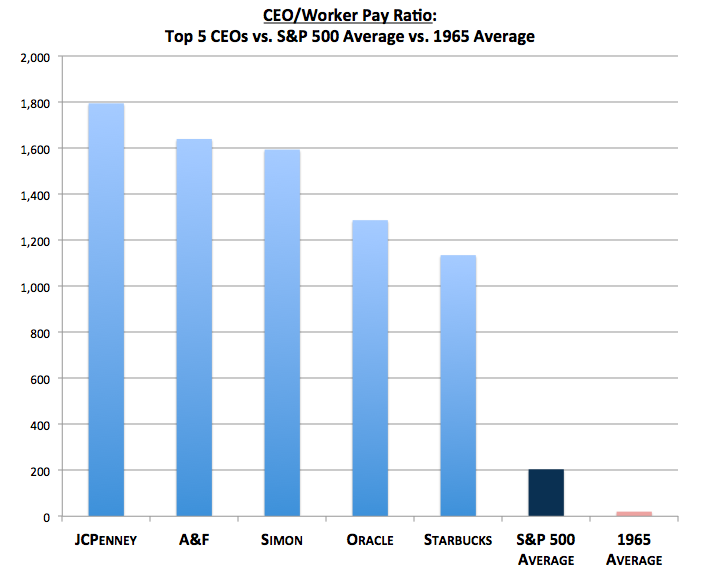
|
|
| | | 462 | Frick
ID: 432501512
Thu, May 02, 2013, 13:31
|
CEO pay is going up significantly faster then worker pay, and that is disturbing trend for 99.99% of people. But, the chart that you posted is taking extremes and using outliers. JCPenny's CEO was lured by JCPenny to walk away from an $80M payday he had coming from Apple for working there for years. The Simon CEO's compensation is not what his W-2 shows, by orders of magnitude. He got restricted stock grants that don't vest for years, but to make the case it is all considered salary for the current year.
|
|
| | | 463 | Biliruben
ID: 358252515
Thu, May 02, 2013, 13:35
|
The average, 200 to 1, is plenty concerning without the outliers. Agreed.
|
|
| | | 464 | sarge33rd
ID: 4609710
Wed, Jul 10, 2013, 21:52
|
DC council fails to crumble under threat from WalMart
D.C. lawmakers gave final approval Wednesday to a bill requiring some large retailers to pay their employees a 50 percent premium over the city’s minimum wage, a day after Wal-Mart warned that the law would jeopardize its plans in the city.
The retail giant had linked the future of at least three planned stores in the District to the proposal. But its ultimatum did not change any legislators’ minds. The 8 to 5 roll call matched the outcome of an earlier vote on the matter, taken before Wal-Mart’s warning.
|
|
| | | 465 | sarge33rd
ID: 3871221
Fri, Sep 27, 2013, 11:54
|
BOOM!
According to Zeynep Ton, a retail researcher and associate professor of operations management at the MIT Sloan School of Management, in the early 2000s, Home Depot’s CEO, Robert Nardelli, moved to cut full-time staffing levels while increasing part-time employees in an effort to boost profits by trimming the expense that comes with employing full-time workers. It worked for a short while. However, as Ton notes, eventually customer service declined—and with it, customer satisfaction—leading to a severe decline of same-store sales.
Wal-Mart’s penny wise-pound foolish approach to its business was further well documented in the Bloomberg article referenced earlier where they told the story of Margaret Hancock, a retired accountant from Newark, Delaware, who has always viewed Wal-Mart as her “one stop shopping destination”.
While Ms. Hancock had, for years, been able to get everything she needed at her local Wal-Mart store, recent visits resulted in her failing to locate numerous items as the products were simply were not out on the shelves and available for purchase.
As Hancock explained it, “If it’s not on the shelf, I can’t buy it. You hate to see a company self-destruct, but there are other places to go.”
It's beginning to impact them.
|
|
| | | 466 | Frick
ID: 432501512
Fri, Sep 27, 2013, 13:42
|
That and the fact there stores look like they belong in the 3rd world on the inside. I don't like shopping in stores that spend huge money on interior fixtures, as that money is coming from mark-ups on the items you buy, but there is also minimum to have a respectable impression. Wal-Mart cultivates a cheap mentality and it is showing up in how their employees and customers view them. And there is a difference between cheap and value. Value is great, cheap is bad.
|
|
| | | 467 | Frick
ID: 7631217
Sat, Nov 23, 2013, 09:43
|
Happy Thanksgiving
See, Wal-Mart does care about their employees. They even put out donation baskets so they can have a Thanksgiving meal!
|
|
| | | 468 | sarge33rd
ID: 3871221
Tue, Nov 26, 2013, 00:47
|
Duke steps down as WalMart CEO, just beofre a stockholders meeting and the beginning of the Chrostmas shopping season
This is a bad week for Walmart. Not only have workers in 28 stores spread across 12 states gone on strike, the National Labor Relations Board (NLRB) has announced the result of its probe, which went against the Benton, AK-based retail giant. So it was no surprise when the CEO, Mike Duke, stepped aside this morning, ahead of the shareholders meeting on Tuesday, and just before the holiday shopping season begins on “Black Friday.”
|
|
| | | 469 | Perm Dude
ID: 431013412
Tue, Nov 26, 2013, 02:14
|
You think the new guy will be working Thanksgiving Day, too?
:)
|
|
| | | 470 | Frick
ID: 432501512
Tue, Nov 26, 2013, 08:59
|
Sure, if you mean from his Colorado estate in between ski runs on his cell phone or tablet, he will be working.
I think there should be a balance of power between unions and companies. American auto manufacturers are examples of where the unions got a little to much. Wal-Mart is an example where a company has gotten way, way to much. I hope that the workers of Wal-Mart unionize, but it will be interesting to see how much Wal-Mart and the Waltons can influence Washington. I'm actually surprised that the NLRB found against Wal-Mart. I'm sure there are plenty of Washington lobbyists and representatives that are getting unpleasant phone calls wanting this to be shut down.
|
|
| | |
| | | 472 | sarge33rd
ID: 390471112
Tue, Feb 11, 2014, 23:52
|
explains an awful lot...doesnt it?
|
|
| | | 473 | sarge33rd
ID: 593111219
Fri, May 16, 2014, 19:04
|
Portland to divest of ll WalMart holdings
Walmart and Portland, Oregon don't mix.
Portland Business Journal reports that on Thursday, Portland city officials announced it will not be making any more investments in the world's largest retailer and that the first of the city's Walmart holdings had expired.
Oregon's KOIN reports that the investment pullback came after Portland leaders determined the mega-retailer is "not a socially responsible company." Portland had about $36 million invested in Walmart, or about 2.9 percent of the city's investment portfolio. The city announced Thursday that it would be free of all remaining holdings by 2016.
|
|
| | | 474 | Bean
ID: 5292191
Fri, May 16, 2014, 19:19
|
So, lets see...re-invest in COSTCO right? You gotta love government for profit. hehe
COSTCO HQ
999 Lake Drive
Issaquah, WA 98027 USA
|
|
| | | 475 | sarge33rd
ID: 593111219
Fri, May 16, 2014, 19:26
|
lol
data was from circa 2006 or 2007..
cashier at WalMart, 8 yrs on the job, 22k/yr income.
cashier at COSTCO, 8 yrs on the job, 48k/yr income.
One of these things just does not belong here,
One of these thing just does not belong.
|
|
| | | 476 | Boldwin
ID: 54351610
Fri, May 16, 2014, 19:48
|
Costco insists on a high level of commitment and value added sales ability/service skills from those employees. You can't sleepwalk your way thru that job like you can at Walmart for min. wage.
I have no complaint with either approach. It's not a given which works best and on such bets, businesses rise and fall.
|
|
| | | 477 | Perm Dude
ID: 431013412
Fri, May 16, 2014, 23:02
|
WalMart is the Welfare Queen of corporations.
|
|
| | | 478 | Boldwin
ID: 584491621
Sat, May 17, 2014, 14:38
|
I don't know what welfare you speak of, but I do have a whacky personal theory that Walmart has a side business from which it derives it's business edge. It is hazardous to stumble on the proof.
|
|
| | | 479 | sarge33rd
ID: 593111219
Sat, May 17, 2014, 14:41
|
what welfare? The welfare WalMart employees qualify for, despite being employed, because WalMart refuses to pay them. The welfare, provided by the tax-payer, as a profit subsidy to WalMart. THAT welfare.
|
|
| | | 480 | sarge33rd
ID: 593111219
Sat, May 17, 2014, 20:28
|
One Walmart's Low Wages Could Cost Taxpayers $900,000 Per Year, House Dems Find
The study uses Medicaid data released in Wisconsin to piece together the annual cost to taxpayers for providing a host of social safety net programs, including food stamps and publicly subsidized health care, to workers at one Supercenter in the state.
According to the report, Walmart had more workers enrolled in the state’s public health care program in the last quarter of last year than any other employer, with 3,216 people enrolled. When the dependents of those workers were factored in, the number of enrollees came to 9,207.
"When low wages leave Walmart workers unable to afford the necessities of life, taxpayers pick up the tab," the report says.
|
|
| | | 485 | Bean
ID: 5292191
Sun, May 18, 2014, 11:30
|
478 Boldy can you step us through the logic/details of the video you are endorsing? I dont follow it at all.
|
|
| | | 486 | Bean
ID: 5292191
Sun, May 18, 2014, 12:11
|
In keeping with this thread's title, I submit this link for your reflection
|
|
| | | 487 | Bean
ID: 5292191
Sun, May 18, 2014, 12:33
|
Did you see the piece on ESPN discussing the immigrant workers in Qatar? They are preparing for the 2022 World Cup. Their population is just 2M and they have the highest per-capita income in the world. There is no path to citizenship for the migrant workers.
I think Kuwait had the same demographic around the time of Desert Storm.
Make of it anything you'd like.
|
|
| | | 488 | Perm Dude
ID: 431013412
Sun, May 18, 2014, 13:31
|
WalMart costs nearly every local community far more in services than that pay in taxes. They do so proudly and very openly--blaming the "system" for their unresponsibility.
This is the very definition of welfare queen, in my book.
|
|
| | | 489 | Boldwin
ID: 214511715
Sun, May 18, 2014, 13:39
|
Bean re: Walmart
Remember when the CIA got caught in the drug smuggling trade?
Remember the Mena airport?
There were a lot of murdered witnesses in those parts whose murders were covered up by Clinton's choice for corrupt AG, namely Janet Reno.
Some of them went home; told their families they had seen something very dangerous to know. A week later they were murdered and their murder was declared a suicide.
It's just my gut feeling...but knowing Arkansas and Clinton and the Mena scandal very well...that they didn't just witness CIA transports unloading drugs. I think they were then loading them into Walmart trucks. Or Perdue chicken trucks. There is an awful lot of traffic...and profits to launder. And some stupendously wealthy and connected traffickers.
|
|
| | | 490 | Boldwin
ID: 214511715
Sun, May 18, 2014, 13:40
|
PD#488
And we know how much this bothers you from you position on illegal immigration.
|
|
| | | 491 | Bean
ID: 5292191
Sun, May 18, 2014, 14:12
|
489 Thanks Boldy, we'll prolly never know what really happened there, the clip looked familiar though.
Honestly, I never trusted the Clinton's after the stuff about real estate dealings came out. Overall the country seemed to be doing better under their administration, dont know who deserves the credit/blame for things that happened then.
Anyway, attaching all things Arkansas to any drug dealing that may have happened there is a reach. Next thing you are going to to tell me is that every citizen of Arkansas is culpable in these events.
I'll have to tell my brother and his kids and grandkids and my sister's son and his kids we are coming to lock them up. I'm going canoeing with all of them in two weeks on the Buffalo River. I'll ask them if they know any scuttlebutt.
|
|
| | | 492 | Boldwin
ID: 214511715
Sun, May 18, 2014, 14:22
|
There was a carpet cleaning business in the south east if I remember correctly which was expanding at such an amazing rate business insiders just couldn't understand what their edge was and how it could be that successful. It turned out they were dealing drugs.
When I see something that can't be explained by usual means, I go looking thru all the possibilities.
|
|
| | | 493 | Bean
ID: 5292191
Mon, May 19, 2014, 11:52
|
493 We must remain vigilant. You heard about it because some government guy was actually doing his job.
|
|
|
|