|
| Posted by: nerveclinic
- [27051103] Thu, Aug 16, 2007, 11:24
I thought I would move the discussion here since we were high jacking a perfectly good housing discussion thread.
|
| | | 1 | nerveclinic
ID: 27051103
Thu, Aug 16, 2007, 11:24
|
What sectors
1) Consumer Staples Mutual Fund that I've been adding to...it's a safe bet in any market because everyone still has to eat. It's just boring and no relationship to financials.
2) Technology No Relationship to financials unless the entire economy goes in the tank, so far that hasn't happened. Obviously the way the market is reacting some people do think we are headed for a recession, which would hurt tech badly.
3) IVW ETF (I just bought this for the first time this week) this is a large cap SP growth index ETF with very little exposure to financials, lots of the biggest companies who have been flat this year, Exxon, PG, Cisco Johnson and Johnson, GE etc. Safer because they are big companies and they get the world growth story play and the benefit of the weak dollar.
Other then that I bought some SP 500 on the way down between 1450 and 1400. It has some financial exposure but only the biggest companies and they are pretty beaten up already. Obviously some of these entry points were premature but I missed the bottom in February because I waited so I vowed to buy on the way down this time.
I was about 35% cash in my retirement before we hit 1450, now I am all in.
And yes after yesterday and this morning a little scared...hopefully that's a good thing. I really wasn't that worried when I was baiting Billi a couple days ago but now I am a little more concerned. Again, that may be a good sign.
Of course most of this money went into the market at SP 850 in March of 2003 so that gives one a little levity at times like these.
It's long term 10 + year money
I think 1380 on the SP is a really important symbolic test. That's where the lows were in February before the market came back. We hit 1390 as I wrote this.
My biggest problem right now is a small exposure to Materials (Lots of steel) and Mining which I've had for quite some time but it's actually down the last few weeks MORE THEN THE FINANCIALS if you can believe that. Fear that the boom in the world growth story may stall here because of USA home problems. Plus people taking big profits.
I know this post is stock related but to me all the problems stem completely from the housing slump so very appropriate in this thread.
By the way I have no fricken idea what I am talking about so please don't follow any of my advice and then blame me.
Nerve
|
|
| | | 2 | Boxman
ID: 571114225
Thu, Aug 16, 2007, 12:02
|
I think this is an excellent time to buy. My stock strategy is to create passive income from dividends to pay my regular monthly bills. I'm getting close to doing just that.
There are some stocks out there that are going down that I like like bank stocks which are good dividend payers.
On the mutual fund side I haven't changed anything. I'm still sticking with capital appreciation and equity income type funds.
My belief is that the profit in any investment is really determined when you buy and not when you sell. I think tech is a great hiding spot right now, but I wonder if the market isn't fleeing there en masse and then will get out and get into other sectors once they start going up. That's why I think it's better to analyze company financials whose stocks have taken a downturn and buy into strong companies that are getting effected by the subprime panic.
|
|
| | | 3 | biliruben
ID: 4911361723
Thu, Aug 16, 2007, 12:32
|
February was just the preliminary sniff of how bad housing was and how it could impact the larger economy.
This is the full snort, and then some. We still haven't seen too many effects on the economy at large, but we will.
Personally, I think the stock market is going down currently for the wrong reasons, but that doesn't mean the economy isn't on a precipice.
When it becomes obvious that MEW was a main driver in consumption and the economy at large, and stagnating and declining real incomes can't support that level of consumption, we will the recognition of a very soft economy.
Right now people don't really understand all this CDO mumbo-jumbo and it's effect, so the run from fear and uncertainty.
|
|
| | | 4 | Great One
Sustainer
ID: 053272014
Thu, Aug 16, 2007, 12:32
|
Boxman, you may want to look into closed end funds. I know of many clients that live off the consistent monthly payouts.
ETF Connect is an unbiased comparison tool. COY, FRA and FRB are some interesting products that I am familiar with.
You just plug in a symbol up top to get some info and compare closed end funds across the different companies. Very useful website.
|
|
| | | 5 | Perm Dude
ID: 44727169
Thu, Aug 16, 2007, 12:49
|
Watching my IRA rollover fund (spread across 4 different Putnam mutual funds) and it has been dropping like a stone this year. Crappy system--it is only about $7K, but it costs me $50 to make trades.
I need to find someplace to park it long term where, if I have to, trades are much, much cheaper. And I don't have to watch it every day.
|
|
| | | 6 | Pancho Villa
ID: 495272016
Thu, Aug 16, 2007, 13:19
|
Since the Dow hit 14,000 on July 19th, I've lost almost $50,000 on paper from my retirement and kids' AG Edwards accounts.
|
|
| | | 7 | nerveclinic
ID: 27051103
Thu, Aug 16, 2007, 13:33
|
Since the Dow hit 14,000 on July 19th, I've lost almost $50,000 on paper from my retirement and kids' AG Edwards accounts.
Only if you sell at the wrong time.
|
|
| | | 8 | nerveclinic
ID: 27051103
Thu, Aug 16, 2007, 13:36
|
We are at a really important point right now.
The SP 500's March low close was 1374 and change.
If we don't close below that the next few days, it's at least a good temporary sign. If we close any day below the March 1374 low, technically it's a really bad sign.
|
|
| | | 9 | Pancho Villa
ID: 495272016
Thu, Aug 16, 2007, 13:44
|
Nerve,
Hence the term on paper
|
|
| | | 10 | nerveclinic
ID: 27051103
Thu, Aug 16, 2007, 13:44
|
Bili: stagnating and declining real incomes
Bili are you just saying that or do you have the economic data to back it up? I thought I've been reading lately that income has been slightly ahead of inflation. What numbers are you using?
|
|
| | | 11 | Perm Dude
ID: 44727169
Thu, Aug 16, 2007, 13:44
|
You know, the stock market is a lot like TSN fantasy sports...
|
|
| | | 12 | nerveclinic
ID: 27051103
Thu, Aug 16, 2007, 14:23
|
It's really interesting if you look at the SP charts it literally hit that 1374 March low mark and bounced back up from there, now at 1400.
I'm heading out for the night so I won't get to watch the last hour but it may be a very significant short term event.
If the SP closes above 1374 there's life. If it closes below that number...look out below.
I say that and I am not even the technical type.
What gives me hope is that there is so much fear right now...that's a good thing
|
|
| | | 13 | nerveclinic
ID: 27051103
Thu, Aug 16, 2007, 14:28
|
Boxman There are some stocks out there that are going down that I like like bank stocks which are good dividend payers.
Boxman I would be very, very careful of bank stocks right now until there is a little more understanding about how much exposure each of them have to the sub prime markets. They are a mine field right now.
Out of curiosity, when you say you "like bank stocks right now" which banks do you like?
|
|
| | | 14 | biliruben
ID: 35112816
Thu, Aug 16, 2007, 14:46
|
I think you are right that there was a slight up-tick in incomes in the last quarter or three, iirc.
I was talking about the last 5-10 years.
Here's the census info for 2 year moving average for median household incomes.
1999-2000 median household income is 47,635 (Washington state 50,736),
2004-2005 median household incomes is 46,071 (Washington state 49,732).
Home prices nearly doubled in that time, and everything from food to the price of gas has gone up significantly.
Unsustainable.
|
|
| | | 15 | Pancho Villa
ID: 495272016
Thu, Aug 16, 2007, 15:20
|
Checked the DOW about 20 minutes ago - Down 160. Checked a minute ago - Down 227.
Incredible swings.
|
|
| | | 16 | Boxman
ID: 571114225
Thu, Aug 16, 2007, 16:51
|
Nerve: Boxman I would be very, very careful of bank stocks right now until there is a little more understanding about how much exposure each of them have to the sub prime markets. They are a mine field right now.
Out of curiosity, when you say you "like bank stocks right now" which banks do you like?
I am bullish on large banks. Keep in mind my strategy.
I like Citigroup ($2.16 annual dividend paid quarterly), Bank of America ($2.56), and Wells Fargo ($1.24).
Banks are in the money business. I've always liked them. It's not like a company like Target that is in the retail business and make a profit as a result. (I love Target stock BTW.) Banks are always in the money business.
They are paying the price for that now with loose credit terms for mortgages but we all knew a correction was coming and I think the economy will come back and in the meantime I'll enjoy grabbing some shares while they're down and getting more dividend for my buck.
I own shares in other sectors. My portfolio is essentially a customized mutual fund to my strategy. I just really like banks now. I see those three companies and I look at market as being driven by reality but also by panic.
When panic sets in people sell like mad and over correct. I think that's whats going on with banks. Just a hunch.
Another thing to keep in mind is that you and I are pimples on the markets ass. It's the pension funds and mutual funds that really make the market tick. They have to manage people who are retiring in a short time period from now. I'm not. I look at a big drop in Citi, BoA, and WF as an opportunity, not as panic time for my portfolio.
|
|
| | | 17 | Boxman
ID: 571114225
Thu, Aug 16, 2007, 17:06
|
As a potential example of market panic, I wonder what'll happen tomorrow in tech in light of Dell restating their financials.
|
|
| | | 18 | nerveclinic
ID: 105222
Thu, Aug 16, 2007, 19:20
|
As a potential example of market panic, I wonder what'll happen tomorrow in tech in light of Dell restating their financials.
Fortunately HP spanked their earnings estimate.
H-P Roars Past Estimates
SAN FRANCISCO -- Hewlett-Packard (HPQ - Cramer's Take - Stockpickr - Rating) increased its sales by 16% in its fiscal third quarter, sailing past Wall Street expectations.
The Palo Alto, Calif., tech giant said revenue in the three months ended July 31 totaled $25.4 billion, $1.4 billion more than the average analyst expectation.
At this time a year ago, H-P had sales of $21.9 billion.
|
|
| | | 19 | nerveclinic
ID: 105222
Thu, Aug 16, 2007, 19:22
|
I have to say coming home and seeing 1411 on the SP is a good feeling for today.
The index touched 1374 and never went near it again.
We'll see.
|
|
| | | 20 | nerveclinic
ID: 105222
Thu, Aug 16, 2007, 19:54
|
Also significant
The Dow dropped 300 points and wound up almost even.
|
|
| | | 21 | Boxman
ID: 571114225
Thu, Aug 16, 2007, 20:33
|
The market has been having a similar yo-yo effect for I think a couple weeks now. Up a lot, down a lot, down some more, up a little, ad nauseum. Look at the really sharp peaks in the DOW & S&P charts lately.
Here's a three month chart of the DOW.
S&P
To me that's reflective of a panicked market. People don't really know what to buy or where to hide their $$$.
I think the market can be divided into some large segments right now. Add some if I missed any.
1 - Those riding out the DOW and S&P indexes and the stocks therein thinking long term. I'm in this bucket and you appear to me (because of your liking of S&P index funds) that you are as well. Most of the people I know are doing this.
2 - Dump, run, and convert to cash or bonds.
3 - Sell off and switch sectors. I keep hearing gurus like Cramer suggest this, but my philosophy of profiting when you buy won't allow me to do this. I also think that if you are following, or are acting upon advice from talking heads that you're already behind the 8 ball.
|
|
| | | 22 | nerveclinic
ID: 105222
Fri, Aug 17, 2007, 03:12
|
Sell off and switch sectors. I keep hearing gurus like Cramer suggest this, but my philosophy of profiting when you buy won't allow me to do this. I also think that if you are following, or are acting upon advice from talking heads that you're already behind the 8 ball.
Actually more then half my money is in either sp 500 index, total stock market index or an index or mutual fund very close to those. Also in that number is a total market European index.
Next we get even more conservative with about 10-15% in consumer staples. So as a core holding we are talking a good 60%-70% in basic index type funds or etfs. (normally with the indexs it would be all mutual funds but I wanted some liquidity with the ETF's just in case.)
Next a broad technology index fund. (15%)
I don't think that's anymore speculative then saying "I am buying banks here".
The closest thing I have to speculation is the materials and mining.
Jim Cramer??? I don't trust the guy or his web page as far as I can throw him. (Although I do like Aaron Tasks pod cast but I discount most of what his wall street guests have to say when he interviews them)
I think Cramer is a shark and I assume he is bought and paid for. (Yeah I know cynical conspiracy theory again) That's really what I believe about the guy.
I started making some sector plays a month or two ago to avoid finiacials and housing. I don't need a talking head to tell me thats smart.
What I didn't understand with the metals is that since they had such a good year to this point (30-40% up) That hedge funds etc would sell them when things got dicey because they were liquid and they could book profits. I think the liquid factor is a big reason why a lot of good stocks are being sold, funds need cash as people bail from the fund and they can't sell worthless credit paper to facilitate this. So instead they sell quality liquid stocks.
That's why metal is down, that's why oil is down, that's why solid companies with good earnings are down. The hedge funds need to raise cash and this is how they do it. Lesson learned for future years.
Up until 6 months ago I never bought an individual stock or sectors it was all major index funds.
I am considering going back to that strategy at some point when things unwind.
When I buy mutual funds I only buy no loads. My current cost expense basis on all mutual funds is an average of .33%. According to morning star the average for the typical investor with the same type funds is .88%
|
|
| | | 23 | nerveclinic
ID: 105222
Fri, Aug 17, 2007, 03:15
|
Friday is an extremely important day for the market IMO.
If the SP 500 closes above the March low of 1374 there's a bit of relief. If it goes down and tests that low again, and drops below and stays below at the end of the day, it probably means another big leg down and Bili will get his 1326.
Big, Big day Friday.
|
|
| | | 24 | nerveclinic
ID: 105222
Fri, Aug 17, 2007, 03:27
|
By the way Boxman, if you look at a 2 month chart (Which is when I started buying the tech sector index fund to avoid financials) and compare it with the sp 500 index, tech is down about 4% the sp is down almost 10%.
|
|
| | | 25 | Boxman
ID: 571114225
Fri, Aug 17, 2007, 06:26
|
I think the liquid factor is a big reason why a lot of good stocks are being sold, funds need cash as people bail from the fund and they can't sell worthless credit paper to facilitate this. So instead they sell quality liquid stocks.
Couldn't agree more.
With the weak dollar versus a strong euro, I'll be curious to see when some heavy hitting Europeans show up and leverage the exchange rate to get some stocks really cheap.
I think Cramer is a shark and I assume he is bought and paid for. (Yeah I know cynical conspiracy theory again) That's really what I believe about the guy.
I operate under the assumption that if the person is a stockpicker on TV they are bought and paid for. His analytical info (the numbers which you and I can get on our own anyway) is informative. I give him guru status because he was very successful in the past.
Are there any big earnings calls today?
|
|
| | | 26 | nerveclinic
ID: 105222
Fri, Aug 17, 2007, 09:22
|
With the weak dollar versus a strong euro, I'll be curious to see when some heavy hitting Europeans show up and leverage the exchange rate to get some stocks really cheap.
They can't. There's no liquidity in Europe either. The European banks bought so many of our bad mortgage paper that money has dried up there also.
|
|
| | | 27 | nerveclinic
ID: 105222
Fri, Aug 17, 2007, 09:23
|
There should be a nice big bounce today...
Fed cuts discount rate to 5.75% to ease credit crunch 50 basis points.
|
|
| | | 28 | biliruben
ID: 4911361723
Fri, Aug 17, 2007, 09:49
|
...and there is. We'll see if it can be sustained. I don't really think this will solve the fundamental liquidity problem. Investors aren't going to start having confidence that mortgage derivatives are anything but garbage and start buying them again.
|
|
| | | 29 | biliruben
ID: 4911361723
Fri, Aug 17, 2007, 09:51
|
One of my shorts just jumped 200% on open. That can't be right.
|
|
| | | 30 | nerveclinic
ID: 27051103
Fri, Aug 17, 2007, 09:58
|
One of my shorts just jumped 200% on open. That can't be right.
I assume you mean it's a 200% loss?
Very possible if you were shorting something that is effected by interest rates like housing or financials. I wouldn't want to be short anything today.
I placed 2 orders with Fidelity at the market open and 24 minutes later they still haven't filled either one of them.
|
|
| | | 31 | biliruben
ID: 4911361723
Fri, Aug 17, 2007, 10:03
|
Yeah, no it was a yahoo glitch. I have little faith in the long-term impact of the discount rate cut. Just a short-term psychological boost which could end up backfiring, if the fed looks impotent.
Ride those shorts! (I'm actually much, much more long than short - shorting is just a minor hedge against my abode as well as to keep this housing bust interesting, and I'm still well in the money).
|
|
| | | 32 | nerveclinic
ID: 27051103
Fri, Aug 17, 2007, 10:51
|
Strange.
45 minutes into the market and an order I placed for SP index (SPY) with Fidelity still hadn't filled. I called and they said it was because the AMEX isn't trading yet, there was a problem so I canceled the order.
Looks fortunate now as the SPY is coming back down.
You can't trust the charts on The Street.com
At the same time I am looking at real time trades on fidelity showing the SP was now only up .35% Thestreet.com still showed it up 1%
Looks like the market agrees with you Bili as the index is headed back south already.
Now I'm seeing .24%
|
|
| | | 33 | biliruben
ID: 35112816
Fri, Aug 17, 2007, 12:59
|
Huh. I don't see the S&P500 ever going below 0.5% up, except at open.
Barrons - Credit still crunched.
But, says Dominic Konstam, Credit Suisse interest rate strategist, the current crisis is worse than the LTCM episode. Then, "you could identify the problem, ring-fence it and basically deal with. You could identify the illness and prescribe the right cure."
"Now, nobody knows where the problem lies other than there was too much of a good thing" in terms of leverage, he continues. It isn't just subprime mortgages and leveraged-buyout lending. The technology of the CDO market and transmission of that risk to the ABCP market are what allowed the bubble in the securities market to take place. "It all adds up to an awful lot of leverage in the system."
Once confidence is lost, leverage is a deadly weapon, Konstam says. To unwind the leverage, "you need to transfer assets to a 'real money' guy, who's nervous and only is willing to buy at a rock-bottom price. And then only today. The next day, the bid might not be there."
|
|
| | | 34 | biliruben
ID: 35112816
Fri, Aug 17, 2007, 13:09
|
Shades of 1929 - Bank run on CFC: (LA Times - registration required
Anxious customers jammed the phone lines and website of Countrywide Bank and crowded its branch offices to pull out their savings because of concerns about the financial problems of the mortgage lender that owns the bank.
Countrywide Financial Corp., the biggest home-loan company in the nation, sought Thursday to assure depositors and the financial industry that both it and its bank were fiscally stable. And federal regulators said they weren't alarmed by the volume of withdrawals from the bank.
The mortgage lender said it would further tighten its loan standards and make fewer large mortgages. Those moves could make it harder to get a home loan and further depress the housing market in California and other states.
The rush to withdraw money -- by depositors that included a former Los Angeles Kings star hockey player and an executive of a rival home-loan company -- came a day after fears arose that Countrywide Financial could file for bankruptcy protection because of a worsening credit crunch stemming from the sub-prime mortgage meltdown.
The parent firm borrowed $11.5 billion Thursday by using up an existing line of credit from 40 banks, saying the money would help the lender meet its funding needs and continue to grow. But stock investors, apparently alarmed that the company felt compelled to use the credit line, sent Countrywide's already battered stock down an additional 11%.
At Countrywide Bank offices, in a scene rare since the U.S. savings-and-loan crisis ended in the early '90s, so many people showed up to take out some or all of their money that in some cases they had to leave their names.
Perhaps that was the reason for the cut. Keep CFC afloat (and screw up my short-ride to bankruptcy!).
|
|
| | | 35 | nerveclinic
ID: 105222
Fri, Aug 17, 2007, 13:19
|
Huh. I don't see the S&P500 ever going below 0.5% up, except at open.
When I was looking at SPY on Fidelity it was at .34% at one point. Could have been a screw up due to this "Amex is open yet" snafu. I always thought SPY mirrored exactly the SP 500.
This is what I was offered on my trade screen.
|
|
| | | 36 | biliruben
ID: 35112816
Fri, Aug 17, 2007, 13:34
|
Man. The more I read about this rate cut, and the concurrent rules changes that go along with it, the more amazed I am.
The fed just violated the integrity of the markets. They changed to rules so these loans are now 30 days instead of 1 day (actually infinite, as the borrower can re-up indefinitely), and they loosened their rules so they would take sub-prime CDOs and other crappy derivatives as collateral.
I am not an expert, but it seems to me that basically puts the taxpayer on the hook for trillions of dollars.
CFC can now go back to business as usual, originating subprime loans to high risk folks at any price they want, and joe-taxpayer takes on all the risk.
I need to read more and try and figure out if this is really true. If so, and I were one of the dozens of lenders that have already gone bankrupt, I would be really angry.
If I were a taxpayer I'd be angry as well. If I were short CFC I'd be doubly angry. Wait a sec...
|
|
| | | 37 | biliruben
ID: 35112816
Fri, Aug 17, 2007, 13:47
|
Okay, maybe I overreacted (and so has the market).
Here's a nice bit from the econblog at WSJ:
"We can only speculate about this, but the decision to move the primary discount rate rather than the Fed funds rate may indicate that the Fed anticipates some institutional failure as soon as today, probably not a bank, but rather an institution that has substantial bank liabilities that may not be able to clear. Markets should not be calmed by this tactic. Unlike the Fed funds rate — which affects all banks’ cost of funds — a discount rate cut only lowers the cost of emergency borrowing by institutions in distress. This move is not going to provide any relief to the overall economy. However, we believe that the Fed’s action and statement today raise the odds of a reduction in the Fed funds rate at the September FOMC meeting, or perhaps even before."
|
|
| | | 38 | biliruben
ID: 35112816
Fri, Aug 17, 2007, 13:49
|
So basically they are trying to save CFC from bank failure. The run shook up Bernanke enough to step in.
Countrywide BANK was teetering on the brink, and may not have been able to pay it's depositors today.
|
|
| | | 39 | biliruben
ID: 35112816
Fri, Aug 17, 2007, 13:56
|
There is a bit of speculation it might have been for WAMU...
I don't believe it, but bank failures are not good. Even talk of bank failures are not good.
Do what you must, Ben. My shorts be damned.
|
|
| | | 40 | nerveclinic
ID: 105222
Fri, Aug 17, 2007, 14:58
|
Huh. I don't see the S&P500 ever going below 0.5% up, except at open.
I see 2 possibilities.
The "stated" market open is 1311. (Big Charts) The SP was never at 1311 at the opening. The FED made the rate cut announcement well before the opening. I was looking at the pre market trading and it was well above that at 9:10AM.
So when you see the lowest point being 1.50% it's using a chart based on the false 1311 open.
There are different charts out there just for today. Go to the street.com and open the 1 day interactive chart for SPX... it shows the open as
1415.51 and intra day low of 1421.62 which is just about .40 percent (by the minute)
Big Charts shows the open as 1311 which again I am claiming as a false number.
Fidelity is probably basing their trades on where the SP actually opened on the trading day which was considerably higher, i.e. where you could actually make the trade.
No one got 1311 at the open.
The second possibility is I am flat out wrong and was just looking at something incorrectly...always a possibility.
If you use real numbers though, the true open, where you could actually buy after the premarket trades were made, the market got much closer to a .40% bottom then the 1.50%.
|
|
| | | 41 | nerveclinic
ID: 105222
Fri, Aug 17, 2007, 15:08
|
It's interesting the FED choose pre market today to make the cut.
Could be due to completely different factors but, as discussed yesterday.
Yesterday we tested the March lows of 1374 and bounced off them...very critical moment in this market.
Had we retested today and breached that number the bottom would have fallen out because it would have triggered huge sell signals for technicians.
Instead we have a 10% correction in place, and we are moving away from the March bottom.
Was the Fed watching this or is it pure coincidence?
Now this last hour of trading before the weekend is crucial. The market has been dropping in the last hour of trading lately. The last hour is always the smart money.
Now we are headed into a two day weekend.
A movement down, especially below 1374 would be devastating.
A sideways last hour or even better an up hour would be a nice short term positive.
Here we go.
|
|
| | | 42 | biliruben
ID: 35112816
Fri, Aug 17, 2007, 15:13
|
They made the cut to keep one or more banks solvent. There were runs at Countrywide. There are rumors of WAMU solvency.
The FED is not watching the S&P charts. They are trying to keep this unwind orderly.
|
|
| | | 43 | Doug
ID: 113132214
Fri, Aug 17, 2007, 15:25
|
The 5.25% overnight Fed Funds rate is merely a "target" rate. But in reality, the overnight rate has recently been averaging sub-5% the past week, which is well below it's stated "target". The Fed can buy/sell short-term bonds to influence the rate at which banks lend money to one another... and the resulting average of actual overnight rates that the banks use is the "effective" Fed Funds rate.
The linked blog suggests that the "slide-rule committee" (first I've ever heard this term used) through it's open market operations (the aforementioned buy/sell of bonds) has been intentionally implementing this "stealth easing" of the overnight rate by the Fed (and I've seen similar comments on other sites).
There have been some explanations by other observers that the lower average has to do with some highly unusual trades... that there have been some instances of "0% interest" trades in recent days that are bringing down the average. Others seem to think this is an intentional behavior by the Fed, but that they are hoping it is merely a temporary necessity, and that they can soon return to the 5.25% target rate... hence no formal announcement. My gut is that it's a bit of both... the Fed effecitvely implementing a 25 basis point reduction, coupled by a few odd 0% trades (due to "excess reserves"... which I assume was due to the Fed's sudden liquidity injection) bringing the average down below that 5% mark. The liquidity injection and 0% trades serve as a short-term cover story for the Fed's easing back to 5%. It seems somewhere the individual data of the overnight trades should be available, not just the "overnight average"... maybe it is and I just don't know where to look... or maybe it's not because 99.999% of the time nobody cares about the individual trades (only in a freak situation like we have now), so there's rarely any demand/request for this info to be published (and doing so would be a waste of resources the vast majority most of the time).
Regardless, if the current situation persists much longer, the market will essentially recognize that the Fed has already lowered the rate, and any such announcement at the Sept. 18 FOMC (or sooner) would become a non-event.
|
|
| | | 44 | biliruben
ID: 35112816
Fri, Aug 17, 2007, 15:42
|
Yeah, they've been missing their target. Probably intentionally. Last time I checked, it had been slowly moving closer, however.
In any case, any sort of rate cut - discount, faux, ff, whatever - I take as a very negative sign.
|
|
| | | 45 | Perm Dude
ID: 35738179
Fri, Aug 17, 2007, 15:44
|
bili, where have you heard about WAMU? They are, of course, the company holding my own mortgage. I dunno if I want them to go down or not...
|
|
| | | 46 | biliruben
ID: 35112816
Fri, Aug 17, 2007, 15:52
|
Has the mortgage been funded yet? If so, you probably have nothing to worry about. It's probably been cut into so many teeny tiny pieces of "risk" floating around the ethernet in bits and bites, that you don't have to worry about it. WAMU is probably just your servicer at this point.
If it hasn't yet been funded, that's a different problem.
You probably have nothing to worry about in any case. These are just rumors. In Countrywide's case, there were actual long lines of depositors at the branches yesterday, trying to withdraw their money (who would have thought people still have money in savings accounts?).
I haven't heard anything like that for WAMU. I have several accounts there and am not too concerned.
Yet ;)
In any case, Ben seems pretty darned determined to give these big banks as much money as they can possibly digest to keep them solvent, and I appreciate that. Bank runs lead to a serious lack of confidence in the financial infrastructure, and noone benefits from panics. Except Potter.
|
|
| | | 47 | biliruben
ID: 35112816
Fri, Aug 17, 2007, 16:00
|
I think it might not be the long lines of depositors that are the real issue, btw.
There is talk that some of these big hedge funds are trying to burn down the lenders to save their own bacon. Brute-force kill or be killed unregulated and unadulterated capitalism at it's worst.
I don't understand how that works and what's going on behind the scenes.
|
|
| | | 48 | nerveclinic
ID: 105222
Fri, Aug 17, 2007, 16:07
|
They made the cut to keep one or more banks solvent. There were runs at Countrywide. There are rumors of WAMU solvency.
The FED is not watching the S&P charts. They are trying to keep this unwind orderly.
OK so I will put you in the "coincidence camp".
Of course they are "trying to keep the unwind orderly." People were scratching their heads why they didn't do it earlier.
But to say the fed isn't watching the market is IMO inaccurate. They certainly watch the market to an extent.
They could have "saved the banks" 2-3 days ago.
I stand by the theory the timing is interesting.
Making their move the day after the March Lows were tested and a 10% correction was reached is a heck of a coincidence. My point is they may hae wanted that correction to wash out some of the week investors, bad loans etc.
But what do I know, I would have been terrified of being short at a time when everyone and their mother is begging the FED to cut interest rates.
|
|
| | | 49 | biliruben
ID: 35112816
Fri, Aug 17, 2007, 16:14
|
I'm not saying they ignore the market, Nerve. I'm just saying you might be just a bit too caught up in this chartist stuff, and you are missing the big picture.
They had a RUN ON A BANK YESTERDAY. They were worried that Countrywide wouldn't be able to pay their obligations this morning. They had to open the discount window, which is like taking a cash advance on your VISA to a bank (not a sign of good financial health), so this bank or banks would not default on their obligations and start a panic.
It had nothing to do with retesting lows, inflection points or support levels. It had to do with the solvency of major banks.
|
|
| | | 50 | biliruben
ID: 35112816
Fri, Aug 17, 2007, 16:29
|
You'd be terrified of being short a company teetering on the brink of insolvency? I can't believe my luck, quite frankly.
Unfortunately for me, it has been deemed too big to fail. But fortunate, I would guess, for the financial system.
|
|
| | | 51 | nerveclinic
ID: 105222
Fri, Aug 17, 2007, 17:15
|
You'd be terrified of being short a company teetering on the brink of insolvency? I can't believe my luck, quite frankly.
First of all far be it for me to give you any advice on shorting because, frankly I am not sophisticated enough of an investor to try it.
However...Teetering on insolvency? That's a debatable point.
I was on the phone with a friend of mine who works for Country Wide yesterday and he told me a co- worker was buying stock when it hit 20% down. Not because he had insider information, just because he knows enough about the company to believe they weren't going down.
Now on top of that with all the talking heads screaming that the FED was irresponsible to let all these banks fail, it just seems like too dicey a situation to be short. Heck I would have thought shorting was dicey early in the week because the FED might act.
But again, I know nothing about shorting.
|
|
| | | 52 | biliruben
ID: 35112816
Fri, Aug 17, 2007, 17:23
|
I didn't just short them. My position's been open for months. It's just that didn't cover yet. I think your friend was right - yesterday would have been a good time to cover or buy long.
In fact there is a rumor that one unknown investor bought 15% of the shares outstanding yesterday at it's lows.
Probably Ben Bernanke. ;)
|
|
| | | 53 | biliruben
ID: 35112816
Fri, Aug 17, 2007, 17:28
|
I'm not sure out debatable that point is. I do know that they did take out the last of their available credit line yesterday. I would also hazard a guess that their liabilities far outweigh their assets (though it's impossible to prove until they are forced to mark to market) and the amount of loans they make will shrink pretty significantly going forward.
I'm skeptical they would have survived without divine intervention, but now I give them better than 50/50.
|
|
| | | 54 | nerveclinic
ID: 105222
Fri, Aug 17, 2007, 17:40
|
I'm skeptical they would have survived without divine intervention, but now I give them better than 50/50.
Again I honestly know nothing about shorting, but I would think when you are practicing it, divine intervention is one of the most important variables to be cognizant of. Everyone was suprised it didn't happen sooner.
As soon as it happens, the shorts have to run for cover.
When I made my bet that we will hit 1526 before 1426 earlier in the week, (which I still may lose) it was with the assumption I would get help from the FED.
Bili...not giving you a hard time, I admire your savvy to be able to trade this way, it's honestly well beyond my level of sophistication to short.
Heck I bought my first stock 6 months ago, it's all been mutual funds the last 15 years before that. (My company 401K didn't allow stock buying)
|
|
| | | 55 | biliruben
ID: 35112816
Fri, Aug 17, 2007, 18:10
|
Yeah - I wouldn't risk a substantial portion of my money shorting. The deck is definitely stacked against you. I wish it weren't.
It's worked out for me so far, but I prefer to be long.
|
|
| | | 56 | biliruben
ID: 35112816
Fri, Aug 17, 2007, 18:36
|
Sorry - no link:
For Joe Mason, an economist and professor of finance at Drexel, the 30-day window is not long enough.
"[Lenders] are going to have to roll that over in 30 days, max," he said. "The problems will take a lot more than 30 days to work out."
Mason also cited Bagehot's rule, a basic banking principle which he explained as the need to distinguish between illiquid and insolvent organizations. "You want to lend to illiquid but not insolvent institutions," he said. Lending to insolvent institutions just enables them to dig themselves an even deeper hole.
To him, that's what seems to be happening.
"I would argue that Countrywide is insolvent. Their only asset is their pricing platform, their business algorithm, and that's not working. The next biggest asset they have is the toner for their copiers."
|
|
| | | 57 | nerveclinic
ID: 105222
Fri, Aug 17, 2007, 20:10
|
Bili "I would argue that Countrywide is insolvent. Their only asset is their pricing platform, their business algorithm, and that's not working. The next biggest asset they have is the toner for their copiers."
I'm not going to argue that the CFC doesn't have some serious challenges ahead, but that's a worse case scenario and apparently the "market" agrees since it ran up the stock today.
From Morningstar posted today:
This is a paid subscription so I can't link to it...
After reviewing Countrywide's CFC financial position, we believe the chances of bankruptcy are remote and the firm will be able to operate through the current liquidity squeeze. We're maintaining our fair value estimate. We do not think Countrywide Financial will be able to avoid this near-term pressure entirely, but we believe any earnings hit will not destroy significant value. Countrywide is facing unprecedented disruptions in the mortgage market. There is a lack of buyers of nonconforming loans--those that can't be sold to government-sponsored entities (GSEs). As a result, Countrywide has a pile of loans on its books that are effectively underwater and can't be sold to the secondary market.
Assuming it originates and sells conforming loans at break-even and does not reduce its head count, Countrywide burns cash at a rate of about $1.4 billion annually, or $120 million per month (the difference between the $5.6 billion cash revenue generated through its servicing operations and its $7 billion of noninterest cash expenses). In addition, $12 billion of debt will mature over the next year. Beyond this $13.4 billion, we assume the firm will need to secure additional cash of $6.6 billion to meet any unforeseen contingencies, bringing the total amount of funding required to stay in business over the next year to about $20 billion.
Next, we examined the firm’s funding sources; we're comforted by the diversified avenues the firm has available to meet its funding requirements (including deposits, Federal Home Loan Bank advances, federal funds, and commercial paper). We identified $15 billion of trading securities the firm could sell to the market to raise cash, most of which are agency or GSE, indicating that these securities could be sold at or near carrying value. Further, Countrywide maintains about $20 billion of mortgage-backed securities that can also be off-loaded in the market; however, the sale of any non-GSE securities would be at a discount to its carrying value. If the firm sold enough securities to raise the remaining $5 billion needed to stay in business over the next 12 months, it would need to take a 27% haircut on this sale before its Tier 1 capital ratio falls to below 10%, a level that we believe would invite increased regulatory scrutiny. We believe such a sequence of events is a remote possibility.
That said, we see a lot of alternative means available to the firm before it must sell securities to meet funding needs. We expect the firm to aggressively solicit deposits and tap the maximum amount of FHLB advances at its disposal. It will only begin selling a significant amount of securities after exhausting the funds available via these avenues. As a result, we believe its access to liquidity will enable Countrywide to weather the current storm.
The waters ahead are choppy, and market fear is not subsiding. However, we contend that as the best-positioned mortgage originator, Countrywide is highly undervalued right now.
Of course it's just another opinion.
|
|
| | | 58 | biliruben
ID: 4911361723
Fri, Aug 17, 2007, 20:45
|
Yeah, they may be right. I had read they had already maxed out their FHLB loans, and they had no takers on the commercial paper, leaving the fed, which is why I think we saw the rate cut today.
|
|
| | | 59 | nerveclinic
ID: 105222
Sat, Aug 18, 2007, 04:02
|
I am really looking forward to Bob Brinker's show this weekend.
If anyone is looking for intelligent, reasoned, unbiased insight into what is happening in the markets at the moment you will find it from Bob. (Assuming he is on this week, last week was a guest host)
The only reason I was so cocky this week about the state of the market is because of him.
He will be the first to tell you though that he doesn't have a crystal ball but so far in the 10+ years I've listened to him he's the closet thing.
He's not bought and paid for because he has a newsletter that is easily tracked and Hulbert currently has him rated as the number one newsletter for basic investing. (Hulbert is a newsletter tracker on Marketwatch.com whose been following hundreds of newsletters for 20+ years)
That rating may change if this market turns out to be more then a correction.
Brinker hoped for a 10% correction in February/March, it was only 6%. His August 3rd investing letter again predicted this was a market correction and to invest new money as we go down below 1450. (Which I did Gulp)
You can get most of his insights by just listening to the first 10-15 minutes of his show. He comes on and basically gives his views on what has happened the prior week before taking calls.
The calls may or may not be related to market conditions but during turbulent times like these a lot of callers do ask market condition related questions.
His investing style is simple, only buy broadly diversified no load mutual funds and use very limited market timing techniques.
I've said it ad nauseum but he had listeners pull their money out of the market in Jan 2000 at SP500 1465 level. He had listeners put money back in March 2003 with the SP 500 at right around 800. He hit the March low to the day.
I made those moves with blind faith, it was tough to take my money out of the market in January 2000 when everything was going up but by then I trusted him. Anyone who did not follow his advice just got back to the highs from 2000 this spring. People who did take his advice were saved from close to a 50% drop in the SP500 and then put their money back in at a point that still has it up over 70% from the low when you factor in dividends.
Beyond that he has recommended dollar cost averaging except for a couple of times, for instance during the March correction he said you could add additional money. He said this a couple times earlier during small market corrections and again this month.
His talks are not the simple minded dumbed down discussions one expects from mainstream radio. At times he talks using fairly sophisticated investing language which can be off putting to an unsophisticated listener. If that describes you, I urge you to still muddle through it.
When I first started listening to him I understood less then half of what he was talking about, today I understand everything just because of his show.
Like many who have listened to his show for a long time I can't say enough about how he has developed and shaped my investing style. It seems every mistake I make is when I deviate from his advice (Like buying individual sectors, something he does not recommend)
I listen every single weekend and have for 10+ years for 4.95 a month I subscribe to the down loadable version of his radio show so I can listen to it anytime.
I've come on here many times and written about him because I just think so highly of him and in times like these it's good to have someone to listen to who you trust. (That doesn't mean he can't be wrong, the market is a tough poker player)
It's a great feeling to have an investing partner who called very close to the top in January 2000 and right on the bottom in March 2003.
He is on every Saturday and Sunday 4PM ECT 1PM WCT.
The stations he is on are listed HERE.
Again if you will invest 15 minutes to the first portion of his show you will likely get a lot of his insights as to what is happening in the market.
I'm passing this along again because I feel so strongly about his opinion.
One final note, he's sort of the "Anti Cramer" meaning his style is almost the complete opposite of Jim Cramer's who seems to have people buying and selling individual stocks 5 days a week running up nice fees for the brokerage firms.
Brinker will never discuss an individual stock on his show.
Nerve
|
|
| | | 60 | nerveclinic
ID: 105222
Sat, Aug 18, 2007, 07:04
|
Someone else I have a great deal of respect for is John Bogle, founder of Vanguard and originator of the idea of using no load index funds instead of picking stocks.
He has some interesting insights, and leans more towards Bili view that we are still possibly looking at further downside from these levels.
2 caveats...Bogle is not and doesn't claim to be a market timer.
Also it looks like the interview took place before the Fed Rate cut which certainly can have an effect on anyone's short term opinion of where the market is headed.
Here are a couple excerpts...
We clearly have a problem with confidence in the market. Equally clearly, as all market cycles go, we have gone from hope, to greed, and now we're going to fear. Eventually hope will return. And very eventually greed will return. But I think it's going to be a while before we have the kind of greed that we have witnessed in this recent era reappear.
Even if I was pretty confident that the decline will continue -- and I think it's more likely than not -- you've not only got to get out right, you've also got to get in right. You must be right twice. So if you get out now, and the market goes way down another 15 or 20%, which is quite possible, they will be so scared they won't get in. So I'm a stay-the-course person. Personally, I'm about 60% bonds and 40% stocks. (He's in his 70's thus the high bond level) I haven't changed a single thing in my portfolio. I'm largely indexed on both sides. I haven't made a significant change in my portfolio in six or seven years. On a day like today, I may be worth as much at the end of the day as I was at the beginning because the bonds are up 1% and the stocks are off 2%-3%.
The rest of the interview is HERE
|
|
| | | 61 | biliruben
ID: 4911361723
Sat, Aug 18, 2007, 11:09
|
It's great you found something that works for you, your personality and your investment style.
I've listened to Boggle, and he's a bit too conservative for me.
I like to dig a little deeper into individual companies, and increase the reward as well as the risk. I think my returns are a better than I would do with funds.
Of course I enjoy it, so the I don't consider the research time work. With the baby, I haven't had the time to do as much research as I would like, but fortunately that coincided with my not liking the market outlook.
I think the key is finding a style that works for you and sticking to it. I'll try and give your bud brinker a listen.
|
|
| | | 62 | nerveclinic
ID: 105222
Sat, Aug 18, 2007, 14:29
|
Of course I enjoy it, so the I don't consider the research time work. With the baby, I haven't had the time to do as much research as I would like, but fortunately that coincided with my not liking the market outlook.
I know what you mean, I've been buying stocks too because it's "fun", I enjoy it.
The simple truth is though, that after factoring in brokerage fees, (And if the stocks are in a taxable account, taxes) the vast majority of investors do better if they buy no load mutual funds.
It's been well documented.
It's hard to beat a wall street pro who has inside access to companies.
Sometimes you do it for 6-12 months and think you have the game figured out. Brinker has used the no load strategy for 10 years and is coming out ahead of other newsletter writers who are doing exactly what you suggest Bili...picking stocks.
Now if these guys earn a living picking stocks, spend all day doing it, and charge customers for their newsletters, why have their "riskier" results not beat Brinkers method?.
Again this is Hulbert claiming this not Brinker.
When you say I like to dig a little deeper into individual companies, and increase the reward as well as the risk. I think my returns are a better than I would do with funds.
Are you sure?
If you are doing better, you are in very heady company, a very, very small percentage of the stock picking community including pros beats the index.
Don't get me wrong, I am doing it too with about 30% of my portfolio. I felt more comfortable this week buying stocks because so many good companies lost value because the whole market went down and took the bad with the good.
|
|
| | | 63 | biliruben
ID: 4911361723
Sat, Aug 18, 2007, 14:39
|
Yeah, I'm sure. I can't swear that I can continue, but it's something to aspire to.
I learned from my dad, and he's beat the S&P for 29 of the last 30 years. It can be done. The funds have their own disadvantages.
|
|
| | | 64 | nerveclinic
ID: 105222
Sun, Aug 19, 2007, 01:57
|
Brinker
He came on at Midnight here so I only listened to the first part of the show. He made some very serious charges against Jim Cramer and his "melt down".
His complaint wasn't that Jim was asking the Fed's to act because Brinker agreed. Briner asked them to cut 2 weeks ago on his show.
His criticism is that Cramer had told his audience during the week that he was shorting financials and housing stocks and then during his melodramatic performance he tells people their houses are worthless and creates a hysteria about the whole situation.
Of course all Cramer's comments would serve to create a panic in those stocks and be a big help to anyone shorting, which Cramer had already said he was doing.
Brinker found the behavior unethical and seemed to imply it may have been intentional to serve a shorting purpose. He said CNBC should be extremely embarrassed by the performance. He's never been a fan of Cramer.
Brinker also made scathing remarks toward Fed governor Poole. 48 hours before the rate cut Poole had commented the only way they would cut rates is if there is a "calamity". 2 days later they cut rates. Brinker was clearly disgusted with Poole's performance and suggested he needed a new line of work. He really tore into Poole and questioned his competence as a member of the Fed board. He said he assumed Bernake was troubled by Poole's remarks.
As an aside, Poole wasn't on the conference call when the rate cut was determined even though he is acting head governor. He claims it's because he had a planned diner date and didn't want to tip anyone off.
A caller thanked Brinker for his recent advice, meaning the suggestion to put new money in below 1450 as I did and Brinker just said "your welcome". It looks like he is sticking with his early August analysis for the time being but I will have to listen to more of the show to be sure.
|
|
| | | 65 | nerveclinic
ID: 105222
Sun, Aug 19, 2007, 08:35
|
By the way Bili, Brinker agreed with your position that the Fed is not acting because they are watching the stock market. He said that would be one of the least important factors to them when analyzing when to make a move.
I'm back to feeling like 1526 will come before 1326 but Brinker doesn't really show his hand much as he looks at the market at any given moment and doesn't project too far into the future.
|
|
| | | 66 | Boxman
ID: 571114225
Sun, Aug 19, 2007, 17:59
|
Nerve: What do you make of the charges against Bernanke and Poole by Cramer that they are too academic and aren't grounded in the real world?
A knock against them (or it may have been against one of them, I don't recall) is that they never sat behind a trading desk.
Is this a valid complaint? Should fed chiefs have that kind of experience?
|
|
| | | 67 | nerveclinic
ID: 105222
Mon, Aug 20, 2007, 01:54
|
Nerve: What do you make of the charges against Bernanke and Poole by Cramer that they are too academic and aren't grounded in the real world?
A knock against them (or it may have been against one of them, I don't recall) is that they never sat behind a trading desk.
Is this a valid complaint? Should fed chiefs have that kind of experience?
I think it's the knock against Bernake because if I'm not mistaken he's only been a professor.
I'm certainly not an expert on the fed, I only know what I hear. As Bili pointed out though it's not their primary objective to make sure the stock market continues to go up. They are supposed to control inflation, help maintain strong employment numbers and keep the economy in smooth running shape. I'm not sure why any of the above would require time at a trading desk.
I will say that Brinker has been asking for a rate cut for quite some time. (probably a good 9 months and he really turned the heat on two weeks ago even before Cramer's melt down) Looking back on the Feds performance I'm not sure he's been completely right. Up until recently the economy has done pretty well and the dollar is so beat up, a rate cut earlier would have brought it down even further. A weak dollar has been great for exports but too weak is not good and we are close to that point.
Brinker's argument is that there hasn't been real inflation all year. He finds their target rate of between 1-2% in the core inflation rate arbitrary and low. He felt it hurt the economy unnecessarily in the first quarter (0.6 GDP)
Of course the defense of Bernake's moves is that the dollar is already extremely weak and any lowering of rates could knock it down to even lower levels.
In any case, I'm really the wrong guy to ask.
As far as Cramer goes I have to tell you he is pretty low on my trust list, not just because of Brinker's comments.
I look at thestreet.com every day. I'm seriously thinking about stopping. I'm concerned I'm subconsciously allowing it to effect some of my stock trading and because I don't really trust the site that's obviously a bad thing.
The more I watch Cramer, the more I think there's something fishy about him.
Just look at his lighting rounds, For every 20 stocks he's asked about it he says to buy 16 and don't buy 4.
That's a lot of trading and there's no way that the percentage of stocks you should be buying, especially 3 weeks ago, is that high.
Nerve
|
|
| | | 68 | biliruben
ID: 4911361723
Mon, Aug 20, 2007, 02:13
|
Cramer ain't all that.
im Cramer's stock picks on his nightly CNBC show "Mad Money" haven't beaten the market over the past two years, according to an article in the August 20 edition of Barron's.
Over that period, Cramer's stocks rose 12 percent, compared with a 22 percent rise in the Dow Jones industrial average and a 16 percent rise in the Standard & Poor's 500 index, Barron's said.
I hardly ever watched or read him until his outburst. Good theater.
|
|
| | | 69 | Boxman
ID: 136161615
Mon, Aug 20, 2007, 13:14
|
Of course the defense of Bernake's moves is that the dollar is already extremely weak and any lowering of rates could knock it down to even lower levels.
You're more learned on the topic than I am so I've got another comment here.
Isn't the weakening of the dollar the whole strategy of the fed; or seemingly so? With a weak dollar our exports are more attractive, our national tourism to foreigners is more attractive, and our debt to foreigners is also cheaper. It's also a clever way to pump up stock prices, key indexes, and corporate earnings reports thus making everybody feel that the economy is rosey.
Biliruben: I hardly ever watched or read him until his outburst. Good theater.
I agree. Like I said earlier he's probably bought and sold like the rest of the talking heads. I think he does bring up valid debate points sometimes such as the academic thing I asked nerveclinic about.
I also question any stock advice that is given to me in 30 second sound bites. I question any stock advice I receive, period, until I look at some financials and glance over an annual report or two.
|
|
| | | 70 | biliruben
ID: 35112816
Mon, Aug 20, 2007, 13:37
|
Box - we fund our lavish lifestyles by borrowing money from foreigners. If the dollar starts to spiral down, why would anyone buy our debt?
|
|
| | | 71 | Boxman
ID: 136161615
Mon, Aug 20, 2007, 13:45
|
Box - we fund our lavish lifestyles by borrowing money from foreigners. If the dollar starts to spiral down, why would anyone buy our debt?
They have been for some time.
Value of a Dollar
|
|
| | | 72 | biliruben
ID: 35112816
Mon, Aug 20, 2007, 13:54
|
Actually, that's not true - mainly because we didn't need them to.
The trade deficit didn't start getting bad until the late 90s.

|
|
| | |
| | | 74 | nerveclinic
ID: 105222
Mon, Aug 20, 2007, 14:07
|
Boxman Isn't the weakening of the dollar the whole strategy of the fed; or seemingly so? With a weak dollar our exports are more attractive, our national tourism to foreigners is more attractive, and our debt to foreigners is also cheaper. It's also a clever way to pump up stock prices, key indexes, and corporate earnings reports thus making everybody feel that the economy is rosey.
The weaking of the dollar isn't "the strategy of the Fed", it's a side effect of the massive debt we are carrying.
The only relationship to the Fed is that when they lower the prime rate it causes the dollar to weaken further. Over the last year they've raised rates which should have the effect of strengthening the dollar so it must not be their strategy to help weaken it.
It continues to weaken because of the massive debts we are running up.
I agree with all your points about the benefits of a weak dollar, it has a definite upside (As long as you don't want to vacation in Europe) and you listed all of them.
Like anything else though you can get too much of a good thing and at some point a weak dollars pluses start to become offset by the minuses.
Probably the biggest negative is the cost of goods coming into this country. Up until this point importers have cut their margins to keep from raising prices as the dollar drops. At some point though, if the dollar drops too much they (Honda, Toyota etc.) can't keep their prices in check.
That will mean inflation and more Fed rate raises which will hurt the economy and stock market.
There are other negatives if it gets too weak but I am not up to speed on all of them, maybe someone else can answer.
|
|
| | | 75 | nerveclinic
ID: 105222
Mon, Aug 20, 2007, 14:41
|
Another problem with a weak dollar. The price of a barrel of oil.
The weak dollar is a big reason that oil is as expensive as it is. We are importing a product with a dollar that is 30-35% weaker then a couple years ago.
If the dollar were not so weak a barrel of oil would not be so expensive. There's one clear example of the current negative effect.
|
|
| | | 76 | Doug
ID: 441251914
Mon, Aug 20, 2007, 14:47
|
Re: 71 - There's a distinction between the value of a dollar over time due to inflation (as that link shows), and the strengthening/weakening of a dollar relative to other currencies. If the dollar is weakening, and projected to continue weakening... then that tends to deter foreign investment in dollar-denominated debt (such as US govt. bonds, etc.)
Here's a general example without getting into the specifics of the bond market or whatever:
Say there's 150 yen to a dollar. A Japanese investor spends 15000 yen to buy a 100 dollar 1-year bond that yields him 5%. At the end of the year he has 105 dollars. If the dollar has weakened during that time, say to 140 yen, then he winds up with 14700 yen (ignoring transaction costs)... which is less than what he started with! Even at 145 yen to a dollar he'd only have 15250 yen, which is a measly 1.67% return.
By contrast, if the dollar went up to trade at 155 yen, he'd have an 8.5% return. So the effect of a currency strengthening/weakening can be rather significant for foreign investors. But the interest rate itself obviously matters as well... it's "known" at the time of investment, whereas currency fluctuations can only be guessed at (eductated guesses, but guesses nevertheless).
But if foreign investors perceive the US dollar is/will be weakening, and if interest rates on our debt are lowered rather than raised (making our debt even less attractive, currency valuation considerations aside), then why would they continue to buy it? If there are other "better" investments out there, they might start moving towards those... or in some cases (such as the example I gave above with the yen moving to 140) just convert back to the home currency and hold cash. Even domestically they should be able to get a few percent return. If/when they perceive the dollar has stabilized or may rebound... THEN it makes sense to start buying dollar-denominated debt again.
FWIW, my family has about 20% of our "non-real-estate" investment portfolio in foreign-denominated assets (Australian/Canadian/Chinese stocks mostly) as a hedge against the dollar.
That's my understanding anyway... if anyone sees any errors in this reasoning or has an alternate view I'd love to be educated. :)
|
|
| | | 77 | nerveclinic
ID: 105222
Mon, Aug 20, 2007, 15:01
|
But if foreign investors perceive the US dollar is/will be weakening, and if interest rates on our debt are lowered rather than raised (making our debt even less attractive, currency valuation considerations aside), then why would they continue to buy it?
Because in times of stress in the financial world, (like now) US bonds are the gold standard as being the safest place to store money.
|
|
| | | 78 | nerveclinic
ID: 105222
Mon, Aug 20, 2007, 15:05
|
Message to subscribers on Brinker's site...
August 16, 2007
S&P 500 Index close: 1411.27
In our view, the stock market is currently in the process of forming the area of the S&P 500 Index correction low for calendar year 2007. Correction bottoms are frequently accompanied by a high level of stock market volatility and negative financial news, and both of these factors contribute to the formation of the bottom.
One of our key sentiment gauges, the 60-day put/call ratio, closed today at its historic record high of 1.06. This reading shows extreme pessimism for this contrary indicator, which places it solidly in the positive category.
The Marketimer stock market timing model is currently in highly favorable territory.
Any further testing of the area of the correction lows, which we expect to be close to the current S&P 500 Index level, is regarded as an additional buying opportunity for subscribers looking to add to stock market holdings.
Marketimer expects the S&P 500 Index to register new historic record highs as we move forward into next year.
|
|
| | | 79 | nerveclinic
ID: 105222
Mon, Aug 20, 2007, 15:16
|
my family has about 20% of our "non-real-estate" investment portfolio in foreign-denominated assets (Australian/Canadian/Chinese stocks mostly) as a hedge against the dollar. That's my understanding anyway... if anyone sees any errors in this reasoning or has an alternate view I'd love to be educated. :)
If you've been doing that for a few years now you've done really well, wish I had been that smart...or my old company 401 k even offered the option.
You can hedge against the dollar by buying American large cap and mega large cap stocks and stock funds that have a strong international business.
The weaker the dollar the cheaper their goods are to foreign markets. Also the stronger the foreign economy the better these American companies do because they now have so much business tied up in the international market.
I don't think that China is a hedge against the dollar because they don't allow their currency to float. Unless you mean a hedge because their stocks have done so well?
While the future for China stocks is likely bright a lot of people think it's getting to be a borderline bubble situation there especially with the government vowing to take measures to slow down growth.
10-12% annual growth is built into their stock prices...lot's of bad press lately about their products.
Emerging growth stocks have been on fire though and Canada has done really well too.
|
|
| | | 80 | nerveclinic
ID: 105222
Fri, Aug 24, 2007, 13:05
|
Earlier Friday, the Commerce Department reported that orders for U.S.-made durable goods surged in July, jumping 5.9% on higher demand for airplanes, vehicles, computers, machinery, steel and most other kinds of long-lasting manufactured goods.
The increase far exceeded the expected 1.5% gain forecast by economists surveyed by MarketWatch. It was the largest gain in total orders in nearly a year.
This is extremely positive news and the market is barely budging on it. In fact I get the sense the market may have taken some of it's recent profits going into the weekend because of subprime fears and instead we are getting a mild bump. In any other market I have to believe that a report like the one above would have the market exploding.
It shows strong demand for USA durables (Likely some of it caused by the weak dollar)
This was also decent news Sales of new home increased 2.8% in July to a seasonally adjusted annual rate of 870,000 as the inventory of homes for sale dropped for a fourth straight month, the Commerce Department estimated Friday.
Sales were stronger than the 820,000 annualized pace expected by economists surveyed by MarketWatch. In addition, sales in June were revised slightly higher.
Those are actually low numbers on housing but still 50,000 more then the market expected.
Which again failing to inspire the market shows just how scared stock buyers still are...any time stock buyers are "scared" it's a bullish sign.
|
|
| | | 81 | biliruben
ID: 17502215
Fri, Aug 24, 2007, 13:24
|
The durable goods numbers are heartening.
The new home sales numbers, however, are not decent.
Inventory numbers from the Census Bureau do not include cancellations - and cancellations are once again at record levels. Actual New Home inventories are probably much higher than reported - some estimate are about 20% higher.
This represents a supply of 7.5 months at the current sales rate.
This is another weak report for New Home sales. And the data for July is pre-turmoil. These numbers will probably be revised down, and the in-turmoil numbers for August will likely be much lower.
|
|
| | | 82 | Myboyjack
ID: 17262011
Fri, Aug 24, 2007, 14:19
|
I just bought a "new" house last month. It was builder' spec home and construction on it was complete 15 months before my contract on it. I paid 68% of the original offered price. The interest on the construction mortgage alone must have been terrible.
|
|
| | | 83 | Boxman
ID: 211139621
Fri, Aug 24, 2007, 16:00
|
Nerve: This is extremely positive news and the market is barely budging on it. In fact I get the sense the market may have taken some of it's recent profits going into the weekend because of subprime fears and instead we are getting a mild bump. In any other market I have to believe that a report like the one above would have the market exploding.
It shows strong demand for USA durables (Likely some of it caused by the weak dollar)
You hit it. The cost of capital is very low right now; especially for multinationals that operate in multiple currencies and invest in the US. There are also those that practice carry trade with Japanese currency where interest rates are laughable.
Expensive depreciable assets like durable goods may require financing and who does the financing? Banks. Time to buy some more.
I wonder if they are using cash to purchase these or are financing? With stocks the way they are now, there has got to be some juicy takeover opportunities out there and I think the cash could be used for that. Hmmmm.
|
|
| | | 84 | biliruben
ID: 17502215
Fri, Aug 24, 2007, 16:10
|
MBJ - that's the beauty of the builders. They can and will undercut the rest of the market as much as necessary to get the inventory off their books.
For a while there, they were trying to avoid cutting prices by jamming buyers with incentives like pools and TVs and fancy kitchens, so as to not drag down the comps for the next sale.
Now that it's nearing the end-game for them in some parts of the country, they are caring less. The only folks they are hurting now are the sellers of existing homes, who usually can't or won't slash prices to compete because they would be under-water.
I thought you lived on your family ranch or farm?
|
|
| | | 85 | nerveclinic
ID: 105222
Fri, Aug 24, 2007, 16:13
|
Boxman I haven't checked in the last day or two but I did check up on your bank picks and you were right on. They were great picks that made fast gains right after you posted.
Takes guts but you nailed it.
I almost posted when Apple hit 112 it was a screaming buy but it was falling so fast at the time I didn't have the nerve to do it.
|
|
| | | 86 | Boxman
ID: 211139621
Fri, Aug 24, 2007, 16:28
|
Thanks for the props on my bank picks.
I almost posted when Apple hit 112 it was a screaming buy but it was falling so fast at the time I didn't have the nerve to do it.
I don't know what to make of Apple. It's like I'm waiting for some bad news. A concern I have is that Jobs doesn't have a proven successor in line; admittedly that is pretty weak in a list of bad things because that company is so strong everywhere else.
Their balance sheet and income statement are formidable. Those financials they put up are monsters. You could probably get in now and watch the stock soar for a while. I think i-Everything (pods, phones) are going to go bananas at Christmas time and then watch out for the monstrous Q4 earnings report. Apple is beating the hell out of the market right now and consumer techs big $$$ season hasn't even shown up yet.
They don't pay a dividend so I don't pay them any direct attention since that doesn't fit my strategy.
What I did do was increase my AT&T ($1.42 annual dividend paid quarterly) holdings months ago since they are the ones supporting the iPhone so in essence I'm piggybacking on Apple's success.
|
|
| | | 87 | Boxman
ID: 211139621
Fri, Aug 24, 2007, 16:32
|
Adding on to 86 here, I think Q4 forecasts, in the minds of investors, overall might be weak because of subprime. To me that means that since expectations are low, they are easily beat and Apple has a product line to do it.
One thing I've wondered about is let's say a family lost their house and got booted by foreclosure. They have a blackhead on their credit score, but they also have the $$$ freed up from the mortgage payment. Now they are renting in a market that is saturated with inventory. I'm guessing they are paying much less in rent than they are in mortgage and housing related payments.
That means increased cash flow, and an increase in disposable income. That's good news for Christmas.
|
|
| | | 88 | Myboyjack
ID: 8216923
Fri, Aug 24, 2007, 16:39
|
bili`-` thought you lived on your family ranch or farm?
We did. Still have it, just had to move out of the old homeplace. We had some security issues last spring and wifey said we had to move. She likes the nice, new house thing anyway.
|
|
| | | 90 | Mac Daddy
ID: 1712021
Sat, Aug 25, 2007, 07:21
|
Got linked to this article through my AMTD account...I love analysis like this.
http://www.minyanville.com/articles/PIMCO-FNM-PTTRX-FRE-mortgage/index/a/13864 link
|
|
| | | 91 | nerveclinic
ID: 105222
Thu, Aug 30, 2007, 13:34
|
This story is on "thestreet.com" today.
As if the mortgage-market meltdown isn't enough to spook investors, some market players are worrying about unusual options bets that some observers have dubbed "Bin Laden Trades."
The blogosphere and options trading desks have been rife with speculation about these trades, which are unusually large bets that the market will make a huge move in the next month. Some entity, or entities, has taken a large position on extremely deep in the money S&P 500 options, both puts and calls, that won't pay off unless the market undergoes an extremely large price move between now and the options' expiration on Sept. 21.
Those worrying about the worst-case scenario are recalling that large put contracts were placed on airline stocks, notably American, a unit of AMR and United Airlines, in the weeks leading up to the Sept. 11, 2001 terror attacks.
The first area of focus is that open interest on September 700 S&P puts is 116,000 contracts, an unusually high number for such a low-probability trade. A put is a defensive bet that gives the holder the right to sell a security at a specified price, in this case more than 50% below the S&P 500's current level of 1463 as of Wednesday's close.
For comparison's sake, according to the Option Clearing Corp., the open interest in the July 700 strike some three weeks prior to expiration on July 20 was 790 calls and 7,300 puts, and the August 700 strike showed 1,250 calls and 14,800 puts prior to Aug. 17 expiration.
And the volume completely outstrips anything seen last September, when the S&P was around 1300, some 20% below current levels. In September 2006, the 700 strike had 600 calls and 7,500 puts, and no strike below 1000 had open interest surpassing 42,000 contracts, and that was the 900 puts.
Story is here
|
|
| | | 92 | Perm Dude
ID: 19758307
Thu, Aug 30, 2007, 13:37
|
I'd have throught we'd have put to rest the airline stock option/911 connection.
|
|
| | | 93 | nerveclinic
ID: 105222
Thu, Aug 30, 2007, 14:33
|
And your points are noted at the end of the article...
Those concerned about the similarities to those options trades on the airlines before the Sept. 11, 2001 attacks could extract some comfort from this excerpt from the 9/11 Commission Report:
"Exhaustive investigations by the Securities and Exchange Commission, FBI, and other agencies have uncovered no evidence that anyone with advance knowledge of the attacks profited through securities transactions," according to the Final Report of the National Commission on Terrorist Attacks Upon the United States.
Someone is betting big though that the SP 500 might go to 700 by 9-21.
There are a couple possible explanations given in the article and also in an online video interview. Still they conclude that the only way that it's a smart bet though is if there's a huge catastrophic event.
Of course this is "thestreet.com".
On the other end there is also almost as big a bet being placed that the SP will hit 1700 by 9-21 and the two could be connected, although they say it's hard to understand how this type of a bet could make any money or why someone would make such a big risky bet.
I just know everyone here loves conspiracy theories so I had to drop it off.
One funny point in your article PD. They say A single US based investor with no possible ties to Al Queda
The funny thing is it never even crossed my mind it was someone connected with AQ who made the bet. I mean how could someone with ties to AQ collect their money? It would be too obvious.
In any case just a fun article. Someone made the effort to invest a huge amount of money in the possibility that the SP will be cut in half by 9-21.
The puts were bought in June of this year. It's a huge amount of money and extremely out of the ordinary.
|
|
| | | 94 | biliruben
ID: 17502215
Thu, Aug 30, 2007, 14:46
|
Someone could simply be betting variability. A huge put and a huge call that the market will either double or halve in the next month.
Bizarro.
Up until a month ago we'd seen very little variability in the market.
Maybe one of these smarty-pants hedgehogs, has a market the projects huge spikes in variability, but not direction.
|
|
| | | 95 | nerveclinic
ID: 105222
Thu, Aug 30, 2007, 15:07
|
PD just in case you think I take this stuff too seriously, I'm still almost fully invested.
I'm certainly not going to let this conspiracy" scare me...just fun stuff.
|
|
| | | 96 | nerveclinic
ID: 105222
Thu, Aug 30, 2007, 15:47
|
Now thestreet.com explains the rational behind the move...
However, Dan Perper, a Partner at Peak 6, one of the largest option market makers and proprietary trading firms, has confirmed that the trades are part of a "box-spread trade."
"This was done as a package in which the box spread was used [as a] means of alternative financing at more attractive interest rates" explained Perper.
Simply put, two parties agree to trade the box at a price that essentially splits the difference between current rates.
For example, the rough numbers would be that given the September 700/1700 box must settle at a value of 1,000 -- it is currently trading around 997 -- that translates into a 5% interest rate.
For the seller it is a way to borrow money at a slight discount to the prevailing rate, and for the buyer, it is a way to lend money at a low rate of return, but it's better than nothing at a time when others are scared and have painted themselves into a box (ha ha) because they have run out available funds.
|
|
| | | 97 | Frick
Donor
ID: 3410101718
Thu, Aug 30, 2007, 15:55
|
I'll have to see if I can find my securities books at home, but the "box" from box spread doesn't come from "painted themselves into a box"
There are some options strategies that maximize their profit when there is no market movement. Someone has purchased the options, that also implies that someone has sold them. If the market doesn't move, the seller makes money (by the options expiring, the seller keeps the sell price). If the market does take a dramatic move in either direction, the exposure to the seller is limited by the opposing option.
|
|
| | | 98 | nerveclinic
ID: 105222
Thu, Aug 30, 2007, 17:02
|
but the "box" from box spread doesn't come from "painted themselves into a box"
I think it was just the writer having a play on words with the lack of funds the parties otherwise would have had for the loan. He wasn't being literal.
|
|
| | | 99 | nerveclinic
ID: 105222
Fri, Aug 31, 2007, 09:23
|
It should be an interesting day for the market today.
Going into the weekend we just got great numbers on inflation just .01%. Consumer spending was good.
Bernake speaks today and even if he doesn't say much, Bush is expected to unviel a strategy to bail out people with lousy home loans.
Not much not to like today unless Bernake says he might raise rates... 8-}
|
|
| | | 100 | ukula
ID: 337233114
Fri, Aug 31, 2007, 15:33
|
pd uses snopes.com of all things to justify his point. Ugh! I think I'm going to throw up on my computer.
|
|
| | | 101 | Perm Dude
ID: 52737319
Fri, Aug 31, 2007, 15:37
|
Whatever it takes for you not to darken our door again....
If you had a problem with snopes.com or with that article, you have your chance. Otherwise, true to form, you look like an idiot by talking about how you feel rather than any fact-based reality.
|
|
| | | 102 | biliruben
ID: 17502215
Fri, Aug 31, 2007, 15:53
|
Consumer spending looks sluggish, and that's "pre-turmoil" data.
|
|
| | | 103 | nerveclinic
ID: 105222
Fri, Aug 31, 2007, 16:20
|
Consumer spending looks sluggish, and that's "pre-turmoil" data.
I agree with the second part of your statement but I'm not understanding the first part.
From NYT this morning.
The Commerce Department reported Friday that consumer spending rose by 0.4 percent in July, double the June increase. The spending was supported by a solid 0.5 percent rise in incomes, the best showing in this area in four months.
The gain in spending was right in line with expectations, while the increase in incomes was double what analysts had expected.
Here's your second point Bili...
However, economists cautioned that the July increases could be temporary given recent weakness in consumer confidence caused by a prolonged slump in housing and the past several weeks of financial market turbulence.
|
|
| | | 104 | biliruben
ID: 17502215
Fri, Aug 31, 2007, 17:48
|
1.6% annualized increase in PCE is sluggish.
When you are used to seeing it up in the high 2s, 3s and 4s, like it was throughout the 90s and this decade, with the exception of the dot-com crash, 1.6% ain't all that. It isn't a recession, but it's, uh, sluggish.
|
|
| | | 105 | nerveclinic
ID: 105222
Sat, Sep 01, 2007, 08:41
|
Bili the article you posted to has nothing to do with my comments. I was discussing only the July numbers that were released Friday.
Consumer spending in July was .04% x 12 months would be an annualized 4.8%, nice numbers and not the 1.6% your author was referring to (Which included several months.
You are comparing apples to oranges since I was talking about July's numbers by themselves and they certainly weren't "sluggish".
|
|
| | | 106 | nerveclinic
ID: 105222
Tue, Sep 04, 2007, 14:37
|
I just received Bob Brinker's September newsletter. Again this the number one rated market timing newsletter on a 10 year performance basis.
Highlights:
He remains very bullish into at least early 2008.
He believes the August correction got a lot of unworthy investors out of the market.
He makes these points as positives for the market NEAR future.
Fed's change in monetary policy and overall tone to be looking out for the financials.
Interest Rate environment appears to be headed down not up.
Inflation running at 1.9% annual is not a problem.
The housing market problems are GET THIS a positive for the market. They will keep growth moderate and in turn avoid higher interest rates and inflation, the two biggest causes of a bear market.
He is estimating a possibility of SP 1650 sometime early next year.
He also mentioned because of fear and tension concerning the housing issues we could see another drop in the market which he views as buying opportunities for new money.
At this current level SP 500 1470 he recommends dollar cost averaging new money.
|
|
| | | 107 | nerveclinic
ID: 105222
Tue, Sep 04, 2007, 18:59
|
PD Watching my IRA rollover fund (spread across 4 different Putnam mutual funds) and it has been dropping like a stone this year. Crappy system--it is only about $7K, but it costs me $50 to make trades.
I need to find someplace to park it long term where, if I have to, trades are much, much cheaper. And I don't have to watch it every day.
I'm in Fidelity but if I had it to do over I would go Vanguard. They are the gold standard for no load mutual funds right now PD.
If you put your money there, you can buy their mutual funds (Clearly being rated right now by the market as the best) for no cost. No $50 fee...nada.
They probably have a one month penalty if you withdraw early, but other then that it's free to buy them and add to them, and they have some of the lowest expense ratios in the world. Usually always less then 1.0% a year and often .10-.20-.30% a year.
They also have what are generally acknowledged to be the savviest mutual fund managers at the moment (For no load)
Fidelity has had a lot of turn over of management.
I wish I was at Vanguard. I don't think you can go wrong there.
Now if you buy non Vanguard funds (at Vanguard) there's probably a fee. But their funds are so good there's no reason to buy anyone else's.
|
|
| | | 108 | biliruben
ID: 17502215
Tue, Sep 04, 2007, 19:08
|
I have 4 Vanguard index funds for my retirement account. They don't give you the option for the best funds, but their index funds are decent enough, and as nerve says, the fees are just a few pennies.
The international index funds have done pretty well over the last 5 years. The other two, simply ok.
|
|
| | | 109 | nerveclinic
ID: 105222
Fri, Sep 07, 2007, 10:16
|
Wow just after I post in the housing thread that the beige book numbers for August looked good, out comes the August employment's figures. For the first time n 4 years there was a net loss in jobs.
This almost guarantees a Fed rate cut, maybe even before the Sept. 18th meeting.
|
|
| | | 110 | nerveclinic
ID: 105222
Tue, Sep 18, 2007, 12:04
|
Wow Cramer is a real piece of work.
You remember Jim Cramer? The guy who went on a tirade a couple weeks ago that the Fed was out of touch and should cut rates, screaming viens bulging on neck?!!!
Today on his web site he does an interview saying the Fed should do nothing with a complete straight face.
I checked the calender to see if it was April First,
Heres the Vid...
link
|
|
| | | 111 | nerveclinic
ID: 105222
Tue, Sep 18, 2007, 14:27
|
50% rate cut.
|
|
| | | 112 | biliruben
ID: 17502215
Tue, Sep 18, 2007, 14:27
|
Geez.
|
|
| | | 113 | nerveclinic
ID: 105222
Wed, Sep 19, 2007, 10:33
|
And now we have our answer...
Nerve
August 15 Nerve... Let's do it another way Bili
we opened the market today at SP 500 1426.
Which will we hit first 1526 or 1326?
I'll take 1526
Bili if someone put a gun to my head, and those were the only two choices, I'd have to pick 1326. Panic is in the air, the pros are confused and the momentum is down.
Well folks we just blew by 1526
And finally Mr Brinker's view point...
August 16, 2007
S&P 500 Index close: 1411.27
In our view, the stock market is currently in the process of forming the area of the S&P 500 Index correction low for calendar year 2007. Correction bottoms are frequently accompanied by a high level of stock market volatility and negative financial news, and both of these factors contribute to the formation of the bottom.
One of our key sentiment gauges, the 60-day put/call ratio, closed today at its historic record high of 1.06. This reading shows extreme pessimism for this contrary indicator, which places it solidly in the positive category.
The Marketimer stock market timing model is currently in highly favorable territory.
Any further testing of the area of the correction lows, which we expect to be close to the current S&P 500 Index level, is regarded as an additional buying opportunity for subscribers looking to add to stock market holdings.
Marketimer expects the S&P 500 Index to register new historic record highs as we move forward into next year.
*******************
And this is how market timing DOES work.
If your a Brinker subscriber, not only did you go mostly to cash in Jan 2000 SP500 1465 and then back in 100% equity March 2003 SP500 811... you took the opportunity at 1411 to move any money you had in cash into the market when the blood was in the streets and to quote Bili "Panic is in the air, the pros are confused and the momentum is down".
Yesterday was one of those good days to be fully invested (And not short)...of course that could all change next week and Bili will be copy and pasting this post.
|
|
| | | 114 | biliruben
ID: 17502215
Wed, Sep 19, 2007, 12:46
|
Did you invest the index for the devalued dollar? ;)
The US dollar fell through the floor yesterday. If I were a foreign central bank or investor, and I were getting 5% return in US bonds, but losing 9% annually in the currency exchange, I would start to ponder whether investing in the US is wise.
|
|
| | | 115 | biliruben
ID: 17502215
Wed, Sep 19, 2007, 12:49
|
David Rosenberg, chief economist at Merrill Lynch, said it was hard to combat a deflating credit and asset bubble. He said that while markets soared when the Fed cut rates by 50 basis points in January 2001, they soon fell back.
The S&P 500 closed at 1,276.05 on January 2nd, 2001. The Fed cut rates 50bps on Jan 3rd. The S&P 500 closed at 1,347.56, up 5.6% for the day. Then the market started to sell off, falling almost 20% by March. Rosenberg is correct (doesn't mean history will repeat). Calculated Risk.
|
|
| | | 116 | biliruben
ID: 17502215
Wed, Sep 19, 2007, 12:49
|
Er... I meant adjust the index, not invest the index...
|
|
| | | 117 | Boxman
ID: 337352111
Wed, Sep 19, 2007, 13:22
|
Yesterday was one of those good days to be fully invested (And not short)...of course that could all change next week and Bili will be copy and pasting this post.
Yes it was.
I'm trying to figure out if this is a good time to keep putting $$$ into the market right now and wait for the joyfull exuberance to be over and have the market dip a little before the next buy. I still think there are some value companies out there and I still like the banks.
I'd be interested in hearing from the board about Microsoft. I figure they're due for something special to happen. Any thoughts?
They have about 23.4 billion in cash. That's just WAY too much to be sitting on. Their dividend yield is a paltry 1.50% and their stock performance has been lame (to put it politely) over the past 3-4 years. They had a special $3 dividend in '04.
I don't see a reason for the stock to take off without a big acquisition. That much cash can just buy out some companies whole.
Instead of an acquisition maybe they just pump up the dividend.
I've been thinking about buying MSFT, but I don't want a flat stock for 4 years.
MSFT Financials
|
|
| | | 118 | biliruben
ID: 17502215
Wed, Sep 19, 2007, 13:31
|
I owned msft for a couple years 2003-05 thereabouts, right after their drop. The margins are so tasty that it's hard to resist, and then there is that monopoly thing, but the way they were handling options and their complete incompetence when it comes to actually producing a decent product led me to give up on them.
Plus I was taking huge karma hits, my character was having trouble maintaining it's chaotic good standing. I was reverting to neutral evil, and my charisma dropped 4 points.
|
|
| | | 119 | Mattinglyinthehall
ID: 454491514
Wed, Sep 19, 2007, 13:41
|
You need a more lenient DM.
|
|
| | | 120 | biliruben
ID: 17502215
Wed, Sep 19, 2007, 13:47
|
Yeah. Greenspan was a hard-ass. Constantly being ambushed by Lurkers from Above, and treasure was scarce.
|
|
| | | 121 | nerveclinic
ID: 105222
Wed, Sep 19, 2007, 13:59
|
Bili
First of all you know I'm just having fun right? 2 days later, like you, I was wondering about my prediction.
As far as this goes though
David Rosenberg, chief economist at Merrill Lynch, said it was hard to combat a deflating credit and asset bubble. He said that while markets soared when the Fed cut rates by 50 basis points in January 2001, they soon fell back.
First of all, you are quoting someone who works for a brokerage Firm.
In other words you are quoting a shark.
Someone who is bought and paid for.
Someone with an agenda.
Chief Economist? Chief liar is more likely. I think as highly of stock brokers as I do con artists and I'm not exaggerating.
I never, listen to anything anyone from a brokerage says because they might be telling you to buy when they are trying to sell to run the price up.
In my opinion their opinions are not only worthless, they may be worse then worthless, they are likely DISHONEST.
But then I'm a cynic.
How can we compare the situation in 2001 to today.
The S&P 500 closed at 1,276.05 on January 2nd, 2001. The Fed cut rates 50bps on Jan 3rd. The S&P 500 closed at 1,347.56, up 5.6% for the day. Then the market started to sell off, falling almost 20% by March.
My answer to this is that after the rate cut in 2001 Brinker's position remained unchanged, cash.
You seem worried. Have you gone to cash at all? If not why not if it's all doom and gloom? Now that the market is up you have a chance to make a clean break and go to cash.
All that having been said. I don't think we are going straight up. I'm looking for spots to add some cash. Maybe unloading the consumer staples which seems less valuable after the rate cut.
Heck maybe we will see 1426 again, but not 1326 anytime soon I don't think.
|
|
| | | 122 | nerveclinic
ID: 105222
Wed, Sep 19, 2007, 14:04
|
I'd be interested in hearing from the board about Microsoft.
I refuse to comment on individual stocks. It's too easy to wind up with egg on your face.
Heck I was afraid to say say APPLE was a steal when it dropped to 112 during the August massacre.
Box I know you are into dividends. Have you looked at DVY for an ETF? It made up of stocks that all have dividends.
|
|
| | | 123 | biliruben
ID: 17502215
Wed, Sep 19, 2007, 14:23
|
I never go below a quarter invested if I can avoid it. I'm not particularly worried. I always keep diversified enough that we do fine, barring catastrophic economic collapse; and even then there is always my gold coin collection. ;)
I haven't yet covered my shorts. That's just greed I'm afraid. I should just take my 40% and run, but they are such a small position that I like having a front row seat at the train wreck.
|
|
| | | 124 | biliruben
ID: 17502215
Wed, Sep 19, 2007, 14:25
|
As for Rosenberg, how can he lie? He's just stating what the market did in 2001. Fully verifiable.
|
|
| | | 125 | nerveclinic
ID: 105222
Wed, Sep 19, 2007, 15:22
|
As for Rosenberg, how can he lie? He's just stating what the market did in 2001. Fully verifiable.
He's not lieing about what happened in 2001, but perhaps he's bringing it up with the purpose of scaring or discouraging the average investor so they will sell because maybe he is short or maybe he is in cash and wants to get in at a lower price.
2 possible reasons he would bring up a past market condition with nothing analogous to today except for the rate cut.
I'm just saying that as soon as I see that an "expert" works for a brokerage firm. I put in ear plugs. Better yet, think the opposite of what they are saying.
I've said this to brokers themselves and they said that's a wise policy.
|
|
| | | 126 | biliruben
ID: 17502215
Wed, Sep 19, 2007, 15:40
|
Generally I agree with you. Ignore all biased, "professional" opinion.
But there is one teensy-weensy other thing besides a rate cut that is analogous to our current situation.
Think bathtubs. Champaign. Hubba Bubba.
|
|
| | | 127 | biliruben
ID: 17502215
Wed, Sep 19, 2007, 18:55
|
Maybe you have a better perspective on this situation in your part of the World, Nerve, but this looks to be the prospect immediate consequences for our inflationary rate-cut:
Saudi Arabia doesn't cut rates in lock-step with US:Saudi Arabia has refused to cut interest rates in lockstep with the US Federal Reserve for the first time, signalling that the oil-rich Gulf kingdom is preparing to break the dollar currency peg in a move that risks setting off a stampede out of the dollar across the Middle East.
# China threatens `nuclear option' of dollar sales
"This is a very dangerous situation for the dollar," said Hans Redeker, currency chief at BNP Paribas.
"Saudi Arabia has $800bn (£400bn) in their future generation fund, and the entire region has $3,500bn under management. They face an inflationary threat and do not want to import an interest rate policy set for the recessionary conditions in the United States," he said.
The Saudi central bank said today that it would take "appropriate measures" to halt huge capital inflows into the country, but analysts say this policy is unsustainable and will inevitably lead to the collapse of the dollar peg.
As a close ally of the US, Riyadh has so far tried to stick to the peg, but the link is now destabilising its own economy.
The Fed's dramatic half point cut to 4.75pc yesterday has already caused a plunge in the world dollar index to a fifteen year low, touching with weakest level ever against the mighty euro at just under $1.40.
I would prefer a recession, I think.
|
|
| | | 128 | nerveclinic
ID: 105222
Thu, Sep 20, 2007, 04:43
|
I would prefer a recession, I think.
As long as you aren't one of the unfortunate many who gets laid off during the recession.
Funny I was literally coming to the thread to post the exact same story you posted Bili.
Here in UAE we are pegged to the dollar and people are really ticked off at how expensive things are here like clothes. European brands are very big here and the prices in the malls are aimed at European Customers who vacation here who can't believe how "cheap" everything is with their 1.40 to the dollar Euros.
A drop in the value of the dollar is a definate side effect of these lower interest rates. The price of oil will shoot up, not just because of low supplies but also because the dollar simply buys less oil now.
Imagine what this will do to the price of Saudi oil once they "un peg".
If the UAE un pegs, it will essentially mean a salary reduction for me.
|
|
| | | 129 | biliruben
ID: 17502215
Thu, Sep 20, 2007, 12:52
|
I may very well be one of the layoffs. My job is far from safe.
I feel like any good capitalist (which I actually am not) should view recessions as an essential part of the business cycle; allowing labor and capital to flow to more efficient and productive companies and industries.
Sure, there is pain on the individual level, but if you think capitalism is the be-all and end-all, then recessions should not something to be avoided. I also happen to think one is inevitable, and the longer we fore-stall the coming recession with band-aids and gimmicks, the worse the recession is going to be.
I think we should have had one in 2001, so we have been living on borrowed time for 6 years, so this next recession may very well be a doozy.
|
|
| | | 130 | biliruben
ID: 17502215
Mon, Sep 24, 2007, 15:55
|
Jon Stewart asks Al some kinda hard questions.... ...which Al of course sidesteps.
|
|
| | | 131 | Perm Dude
ID: 368192311
Mon, Sep 24, 2007, 16:28
|
Great find, bili!
|
|
| | | 132 | nerveclinic
ID: 105222
Wed, Sep 26, 2007, 15:41
|
Jeez Bili here I go again, I'm Sorry but you made one simple sentence and I find a lot wrong with it.
And I'm no disciple of Greenspan.
I don't think Greenspan sidestepped anything.
I think Jon Stewarts questions were overly simple, and lacked the basic understanding of how the fed works.
For instance he said the Fed decisions seemed to favor, among others, people shorting...huh? did you feel that way after the surprise 50 point drop?
Given the questions he was asked, I thought Greenspan did a decent job of trying to dumb it down to Stewart's level.
Why does a worker (except the poorest of the poor) not have the ability to put money away to buy stocks or mutual funds?
If they (the worker Stewart spoke of) have money in the bank (as Jon said, his example not mine), they could just as easily RISK it in the stock market as the people that Stewart implied the Fed is helping...Hey then the worker would be helped too.
Greenspan was too polite to point out to Stewart how backassward his argument was.
When the Fed raises interest rates will Stewart come on and whine that investors who risked their earnings investing in the stock market were burned by the Fed while the working man who just saves in banks is being favored by the Fed? Because that's basically what Greenspan did TOO STOP THE IRRATIONAL EXUBERANCE OF THE LATE 1990 TECH BUBBLE WHEN HE DRAMATICALLY RAISED INTEREST RATES.
Simple, simple simple Jon.
What was the "hard question" Greenspan sidestepped?
I hope I am as articulate when I am 80+ years old going up against an intelligent cynic like Stewart (Not that he's not talented) Frankly, in this interview, I think Stewart was a bit out of his league.
I think Stewart tried to bring Greenspan into a bear trap and I think Greenspan was surprised how simple minded the ammo was.
It was a great coup that Stewart had him on the day the Fed cut interest rates. Greenspan's knowledge would have been better served on a more informed show.
|
|
| | | 133 | biliruben
ID: 17502215
Wed, Sep 26, 2007, 16:26
|
Huh. I thought those questions would have been right up your alley, Nerve. Jon's main question, which I paraphrase from memory as "why are you bailing out risk takers to the detriment of conservative savers", were only slightly different those that Ron Paul, a libertarian I thought you might respect, asked Bernanke in front of Congress last week.
A lot of this has to do with how you define inflation. I don't like the government's definition very much.
I don't recall the short selling question, but I'll give it another listen when I'm not at work.
|
|
| | | 134 | biliruben
ID: 17502215
Wed, Sep 26, 2007, 16:32
|
BTW - I never said I agreed with where Jon was going with it, I only thought it was a really nice, important point that there are both winners and losers when the fed acts; something that the mainstream media tends to overlook.
I am not one to think that the Fed has outlived it's usefulness, but if you don't think the question should be asked and that it is a good one, you aren't the libertarian I thought you were.
Whether Bernanke should or shouldn't have cut rates I don't feel qualified to answer. Personally, I think he may be damned if he did and damned if he didn't.
|
|
| | | 135 | Perm Dude
ID: 48532519
Wed, Sep 26, 2007, 16:39
|
Well, these were very basic questions about the Fed. But I think you could ask 1000 people when the role of the Fed is and you would get blank stares from 900 of them, and wrong answers from half the rest. Just because the questions were simple doesn't make them "simple-minded."
I have no problem with Stewart's questions, since he is right that the fed reduces risks for investors while disincouraging straight savings. And it isn't just the poorest of the poor who can't invest. Look what has happened to all those who tried to invest in their first house.
pd
|
|
| | | 136 | biliruben
ID: 17502215
Wed, Sep 26, 2007, 16:49
|
There is a huge class of people that arguably can't or shouldn't be in stocks, whether they have money or not.
The elderly on a fixed income, anyone saving for college in the next few years, anyone with a large purchase on the horizon.
The majority of people aren't in the stock market in any appreciable way. It is a vehicle that the rich dominate, and it's the rich who benefit vastly more when it is manipulated like this by the fed. That no one can deny.
|
|
| | | 137 | nerveclinic
ID: 105222
Thu, Sep 27, 2007, 06:57
|
huh I thought those questions would have been right up your alley, Nerve. Jon's main question, which I paraphrase from memory as"why are you bailing out risk takers to the detriment of conservative savers", were only slightly different those that Ron Paul, a libertarian I thought you might respect, asked Bernanke in front of Congress last week.
You must have me confused with someone else, I thought Jon looked like he was politically posturing and was frankly either ill informed or disingenuous.
I thought he embarrassed himself frankly. I thought Greenspan was gracious to answer him so politely.
While I like Ron Paul's stance on the Iraq war, I study the economy enough not to need any politicians opinion to speak for me. I'm spending 4-8 hours almost every night right now on the economy, the stock market etc. It's pathetic.
I don't care about Ron Paul's or any other politicians opinion. In fact a politician is the last person I would ask for advice on the economy.
Now as far as the issue of whether or not we should have a Federal Reserve I'll be perfectly frank with you. I am not versed enough on all the issues involved, libertarian or otherwise, to give a intelligent assessment of whether we should or should not have this system. I don't even know what the alternative would be.
Given the fact we do have the Fed system currently, I would take issue with anyone who was critical of the rate cut.
If Ron Paul asked Bernake why he helped risk takers and hurt conservative savers then I think he lacks an understanding of the purpose of the Fed given the fact that this is the mechanism we have in place today.
Yes, when they cut rates a natural by product is that it helps investors. That doesn't mean it's the reason that rates were cut.
If you go back and look at the timing of the cut it was after the August employment report came out that showed a loss of 5,000 jobs in August when a gain of 100,000 was expected.
Now, given that so many Americans are losing jobs, how was the Fed not looking out for the little guy by providing liquidity at exactly that point?
It's the Fed's job to look at inflation and look at the strength of the economy (more specifically employment) and determine which is the biggest danger to the USA, leaving rates and risking recession, or keeping rates steady to control inflation.
When the horrendous employment report came out in August, the Fed shifted their concerns from inflation to recession.
How a congressman can take issue with that is beyond my ability to reason.
Frankly to take issue with that is in my opinion either political posturing or a misguided perspective.
The issue that may be more open for debate is whether a 25 basis point or 50 basis point cut was called for.
Some have been critical the rate cut won't be enough to help people who took bad loans. Bernake has said all along he will not make rate cuts to help people who made bad investment decisions (ARM mortgages).
He is only trying to protect the broader economy, that did nothing wrong, from the housing bubble. This is what he has said on record if anyone bothers to look.
The elderly on a fixed income, anyone saving for college in the next few years, anyone with a large purchase on the horizon. The majority of people aren't in the stock market in any appreciable way. It is a vehicle that the rich dominate, and it's the rich who benefit vastly more when it is manipulated like this by the fed. That no one can deny.
Before they became elderly they may have built their 401K on the stock market...people saving for college often do it investing for their children in the stock market.
Fine, so if we go into recession, how would the little guy be helped?
If this is what Ron Paul and others believe they are confusing the side effect of rate cuts (Helping the investor) with the real purpose...keeping the economy out of recession therefore protecting American workers from job cuts.
And the Fed also raises interest rates, which hurts the risk taker, why would they ever raise them?
According Ron Paul and others with the "Fed against the little guy" bias, the Fed only works for the stock investor. Well then why does the Fed hurt the stock investor (Like 1999) when they continually raised rates???
I'm sorry but the simple mindedness of the logic is exasperating.
You can't have it both ways.
I think the people making this argument against Bernake are either politically motivated, are bears caught with their money out of the market at the moment, or don't understand the Fed's job. Risk takers (like Bob Brinker) have been screaming for a rate cut for close to a year now. If Bernake is only out to help the risk taker why did it take him so damn long to cut rates???
Some people will complain about anything.
Politicians will complain if they think it will give them votes.
I do think a lot of ordinary Americans benefit from the stock market. I was socking money into my 401K when I was way below the median income years ago and I liked watching the 401K go up. I wasn't rich, I wasn't even middle class. I was glad I had the opportunity to participate though...but then I'm not a socialist.
|
|
| | | 138 | nerveclinic
ID: 105222
Thu, Sep 27, 2007, 07:03
|
By the way while I do think Jon Stewart is a smart and entertaining guy...he's also a politician.
So is Bill Maher for that matter and as I've said I happen to like Bill, and agree with Bill a lot.
|
|
| | | 139 | Building 7
Sustainer
ID: 171572711
Thu, Sep 27, 2007, 11:22
|
Ron Paul wants to eliminate the Federal Reserve and go back to the gold and silver standard as provided for in the Constitution. I agree with him. Congress created the Federal Reserve and Congress can eliminate it.
|
|
| | | 140 | biliruben
ID: 17502215
Thu, Sep 27, 2007, 12:24
|
I agree that ordinary Americans can and do benefit from the stock market. I have no doubt of that. Something I also have no doubt of is that the rich benefit immeasurably more.
Anyway, enough of that. I'm a risk-taker, generally a bull, and long the market, so I'm not upset at the rate cut from a personally. But I certainly don't think pointing out that there are winners and losers in every Fed action is simple-minded, and I don't think questioning the existence of the Fed is simple minded either. I guess we shall have to agree to disagree. I appears that I don't really understand what a libertarian's core values are. I thought free, unfettered markets was a pretty agreed-upon value, but perhaps I was wrong.
As for spending 8 hours a day studying the market. Wow. These days I am lucky if I can eek out 8 minutes. A bit of advice if you want a higher return on your time investment - use that time to analyze small-cap, lightly analyzed companies. You can find some bargains that will make you money if you have the time, and it sounds like you have the time.
Macro-economics is more fun, but not very rewarding.
|
|
| | | 141 | nerveclinic
ID: 105222
Thu, Sep 27, 2007, 13:35
|
I agree, enough of that.
For the record though, yes I have voted Libertarian, but they have plenty of beliefs I disagree with. I am not as conservative as they are.
I don't march lock step with any political party I just like some of their broad concepts like legalizing victimless crimes. Plus Dems and Repubs are all bought and paid for so I have no use for any of them.
As far as the free and unfettered market, maybe I would agree with it if I understood it.
As I said before while I have heard of the "gold standard", it's not something I've studied. I don't have the background and education to know if it would be a better system so I am not going to pontificate on something I am not versed in.
The Fed seems to be doing a reasonable job, we've spent most of the last century as the strongest economy in the world. Maybe not because of the Fed, but certainly in spite of the Fed.
I'm just learning about individual stocks Bili. As I mentioned I've only had the ability in the past to buy mutual funds in my 401k which is where all my investing money went. This only changed in February when I rolled my 401 K over.
I'm determined to keep 70% of my fully invested stock money in no load mutual funds or BROAD index ETF's. Brinker has proven with a long track record that it works. I like dabbling though so...
The other 30% I am carefully (Is there such a thing) putting in individual stocks. I follow another Brinker rule of never more then 4% of your invested money in any one stock.
Here's what I have right now just to give you an idea...
APPL (Bought at 89) NVDA, QCOM, UNT, YUM, APA, NKE, PG, VGT (Vanguard tech ETF) and XME (metals and mining ETF) which is finally back up.
I'm spending a lot of time because I really enjoy it and I am going through a learning curve.
I have a list of about 50-75 other stocks I am watching on an almost daily basis trying to look for good entry points if they come up.
Small stocks are fine if you know what you're doing but as you know they are far more volatile, if for no other reason there are fewer shares so when the market goes down they go down a lot more then large caps. 'll ake it slowly.
Also small caps have had a great run the last 5-6 years but the last 6-9 months large cap growth stocks have been winning in part because of it's exposure to the world economy and emerging market growth story.
Technology seems like a great story now in that these stocks were creamed when the tech stock bubble burst and people have been scared of them. They are just now hitting their stride again and the PE ratios are more reasonable this time around.
I piled more into metals and oil the day of the rate cut because in a more liquid economy commodities will thrive and with the weaker dollar and growth oil prices will go up.
Those are some of the side concepts I am playing with right now.
It's petty cool having the market open right at the end of my work day, of course that's a lot of sitting in front of the computer but when it's 110 degrees out who really wants to go outside?
Feel free to throw any stock ideas my way. I would never invest in them without doing my own research so you would never have to feel like you led me astray if one tanked.
|
|
| | | 142 | biliruben
ID: 17502215
Thu, Sep 27, 2007, 14:07
|
Oh, good. I was imagining you poring over S&P teacups, and chartist trending of macro-markets.
I'm glad you are spending time looking at earnings, cash flows and balance sheets.
I wrote out a few recs but changed my mind. I'm a bit wary of suggesting specific stocks, particularly since my detailed research has been lacking, and I've recently only been investing in companies of people I trust. That kind of advice can be tricky.
|
|
| | | 143 | nerveclinic
ID: 105222
Thu, Sep 27, 2007, 16:35
|
Yeah I know I threw the technical comment in when the SP hit 1374 but I really don't base my investing on technical analysis.
I'm studying companies, using all the research tools on Fidelity which are pretty good, using advice I've paid for (I subscribe to Motley Fool and I'm impressed so far) and read as much as I can from a variety of sources.
I don't even know what a chartist trending of macro-market is...8-}
I am looking at earnings, cash flows and balance sheets...debt to cash ratio, LTG Forecast, earnings surprises, insider buying, unbiased analyst reports, meaning analysts who earn there living making the report that do not work for investment banks and have no other way to profit off the advice they give unlike brokerages (Fidelity provides these for free). I also look at institutional investors who own large holdings.
I do think there is some credence to technical issues if for no other reason then so many market timers believe in it and make trades based on things like 50, 100 and 200 Moving averages.
I don't think it's a coincidence that the day I pointed out we were hitting a major resistance point at SP 1374, critical really, the market snapped back.
I was incredibly relieved to see the bounce off that and I put my last 10% of cash in the market the next trading day (Around 1400 SP) based on the bounce off that resistance level.
|
|
| | | 144 | nerveclinic
ID: 105222
Fri, Sep 28, 2007, 14:42
|
Building 7 Ron Paul wants to eliminate the Federal Reserve and go back to the gold and silver standard as provided for in the Constitution. I agree with him.
OK I honestly have an open mind. Since you think returning to a gold standard is a good thing, how would it work and what would the benefits be?
Or maybe point me in the direction of a web page I can look at written by an economist that supports the gold standard. Please not some wacko conspiracy theory site (And as you know I am one of them) I'd like to hear it from someone who has spent their life studying economics.
|
|
| | | 145 | Perm Dude
ID: 14851288
Fri, Sep 28, 2007, 14:53
|
There is no gold standard on the federal level in the Constitution, B7. The restriction in the Constitution (Article 1, Sec 8) is specifically on the States.
|
|
| | | 146 | nerveclinic
ID: 105222
Mon, Oct 01, 2007, 18:28
|
Ah the joys of a stock market moving in the right direction again.
Dow hits new high
SP at 1547 is close to new high and comfortably looking in the rear view mirror at 1526.
Nerve
|
|
| | | 147 | Building 7
Sustainer
ID: 171572711
Tue, Oct 02, 2007, 09:32
|
Re: 144 mises.org has some good articles and links. Anything to do with the Austrian School of Economics. I own a lot of gold and silver related stocks, so I am biased. We would not be $60 Trillion in debt under the gold standard.
If you read about Weimar Germany currency in the early 20's or modern day Zimbabwe, those people affected can explain why the gold standard is a good idea.
|
|
| | | 148 | nerveclinic
ID: 105222
Fri, Oct 05, 2007, 08:41
|
If you read about Weimar Germany currency in the early 20's or modern day Zimbabwe, those people affected can explain why the gold standard is a good idea.
OK but we are the USA in 2008 and we've been off the gold standard for close to a century...why do I need to analyze Zimbabwe or Germany in the 20's to decide the gold standard is needed here?
|
|
| | | 149 | nerveclinic
ID: 105222
Fri, Oct 05, 2007, 08:45
|
From Marketwatch.com
The U.S. unemployment rate rose to 4.7% in September, but job growth was stronger than expected over the past three months, the Labor Department reported Friday.
Nonfarm payrolls rose by 110,000 in September, including 73,000 in the private sector, very close to expectations of 113,000 total payrolls.
Payroll growth in July and August was revised higher by 118,000, the government said. Instead of falling by 4,000 in August, payrolls rose 89,000 after revisions.
So much for the sky is falling. This may actually be bad for the market because it may make the economy look too strong, implying the FED is done cutting rates.
Look at the revised August numbers. Part of the reason the Fed cut rates is there was a 4,000 job loss. Now that's been revised to an 89,000 gain...heck we may get a rate hike.
How do they get the number that wrong?
|
|
| | | 150 | Myboyjack
ID: 4094756
Fri, Oct 05, 2007, 08:51
|
Hmmm....And all the headlines I saw just focused on the higher unemployment claims - as though that was the big story. Talk about burying the lead....
|
|
| | | 151 | biliruben
ID: 4911361723
Fri, Oct 05, 2007, 09:02
|
I read about the methodology a couple years ago.
More than half of the employment data is just guestimates based on past trends and such from their birth/death models.
The BLS, consequently, is almost unusable at turning points in the economy.
|
|
| | |
| | | 153 | nerveclinic
ID: 105222
Fri, Oct 05, 2007, 09:49
|
Hmmm....And all the headlines I saw just focused on the higher unemployment claims - as though that was the big story. Talk about burying the lead....
The financial web sites like marketwatch.com got the important stats.
NEW YORK (MarketWatch) - U.S. stocks opened higher Friday after the much-awaited employment report offered as-expected growth in September and a surprise upward revision to the prior month's count, calming worries about the economy.
"For the time being, the sense is the sky is not falling. We have a major concern about the magnitude of the slowdown in the U.S. economy, so this is clearly good news," said Art Hogan, chief market strategist at Jefferies & Co.
|
|
| | | 154 | nerveclinic
ID: 105222
Fri, Oct 05, 2007, 14:12
|
Is anyone besides me impressed with this stock market?
All time highs.
Doom and Gloom brushed aside.
Bears caught in the head lights.
Mr Brinker looking like a profit (pardon the pun) once again.
Pretty Incredible to sit back and watch.
|
|
| | | 155 | Boxman
ID: 571114225
Sat, Oct 06, 2007, 16:28
|
Nerveclinic: What concerns me about the market is the degree to which the future fallout of subprime is priced into shares. As more ARMs become fixed and foreclosures increase, could we see another shock wave? Only time will tell.
In the meantime I'm adding shares of the banks I've mentioned before, especially Wells Fargo, and an Asian sea faring transportation company called Seaspan (NYSE: SSW) which I got into a while ago.
I'm also liking Lions Gate Entertainment (NYSE: LGF) as a long term spec play (3-5 years), but the age of the Saw franchise is worrisome. Their market cap is puny (1.2 billion), but they have a strong library of titles and their margins are strong compared to the industry. I think they're ripe for an M&A or to be bought outright.
|
|
| | | 156 | nerveclinic
ID: 105222
Sat, Oct 06, 2007, 17:10
|
Nerveclinic: What concerns me about the market is the degree to which the future fallout of subprime is priced into shares. As more ARMs become fixed and foreclosures increase, could we see another shock wave? Only time will tell.
I think the market is finally figuring out The "sub prime mess"is a GOOD thing for stocks.
The "sub prime mess" has to a large degree been priced into the appropriate stocks, although I would be careful about home building and financial stocks unless you know what you're doing.
The "sub prime mess" is keeping the economy from getting "overheated".
The "sub prime mess" has given us rate cuts and may give us more.
The "sub prime mess" will help keep inflation in check which will allow the Fed to keep down rates.
The "sub prime mess" has scared a lot of investors meaning we've made these recent gains but there's still a lot of money on the side lines.
The "sub prime mess" which allowed rate cuts has weakened the dollar which means US companies could become takeover targets for foreign investors, another plus for the market. The weak dollar also makes US products more competitive overseas.
All this while the world economy is on fire especially BRIC.
The rate cuts have made bonds unattractive compared to stocks, another plus for the market.
People have warned that the American homeowner doesn't have extra money to spend because their houses are worth less but this has actually been good for the stock market by moderating growth, keeping down inflation which allowed the Fed to cut rates.
Good luck with the bank stocks, I don't understand how to play them right now (not my comfort zone) and I've had too much luck with technology to care.
This doesn't mean in the end there won't be more problems but right now (Specifically the stock market)they are hard to see, especially with a Fed who has promised to rescue us.
I take things day by day and week by week, right now it looks pretty good.
|
|
| | | 157 | Building 7
ID: 536342220
Sun, Oct 07, 2007, 09:44
|
Mr. Nerveclinic, glad to hear you're doing so well in the stock market.
OK but we are the USA in 2008 and we've been off the gold standard for close to a century...why do I need to analyze Zimbabwe or Germany in the 20's to decide the gold standard is needed here?
You do not, since you do not think the currency can go to zero here. All paper currencies have eventually gone to zero. The US money supply is increasing at 13% per year. The global money supply is increasing ~20% per year. That money has to go somewhere. A lot goes into the stock market. Yet they claim the CPI is 2%. Anyways, oil and gold are not increasing 13%; so one can expect thier price to rise. Also, we have only been completely off the gold standard since 1971; when Nixon closed the window.
Here is a recent short radio interview with Presidential candidate Dr. Ron Paul. In the 2nd half of the interview, he discusses these very matters. link
|
|
| | | 158 | nerveclinic
ID: 105222
Sun, Oct 07, 2007, 13:54
|
Building 7 All paper currencies have eventually gone to zero. The US money supply is increasing at 13% per year. The global money supply is increasing ~20% per year. That money has to go somewhere. A lot goes into the stock market. Yet they claim the CPI is 2%
With all due respect, coming from someone who has called himself a conspiracy theorist politically since the late 80's without wavering...I've heard all this doom and gloom for decades (From conspiracy theorists I respect).
Had I listened I'd be a lot poorer today.
I'm telling you these guys have been saying the same thing for decades. The bottom is always about to drop out. The country is going bankrupt...
What Ron Paul is saying on the interview I have heard for decades and in the meantime we had the best stock market gain in the history of our country in the 90's.
Yeah it took a big dive in 2000 but even if you didn't get out if you continued to invest all along you did fine. Fortunately some got out.
When Reagan was in office the USA was "going to go bankrupt" because of the deficit. Then Clinton comes along and creates a surplus and everything is OK.
Is the deficit troublesome right now...absolutely and something needs to give but it's not Armageddon yet.
I'm actually less impressed with Ron Paul having listened to the interview.
If he's right, there would be many very smart people out of the market and holding nothing but gold.
Hey I bought junk silver dimes in the 80's because I bought into these same stories. (I sold them on Ebay 20 years later before I moved to Dubai) I would have done literally 10 times better if the money had been in stocks.
The truth is if you bought gold as an investment in the early 70's, you would just now be breaking even. It was as bad an investment as any depression we have ever seen.
I will need a lot more convincing then that vague Ron Paul interview.
Does that mean I will buy and hold the stock market? He11 no, I was out from 2000 until 2003.
If you want an intelligent response to the points your making give Brinker's show a call. If you word it inquisitively he may not come down too hard on you. In any case I think you'll get an intelligent response, seriously, just be prepared for some ridicule.
I'm just telling you, I've heard the same arguments for decades. Decades.
The sky is falling...
Have you ever considered that the REAL conspiracy is to scare common people out of the market with stories like these periodically so they will panic and pull there money out of solid, well run, high value companies so they can swoop in and buy them on the cheap?
Now that's a conspiracy theory I can believe.
|
|
| | | 159 | nerveclinic
ID: 105222
Sun, Oct 07, 2007, 13:59
|
Anyways, oil and gold are not increasing 13%; so one can expect their price to rise.
Oil has real value that can be measured in an expanding economy.
The problem with beloved gold is so much of it's value is is speculation and hedging rather then intrinsic.
In the end if you have a lump of gold there is only so much you can do with it. Yes it has uses and intrinsic value, but is the intrinsic value really 800+ an ounce?
Now take a barrel of oil and think what you can do with it. It's a lot easier to see where it value comes from.
Where does Gold stop becoming a commodity and start becoming a "speculation"? That's the tricky part.
|
|
| | | 160 | Building 7
Sustainer
ID: 171572711
Tue, Oct 09, 2007, 10:08
|
I liked the part where he talks about the current CPI being 8 to 10 %, if calculated under the old method. Not 2% as is reported now. One would think this would be newsworthy, a Presidential candidate claiming the government's CPI calculations are understated by 6 to 8 %. I don't think Big Media wants anyone looking into it though.
The #1 stock market in the world has been the Zimbabwe market. The old ZSE index is up 12,000% in the past year (As of April) Here is a short article from the Ludwig von Mises Institute about the Zimbabwe stock market, and why we should be interested.
|
|
| | | 161 | nerveclinic
ID: 105222
Fri, Oct 12, 2007, 09:02
|
I liked the part where he talks about the current CPI being 8 to 10 %, if calculated under the old method. Not 2% as is reported now. One would think this would be newsworthy, a Presidential candidate claiming the government's CPI calculations are understated by 6 to 8 %. I don't think Big Media wants anyone looking into it though.
Easy to say, but show me the evidence.
You are saying we have 8%-10% a year inflation?
I don't buy it. (other then maybe oil)
What are the statistics and data you are basing this on? You "like when he said that"? why...Let's see the data being used.
I'll use an example I gave when this came up earlier.
20 years ago what did a Honda Civic cost? $4,000? $5,000? (That's a guess)
Today it might cost $13,000 for a basic model.
You can't compare the two cars though. The 2008 Civic is just a much better product then the one you could have bought in the mid 80's. If the exact 80's model came out today it probably would sell for maybe, maybe $7000-$8,000.
Are these the numbers Paul is using. Let's put our money where our claims are. What's Paul's data?
If you like what he said you must know.
At the end of the day, he's just another politician with an agenda. If he's claiming we have 8-10% inflation, IMO he's now a joke.
|
|
| | | 162 | Building 7
Sustainer
ID: 171572711
Fri, Oct 12, 2007, 09:54
|
inflation = increase in the money supply = 13-14%
CPI - consumer price inflation = 2% or whatever low number they've concocted
shadowstats.com is a site that questions government statistics.
The government has every incentive to keep the CPI number as low as possible. It is used for Social Security increases, government contract escalations, the GDP price deflator, etc. What do you think this administration is going to do?
I'm looking at a new company's stock that provides energy from ocean waves. I don't know who it is yet, but I received a newsletter touting it. They want me to pay $50 or so to sign up and find out who it is. I get a lot of these in the mail, I must be on some list. Anyways, there is usually just enough info in the newsletter to go to google and enter some key phrases or yahoo and look up some financial numbers that I can fgure out who the company is.
I dumped my Merrill Lynch account about 6 years ago and now do it myself in an on-line account. I think ML keep the good investments for themselves, and get the public to take the other side of their trades.
Sorry to be such a cynic or doom and gloomer. It's just a different way of investing. I have my natural resource and commodity investments. Boxman likes banks and multi-nationals. You like your stuff and Brinker's analysis. I don't know if there is any one right way.
|
|
| | | 163 | Perm Dude
ID: 1951116
Fri, Oct 12, 2007, 10:21
|
CPI = Consumer Price Index
There are plenty of reasons why CPI runs "countintutive" (as your for-pay "shadowstats" site puts it), which has nothing to do with government manipulating the data.
This is, however, a good example of what I would call a fake conspiracy: An inept, outdated, or mis-characterized government function is described as being an active manipulation of data by the government, rather than any of the more obvious reasons. And those who bring you this theory are making some money off continuing to call it a "manipulation."
And, it should be noted that Social Security is not currently indexed to CPI, though Madman, in this old DPS post tackles the question of progressive CPI indexing to SS benefits, and (in particular) changing the bend points to open up more SSA solvency. This doesn't have anything to do with CPI itself, however, which is merely a calculation (with some base assumptions changed every year, in order to keep current).
Now, you might have some problems with what the CPI measures, and some of the assumptions (you wouldn't be alone). But your point is, essentially, that the government knows what the numbers really are and are manipulating the reporting of those numbers for its own purposes.
|
|
| | | 164 | nerveclinic
ID: 105222
Fri, Oct 12, 2007, 11:33
|
B7 I liked the part where he talks about the current CPI being 8 to 10 %, if calculated under the old method.
Then I say What are the statistics and data you are basing this on? You "like when he said that"? why...Let's see the data being used.
Now you are completely changing the original statement... inflation = increase in the money supply = 13-14%
CPI - consumer price inflation = 2% or whatever low number they've concocted
Huh? Your not answering the question. If you believe the Current CPI is 8-10% what is the data you're using?
The shadow government site you sited makes a lot of claims but only in broad terms. Again they don't provide the hard evidence just "the government did this and that" and no real world examples of the changes.
They also site what I mentioned earlier, taking into account better products as not being truly inflated (I used the Civic example they used a washing machine with better features) why is it not fair to take into account a much better product not being as "inflated". If you still want a brand new "Honda Civic" of the early 80's you can't buy it now, the car is so much better quality, so why should you compare the inflated price with the 80's version. Buy a cheap Hundi (?) and you still have a better car but probably with the 2-3% annual inflation.
To show the "bias" of the site you linked to, they don't like taking into account a better product as being "worth more" rather then "inflated"
Is it far to compare a car 20 years apart as over inflated (Beyond 2-3%) when the new version has standard front and side air bags, a better stereo, drives better, stronger engine, more comfortable seats, computerized engine processes etc. Why is it not fair to take these major improvements into account?
Has there been any playing with the stats by the government? No doubt, but I still don't buy we have 8-10% inflation.
So now you made a charge, I asked for the data you are using to come to your conclusion which you don't provide. The web site you linked to only vaguely discusses it.
Then you completely change the subject and talk about "I dumped my Merrill Lynch account about 6 years ago and now do it myself in an on-line account. I think ML keep the good investments for themselves, and get the public to take the other side of their trades.
Which has nothing to do with the subject. Any number of people on this forum, myself at the top of the list have discussed not trusting brokerage firms. Look at post 121 where I said I think as highly of stock brokers as I do con artists and I'm not exaggerating.
What does not trusting brokerage firms have to do with your claim the true CPI is 8-10%, a statement you still haven't backed up with the data you are using to make it.
B7 concerning brokers Sorry to be such a cynic or doom and gloomer. It's just a different way of investing.
That's not cynical it's logical. Lots of people on this forum understand the interest of the brokerage firms are not to protect the "little guy" but instead to help their big money clients. It still as nothing to do with your claim that CPI is 8-10%.
I never have nor never will use a shark (sorry I mean stock broker) but it has nothing to do with the "true CPI".
None of my statements above should be taken to mean I don't think there are plenty of conspiracies in the financial world.
Don't get me wrong. I think there is truth to the point that the way inflation has been measured over the years has changed, probably at times to save the government money, I just don't buy that we are living with 8-10% inflation.
|
|
| | | 165 | nerveclinic
ID: 105222
Wed, Oct 17, 2007, 03:26
|
August 16 day before rate drop...
Nerve: Boxman I would be very, very careful of bank stocks right now until there is a little more understanding about how much exposure each of them have to the sub prime markets. They are a mine field right now.
Box When panic sets in people sell like mad and over correct. I think that's whats going on with banks. Just a hunch.
I like Citigroup ($2.16 annual dividend paid quarterly), Bank of America ($2.56), and Wells Fargo ($1.24).
I understand your in for the long haul but these three stocks just missed a great run in the market.
Aug 16 (Date of post and really a golden day for bank stocks because it was right before the rate hike)
Citi 8/16 47.55 today 44.79 -6%
Bank America 8/16 92,74 today 95.94 + 3.5%
Wells Fargo 8/16 35.40 today 34.55 -2.4%
SP 500 8/16 1411 today 1538 +8.3%
I know a week from now these numbers could all be different but until the sub prime is clear I have a hard time betting on stocks that are still question marks when there have been so many obvious sectors that do better in newly liquidated economies...materials, energy and technology.
We just had a fantastic run in the overall market (even after two tough days in a row here) but 2-3 of these banks stocks lost money ad the third only made 30% of what the overall index made.
Why not buy stocks in a rising tide that are in areas that have strong momentum and come back to banking when there's a little more clarity on the sub prime issue?
I know, hindsight is 20-20.
|
|
| | | 166 | biliruben
ID: 4911361723
Wed, Oct 17, 2007, 08:32
|
C is desperate not to have to write down their SIV losses right now and bring their 80 billion or so on their books. This whole superconduit thing is the government's attempt at a "non-government" solution. It may be just a step towards a bailout of C, and other big banks in the same boat.
When Paulson's mucking about on behalf of the banks, the politics are more important to watch the financials.
|
|
| | | 167 | Boxman
ID: 337352111
Wed, Oct 17, 2007, 09:34
|
Why not buy stocks in a rising tide that are in areas that have strong momentum and come back to banking when there's a little more clarity on the sub prime issue?
I do not for a second believe that my investing methodology is perfect. Here is where I'm coming from.
Your position is valid Nerveclinic from a certain point of view. I believe that profit is made when you buy, not sell. I sell when the market is going up (at least when I believe it has peaked to the best of my admittedly limited knowledge) and buy when the market goes down. I do buy more in a down market than I sell in an up market.
I do fault myself for not buying Citi or Wells Fargo yesterday. I had already used my $$$ to buy them earlier. Citigroup cannot be allowed to fail; they are too big and too ingrained in the workings of our country for the gov't to allow them to fail. Also, Citi has huge overseas exposure that can help offset losses at home.
This is going to sound sadistic (or is it masochistic I forget?), but I'm hoping that not all of the subprime economic fallout has been priced into the market. I am thinking that in the spring, when a boatload of ARMs reset and people lose their homes, the market will panic again. So I'm weighing on switching to retail buying, mainly Best Buy, and waiting for the spring to hit.
Your assertions are correct though and I can see how you'd make $$$ doing that.
|
|
| | | 168 | nerveclinic
ID: 105222
Thu, Oct 18, 2007, 04:34
|
This is going to sound sadistic (or is it masochistic I forget?), but I'm hoping that not all of the subprime economic fallout has been priced into the market.
Yeah I waiting for a slight correction also, I took some off the table at 1530 (15%), then watched it run to the 1565 (SP) against the advice of my mentor. When I ignore his advice, more often then not I wind up on the short end.
Fortunately we are back down near 1530.
My comments weren't meant as criticism I make plenty of mistakes. I'm just trying to learn/understand the logic of buying into the worst performing sector when it looks like we may still have a good way to go through sub prime mess.
I know blood in the streets and all that but there were just too many sure things after the rate cut to mess with the sub prime mess IMHO.
I have a home builder I want to buy (MTH) but I'm willing to give up some of the bottom on that one to make sure we are out of the woods first.
|
|
| | | 169 | Boxman
ID: 571114225
Thu, Oct 18, 2007, 06:28
|
My comments weren't meant as criticism I make plenty of mistakes. I'm just trying to learn/understand the logic of buying into the worst performing sector when it looks like we may still have a good way to go through sub prime mess.
Don't worry about it. Think of what I'm doing as timing out a position in those companies. I don't know where the bottom in the banking sector is. As you know, timing the market is extremely difficult if not impossible for us regular investors. I'm buying shares over time as the market moves, once banking takes off again, and it will, I'll stop buying. In the meantime I use the dividends to ease losses.
My thinking behind switching to retail buying is that I think market "panic" is setting in or has already set in as the worries about subprime trickle down the market. Less new homes, more foreclosures, means less big ticket item purchases like big TVs, computers, that sort of thing. Yet I see a company like Best Buy or Target and, if Christmas goes bad, these guys are going to get hurt but they are still good companies. Time to buy.
For MTH, this is probably Mith's favorite symbol :), obviously this is a stock that got clobbered like most/all stocks in this sector. This is an interesting play because of where they build homes; the American south and west. If you told me Illinois, I'd shrug, but this area though I think is different. There's a ton of immigrant activity and as the boomers retire they go to Florida. That's the old cliche.
I think you're right in waiting to time out a bottom, but I'd still keep my eye on this one.
|
|
| | | 170 | nerveclinic
ID: 105222
Thu, Oct 18, 2007, 11:44
|
MTH obviously this is a stock that got clobbered like most/all stocks in this sector.
Yeah and it's down another 5% right now, I just can't believe it and I am tempted to buy but the thing is some of these home builders may go belly up and then the stocks at zero. With such deep losses and no end in sight to the housing glut one has to wonder just how low someone like MTH can go.
I think you're right in waiting to time out a bottom, but I'd still keep my eye on this one.
I watch it every single day... 8-}
|
|
| | | 171 | Building 7
Sustainer
ID: 171572711
Thu, Oct 18, 2007, 11:58
|
Permdude: And, it should be noted that Social Security is not currently indexed to CPI
Social Security raises '08 benefits by 2.3%
Payments to Social Security recipients and most federal retirees will increase 2.3 percent in January. It is the smallest cost-of-living adjustment since 2003, reflecting a lower rate of inflation.
The adjustment will increase the average monthly Social Security retirement benefit by $24, to $1,079. It is based on the rise in the consumer price index (CPI) in the third quarter, a figure the Labor Department released Wednesday.
The increase directly affects the finances of about 50 million people, including more than 31 million Social Security retirees and 11 million people who receive disability or other supplemental income from the Social Security Administration.
It is also a significant number to the more than 4 million federal government and military retirees.
The pensions of most civil-service, foreign-service and military retirees will match Social Security's 2.3 percent increase.
2.3% Pathetic.
If you believe the Current CPI is 8-10% what is the data you're using?
I go to the store and I buy consumer products. IMO, prices of the products I buy have gone up in the last year closer to 8% than 2%.
I sold my Meridian Gold, 100 shares for a 95% profit. I think I may buy 5 shares of Baidu, the Chinese google.
|
|
| | | 172 | nerveclinic
ID: 105222
Thu, Oct 18, 2007, 13:48
|
Building 7 I think the post above is spot on. You are making excellent points.
I don't trust the government anymore then you do and I have no doubt they mask some inflation to keep down benefits like Social Security. I just don't believe it's going up 8-10% a year. That was my only argument.
As far as your 95% gain in gold, you got in at the right time. Imagine the sucker who put a big chunk in, in the early 80's, he just broke even this year. It took 27 years for him to break even.
Anyone who took Brinker's advice in March of 2003 and dumped their money back into the market just made a 100% profit (Including dividends) in just over 4 years, and all they had to do was put the money in an index fund. That's without adding anything to it.
Are you putting all of it in Baidu?
|
|
| | | 173 | nerveclinic
ID: 105222
Thu, Oct 18, 2007, 14:57
|
Every once and a while I make these stupid little speculative plays that I know I have no business making but I do it anyway.
I'm not talking about any large amount of money but it's always against my better judgment.
Yesterday when oil went over 88 a barrel I bought shares of DUG which is actually a short of oil prices/index x 2.
Basically if oil does well DUG goes down x 2, if oil does badly DUG goes up x 2.
I'm thinking 88 has to be close to a temporary top? Right? I'm talking about only holding this a week or two. I know everyone is talking 90-100-120 a barrel oil but short term 88 seems high. It's because of all this Kurd/Turkey nonsense which doesn't make sense because there's no oil coming out of northern Iraq right now anyway...
Worked well yesterday but today not looking as smart.
|
|
| | | 174 | Perm Dude
ID: 295187
Thu, Oct 18, 2007, 18:22
|
#171: Thanks--this is new. I agree with you on the percentage increase, particularly since the CPI doesn't give very good weight to the costs of retirees.
I see that they have raised the ceiling for paying into Social Security as well, at an amount above the COLA. Perhaps this is some previously-agreed upon increase?
|
|
| | | 175 | biliruben
ID: 579411512
Fri, Oct 19, 2007, 12:15
|
I found myself rooting against my interests, so I finally covered my short of Countrywide, and of course it falls another 5% today. Can't time these things!
|
|
| | | 176 | nerveclinic
ID: 105222
Fri, Oct 19, 2007, 16:13
|
Every once and a while I make these stupid little speculative plays that I know I have no business making but I do it anyway.
bbasically if oil does well DUG goes down x 2, if oil does badly DUG goes up x 2.
This actually saved me today.
I made the first buy 2 days ago when I first posted, yesterday when oil was up again I added to the position at market close.
Today DUG was up 8.61% while the rest of the market tanked.
My total portfolio was down 3/4% today, the SP was down 2.61%.
As far as the regular market goes, I was a buyer in the last half hour today.
|
|
| | | 177 | Boxman
ID: 337352111
Fri, Oct 19, 2007, 16:28
|
I figured this thread would be abuzz about today. Once I get home I'm going to look and see what really got hit and where some bargains are. Busy day at the salt mines so I haven't been able to check some stocks.
|
|
| | | 178 | biliruben
ID: 579411512
Fri, Oct 19, 2007, 16:58
|
Wow. Down 2 and a half.
Actually did okay today, even though most of my stocks are down, my last short is way down and two of my largest holdings were up; one way up.
A few more days like this, and I'll start considering getting some more money in.
|
|
| | | 179 | nerveclinic
ID: 105222
Fri, Oct 19, 2007, 17:14
|
Once I get home I'm going to look and see what really got hit and where some bargains are.
I've wanted to get into MVL Marvel and they dropped 7% today so I bit a little off.
They have a movie coming out in May 08, Iron Man, staring Robert Downey Jr. that is completely self produced.
They've owned the Spiderman character but allowed others to produce the movie. (They own 5,000 comic characters) This is the first production where they own the whole thing.
The stock has been down all summer from the "post spiderman blues". It shot up the last week or so over the "Iron Man" tailor buzz. They gave it all back today (Lead paint in one of the toys they license combined with todays market sell off.)
Basically if the movie is a hit, they will clean up. Check out the clip and see what you think, it's the reason I bought along with research on their quality fundamentals.
Iron man
It's one very big "Dubai" advantage. When I finish working for the day, the market is just opening in NY.
Basically if I want I can watch with no distractions for the entire market day.
|
|
| | | 180 | biliruben
ID: 579411512
Fri, Oct 19, 2007, 17:26
|
Sometimes you can make money with movie companies, but if they don't have a lot of depth in terms of the number of releases, you have to be both movie critic and an investor.
Same with video game companies.
Back when I had my finger on the pulse of the latest and greatest, I dabbled in them. Now I just don't have time for it. You also have to be ready to get in and out pretty quickly. Buy and hold is usually not an option. That's work!
|
|
| | | 181 | Boxman
ID: 571114225
Sat, Oct 20, 2007, 07:14
|
I've wanted to get into MVL Marvel and they dropped 7% today so I bit a little off.
Marvel is an interesting pick. Don't take this opinion of mine as critique, I'm trying to learn just like you.
3 Year Income Statement
3 Year Balance Sheet
5 Year Chart
They don't pay a dividend so they really have to convince me there is some serious capital growth potential. Net income has decreased each of the last three years. I don't like their balance sheet since if you factor out goodwill they are bankrupt.
I also worry about the long term viability of their key movie franchises. How many X-Men / Spiderman movies can the market support? I bet the kiddies wouldn't mind if they made a hundred Spiderman flicks. I've seen the clip for Iron Man before and it looks great; almost as if Downey was born for it. If Marvel has a movie series for adults to compliment the "kiddie" type movies, they're looking good.
I think it depends on how long you want to hang on to the stock. With their involvement in the toy industry, them being down 7% is probably indicative of a forecasted bad Christmas.
Do you think Christmas is going to be good or bad? If you think its good, buy, if not...find another reason to buy or wait, hope it goes down some more and time out the valley.
WSJ Online is showing their calls for January 2009. One of the January calls has a strike price of 15 for a call price of 5.40. A January 2010 call has a strike of 25 with a call price of 2.35. I'd like to see their movie lineup between now and January 2010.
|
|
| | | 182 | nerveclinic
ID: 105222
Sat, Oct 20, 2007, 13:18
|
OK to your points concerning MVL.
Yahoo left out this years income to date.
Here's 2nd Q earnings report compared to 06.
Q2 2007 Q2 2006 Change
Sales $101,475 $84,363 20.3%
Net Profit $29,087 $16,297 78.5%
EPS $0.34 $0.19 78.9%
28% Margin
These would by any measure be excellent numbers granted mostly due to the money they made off the blockbuster Spiderman 3. Now imagine how much they would have made if they produced it themselves which they will be doing for the first time with the Iron Man movie (The are all ready planing minimum 3 Iron Mans if the first is successful)
It's the change in model (producing their own films) that they believe will increase growth. Had they produced the Spiderman series, 3 of the largest grossing movies of all time, you'd be looking at an even larger company.
As far as their balance sheet goes you don't really say what you don't like. They are running 6.6% long term debt to capital ratio. This is excellent, anything below 25% is a sign of a healthy well financed company. The average debt for a typical company in their category is 24.1%.
I also worry about the long term viability of their key movie franchises. How many X-Men / Spiderman movies can the market support? I bet the kiddies wouldn't mind if they made a hundred Spiderman flicks.
I just don't see the limit to what the market will bare for these kinds of productions. Superhero genre movies seem to consistently do well. Marvel's been in the movie business 7 years (With their characters and has had smashing success)
I've seen the clip for Iron Man before and it looks great; almost as if Downey was born for it. If Marvel has a movie series for adults to compliment the "kiddie" type movies, they're looking good.
Yeah the Iron Man character is an alcoholic so Downey is a natural and this will make it an edgier more adult/older teen film to an extent.
I think it depends on how long you want to hang on to the stock. With their involvement in the toy industry, them being down 7% is probably indicative of a forecasted bad Christmas.
Do you think Christmas is going to be good or bad? If you think its good, buy, if not...find another reason to buy or wait, hope it goes down some more and time out the valley.
The rest of this year has no bearing on my decision. The numbers I am looking at are based on the movie business not the toy business. They don't make their own toys the just license the characters to others. A "bad" Christmas would have no effect on this purchase for me.
In fact I would like a bad Christmas to knock the stock price down before spring so I could add a second position.
The real money is in the movies and I look at a stock that's been knocked down more then the market, with low debt and a potential blockbuster coming out in May that they are producing themselves for the first time.
I expect Xmas to be bad because of the lead paint in toys reports they just got hit with.
I've been watching this stock for a few months. When the Iron Man trailer came out (around Oct 1) the stock shot up 10% over the course of days. They gave most of it back yesterday and a day or two before. I interpret some of it being an announcement made last week that one of the toys they license has lead paint in it. They don't make the toy mind you they just license the character.
Now what about the 5 year chart? They are up 500% compared to 100% for the SP 500, obviously the movie business has been very, very good to them.
Those are my thoughts. I bought a small position. Depending on the continued buzz for the movie I will add to it if the price stays close or goes down.
I don't worry about dividends for growth stocks. 500% return on investment is the kind of growth that doesn't need a dividend. Now if they can just keep it up.
|
|
| | | 183 | Perm Dude
ID: 50955206
Sat, Oct 20, 2007, 16:04
|
The thing about Marvel is that they are making a huge jump in setting up their own production company. High risk/high reward. Previously they were just a comic book/merchandising company, and then revived themselves through licensing sales.
I think it is time for them to make the move. They saw how it was done with their Spiderman series and now they can make the jump. Truth be told, there was really no way those movies would be as big if they were doing it themselves. Marvel needed the big studio backoffice/publicity/etc and they knew it. If they'd done the exact same movie with the exact same cast, they almost certainly would have gotten a lot less net income. Smart move, IMO.
|
|
| | | 184 | nerveclinic
ID: 105222
Sat, Oct 20, 2007, 18:22
|
Agreed PD
They feel like they have learned a great deal about the movie business over the last 7 years watching the spiderman series evolve.
Bear in mind when we say they are "producing it" it really just means they are raising the capital instead of licensing the character.
They still will turn the project over to the same Hollywood professionals to make the product.
In any case a bet like this only starts as 1 to 1.5% of my total portfolio and maxes out at 4% so I limit risk.
|
|
| | | 185 | nerveclinic
ID: 105222
Sat, Oct 20, 2007, 18:46
|
Boxman by the way WSJ Online is showing their calls for January 2009. One of the January calls has a strike price of 15 for a call price of 5.40. A January 2010 call has a strike of 25 with a call price of 2.35. I'd like to see their movie lineup between now and January 2010.
I have no idea what this means, I'm only looking at May 2008.
|
|
| | | 186 | Boxman
ID: 571114225
Sun, Oct 21, 2007, 07:28
|
I have no idea what this means, I'm only looking at May 2008.
Looking at where the strike prices for calls are going is an indicator of where the market believes the stock is going. It's up to you, the investor, to determine if they are right or wrong and buy the call if you think there's money to be made there.
According to Yahoo Finance, the stock is trading at 22.90 in after hours.
So with calls out there for 15, people are making money hand over fist. They exercise the call for 15 and sell for the market rate. The January 2010 strike of 25 still needs some more time to be a money maker, but I'm guessing this stock can move 2.1 points over two years.
I don't know much about this, but, what is the deal with the movie strike I hear about? I was reading an article about the 4th Indiana Jones flick and they said something about getting the film done before the strike. I wonder if investors are nervous about the effects of a strike and that's what made the calls so low?
I'm not disputing your stock pick, just trying to learn here. The past growth has been, like you said, extremely good. I'm more curious as to where its going and not where its been.
|
|
| | | 187 | nerveclinic
ID: 105222
Sun, Oct 21, 2007, 08:10
|
The Iron Man movie is already completely finished filming.
The strike is a "screen writers strike". This would only effect movies that haven't been written yet.
If you want to read about it it's the lead story on Drudge.
It turns out I didn't get MVL Friday. Fidelty is telling me I executed the trade 10 seconds after market close (Although I know I started to execute before then)
I find that on extremely busy days Fidelity's system gets glitchy. I don't know if this is "their" problem or something that happens with a lot of online trading. It's not the first time I've gotten screwed like this.
I like to make trades with only a few minutes left in the market so I can follow momentum, in this case the down momentum and get the best price.
This time it bit me.
So at the moment the after hours trading is only 15 cents above where it closed? Maybe I have hope to get in close to where I tried Friday. It probably all depends on what happens with the general market mood Monday I suspect.
|
|
| | | 188 | Building 7
Sustainer
ID: 171572711
Mon, Oct 22, 2007, 11:42
|
DUG should be doing good today. Hope you still own it. Have added Baidu and Marvel to my watch lists. Maybe jump in this week.
|
|
| | | 189 | nerveclinic
ID: 105222
Mon, Oct 22, 2007, 12:35
|
DUG should be doing good today. Hope you still own it. Have added Baidu and Marvel to my watch lists. Maybe jump in this week.
DUG's up 13%+ in the three trading days I've owned it. The only thing holding it back is the situation with the Kurds and Turkey.
While logically there's not a big oil risk since very little oil comes from that region, emotionally the tension in the region is having an effect on the price of oil.
It's a dicey situation. One temptation is to not get greedy, take the 13% and run. Another temptation is the realization that this is the only thing keeping the price where it is at the moment (I'm talking very short term, like one week in the future not months)
I will likely close the position before the end of the day since it was a bit of a gamble anyway and it paid off.
Please do your own research on MVL. I'm buying it as a long term play, I would not be surprised at all if it goes down before it goes up.
DUG is a very short term play.
|
|
| | | 190 | Pancho Villa
ID: 495272016
Mon, Oct 22, 2007, 13:44
|
My only experience with Marvel is that I was huge fan in the 1960s when most of the most famous Marvel characters were invented by Stan Lee.
Given that, it seems to me that most of the Marvel franchise superstars have already been covered in the movies, some with mixed results.
Obviously, Spiderman is the franchise superstar, but it remains to be seen how much of a lifetime it has left. Will moviegoers really flock to Spiderman VI?
Fantastic Four, X-Men and the Hulk, the next rung of Marvel stars, likely have run their course.
Daredevil did spawn a sequel with Jennifer Garner's character(Elektra), but I don't remember either being a blockbuster, or even moneymakers.
Iron Man may be a hit, but nerve's
Yeah the Iron Man character is an alcoholic
isn't what I remember about him. I remember a playboy millionare industrialist with a bad heart, the main reason he built the Iron Man outfit(kind of like a super pacemaker).
So what Marvel characters of any real stature haven't been transformed into real-life features?
Captain America, Thor, Nick Fury and the Avengers come to mind, the Avengers being Marvel's answer to DC's Justice League, featuring Iron Man, Thor, AntMan, Wasp and sometimes the Hulk, Scarlett Witch and Captain America.
But the Avengers, standing alone, never had the character development as group as the X-Men, since that development was generally covered in the heroes' individual strips.
I just don't know if Marvel has a deep enough roster of characters for long term growth. That's not to say that they aren't capable of creating new characters that strike gold with the moviegoing public, but that hasn't been their track record.
|
|
| | | 191 | nerveclinic
ID: 105222
Mon, Oct 22, 2007, 15:14
|
Pancho
You know a heck of a lot more about Marvel and comics then I do. I never really read them.
I got the info on the "alcoholism from a thread about the trailer when someone questioned the choice of Robert Downey Jr., maybe the guy was wrong here's what he said...
I understand Tony Stark has recurrent bouts with alcoholism in the comics - if they're working that into the movie, then Downey's an appropriate choice.
Later someone followed up with this...
Yes, Dave is correct; Tony Stark overcame a dependence on alcohol, so this is going to be really a good fit for Downy. He will look the part. Then when he transforms to IronMan, the suit will make up for the lack of physical intimidate.
and he linked to wikepedia...
Throughout the character’s comic book series, technological advancement and national defense were constant themes for Iron Man, but later issues developed Stark into a more complex and vulnerable character as they depicted his battle with alcoholism and other personal difficulties.
Writers often portray Iron Man as a symbol of humanity's creativity as well as its frailties.
Finally they show him drinking what appears to me to be scotch in the movie...maybe just creative license because of Downey Jr.
I don't think they are counting on much more from the Spiderman franchise and in any case the license is still owned by someone else (Although Marvel's take of profits have been great)
I keep reading they own 5,000 characters, of course maybe 4,975 are worthless.
They have other ideas in the pipeline but the franchise is to an extent banking on this Iron Man movie for the next year so if it flops there is a gamble there.
I thought the trailer looked good (let me clarify it didn't look like a film I would go see, but I film I thought could sell.)and I know the company financials, at least currently with on 6.6% longterm debt are solid.
Here's the interesting...and safe part of the financing part for Iron Man
For the movies, Marvel, as the studio, has a distribution deal with Paramount. Marvel also will receive a producers' fee from the cost of the movie as financed and the bank gets paid from their take of MVL's box office revenue first. (The take for the studio is about 40-50% depending on the distribution deal and the size of the release, more for foreign box office) IF the box does not recoup the loan cost, then the right to the character for movies would revert to the bank and Marvel would not be required to pay the debt
Now that's just awesome. Of course the stock would take a hit, but they have protected themselves from any huge cash loss. I'm amazed they found a bank to take that deal.
|
|
| | | 192 | Perm Dude
ID: 55937226
Mon, Oct 22, 2007, 15:21
|
Now that's just awesome. Of course the stock would take a hit, but they have protected themselves from any huge cash loss. I'm amazed they found a bank to take that deal.
This is a great deal. But I wouldn't be surprised if the bank has either some kind of spending cap or veto over additional expenses, as a way to limit their own risk.
Coldwater Coyotes would know this stuff front & back--would love to hear his take on this.
|
|
| | | 193 | Pancho Villa
ID: 495272016
Mon, Oct 22, 2007, 17:03
|
I read Marvel Comics voraciously until I left bording school in 1967. It's very possible that Tony Stark's bout with alchoholism was introduced after my interest waned.
The great thing about Marvel characters, as opposed to DC(with the obvious exception of Batman), was that they were complex, conflicted amd flawed characters more likely to be found in literature than comic books. So an adult theme like Iron Man having a problem with the bottle fits well with their agenda. It's especially amazing that Iron Man was able to keep his problem a secret from the writers during the early years of the series;)
|
|
| | | 194 | nerveclinic
ID: 105222
Wed, Oct 24, 2007, 09:39
|
Boxman
Looks like there's better news on MVL options and also an answer to your Christmas toys question.
MVL - Marvel Entertainment options are moving at 8 times the norm today – the highest volume in more than a month – as shares edge half a percent lower to $23.78. The 10,000 contracts in play equal roughly 13% of the total open interest. A look at overall open interest shows more than 3 call positions open for every put – which all else being equal, may safely be considered a bullish mien on the part of investors. But of particular interest to us was heavy trading in the January 35 calls. These calls traded to the middle of the market at a dime apiece – positioning that we are inclined to think is a trader seizing on a cheap upside bet with ample time value to wager on a more than $10 upside move for Marvel shares after the Christmas shopping season. The news flow coming out of toyland offers some support of such a scenario, if you’re drawn by bullish expectations on revenues resulting Marvel’s licensing agreement with toymaker Hasbro. Timing also looks right for an upside move in Marvel – its standing 52-week high of $30.95 was set in February of this year.
|
|
| | | 195 | biliruben
ID: 579411512
Fri, Oct 26, 2007, 14:53
|
After covering my CFC short at 15, I was starting to kick myself, as it went to 12. Today it jumps 30%, and I feel a bit better.

Of course, the jump is due to wild-hair speculation from Mozillo, so it is by definition not to be trusted, but the market liked it.
|
|
| | | 196 | nerveclinic
ID: 105222
Fri, Oct 26, 2007, 16:12
|
but the market liked it.
And that's all that really matters when you are playing the short game right/ 8-}
|
|
| | | 197 | nerveclinic
ID: 105222
Fri, Oct 26, 2007, 16:18
|
Take a look at the charts of the SP 500 for the last 3 days.
Wednesday and Thursday particularly but even today.
The chart goes up the last hour all three days.
The smart money generally comes in and shows their hand the last hour most trading days.
There will be a rate cut of .25% on the 31st and the boys are positioning themselves for it.
I left the house Wednesday a couple hours before the market close with the SP down (off the top of my head) about 20 points with the intention of buying. I come back an hour before the close and the markets almost even again.
|
|
| | | 198 | Boxman
ID: 571114225
Sat, Oct 27, 2007, 22:00
|
Tx for the info on Marvel Nerve.
This requires an online subscription to the WSJ so I'm going to post the whole thing.
What's everyone's take on a possible Merrill / Wachovia merger?
Merrill Board
Weighs the Fate
Of CEO O'Neal
Overture to Wachovia,
$8.4 Billion Credit Hit
Spur Directors to Move
By RANDALL SMITH and TOM LAURICELLA
October 27, 2007; Page A1
Directors at Merrill Lynch & Co. were debating the fate of embattled Chief Executive Stan O'Neal in the wake of this past week's $8.4 billion in write-downs and an unauthorized overture to Wachovia Corp., people familiar with the matter said.
The board met Friday and a decision could be made before the weekend is out, the people said. Those in the running for Mr. O'Neal's job include Laurence Fink, chief executive of money manager BlackRock Inc., and Gregory Fleming, Merrill's co-president. There could also be some power-sharing arrangement involving the two men. Bob McCann, head of Merrill's huge brokerage arm, is also considered a candidate for a top job, according to Wall Street executives.
Mr. Fink's name has been mentioned repeatedly over the past week, but people familiar with the matter said the board hasn't had extensive discussions with him.
Directors have grown increasingly frustrated since Merrill announced $5 billion in write-downs three weeks ago. In the past week, the size of the hit grew by more than $3 billion, and Merrill reported a $2.24 billion net loss for the third quarter. Analysts say several billion dollars in additional write-downs may be in store.
The latest board meeting came after news that Mr. O'Neal had approached Wachovia Chief Executive G. Kennedy Thompson in the past week about whether the Charlotte, N.C., bank would be interested in a combination with Merrill. Mr. O'Neal didn't consult with the board before making the phone call. Mr. Thompson, who has said he is focused on integrating two recent acquisitions, said the timing wasn't right for a deal, people familiar with the matter said.
Mr. Fink and Mr. O'Neal had dinner together Thursday night, people familiar with the matter said, fueling speculation of a management change. A Merrill spokeswoman declined to comment.
The discussions between Merrill and Wachovia were reported in the New York Times.
At a company-wide meeting to discuss the write-downs, someone asked Mr. O'Neal if he had considered a merger, and he said no, according to people who heard his remarks.
Merrill's stock price surged $5.19, or 8.5%, to $66.09 a share Friday on reports that Mr. O'Neal might be on his way out and on speculation the firm could be acquired.
Another person mentioned as a candidate for Merrill's top job is New York Stock Exchange chief John Thain. He has plentiful Wall Street experience as the former co-president of Goldman Sachs.
Most of Merrill's directors have arrived since Mr. O'Neal took over as CEO in 2002 and several have longtime ties to him. However, some directors have been griping about the losses and agitating for change. A handful of Merrill alumni have also been considering a movement to get Mr. O'Neal pushed out.
Some of the most pointed questions at the previous Merrill board meeting, at which Mr. O'Neal discussed the third-quarter write-downs, were asked by Armando M. Codina, the chief executive of Flagler Development Group in Jacksonville, Fla., according to a person familiar with the meeting. Mr. Codina, a director since 2005, chairs the board's nominating and corporate-governance committee.
Mr. O'Neal, 56 years old, is the first African-American to head a major Wall Street brokerage firm. The Alabama native earned a Harvard M.B.A. and was working in finance at General Motors Corp. when he was recruited to join Merrill's investment bank in 1986. By 1998, Mr. O'Neal was chief financial officer.
The Merrill Mr. O'Neal inherited earned $1.7 billion less than rival Morgan Stanley on almost exactly the same revenue. Those were the figures for 2000, the year before the Merrill board picked Mr. O'Neal as president and he effectively began running the show.
Most of his predecessors as CEO had been outgoing former stockbrokers who favored expansion as the way to profits. Mr. O'Neal refocused Merrill, cutting costs and focusing on high-profit areas. One of those areas was the business of bundling home loans into securities, the area that later played a big role in the write-downs.
At times Mr. O'Neal has been reluctant to share power. Until May, he held all three top jobs at the firm as chairman, chief executive and president. He is not afraid to fire those around him who he doesn't feel are up to snuff. In July 2003, six months after becoming CEO, he ousted two top executives, including his then-No. 2, Thomas Patrick, who had helped engineer Mr. O'Neal's ascent as CEO. That came after Mr. Patrick objected to the firing of another executive, Arshad Zakaria, who was campaigning to become the firm's president. In the wake of the recent losses, senior executives in Merrill's bond department were shown the door.
Mr. O'Neal has had his share of successes, including the deal in 2006 that gave Merrill a 49% stake in BlackRock in exchange for Merrill's asset-management business.
But that deal is coming back to haunt Mr. O'Neal as BlackRock's Mr. Fink appears to be in the running to be the next Merrill CEO. The week before Merrill reported its $8.4 billion write-down, BlackRock beat analysts' earnings estimates and reported $40 billion in new inflows as investors turned to the firm to manage their cash following the summer's volatile markets. On Thursday, Goldman Sachs Group Inc. upgraded BlackRock stock to a buy from a neutral rating, noting "the visionary leadership" of Mr. Fink.
Hanging on the wall outside Mr. Fink's office at BlackRock is a framed menu bearing his signature and that of Mr. O'Neal. The menu is from the Three Guys Restaurant, a Manhattan diner where in January 2006 the pair met to discuss the deal between Merrill and BlackRock. Mr. Fink helped found BlackRock and built it into one of the world's largest money managers with $1.3 trillion in assets.
If the 54-year-old Mr. Fink lands the Merrill job, it would close another circle. In March 1988, Mr. Fink left First Boston Inc. after the mortgage-backed securities group he oversaw suffered huge losses. The experience helped shape Mr. Fink's strategy at BlackRock, which stresses risk controls in managing money. The firm has largely dodged the bloodletting that started this summer in the mortgage-backed securities market, as well as turbulence elsewhere in the stock and bond markets.
Mr. Fink is "very, very concerned about the risk-management side of the business and I think that's been a hallmark of BlackRock," says Morningstar analyst Rachel Barnard.
Over the past year, BlackRock's risk models began waving red flags about lending standards and the potential for rising defaults in the mortgage market, even as ratings agencies were still giving many mortgage-backed securities top scores for safety, says BlackRock President Robert Kapito. BlackRock began pulling back from riskier parts of the mortgage market. "It can be painful when the competition is showing higher yields," says Mr. Kapito.
Mr. Fink's risk-management abilities could help him at Merrill, but he doesn't have recent experience within a major brokerage firm. Merrill's core is its army of 16,000 brokers, who rank No. 1 in revenues per broker. Mr. Fink also lacks experience managing a trillion-dollar balance sheet, which proved perilous for Mr. O'Neal.
If Mr. Fleming were to take charge with Mr. Fink, it would help placate Merrill's investment bankers and possibly the brokers, who might resent an outsider taking over a firm that prides itself on its home-grown talent. Mr. Fleming began as an investment banker doing deals for financial companies. He advised Wachovia's Mr. Thompson on predecessor First Union Corp.'s $14.5 billion acquisition of Wachovia.
The head of Merrill's brokerage force, Mr. McCann, is also likely to figure in the new management mix because the business he leads has been successful and wasn't part of the write-down problem. Although Mr. McCann once led the firm's research and global stock-markets division, he doesn't have Mr. Fink's deep bond-market experience.
|
|
| | | 199 | Boxman
ID: 571114225
Sat, Oct 27, 2007, 22:03
|
One more thing, Chase branches are popping up like mad around where I live. It's not like I'm in a new construction area; although there is/was a good deal of it going on within 4-5 miles of the house.
We were doing the family errands today and we saw 3 new branches. I wonder if there's a big expansion project underway at Chase?
|
|
| | | 200 | nerveclinic
ID: 105222
Thu, Nov 01, 2007, 16:03
|
It was really brutal today.
My interpretation is that there are a lot of people who decided today we are headed for a recession.
|
|
| | | 201 | Building 7
Sustainer
ID: 171572711
Thu, Nov 01, 2007, 16:13
|
I agree. I had about 25 red and 1 green in my on-line account. Brutal. Yesterday was one of my best days ever, though.
|
|
| | | 202 | nerveclinic
ID: 105222
Fri, Nov 02, 2007, 09:12
|
The jobs report comes out and it's double the expected number 166,000 instead of the consensus 80,000.
This should have a big effect on economy related stocks...materials, retail?
We'll see.
Looked like a lot of people were spooked yesterday.
|
|
| | | 203 | Boxman
ID: 337352111
Fri, Nov 02, 2007, 09:22
|
Today is going to be a lot of fun in the market. I know this is one of those days where we all think it's going one way and we get surprised.
I'm predicting a shopping spree that MIGHT even involve the financial sector (without Citi) with the DOW up around 150-200. Citi is in my doghouse and I will not be adding anything until there is a firm statement from the BOD that the rumors about a dividend cut are killed.
Fun fun fun.
|
|
| | | 204 | nerveclinic
ID: 105222
Fri, Nov 02, 2007, 10:43
|
I'm predicting a shopping spree that MIGHT even involve the financial sector
As soon as the market trned down today I started shopping and did a little buying. It just doesn't make sense. I bought stocks that I've had my eye on that have gone down the last two days just because the market went down IMO.
I'm still wary of financials because no one really knows how bad the damage is.
Maybe a good short term play on big down days.
|
|
| | | 205 | Building 7
Sustainer
ID: 171572711
Fri, Nov 02, 2007, 13:55
|
They must be running out of gold to sell or lease. Now over $805. Keep printing that paper money. It now costs $1.07 to buy $1 Canadian.
|
|
| | | 206 | nerveclinic
ID: 105222
Mon, Nov 05, 2007, 10:29
|
I usually avoid naming individual stocks. Among other things I would hate to name one have someone buy it and then have it tank.
I stuck my neck out on Marvel though.
Did anyone check it out?
Marvel Entertainment Inc (MVL), which licenses comic book characters like Spider-Man, posted a higher third-quarter profit, helped by worldwide licensing operations and growth in its publishing segment, and raised its 2007 outlook, sending shares up more than 20 percent.
Net income for the quarter rose to $36.3 million, or 45 cents a share, from $13.2 million, or 16 cents a share, a year ago.
Net sales rose 34 percent to $123.6 million.
Analysts had expected earnings of 28 cents a share, before exceptional items, on revenue of $90.52, according to Reuters Estimates.
Net sales at its licensing segment, which benefited from strong contributions related to Spider-Man 3 consumer merchandise licensing, rose 133 percent and sales at its publishing segment rose 13 percent.
"The publishing segment continues to benefit from strong sales of event-driven imprints such as World War Hulk and Stephen King's Dark Tower series," Marvel's chairman, Morton Handel, said in a statement.
For 2007, Marvel now sees earnings of $1.60 to $1.65 a share, on revenue of $455 million to $475 million. It had earlier forecast earnings of $1.30 to $1.55 a share, on revenue of $375 million to $435 million.
Analysts on average were expecting a profit of $1.44 a share, before items, on revenue of $431.8 million.
Marvel shares rose $4.69 to $28 in early electronic trade, after closing at $23.31 Friday on the New York Stock Exchange.
The bonus is this isn't even the main reason I bought it, I really bought it for Iron Man which I will keep a careful eye on.
I got in at 22.67 about 2 weeks ago, it's sitting at 27.92 up over 20%.
This makes up for Volcom which I bought last week (Half the value of this thank God) which beat earnings for the quarter but came out with lower future earnings guidance and dropped over 20% the day after I bought it.
Win some lose some.
|
|
| | | 207 | nerveclinic
ID: 105222
Mon, Nov 05, 2007, 16:04
|
Once again, a stock market that appeared to be headed south turns around in the last hour and gets back close to even.
This is happening a lot lately and shows that the "smart" money is coming in the last hour and looking for stocks they like that have been beaten down with the rest of the pack.
|
|
| | | 208 | biliruben
ID: 579411512
Mon, Nov 05, 2007, 16:45
|

The really smart money then sells off during the final 15 minutes, to bring it back to the low open. ;)
|
|
| | | 209 | WTC Building 7
ID: 41943112
Mon, Nov 05, 2007, 22:09
|
I missed the boat on Marvel, and Baidu is up about $100 since I've been watching it. Oh well. Thanks for the tip though. I would not blame someone else for a bad stock tip. People need to do their own due diligence. I appreciate any insight, like that for Marvel. The financial stocks look scary to me.
|
|
| | | 210 | nerveclinic
ID: 105222
Tue, Nov 06, 2007, 03:57
|
The really smart money then sells off during the final 15 minutes, to bring it back to the low open. ;)
nice Bili. Yeah I wrote it with 30 minutes to go before the close. I should have known beter...
In any case it still was up 15 points over the lows of the session.
|
|
| | | 211 | nerveclinic
ID: 105222
Tue, Nov 06, 2007, 04:16
|
Here is a really misleading article, especially the headline.
The story in plain text my comments in bold.
Headline: Markets fear banks have $1 trillion in toxic debt
implies the fear is there might be this much damage
A new phase in the credit crunch, one of “$1 trillion losses” seems to be dawning.
again implies losses could be as high as One Trillion
The crisis at Citigroup and renewed doubts about some of the world’s leading banks disquieted stock markets on both sides of the Atlantic yesterday, with the fractious mood set to continue.
In New York, Citigroup, down |4.9 per cent to multi-year lows, weighed on the Dow Jones index, which fell 51.7, or 0.4 per cent,
a 4/10% drop is "disquieted"
Bill Gross, the chief investment officer of Pacific Investment Management, said US mortgage delinquencies and defaults would rise in 2008. “There are $1 trillion worth of sub-primes, Alt-As [self-certified] and basically garbage loans,” he said,
Oh now we see it's that there are One Trillion sub primes, not an implication that every last one will default
adding that he expects some $250bln in defaults.
So now it's not One trillion it's 250 Billion actually less then the 500 Billion number that has been thrown about from the beginning that write downs would be as high as 500 billion and in the grand scheme of the economy that is a manageable number. We still aren't close to it although we still may get there but the way this article was written is very misleading.
Hey Boxman, looks like the banks aren't out of the woods yet.
link
|
|
| | | 212 | Boxman
ID: 571114225
Tue, Nov 06, 2007, 06:20
|
Hey Boxman, looks like the banks aren't out of the woods yet.
They certainly are not. With all this activity there has got to be a looming credit card bust going on soon which should drive the banks lower.
The dividends sector wide could be in danger as well given all the bad debt. Take Washington Mutual (WM); Their EPS is 3.15 yet their dividend payout is 2.24 with a difference of 91 cents going back to the company. That amount cannot be sustainable in these times.
Compare that to Citigroup, the justified whipping boy of these times, their EPS is 4.38 with a dividend of 2.16. That leaves 2.22 to roll back into the company. Even that might not be enough. It's going to depend on whether Citi is willing to sell off some acquisitions that they've made. Their current dividend yield of 5.7% is easily better than treasuries and I'm surprised that hasn't helped the stock. WaMu has the same case, but that dividend is so big relative to EPS that it's got to be cut.
For me it's now all about timing the bottom of this. I don't think we're there yet and I'm looking at early next year (Q1) for that bottom after a potentially disappointing Christmas.
For the rest of the year I'm no longer considering Best Buy or Target and I'm looking at Procter & Gamble or Colgate Palmolive. Procter's earnings call disappointed relative to the good news at Colgate so I think I can grab PG at a discount. It's down about 2 points since the conference call and inched up from being about 3 points down.
|
|
| | | 213 | nerveclinic
ID: 105222
Tue, Nov 06, 2007, 06:23
|
The really smart money then sells off during the final 15 minutes, to bring it back to the low open. ;)
This also illustrates my displeasure with daylight savings time ending.
Until Sunday, I could watch the market close at 12 AM and still get a reasonable nights sleep.
Now It closes at 1AM and complicates things for me.
|
|
| | |
| | | 215 | biliruben
ID: 579411512
Tue, Nov 06, 2007, 12:18
|
I was just thinking of shorting some Chinese stocks this morning. The problem is that it's hard to predict the psychology of the Chinese investor, and how long it will take for prices to return to a rational level.
Every dip is a buying opportunity over there. And the big companies are largely government owned. They keep a lion's share of the outstanding stock out of the float, artificially creating demand for the remaining shares, and driving up the price.
Most people pretty much assume it's a bubble, but that doesn't mean it will pop tomorrow. It might double instead.
|
|
| | | 216 | nerveclinic
ID: 105222
Wed, Nov 07, 2007, 16:06
|
That was a particularly bloody day...
|
|
| | | 217 | sarge33rd
ID: 99331714
Thu, Nov 08, 2007, 12:43
|
Not sure if its a good thing or a bad thing, that I've been half watching a couple of these:
Making money on "security" concerns
|
|
| | | 218 | biliruben
ID: 579411512
Thu, Nov 08, 2007, 14:18
|
For me, this is shaping up as a bloodier day.
I'm heavy tech.
|
|
| | | 219 | nerveclinic
ID: 105222
Thu, Nov 08, 2007, 16:28
|
I'm heavy tech too but by the end of the day I'm not looking that bad as the market claws back the last hour again.
I actually bought stocks mid day when the market was at it's bloodiest was at it's bloodiest.
Mid 1400's on SP is where Brinker is recommending new money...still. So when we hit 1455 today I started buying.
|
|
| | | 220 | nerveclinic
ID: 105222
Mon, Nov 12, 2007, 09:11
|
Brinker opened his show this week with a discussion of whether or not certain people belong in the stock market.
He said we all know there is a lot of negative news coming out. We had a 7% correction again from the highs a few weeks ago.
The point of his monologue was that if you don't accept the corrections as part of a market like this you don't belong in the market.
He rattled of the last few corrections going back to 2004 and how each time he got calls of panic and investment news services preaching doom and gloom.
He doesn't see the negative indicators yet using his market timing analysis.
I'm sticking with the team that got me here.
|
|
| | | 221 | Boxman
ID: 337352111
Mon, Nov 12, 2007, 10:56
|
Brinker opened his show this week with a discussion of whether or not certain people belong in the stock market.
So true. There are some people that should just invest in simple index funds or treasuries and they have no business buying stocks. A lot of people see what's going on, especially in the financial sector, and think the world is coming to end so they sell everything.
There's nothing wrong with selling as a defensive play to lock in profits. There is something wrong with panic based selling, that is, selling stocks of companies that are actually performing well.
I'm sticking with the team that got me here.
Amen to that. My strategy is still buy and hold dividend stocks and if one of them pops up dramatically, I'll sell off my cost basis and play with the house's $$$.
|
|
| | | 222 | Perm Dude
ID: 2110241111
Mon, Nov 12, 2007, 11:13
|
That's great advice, Boxman. I have zero money to invest, but that sounds very smart.
|
|
| | | 223 | The Beezer
Dude
ID: 191202817
Mon, Nov 12, 2007, 12:06
|
Concur. That's me in a nutshell. I'm an index guy all the way - I get enough headaches dealing with the one stock I own regularly, and I work there. I'm not looking for fabulous returns and am risk-averse, so as much as I like keeping an eye on the market, I'll leave the individual stocks to folks with the stomach for it.
|
|
| | | 224 | nerveclinic
ID: 105222
Mon, Nov 12, 2007, 14:15
|
Boxman
For the rest of the year I'm no longer considering Best Buy or Target and I'm looking at Procter & Gamble or Colgate Palmolive. Procter's earnings call disappointed relative to the good news at Colgate so I think I can grab PG at a discount.
I bought PG on 8-15, I think the earnings report was fine it was the forward guidance that caused concern, mostly because of higher commodity prices. Even with the report it's up 11% since 8-15. Just a good steady rock in the portfolio.
I bought PG, YUM and NKE months ago for the world growth weak dollar play and all three have done great especially YUM. They don't seem to fall much during the down turns.
One trick though is don't buy PG at a market bottom because it's a safety stock. Be counter intuitive. Buy PG in a volatile market when we are up. Use it to shift out of a high flying stock on the way back down.
Gulp unless you think we are headed back down from here.
Retail is so beaten down though that it's priced for recession. If the recession doesn't materialize there are steals. I bought JOSB (Joseph Banks) Thursday after 1.8% same store sales growth while everyone else was reporting same store losses. It tanked just because retail did and I grabbed it.
If the economy stays OK target and Best Buy will be fine.
|
|
| | | 225 | nerveclinic
ID: 105222
Mon, Nov 12, 2007, 14:25
|
Boxman So true. There are some people that should just invest in simple index funds or treasuries and they have no business buying stocks.
I guess you haven't noticed. Brinker is anti buying individual stocks. His model portfolios only hold 5 no load mutual funds. Usually close to 50% is in a total market index fund that has a .10% annual cost.
He meant there are some people who don't belong in the stock market at all (even index funds) if all they do is panic during downturns.
My stock buying is totally against Brinker's creed.
What I meant was he is advising his listeners to stay in the market (With the no loads) during the down turn. In fact he has been 100% invested since March 2003, literally the market bottom.
He has advised during the last few months putting new money in at SP 1450 which has worked brilliantly.
I follow the no load advice on 70% of my portfolio but can't resist playing stocks on the other 30% and I completely blame Bili for that.
Nerve
|
|
| | | 226 | nerveclinic
ID: 105222
Tue, Nov 13, 2007, 15:31
|
Wow
For today anyway.
|
|
| | | 227 | nerveclinic
ID: 105222
Tue, Nov 13, 2007, 15:47
|
Bili
Wow is tentative since there's a half hour left in the market and I need to get some sleep.
|
|
| | | 228 | biliruben
ID: 579411512
Tue, Nov 13, 2007, 16:45
|
You're good on the Wow, I think.
|
|
| | | 229 | biliruben
ID: 579411512
Wed, Nov 14, 2007, 16:43
|
Great quote over on Calculated Risk:
``Bankers are like dogs,'' said Hands, the chief executive officer of London-based Terra Firma Capital Partners Ltd., at the industry's SuperInvestor conference in Paris today. ``They hunt in a pack and go into a feeding frenzy. When hit, they whimper, and hide in their baskets. The bankers have been hit very hard, and they're not going to come out of their baskets.''
Reminiscent of this quote:
"A sound banker, alas, is not one who foresees danger and avoids it, but one who, when he is ruined, is ruined in a conventional and orthodox way along with his fellows, so that no one can really blame him".
-- John Maynard Keynes
Apropos:
Subprime losses might reach 400 Billion.
And those losses don't even include the 2-8 trillion estimated lost equity that homeowners face.
Bloodbath.
|
|
| | | 230 | Building 7
ID: 471052128
Wed, Nov 14, 2007, 16:59
|
What's the deal with E-trade. I don't have an account there, but many people do. Are there accounts in danger? I do have an account at TD-Ameritrade, though. Similar Company.
|
|
| | | 231 | biliruben
ID: 579411512
Wed, Nov 14, 2007, 17:09
|
I would say E-trade will probably survive, but just to be on the safe side, if you have more the 100K in an E-trade account, I would remove anything over that number and diversify. FDIC insurance only covers 100K.
Also, read the fine-print if you are in a money-market. Many of those are not FDIC insured.
I have diversified my TD Ameritrade accounts to be on the safeside. The MM I was in wasn't insured. I put it in a short-term CD at a local bank instead, which is insured. This was money I wanted to keep in cash for a future house purchase. I actually think stocks are probably pretty safe, as long as you are diversified. You may lose a bit if the market tanks, but you won't lose it all.
All this is worst-case thinking, but with a name like B7, I would guess you aren't beyond that.
Better safe than sorry, though it's difficult sometimes to assess what's safe.
My thoughts are that the world economy is extremely robust, and the likelihood of catastrophic collapse is extremely remote.
|
|
| | | 232 | biliruben
ID: 579411512
Wed, Nov 14, 2007, 18:59
|
Article about IBs eating the Money Market Losses so that investors don't have to, so that they don't lose their reputation and investor confidence.
TD Ameritrade Investor Class Money Market (this is my sweep vehicle for uninvested dollars that earns a little over 4%) fine print:
"Money market funds, like mutual funds, are neither FDIC-insured nor guaranteed by the U.S. government and are not deposits or obligations of, or guaranteed by, any bank. There can be no assurance that these funds will be able to maintain a stable net asset value of $1 per share. Tax-exempt portfolios may be subject to the alternative minimum tax. It is possible to lose money by investing in Money Market Funds."
Why take risks that you won't get the full buck back? That's a question I'm asking myself. Right now the answer is convenience, but I'm starting to think that's not a good answer. I should probably work harder to find good investments and get this money working harder for me.
|
|
| | |
| | |
| | | 235 | Building 7
ID: 471052128
Thu, Nov 15, 2007, 14:55
|
It used to be where you could park some money in a MM and it would be safe, but get a lower return. Sometime in the past year, they started sweeping my idle cash into a MM account at TD-Ameritrade. I don't recall authorizing it, but I wasn't objecting at the time. 4% > 0%. Not so sure now.
Here is the audit statement for E-trade from Deloitte & Touche LLP dated March 1, 2007.
To the Board of Directors and Stockholders of
E*TRADE Financial Corporation
Arlington, Virginia
We have audited the accompanying consolidated balance sheet of E*TRADE Financial
Corporation and subsidiaries (the "Company") as of December 31, 2006 and 2005,
and the related consolidated statement of income, comprehensive income,
shareholders' equity, and cash flows for each of the three years in the period
ended December 31, 2006. These consolidated financial statements are the
responsibility of the Company's management. Our responsibility is to express an
opinion on these consolidated financial statements based on our audits.
We conducted our audits in accordance with the standards of the Public Company
Accounting Oversight Board (United States). Those standards require that we plan
and perform the audit to obtain reasonable assurance about whether the
consolidated financial statements are free of material misstatement. An audit
includes examining, on a test basis, evidence supporting the amounts and
disclosures in the consolidated financial statements. An audit also includes
assessing the accounting principles used and significant estimates made by
management, as well as evaluating the overall consolidated financial statement
presentation. We believe that our audits provide a reasonable basis for our
opinion.
In our opinion, such consolidated financial statements present fairly, in all
material respects, the financial position of E*TRADE Financial Corporation and
subsidiaries as of December 31, 2006 and 2005, and the results of their
operations and their cash flows for each of the three years in the period ended
December 31, 2006, in conformity with accounting principles generally accepted
in the United States of America.
We have also audited, in accordance with the standards of the Public Company
Accounting Oversight Board (United States), the effectiveness of the Company's
internal control over financial reporting as of December 31, 2006, based on the
criteria established in Internal Control-Integrated Framework issued by the
Committee of Sponsoring Organizations of the Treadway Commission and our report
dated March 1, 2007 expressed an unqualified opinion on management's assessment
of the effectiveness of the Company's internal control over financial reporting
and an unqualified opinion on the effectiveness of the Company's internal
control over financial reporting.
/s/ Deloitte & Touche LLP
McLean, Virginia
March 1, 2007
Nothing to see here folks, move along
|
|
| | | 236 | nerveclinic
ID: 105222
Thu, Nov 15, 2007, 19:08
|
Why take risks that you won't get the full buck back? That's a question I'm asking myself. Right now the answer is convenience, but I'm starting to think that's not a good answer. I should probably work harder to find good investments and get this money working harder for me.
Convenience is a huge factor. If it's money you use for investing you need it to be liquid. If you don't need it to be liquid I would use a Ginnie Mae ( same protection) over a CD.
If you are with a reputable company MM you shouldn't have to worry about the principle.
Companies like Fidelity and Vanguard are putting there MM funds into very safe vehicles, often the majority of the funds are kept in government backed and other low risk protected securities.
Even if "they" went down, the underlieing investment is a seperate entity and carefully invested.
That's how quality companies operate.
In any case, if you need the money for investing, you can't keep it in a vehicle like a CD that requires time frames for the money to be available for use. If you are that "scared" about the overall risk of the company you are buying stocks with you should find a company you have complete faith in.
I'm not worried about the Fidelities and Vanguards.
The smaller online companies? I have no clue.
|
|
| | | 237 | biliruben
ID: 579411512
Thu, Nov 15, 2007, 19:37
|
Most of my money is in TD Ameritrade. Their investor grade MMs are, much to my chagrin, invested in SIVs and subprime junk to the tune of 3.5%.
If you read the link in post 232, you will see they are not alone. Many of the big banks have been poisoning their MM funds for the sake of a little extra yield. So far, they have been injecting them with money so the investors don't take a direct hit to their principal in this supposedly conservative investment.
TD Ameritrade has come out and warned us. I'm just debating whether to head the warning. Just put my money in a broad-market index fund and sell it as I see companies I want to buy.
|
|
| | | 238 | biliruben
ID: 579411512
Thu, Nov 15, 2007, 19:37
|
Why Ginnie Mae?
|
|
| | | 239 | The Beezer
Dude
ID: 191202817
Thu, Nov 15, 2007, 22:33
|
Explicit full faith and credit of the U.S. government with a higher return, if I'm not mistaken. I wouldn't mind getting into some of that myself, but I'm not sure where I can invest in these without having a truckload of cash - any ideas?
|
|
| | | 240 | nerveclinic
ID: 105222
Fri, Nov 16, 2007, 08:09
|
Why Ginne Mae
1) Government protected to the same degree as a US Bond, full faith and credit of the US Government.
2)They trade like stocks so very easy to buy and sell with your brokerage firm.
3)They've performed as well or better as any comparable vehicle over the last decade.
Only good for money you don't need quickly though because the principle will go down if you withdraw during a Fed interest raising cycle just like bonds. (Of course the principle goes up if you withdraw during a rate cut cycle.)
As long as you keep the money invested for the full cycle though, the principle is guaranteed just like a U.S. savings bond.
|
|
| | | 241 | biliruben
ID: 4911361723
Fri, Nov 16, 2007, 09:32
|
That wouldn't work for me. I'm looking for short-term solutions.
|
|
| | | 242 | nerveclinic
ID: 105222
Fri, Nov 16, 2007, 10:50
|
I was wrong Ginnie Mae's don't trade like stocks. They show a NAV price of 10.90 so it always makes me think "shares" when I look at them but they are essentially a mutual fund.
Fidelity has a minimum $2,500 in personal accounts but only $500 minimum in IRA's.
Unless I think that interest rates are going to shoot up I use them as a short term account because the share price has very little movement if any unless rates are rising, lately the share value has shot up.
Fidelity doesn't charge a trading fee to buy or sell so it's easy to use as a safe short term fund unless rates start going back up. That doesn't look likely anytime soon.
CD's essentially have the same problem if you sell early but of course you can buy a 6 month CD?
GM's are about a 3.5 year maturity.
|
|
| | | 243 | The Beezer
ID: 47755711
Fri, Nov 16, 2007, 11:14
|
Thanks nerve, that's a good time scale for me and a good fit for me risk-wise. I'll check that out.
|
|
| | | 244 | biliruben
ID: 4911361723
Fri, Nov 16, 2007, 11:21
|
There are CDs that trade like bonds, but I haven't ever bought any. That's also a possibility, but you would generally use them to speculate on which direction yields are going in the future.
If yields go down, you can sell the CD offering the higher yield over par, and visa versa.
|
|
| | | 245 | nerveclinic
ID: 105222
Fri, Nov 16, 2007, 14:23
|
that's a good time scale for me and a good fit for me risk-wise. I'll check that out.
Please just bare in mind rates have come down.
Year to date GM have already paid 4.7%. If rates start going up and you withdraw early you will lose a little principle.
The interest pays you dividends monthly though.
You should let your broker know if you want them reinvested.
|
|
| | | 246 | nerveclinic
ID: 105222
Fri, Nov 16, 2007, 15:17
|
Building 7
For lack of a better place to put it.
Someone called into Brinker this weekend and basically did what I suggested you do. Ask him about moving to the gold standard.
The guy brought up Ron Paul being a proponent. and said we should get rid of the federal reserve. He said it was "privately owned" and charged us 10% interest to print money.
Brinker pointed out that to move back to a gold standard we would have to eliminate all the excessive spending and he took a guess no politician is willing to do that.
Brinker pointed out that the Federal Reserve was a government act, is appointed by the government and has to make periodic reports to congress so he isn't sure what the caller means by it being a "private" or "independent" body. The Fed is required by law to visit and answer questions in front of the congress. He's appointed by the President (part of the government)
Then Brinker asked the guy, "your abolishing the Federal Reserve, who would replace it?" and the answer was "congress" which just put Brinker in stitches.
Brinker ended the call saying congratulations, in 22 years of "Money Talk", putting congress in charge of the money supply is the worst idea we have ever had suggested on this show.
In fairness the guy didn't really have his story down.
He sounded like a conspiracy kook. A fraternity I am a proud member of. Why don't the smart ones call in?
B7 here's your chance.
In reality, from everything I'm hearing, it's not as easy as just saying "oh, OK, let's go back to the gold standard." The genies out of the bottle and there would be an enormous amount of suffering and economic pain to get back on it.
|
|
| | | 247 | Building 7
ID: 41943112
Fri, Nov 16, 2007, 21:08
|
Who benefits from a federal reserve?.......Banks, the government , and debtors.
Who loses from a federal reserve?........Savers, the common man, the poor, children.
This is pretty much how Ron Paul’s campaign is aligned. Big Media and lobbyists do not like him. They’ve tried to ignore him, but now are insulting him. They must be getting worried.
In 1913 the DJIA was under 100 today it's at 13,000
There is only one company left from the DJIA of 1913. If you bought and held GE, then you hit the jackpot, the other 29 are no longer around.
The federal reserve is responsible for:
World War I
World War II
The Great Depression
The current $60 Trillion debt of our federal government under U.S. GAAP.
Interest on the national debt of $406 Billion in 2006.
Crippling future generations with unpayable debt.
The current sub-prime mess.
The tech bubble.
Other than that, they’re doing a good job. These would not have happened, or would have been much less severe, had we remained on the gold standard.
In the century before the fed was created, inflation was almost non-existent.
According to the Austrian School of Economics, every boom is followed by an equal or greater bust. All of the malinvesments caused by fed interference must unwind.
They also have a term when inflation spirals out of control called the crackup boom:
This first stage of the inflationary process may last for many years. While it lasts, the prices of many goods and services are not yet adjusted to the altered money relation. There are still people in the country who have not yet become aware of the fact that they are confronted with a price revolution which will finally result in a considerable rise of all prices, although the extent of this rise will not be the same in the various commodities and services. These people still believe that prices one day will drop. Waiting for this day, they restrict their purchases and concomitantly increase their cash holdings. As long as such ideas are still held by public opinion, it is not yet too late for the government to abandon its inflationary policy.’
“But then, finally, the masses wake up. They become suddenly aware of the fact that inflation is a deliberate policy and will go on endlessly. A breakdown occurs. The crack-up boom appears. Everybody is anxious to swap his money against ‘real’ goods, no matter whether he needs them or not, no matter how much money he has to pay for them. Within a very short time, within a few weeks or even days, the things which were used as money are no longer used as media of exchange. They become scrap paper. Nobody wants to give away anything against them.
“It was this that happened with the Continental currency in America in 1781, with the French mandats territoriaux in 1796, and with the German mark in 1923. It will happen again whenever the same conditions appear. If a thing has to be used as a medium of exchange, public opinion must not believe that the quantity of this thing will increase beyond all bounds. Inflation is a policy that cannot last.”
Mises is describing the lunatic phases of a classic inflationary cycle.
At first, no one can tell the difference between a real dollar - one that is earned, saved, invested or spent - and one that just came off the printing presses. They figure that the new dollar is as good as the old one. And then, prices rise…and people don’t know what to make of it. Later, they begin to catch on…and all Hell breaks loose.
You see, if you could really get rich by printing more currency, Zimbabweans would all be as rich as Midas, since the Mugabe government runs the presses night and day.
Then Brinker asked the guy, "your abolishing the Federal Reserve, who would replace it?" and the answer was "congress" which just put Brinker in stitches.
Off hand, my answer would be…..nothing. Just like before 1913. It’s not going to matter, because even if Ron Paul is elected, he does not make law. Executive Orders aside. He also said he would not issue any Executive Orders as they are clearly unconstitutional. He may make one exception, and that would be to make an executive order repealing all prior executive orders. Anyways, if legislation comes before him to repeal the Federal Reserve Act of 1913, he would sign it. That ain’t going to happen, though.
Although the federal government mysteriously stopped reporting M3 a couple years ago, it is now estimated to be at 16% year over year. M3 is the broadest measure of the money supply, and every other industrialized country still calculates their M3.
This is the definition of inflation…….an increase in the money supply. The global increase in the money supply is also estimated to be 16-18%. Commodities, and
Real assets are not increasing that fast, so their price is increasing. We are in uncharted territory as never has the world’s reserve currency been inflated this much.
Hope this answers some of your questions.
|
|
| | | 248 | nerveclinic
ID: 105222
Sat, Nov 17, 2007, 02:06
|
There is only one company left from the DJIA of 1913. If you bought and held GE, then you hit the jackpot, the other 29 are no longer around.
Honestly B7 I don't know how you can make the above statement with a straight face. You know enough about index fund investing to realize that argument is absurd.
You invest in an index that companies move in and out of. If you held that index you would still be more then 4 times richer then if you held gold.
It would likely be much much more then that because I don't believe the index takes into account dividends.
It's fine for you to make points but you have to at least be fair in how you respond to peoples counter points.
You hold up a 20 dollar gold coin from 1913 and want us to be in awe it's worth 800 today.
I hold up a different investment vehicle, an index fund which has slaughtered the gold valuation over that time frame, and you try to counter it by mentioning that the companies in the index have changed over time?
Of course they have. The index represents the top 30 companies in America by market cap. The index is reviewed every year to make sure the top 30 are represented.
That doesn't change the value of the investment vehicle.
The point stands. If you held the index fund you would be looking at the poor fool who held gold instead and laughing.
You have strong opinions about gold but when you are confronted by reality you try to distort the argument.
The SP 500 adds and subtracts companies every year based on market cap. The underling investment is what important.
I've actually read a study that showed if they would have just kept the original SP 500 companies in place the index would be higher because they tend to add companies after they've made a big run and are nearing a peak.
|
|
| | | 249 | nerveclinic
ID: 105222
Sat, Nov 17, 2007, 03:02
|
Building 7 I don't even know were to begin. How do I argue with the statement that the Federal Reserve is responsible for
World War I
World War II
The Great Depression
The current $60 Trillion debt of our federal government under U.S. GAAP.
Interest on the national debt of $406 Billion in 2006.
Crippling future generations with unpayable debt.
The current sub-prime mess.
The tech bubble.
You just state these as facts without any supporting evidence and I guess we should all just take your word for it.
Take the tech bubble.
I listened to Alan Greenspan, Fed Chair at the time, implore everyone that the tech stocks were completely overvalued. He used the term "Irrational Exuberance" to describe it.
If he was the Fed chair, and he was telling anyone who was interested enough to listen they were over paying for tech stocks, how can you accuse him of "being responsible for the tech bubble?"
It doesn't make any sense. If people had listened to him, and not continued to throw money at over valued stocks there wouldn't have been a tech bubble.
I've always noticed with people who argue against the Fed that logical arguments don't really matter.
I've heard people call into Brinker's show over the last 10 years and rail against the Fed. He starts out giving them a chance. As soon as he asks them questions where they have to explain their points the argument falls apart and they start stammering.
So I can only conclude 1) They don't really know what they are talking about. Or 2) They get really nervous on the radio.
Honestly Brinker tried to give this guy a chance to explain himself but he just sounded dumber and dumber...of course maybe the conspiracy plants all these callers.
At least for the twin tower discussions we are arguing over real, tangible evidence.
Your post above just sounds like the rambling diatribes I've heard since the 1980's.
I'm telling you people just like you implored me not to invest in the stock market because it was going to completely crash any day now. Not some time in the future, it was "any day now" and it was all because of the Fed.
It was going to crash because the Federal Reserve was evil and would cause it to and we aren't on the gold standard.
20 years later I'm fortunate I didn't listen.
You want to blame everything on the Fed, but fail to mention the other causes for inflation include a Congress and President who have run up the largest deficit spending in the history of the world.
You also fail to mention a U.S. population that loves credit cards and hates saving.
It's a lot easier when you can just point to a handful of men and blame it all on them.
Look don't get me wrong, it wouldn't take much to convince me there are problems with the Fed and the system we currently use, but every time someone is forced to explain how we would change it, the answer is always so simple...just go to the gold standard and no one would run it.
I know enough to know that's an oversimplified explanation of how we would get there.
I really don't want to keep this discussion going because we are chasing our tails and not arguing over tangible points just esoteric theories that I am not versed in.
If you can show me how the Fed caused the tech bubble, even though Greenspan implored people not to over invest in tech stocks (The tech bubble being defined as people paying more for tech stocks then their valuation justified.) then maybe we can debate something concrete.
For there to be any bubble, there has to be investors willing to pay for a stock, or house, more then it's true value.
You made the charge, I am sure you have a well thought out way to show me why the Fed caused the Tech Bubble.
Give it a shot.
|
|
| | | 250 | Baldwin
ID: 125312919
Sat, Nov 17, 2007, 08:57
|
Nerve
The creation of the Fed wasn't some voluntary act by congress. The French and Indian War was fought for the real purpose of French power elite forcing the USA to accept a central bank with their board of directors and ownership.
That isn't something the MSM is going to tell you but that was the real reason.
I can't remember which historicly famous power elite it was who said "Give me control of the central bank and everything else follows" or something to that effect.
The fact that congress and the President have the right to question the chairman of the Fed is operationally no more significant than saying a rape victim has the right to ask the rapist "How's it going?".
|
|
| | | 251 | Baldwin
ID: 125312919
Sat, Nov 17, 2007, 09:17
|
However, Thomas Jefferson challenged the constitutionality of the First Bank of the United States. Jefferson argued that this act of Congress would combine a group of stockholders into a corporation and that their combined power would be a contradiction of individual freedom. Thomas Jefferson argued that 2 At that time in World History the powerful and influential elitist central banking cartel in Europe had a strangle hold on the leaders of most countries.
You have to see this scenario in terms of common crooks looking for their next victim. American wealth was growing quickly because of basic freedom. The powerful and influential criminal, international, elitist, central-banking cartel-thugs in Europe saw America as their next victim. They began their quest of plundering our wealth by using their money and influence on everyone in authority in America or their friends elsewhere.
Corporations are not a creation of God but of government. They are not alive and cannot do anything a living person can do. They cannot procreate. They cannot die and therefore any land held by them would be held in perpetuity. The land and property would therefore, forever be lost to the people, as they could never be transferred or sold.
This was according to the Laws of Mortmain. They would forever be held by a clique of power brokers and their posterity.
|
|
| | | 252 | Building 7
ID: 41943112
Sat, Nov 17, 2007, 10:57
|
If you can show me how the Fed caused the tech bubble, even though Greenspan implored people not to over invest in tech stocks (The tech bubble being defined as people paying more for tech stocks then their valuation justified.) then maybe we can debate something concrete.
For there to be any bubble, there has to be investors willing to pay for a stock, or house, more then it's true value.
You made the charge, I am sure you have a well thought out way to show me why the Fed caused the Tech Bubble.
Give it a shot.
This is the last ultimatum I'm responding to. I usually tell people to take a hike and do their own research. They can believe me if they want or not.
Did Greenspan make people pay for overvalued tech stocks? No. Did he pull some levers to make it possible for it to happen? Yes.
Check out this article on Greenspan form the boys at Mises.org. More learned people than me can explain it. Caution you will be directed to a site that is not "Big Media".
The Mess Greenspan Leaves
It's not that long.
I forgot about these two blunders that need to be added to the list of federal reserve failures:
"Long Term Capital Management" and "the Asian crisis" Also add, defaulting on Gold Certifcates and Silver certificates by no longer redeeming them in gold and silver as promised. And reducing the value of a dollar to less than 5% from its 1913 buying power.
Who is not in favor of printing up more money?
Hardly anyone. Who wouldn't be? Certainly not your typical politician or the federal government. But there are repercussions for doing so, and they are starting to unfold before our very eyes. Most people disagree with me. Probably not many people in Zimbabwe, though.
|
|
| | | 253 | nerveclinic
ID: 105222
Sat, Nov 17, 2007, 12:59
|
The fact that congress and the President have the right to question the chairman of the Fed is operationally no more significant than saying a rape victim has the right to ask the rapist "How's it going?".
The President APPOINTS the Fed Chairmen for God Sake Baldwin. That's like saying the rapist gets to pick who rapes her.
Established in 1913, the Federal Reserve is America's central bank, run by a board of seven governors who are nominated by the president and confirmed by the Senate;
Can we at least deal with FACTS.
|
|
| | | 254 | nerveclinic
ID: 105222
Sat, Nov 17, 2007, 13:43
|
B7 From your source
Alan Greenspan has a record of repeated rescue operations during times of financial distress. From the stock market crash of 1987 to the S&L crisis of the early 1990s to the Asian crisis and the collapse of LTCM to the feared Y2K crisis to the bursting of the tech stock bubble, Greenspan has proven himself more than willing to bail out failed investors with additional doses of "liquidity"
There is one huge misstatement in this paragraph and it is in fact how it relates to the tech bubble.
It's the last sentence.
Greenspan has proven himself more than willing to bail out failed investors with additional doses of "liquidity"
The truth is, not only did Greenspan warn everyone there was a bubble (over a year before he began raising rates), not only did he call it "Irrational Exuberance", (well before he raised rates) not only did he say tech stocks were over priced (well before he raised rates)...he took liquidity away by raising rates 6 times in a row.
In fact it was the warnings, and the raising of the rates that caused Bob Brinker in January of 2000 to tell his listeners to get their money out of the market because we "can't fight the Fed".
Now I ask you. If he was always there to bail people out with liquidity, why did he warn in advance of the bubble and take liquidity away to curb it?
Yes Greenspan did lean toward dropping rates during times of economic down turn but he did the opposite during the tech bubble and gave plenty of advance warning.
Your web page blames him for the tech bubble arguing...
and it was reportedly Greenspan, together with a certain Ben Bernanke, who claimed that the old economic laws have been repealed and that the Fed can and should "accommodate" the tech stock bubble.
That's funny again I remember it differently. I remember clearly Greenspan warning there was a bubble forming. I remember Brinker saying the same thing on his show week after week and quoting Greenspan. I remember people calling in and mocking Brinker saying the tech run up was different, the world had changed.
There was one thing Brinker always criticized Greenspan for, that was allowing people to borrow up to 50% on margin, that did help move the bubble up.
Finally your web site offers this gem.
Moreover, instead of admitting how he was responsible for the tech stock bubble through the creation of moral hazard and suppression of interest rates, he blamed the bubble on "irrational exuberance."
This is both illogical and non factual.
If for a year Greenspan warns the tech market is over heated. If he signals clearly he's concerned and is going to raise rates, only someone who is not paying attention would have missed it.
If he really wanted to create this sinister bubble and then burst it he would have said nothing and then suddenly raised rates...DUH
He said "irrational exuberance." WELL BEFORE the bubble burst not after.
B7 just reading the discussion on this site about the tech bubble makes it clear, in my opinion, this guy has an agenda and isn't making a fair argument.
If he gets this so wrong, why believe anything he says?
This is what always happens when I dig into the anti Fed pro gold arguments.
I came to this with an open mind, I am a conspiracy theorist, that has been my main political persuasion since the late 80's so I think I have a pretty open mind.
Again I walk away empty handed.
Look I'm not here to be a total defender of the Fed, and again I am sure there is plenty that goes on in back rooms that hurts us, but I am tired of people making arguments and then having no back up data to support their thesis.
In this case the guys argument makes no sense what so ever.
The tech bubble was caused by a bunch of greedy investors who didn't listen when the Fed clearly signaled they were going to cool it down.
It wasn't a secret to me.
Let's just drop the Fed discussion, it gives me a headache and distracts me from the next rate cut.
|
|
| | | 255 | Building 7
ID: 41943112
Sat, Nov 17, 2007, 19:37
|
Sounds good to me. I can think of a lot better things to do than argue about Alan Greenspan.
|
|
| | | 256 | Baldwin
ID: 125312919
Sat, Nov 17, 2007, 23:40
|
Nerve
What do you think the odds are that the President will ever nominate Ron Paul or a Gold Bug or anyone who agrees with Ron Paul to any position at the Fed? The private owners of the Fed are going to have their way with us pure and simple.
|
|
| | | 257 | nerveclinic
ID: 105222
Sun, Nov 18, 2007, 01:15
|
President will ever nominate Ron Paul or a Gold Bug or anyone who agrees with Ron Paul to any position at the Fed?
Well Baldwin what if the President thinks Ron Paul and the Gold bugs are wrong? Why should he appoint him?
I've been reading about the gold standard since this discussion came up and the vast majority of independent economists think it's a bad idea.
One big problem with the gold standard is that because of it's nature, having to physically hold the gold, if the country gets in a catastrophic situation like a world war or a 9/11 even they cannot react quickly financially if they are bound to the constraints of only spending what gold they have.
Now you'll say well in an emergency we can go off the gold standard to spend for that event...well then we are right back to where we started from and we will need a Fed reserve to add the liquidity. Unless you trust congress to do it...if so I will laugh right along with Brinker.
Libertarians like it, but of course they want to cut the Fedral Budget by 50% and I am realistic enough to now that isn't going to happen anytime soon.
Since you were for the invasion and occupation of Iraq Baldwin, and since that has cost our country Trillions of dollars in debt you aren't for the gold standard because we couldn't of executed that war because we wouldn't of had the liquidity.
Congratulations Baldwin, your support for that war helped put us a few Trillion more in debt, probably just what the Fed wants.
Everything would be so simple though if we just went back to the gold standard.
I listened to the entire Ron Paul interview on the subject and there was nothing of substance in the discussion. He said we should go back to the gold standard but he didn't explain HOW he would get there. What he would do to just cut 8-9 Trillion dollars of debt over night.
Easy to say but how do you do it?
I would settle as a first step getting back to the balanced budget of the Clinton years (With due credit also given to the Republican House at the time)
The private owners of the Fed are going to have their way with us pure and simple.
Well if this is true, and it may well be, I guess the best bet is to keep a good eye on them, listen to what they say at their meetings and in front of congress and act on it.
If they say there is a tech bubble, and they are going to raise rates, my advice would be to leave the market rather then continuing to buy tech stocks. Of course many, many people lacked the common sense to do that.
Finally the Fed is appointed by the President, they are confirmed by congress. The President has the right to remove him under certain circumstances.
That's a far cry from the people on this thread who have disingenuously told us they are a completely independent body.
Of course you want their decision process separated from the politicians, if you didn't we would have the Fed making all their moves for purely political reasons.
|
|
| | | 258 | nerveclinic
ID: 105222
Mon, Nov 19, 2007, 13:20
|
Hey Bili you get a second chance...
which will come first SP 1326 or SP 1526.
I'll take 1526 again and a deep breath and wipe of the brow while I say it.
|
|
| | | 259 | biliruben
ID: 471081612
Mon, Nov 19, 2007, 14:50
|
Well ain't very well gonna start showing optimism now!
Six of the last 10 recessions, the market went up. At least that's what I heard on the radio yesterday.
|
|
| | | 260 | nerveclinic
ID: 105222
Mon, Nov 19, 2007, 16:50
|
Bili?
Was that 1526 or 1326?
I'll take 1526
8-}
|
|
| | | 261 | biliruben
ID: 471081612
Mon, Nov 19, 2007, 17:55
|
1326.
All I was saying was it's silly. I would be more confident betting on a recession in the next year, the chance of which I would say is over 50%.
|
|
| | | 262 | The Beezer
Dude
ID: 191202817
Sun, Dec 02, 2007, 11:04
|
True story - I didn't realize Bernanke was in Charlotte this week until I read in the Observer yesterday about his grandma's cheese blintzes. So, 25 or 50 points for this go-round? Is anyone else getting the feeling that Fed is running low on bullets and that there aren't enough to take out all the zombies coming for the economy? I think with what happened at Citi and ETrade this week they're going to go 50, but I'd love to be wrong about that.
|
|
| | | 263 | nerveclinic
ID: 105222
Mon, Dec 03, 2007, 07:38
|
So, 25 or 50 points for this go-round? /b>
I don't think the Fed has decided how much they will lower rates yet. The biggest deciding factor will likely be employement figures and that comes out on Friday. Until we see those numbers it's hard to make an educated guess.
|
|
| | | 264 | nerveclinic
ID: 105222
Mon, Dec 03, 2007, 07:45
|
I've had some really good luck this month with 2 of my stock picks.
One Genlyte (GLYT) I bought a little over a month ago at 58.00, one month later it was bought in a friendly purchase by Philips for 95.50 a share.
Activision (ATVI) I bought on 11/12 for 21.05 a share and it was bought/merged yesterday by Vivendi for 27.50 a share. Shares are up to 26.50 before market open.
That one I would almost prefer to not see happen but I'll take the easy money in this market.
|
|
| | | 265 | nerveclinic
ID: 105222
Mon, Dec 03, 2007, 11:32
|
Here is more evidence that there are benefits to the weak dollar. Both Airbus and VW are exploring opening plants in the United States.
Airbus is looking at the possibility of an airplane factory in Alabama.
Of course it's related to the weak dollar and the Euro buying more over here. To the US citizens who would take these jobs, and the states that will increase their tax base, do you think they will complain about a weaker dollar?
Hey, if a weak dollar is so bad, why is Europe panicking about the strong Euro? You would think they would be THRILLED.
link
|
|
| | | 266 | biliruben
ID: 5610442715
Mon, Dec 03, 2007, 12:02
|
Two sides to every coin.
On an individual level, those who have little debt and save in conservative investments, they are pretty screwed. Particularly if they are on a fixed income.
For those loaded with debt, and partied through the last decade, they are being bailed out.
It depends on what sort of message you want to send regarding responsibility.
On a national level, corporations who do a lot of exporting are happy, because they get to pay their workers a pittance, and sell getting currency with actual value in return.
Small businesses who sell locally and working stiffs who's dollar buys a lot less than it did last year, are very unhappy and nearing a breaking point.
|
|
| | | 267 | biliruben
ID: 5610442715
Mon, Dec 03, 2007, 12:04
|
And yeah - foreign governments and companies are panicking because 20-25% of all consumer goods are consumed by Americans, and they increasingly can't afford to buy anymore.
This is not going to be just a US consumer led recession. It will be global.
|
|
| | | 268 | nerveclinic
ID: 105222
Mon, Dec 03, 2007, 12:32
|
Bili
Two sides to every coin.
That's exactly my point. Some people post here like there is no up side to a weaker dollar. I am trying to illustrate that, that, is a one sided view.
I've brought up the fact that oil costs more because of a weaker dollar but no one besides me seems to talk up the positives.
working stiffs who's dollar buys a lot less than it did last year, are very unhappy and nearing a breaking point.
Yeah Bili once again don't let the facts get in the way of your argument...8-} The only prices going up right now are oil and food, both are volitale items.
Everything else continues to hold below 2%...oh and have you heard? You can get a pretty good deal on a house right now.
And yeah - foreign governments and companies are panicking because 20-25% of all consumer goods are consumed by Americans, and they increasingly can't afford to buy anymore.
Maybe they are panicking because they realize how competitive American companies are becoming again. You know America? Used to have a manufacturing industry? Now we just have a big trade deficit. The dollar's weakness is helping reverse the trend line. Airbus is scared of Boeing.
Yeah there's two sides to the coin, but you generally only hear one side around here.
|
|
| | | 269 | nerveclinic
ID: 105222
Mon, Dec 03, 2007, 12:40
|
Boxman 212 Procter's earnings call disappointed relative to the good news at Colgate so I think I can grab PG at a discount. It's down about 2 points since the conference call and inched up from being about 3 points down.
Now Box that was a great call. PG is up about 6% since Nov 6th and the SP 500 is down 1-2% in the same time frame.
Did you follow through with it?
|
|
| | | 270 | Boxman
ID: 337352111
Mon, Dec 03, 2007, 13:16
|
Did you follow through with it?
Yes. I took a position in PG and it's been doing well. I'm going to hang to it as a defense play against a recession. People still need their products regardless.
I'm scouting out KKR Financial now; symbol KFN. Their profile from Yahoo Finance is,
"KKR Financial Corp., a real estate investment trust and specialty finance company, invests in various asset classes in the United States. The company invests in residential mortgage loans and mortgage-backed securities; corporate loans and debt securities; commercial real estate loans and debt securities; asset-backed securities, and equity securities. KKR Financial Advisors LLC serves as the manager of the company. KKR Financial Corp. was founded in 2004 and is based in San Francisco, California."
I think they are in the process of bottoming out. They have a fat dividend yield of right around 13-1/3%. REITs get to pay out 80% of their profit as dividends IIRC so this could be a nice play if a bottom is timed well. They have been beaten with a whupping stick as a result of the mortgage situation. I may pull the trigger just for the dividend.
I heard on Bloomberg radio over Sirius that AT&T is going to step it up in India and that could be what curtails my buying of KKR. If AT&T can score any decent % of that marketshare, they are golden.
Have you heard anything in your neck of the woods about that?
|
|
| | | 271 | Boxman
ID: 337352111
Mon, Dec 03, 2007, 13:17
|
Nerve: Do you read Forbes or Fortune at all? There was a guy in one of those magazines this month making a case for using a P/S (Stock Price / Sales) ratio instead of P/E when picking stocks. They showed his track record and it was impeccable.
What's your take?
|
|
| | | 272 | boikin
ID: 59831214
Mon, Dec 03, 2007, 13:26
|
Boxman do you have link on that? I can see how P/S ratio could be better indicator of stock proformance at least in the shortterm and for choosing newer compaines who still not gotten over overhead and enificiences.
|
|
| | | 273 | biliruben
ID: 5610442715
Mon, Dec 03, 2007, 13:35
|
I could see how price to sales works if there are decent margins. You can't just look at one metric.
I don't see any bargains in housing. Even in places where we've seen 15% declines, that only brings them back to 2005 prices, which were still way over-priced. I wouldn't dream of paying too much for a depreciating asset with high maintenance costs right now. Maybe in a year or 3 we will see some actual bargains.
Buy when the consensus is that buying is stupid. We aren't close yet.
|
|
| | | 274 | Boxman
ID: 337352111
Mon, Dec 03, 2007, 13:40
|
Found it.
The Magic Metric
What is the best measure of whether a stock is a bargain? The traditional starting point of stock research has been the price/earnings ratio. Money manager James O'Shaughnessy, who oversees $11 billion from an office in Stamford, Conn., says he has a better measure: Compare a company's market value with its revenue. This price/sales ratio should be your starting point in screening stocks.
It has worked for him. Over the past decade, he says, his small-cap growth accounts have averaged a 13.6% annual return after fees, seven points better than the market.
The whole article is worth a read.
|
|
| | | 275 | Perm Dude
ID: 51111428
Mon, Dec 03, 2007, 13:45
|
Well, certainly not nationwide. But the housing market isn't monolithic, and (depending upon financing details, location, and hold times) some deals are there to be found, even among companies going down right now.
I certainly would hold off on any companies with new construction ties, derivative issues, or those limited to mostly housing financing. I believe KKR does some housing (everyone does) but they have limited their housing exposure and are looking to invest much more in corporate loans and asset-based securities.
Their public relations department wants you to look at this. Oops, that's their home page! Same thing.
|
|
| | | 276 | nerveclinic
ID: 105222
Mon, Dec 03, 2007, 17:04
|
Nerve: Do you read Forbes or Fortune at all?
We don't really get magazines over here in the desert...8-}
I mainly do everything online though.
In order of preference.
Web pages
Motley (For stock picking)
Marketwatch
Street.com
Financial Times
Bloomberg
morningstar
NY Times Business
Podcasts;
Brinker religiously
Aaron Task from the Street.com every day really great podcast IMO
Bloomberg
Market Place
There was a guy in one of those magazines this month making a case for using a P/S (Stock Price / Sales) ratio instead of P/E when picking stocks.
I use PEG (Price earnings Growth) more then PE...definition To get a PEG ratio, a stock's p-e ratio is divided by its year-over-year earnings growth rate. In general, a stock with a PEG figure below 1.0 is considered attractively valued. It suggests that investors are putting a lower price on the company's stock than they should based on its earnings prospects.
Really I look at about a dozen different things when deciding which to buy and I use resources of smart analysts whose opinions (never brokerage analysts) I trust and I weigh their rational against others.
Once I've decided I want a company I watch it's charts for entry points.
The RIMM Chart looked really intersting today down 7%.
I might place a limit order (Based on a chart) on a stock I want. If it drops down to the target price I get it, if it doesn't I pass.
|
|
| | | 277 | nerveclinic
ID: 105222
Wed, Dec 05, 2007, 07:02
|
Bili
What web sites do you like for investment news, although I know at the moment you have very little time.
Nerve
|
|
| | | 278 | nerveclinic
ID: 105222
Wed, Dec 05, 2007, 07:25
|
I just received Brinker's December newsletter.
He remains very optimistic and thinks the recent 10% correction has been a healthy cleansing of the market.
He continues to view new money going into the market below SP 1450 as a good investment.
He states that any more movement below the 1450 level is a gift from the market and weaker investors to smart investors.
Obviously he goes into much greater detail concerning the fundamentals and the premise for his optimism but it's a paid copyrighted subscription so I shouldn't go further into it.
There you go.
|
|
| | | 279 | nerveclinic
ID: 105222
Wed, Dec 05, 2007, 12:26
|
Some big economic news out today that continues to imply "the sky isn't falling".
Billi you know I write posts like this just to give you a chance to come on and tell everyone the U.S. will be third world status in the next few months... 8-)
U.S. stocks on Wednesday leaped ahead for the first time this month after early data cast a more positive light on the U.S. economy before Friday's payrolls report, while leaving intact hopes of another interest-rate cut next week. "The data were in sharp contradiction to expectations of an impending recession," said analysts at Action Economics...
ADP reported hiring in the private sector expanded at a faster pace in November, gaining 189,000 after a revised 119,000 jump in October. The latest monthly hike is well above forecasts calling for a rise of 60,000.
They keep revising these numbers up lately it seems.
In a separate report, the Labor Department said productivity in the nonfarm business sector rose at a 6.3% annual rate in the third quarter, an upward revision from the 4.9% tally a month ago.
This is another indication things may not be as bad as some people wish they were. (I can only assume these people are shorting stocks if they are so gloomy)
And, in a signal of milder inflationary pressure than previously thought, the government revised unit labor costs down, showing a 2% annual decline compared to a 0.2% drop estimated a month ago. Read Economic Report.
In a later report, the Commerce Department said orders for U.S.-made factory goods climbed 0.5% in October, its biggest increase in three months.
Notice the US factory numbers continue to climb...can you say "oh that's why a weak dollar can be a good thing"?
Still all this good news has me wondering now if the Fed might not cut rates next week. It was all but in the bag until these reports and a lot of people have been predicting 50%.
I'm not a perma bull or naturally optimistic, but until the evidence starts to shift and show negative growth I'm keeping my outlook cautiously optimistic.
|
|
| | | 280 | biliruben
ID: 5610442715
Wed, Dec 05, 2007, 17:46
|
I use a yahoo feed for the companies I follow, and sometimes read the Fool, as well as read the leaders in their CAPS game.
TD Ameritrade also has some good research tools and articles for those who have accounts.
I also feel like the 10% decline was good, but I still think the economy, if not the market (they are separate and often go in different directions) will continue to deteriorate as housing related effects start to be felt.
I think a bunch of housing-related jobs are independent contractors who, though there business is declining, wouldn't be listed as unemployed. If they had an under-employment number...
The estimates, if you look at the formulas they use, are not be trusted; particularly at inflection points.
There are futures which you can use to analyze the implied probabilities of a cut - looks like the bet is a quarter point:

Fed Funds rate predictions
|
|
| | | 281 | nerveclinic
ID: 105222
Thu, Dec 06, 2007, 03:49
|
Bili you do this all the time... I also feel like the 10% decline was good, but I still think the economy, if not the market (they are separate and often go in different directions) will continue to deteriorate as housing related effects start to be felt.
There are two seperate issues housing and subprime etc and then the general economy. You are implying the "general economy" has been "deteriorating". (I'm not even discussing the stock market here.)
The numbers simply don't support your thesis. My god we just had a quarter of 4.9% growth and the quarter before that was 4%...that's almost too good actually.
Did you see the productivity numbers that came out yesterday?
Now there is a sentiment that the economy will deteriorate in early 2008, but the numbers aren't there yet and it looks like employment is holding up.
Then the other thing you and others do, is every time you make a statement about the economy, and someone shows you the data that refutes your thesis, you simply dismiss the only tool we have for measuring the economy and say the numbers are bad. It's easy to always be right when you have the option of simply dismissing any imperical evidence that refutes your thesis.
I suppose you don't believe in evolution? 8-]
You've been warning for 2 years now that the economy in general not just housing was about to go in the tank...
bili dec 05 2005 "We expect housing to start slowing the economy this quarter or the next," said Edward Leamer, director of the study done at the University of California, Los Angeles.
Well we had one slow quarter, 1st Q 2007 and then things lunged right back. We are still waiting for that guys prediction to come true 2 years later and he implied it was going to happen in early 2006.
Bili Dec 11th 2005 There are plenty of ways that this is going to impact the economy as a whole, and loss of jobs is just one of them. Probably the strongest is the decline in equity spending.
That was two years ago Bili...I mean eventually you have to be right because the economy is cyclical by nature and at some point it always heads for recession but it wouldn't really be fair at that point to say "told you so".
The fact is we just had results that show record productivity, employment (we'll get the govt. numbers tomorrow but ADP says they should be good) has been holding steady, except for oil and food inflation has been excellent, US Companies are for the first time in a decade turning around the trade surplus.
Everyone knows the housing market is a mess. If you look at the threads back to 2004 many of us saw it coming. I just feel like every time you post the general economy you come in with a bias of wanting the next depression and you never acknowledge the positives that are taking place.
If I believed as you I would be out of the market.
I agree the subprime is going to have some effect on the overall economy but at the moment it's only predictions, it's been predicted for 2 years now and up to this point the general economy seems to have weathered the storm more then reasonably well.
I'm just making this point because you are saying but I still think the economy, if not the market (they are separate and often go in different directions) will continue to deteriorate as housing related effects start to be felt.
Honestly I thought I was cynical but you are one of the most pessimistic people I have ever met.
I also have to disagree with this statement...concerning the economy and the stock market...
(they are separate and often go in different directions)
They are seperate, and the market can hold up in a down turn for a little while, but if it becomes obvious the overall economy, not just the sub-prime, housing section is deteriorating, the market will go south quickly and I will be looking for an exit.
|
|
| | | 282 | biliruben
ID: 5610442715
Thu, Dec 06, 2007, 12:45
|
Timing's always the hardest part. I realize my fallibility, so therefore I would never take myself entirely out of the market. Just change the mix, and wait on investing new money. The tax implications if jumping in and out of the market are too great. Unless you know for sure what's going to happen, then you shouldn't act drastically. And I posit no one, not even the smartest economists can predict the market.
You can only look at trends and perhaps tweak your investment mix if it doesn't have too dire a tax impact.
For instance if I had some losses for the year, and felt like a particular stock, especially given the economic environment (like, say a retail company), had gotten a bit expensive, I might sell some so that my gains somewhat matched my losses, and I wouldn't have to pay cap gains taxes on the sale.
I wouldn't look at record foreclosures, which will percolate slowly through the economy causing a general drag in employment and consumer spending over the next several years, and rush out and sell all my stock. That would be silly.
Ignoring the trends and effects, even if you can't time those effects perfectly, would be pretty silly no? That doesn't mean go out and panic sell.
|
|
| | | 283 | nerveclinic
ID: 105222
Thu, Dec 06, 2007, 13:23
|
282
Well that really wasn't the point of my post. The general economy continues to hang in there. You post like the general economy, not the sub prime is already deep in recession.
To your point, to take some of the gains I made on Apple away I sold Nvidia for a nice loss, but I also bought EMC at the same time.
It was another tech stock, that I believe in, that had similar declines over the same time frame. So while I took a loss, I replaced it with what I thought would be a comparable replacement.
|
|
| | | 284 | biliruben
ID: 5610442715
Thu, Dec 06, 2007, 13:35
|
I was mainly commenting on:
"If I believed as you I would be out of the market."
I don't buy based on the current situation. I look into the future.
Frankly parsing the numbers that are currently out there is pretty boring. You're right they currently look pretty rosy. I don't care. The current situation is already built into many stock's prices.
I want to know what things will look 6 months or a year or two years down the road. That's where, if you do a decent job, you can make money.
|
|
| | | 285 | nerveclinic
ID: 105222
Thu, Dec 06, 2007, 17:10
|
Bili I don't buy based on the current situation. I look into the future.
Ok I guess I consider this statement the future...
I still think the economy, if not the market (they are separate and often go in different directions) will continue to deteriorate as housing related effects start to be felt.
|
|
| | | 286 | biliruben
ID: 5610442715
Thu, Dec 06, 2007, 17:30
|
Uh-huh.
I see signs of deterioration; generally in housing, which is part of the economy. I also don't like the labor force participation rate, which I find more useful than the headline unemployment number.
I think that other parts of the economy, particularly corporate numbers look pretty good. I just don't think that it will be enough to balance out stagnating incomes and fewer people even looking for jobs.
I'm not really sure what you are getting at, Nerve. Do you want me to say I was wrong, and that I no longer think there is a better than 50/50 chance we are heading for a recession, because some current numbers are better than expected?
Well, I don't think I was wrong. I think there is a good chance we are heading for a consumer led recession, and the main driver is going to be the housing collapse and loss of liquidity, no matter what our current productivity and employment is today or last month or last quarter.
|
|
| | | 287 | nerveclinic
ID: 105222
Fri, Dec 07, 2007, 04:09
|
Bili I feel like we are just chasing our tail here but I'll try one more time then give you the last word.
Bili I see signs of deterioration generally in housing
OK well, hmmm, now we are parsing words because your original statement was "the economy,... will continue to deteriorate
I'm not arguing there's no deterioration in the housing market that would be absurd.
Many here observed it's inevitability going back several years in the housing thread, especially you.
It's just that on the same day the reports are coming out that the general economy is actually doing better then anyone anticipated I thought you were saying the whole economy is deteriorating not just housing and financials. That's the way your comments read to me. Perhaps I didn't read it correctly.
The phrase will continue implies it's happening now.
I'm not looking for you to say "your wrong". This is a forum where we trade ideas and I thought you were implying the general economy is already in bad shape, so I commented about it. I thought that's what we do here.
I think as much as anyone you've been right on top of the housing data/problems and I've learned a lot from you on it.
At the same time I think you've been overly pessimistic about the current economy which continues to surprise the doom and gloom crowd.
Things like I also don't like the labor force participation rate, which I find more useful than the headline unemployment number.
OK Let's use your number though.
The Labor Participation Rate on a 100 point scale is down about .35% for the year and since August it's up .10% so according to the stats you like to use it's gotten better since the August rate cut.
Here's the current chart...

Even this chart is misleading because the stats are on a 100 % scale and this chart doesn't even show 1% of the spread so it makes any movement seem hyper dramatic. On a 100% graph it would almost be a straight line.
In any case, the stats you prefer are up since August, albeit just a little bit.
As you said it's hard to predict the future, but we are in the present and I am not seeing the same deteriorating economy in the numbers, just a slight slow down so far. (Again accept for housing and financials)
That having been said I'm glad when people are overly pessimistic. When they think the SP is going to 1326 instead of 1526. It tells me there is fear in the air. It gives me the opportunity to buy stocks cheap in the low 1400's. (Wiping sweat from my brow the whole time)
When people aren't pessimistic, the market becomes over priced and it's harder to find the great deals.
When they becoming "irrationally exuberant", I believe it's time to get out.
|
|
| | | 288 | biliruben
ID: 4911361723
Fri, Dec 07, 2007, 08:08
|
Sure, Nerve. I enjoy are discussions. I just honestly didn't quite get what you were trying to say. I'm also sick, boy's got an ear infection (so sleeps at a premium), and I'm swamped at work, so maybe I'm a bit grumpy and short.
I'm not sure you should be using me as a gauge of the general pool of investors, Nerve.
I think for the most part investors are still all-in, and buying on the dips, just like you.
Hedgies need to get their money working to make their bonuses, and they by nature are optimistic and ignore risks to the downside. They are half the active volume, I have read. The mutual funds are probably most of the remainder.
You are making a mistake if you think people like me move markets. The big institutions do. Try and get a feel for their sentiments if you can.
|
|
| | | 289 | biliruben
ID: 4911361723
Fri, Dec 07, 2007, 08:18
|
I also think I look at longer term trends than you. A monthly blip here or a quarterly blurp there means very little to me. It often gets revised up or down, and I used the macro economy, if at all, as a very broad guide to what sectors to consider, and generally hold stocks for 1-2 years, at a minimum.
But I generally look at stocks who have a good chance to double in that time period, making macro-factors almost meaningless. The companies numbers are vastly more important.
I realize index buying, where you have most of your money, is probably much more influenced by macro trends. I have some money in an array of domestic and internal indexes in a retirement account, because I have no choice, but I don't manage it actively. I peeked in a while back and noted it was down 4% from it's peak, but I'm fine with that minor variability, and wouldn't dream of going to cash with it.
|
|
| | | 290 | biliruben
ID: 4911361723
Fri, Dec 07, 2007, 08:20
|
international.
|
|
| | | 291 | nerveclinic
ID: 105222
Fri, Dec 07, 2007, 09:47
|
Bili, I have great news for you so I want to hear a nice positive remark from you! 8-}
Your favorite measure of employment has done even better then the overall employment number.
Just out this morning...
The employment participation rate -- the percent of adults who were in the labor force -- rose to 66.1% from 65.9%.
Sorry about the cold.
It's in the 80's and sunny here right now.
|
|
| | | 292 | biliruben
ID: 4911361723
Fri, Dec 07, 2007, 10:15
|
Whereas I compare it to the 67% at the beginning of the Bush admin, and see it down. Long-term trends vs. short term blips.
|
|
| | | 293 | biliruben
ID: 5610442715
Tue, Dec 11, 2007, 15:36
|
Market didn't like that.
I guess there was a significant number of traders expecting 50bp.
|
|
| | | 294 | The Beezer
Dude
ID: 191202817
Tue, Dec 11, 2007, 22:11
|
I'm glad to be wrong and that the Fed only cut 25bp. Saves a bullet in the gun for later. Even with the cuts, though, the credit market does not seem to be responding. I don't know how low the Fed Funds rate would have to go to get this moving again, but I suspect it's at least 100bp from here if it's even possible.
|
|
| | | 295 | nerveclinic
ID: 105222
Wed, Dec 12, 2007, 00:04
|
The argument I kept hearing for 50 basis points was that the banking system is in serious, serious trouble. The best way out of the trouble is to lower rates dramatically which allows them to make much higher profits on loans they are collecting.
Of course then we get back into arguments about just helping Bernake's and Paulson's friends with moves like that. Or the charge around here that they are "just helping investors".
Obviously from the post rate cut action more people in the market positioned for a 50% surprise then we were led to believe.
|
|
| | | 296 | nerveclinic
ID: 105222
Wed, Dec 12, 2007, 00:08
|
Bili we got within 2.5 points of SP 500 1526. I was just sitting back waiting to give you a hard time.
The intra day high yesterday was 1523 and change.
Now we've fallen through support at 1490 (October low) so it at least looks like it will be a while before we get back there.
|
|
| | | 297 | Pancho Villa
ID: 495272016
Wed, Dec 12, 2007, 10:17
|
Day traders must be absolutely the most stressed-out people anywhere. Yesterday's 300 point drop happened all in the last two hours before the bell. This morning, the DOW is up 200 points after the open.
In the old days, that would be exhilirating. In today's market, that open could be fleeting and the final number today could be hundreds of points from its current position, either way.
It's pretty nuts that any swing less than 100 points is basically considered a flat day.
|
|
| | | 298 | nerveclinic
ID: 105222
Wed, Dec 12, 2007, 11:05
|
Yesterday's 300 point drop happened all in the last two hours before the bell. This morning, the DOW is up 200 points after the open.
In the old days, that would be exhilirating. In today's market, that open could be fleeting and the final number today could be hundreds of points from its current position, either way.
It's pretty nuts that any swing less than 100 points is basically considered a flat day.
Part of the cause for this is the actual size of the Dow at over 13,000. 300 points isn't as big a deal in relative terms as it would be with the Dow at 7,500. In percentage terms, it's not that different from many other times in the past.
The last two hours yesterday were crazy though. I sat here watching with my mouth open in disbelief. I expected some sell off if the Fed only cut a 1/4 because that much was baked in but I didn't expect that...
Right after the announcement there was a red line straight down on the charts.
|
|
| | | 299 | Pancho Villa
ID: 495272016
Wed, Dec 12, 2007, 11:17
|
I sat here watching with my mouth open in disbelief.
I checked about noon(MST) and the DOW was up about 20. I checked again about 1:30 and it was down over 300. I thought it was a mistake, I kept hitting refresh before I finally read an accompanying article, like you, in disbelief.
Sometimes I think I should move every dollar into a 5% savings vehicle just for the sake of sanity, inflation be damned.
|
|
| | | 300 | biliruben
ID: 5610442715
Wed, Dec 12, 2007, 13:47
|
Be careful of those 5% savings vehicles. Money Markets are no longer safe. They've been dabbling in SIVs and subprime nonsense.
|
|
| | |
| | | 302 | Boxman
ID: 571114225
Wed, Jan 02, 2008, 18:47
|
Good find Sarge. I'll speak to the dividend piece because that's what I "know".
I'm a dividend investor. I don't buy stocks that don't pay dividends. I've missed out on the Apple and Google runs as a result. I've made my share of mistakes and my share of successes. Yet, I can't remember the last time I paid for a trade with my own money and if I wanted I could start paying some monthly bills with the dividend coins. Instead I reinvest them and buy more stock. If/when the stock appreciates on its own enough, I pull out my cost basis and play with the house's money.
Don't let dividend yield by itself drive you into a froth and force you to pull the trigger and buy a stock. Dividend yield is the annual dividend divided by the share price. You know a great way to have a huge dividend yield? Take the share price and drive it into the floor. That's not necessarily a company you want.
Here are the main factors that usually decide if I add a stock to my portfolio:
What are the analyist opinions? If the analysts all hate it, it might be time to buy because you may have timed out a low. Conversely, if the analysts all love it, you may have timed out a high and you might want to wait.
What is the dividend relative to earnings per share? This helps me measure the sustainability of the current dividend and the likelihood that it will grow. Look for an EPS that is at 2x the annual dividend. The higher the better.
Do I know the industry? I'm not talking about personal experience, but do I at least have some understanding of what makes the industry tick? What event(s) would make it go into the toilet or the stratosphere?
In the market we're in, there are plenty of wounded stocks and not wounded companies. Wells Fargo, IMHO, is one of them. Wells came out of bank deregulation decades ago as a survivor while others failed. They know how to run their ship. They will survive the subprime hellhole and 2 years from now people who own Wells and add to it now will be glad they did.
I hope this is what you're looking for.
|
|
| | | 303 | Building 7
ID: 48033121
Wed, Jan 02, 2008, 20:01
|
That's similar to the Dogs of the DOW strategy.
Under this plan you buy the worst three performing DOW-Jones stocks from the prior year instead of the entire index. Then you re-do again the next year with the new three worst stocks. This method has statistically out performed the DOW-Jones Industrial Average, from what I remember.
|
|
| | | 304 | biliruben
ID: 5610442715
Wed, Jan 02, 2008, 20:05
|
Unless you know for sure that they will continue to be solvent by finding a way to verify their exposure to hinky securities (and I don't know how you would do this), I wouldn't touch a financial with a 10-foot pole right now.
If your stock's value goes to zero, they may just stop paying the yield. Maybe.
|
|
| | | 305 | nerveclinic
ID: 105222
Tue, Jan 08, 2008, 15:45
|
look
out
be
low
w
w
w
w
SPLAT
8-)
|
|
| | | 306 | Boxman
ID: 571114225
Tue, Jan 08, 2008, 18:37
|
The discount window is open. EVERYTHING MUST GO!!!
|
|
| | | 307 | Boxman
ID: 571114225
Tue, Jan 08, 2008, 20:11
|
Nerve: Here's something that should excite your Marvel interest.
"Hulk" & "Iron Man" Crossover
Hints of an "Avengers" movie, the Marvel Comics equivalent of the Justice League, may be closer than you think with the upcoming "Hulk" reinvention with Edward Norton.
According to a scooper for AICN, a scene was shot for Universal's "The Incredible Hulk" featuring General Thunderbolt (William Hurt) having a meeting with the "Iron Man" himself Tony Stark (Robert Downey Jr.).
This comes on top of Paramount's "Iron Man" featuring a cameo by Nick Fury (Samuel L. Jackson). That film opens May 2nd whilst Hulk opens June 13th.
|
|
| | | 308 | nerveclinic
ID: 105222
Wed, Jan 09, 2008, 11:47
|
Nerve: Here's something that should excite your Marvel interest.
I bought more MVL this week on big down days. It had a phenominal run until this week when it took deep hits like almost everyone else.
I'm stunned by Garmin's drop this week. I understand now why it happened but I didn't see it coming. I want to grab some down here at 68 but it's just too scary right now. They had a killer Christmas but the buzz is that average sale price will be way down (18%)
Since August I've been dumping 20% of my stocks as the SP500 got above 1525 and buying more as it went below 1450-1425. If the recession comes to pass that could be a failed strategy in the end.
If we drop below SP 1374 Billi my get to see what that mystical 1326 looks like. (I was only 2.5 points away from hitting 1526 the second time)
It's certainly a roller coaster ride right now.
|
|
| | | 309 | Boxman
ID: 337352111
Wed, Jan 09, 2008, 12:04
|
Nerve: I'm fully in buy mode right now. Going for AT&T after the $2 drop yesterday and then onto Yamana Gold. From my perspective, the market slide down has been a God send. The discount window is open. Blue light special time.
From a tax perspective, since you live in Dubai, how is that handled when you buy or sell stock? Are you subject to capital gains or dividends taxes?
|
|
| | | 310 | nerveclinic
ID: 105222
Wed, Jan 09, 2008, 17:12
|
Box
Nerve: I'm fully in buy mode right now.
Oh I've been in buy mode since Monday, I'm just out of powder...although I did buy a little more Garmin today when I saw it moving back up. I literally have nothing left to put in now. If you resisted using all you powder my hats off to you box.
From a tax perspective, since you live in Dubai, how is that handled when you buy or sell stock?
It just goes into the pool of earned income just like it would in the states. My taxes are treated just like any USA citizen except that there is an exemption on Federal income tax on the first 83,000 dollars. (You still have to pay SS tax on the full amount though and I am an independent contractor so I pay 16% not 8%.
If you are over that level 83,000 you are taxed on the money including stock income. If you are below that level you are not taxed Fed income tax.
|
|
| | | 311 | Boxman
ID: 571114225
Wed, Jan 09, 2008, 18:44
|
If you resisted using all you powder my hats off to you box.
I'm like an 18 year old who is at the strip joint for the first time.
AT&T stated that they're having a problem with US customers skipping or being late on payments. AT&T is so much more than a US play. It's total street panic. They announced a big increase to the dividend and I believe they have a large buyback (unconfirmed) as well.
Verizon declined to comment on the same scenario. I think their next quarterly announcement will reflect a similar problem.
|
|
| | | 312 | Building 7
ID: 471052128
Thu, Jan 10, 2008, 11:06
|
That Yamana stock ought to do well as gold heads to $1650 and beyond, good luck with that. I own it, too.
|
|
| | | 313 | nerveclinic
ID: 105222
Sat, Jan 12, 2008, 07:01
|
as gold heads to $1650 and beyond
With that view I assume you are 100% in gold?
When people make such bold pronouncements it's often an indication we are about to hit at least a short term top.
|
|
| | | 314 | Boxman
ID: 571114225
Sat, Jan 12, 2008, 12:44
|
When people make such bold pronouncements it's often an indication we are about to hit at least a short term top.
I see your point regarding the short term top. If/when the fed makes a substantial rate cut hopefully in Q1 and then in Q2 (if needs be) this year, I see gold cooling off. Right now, panic rules the day and the gold rush is on.
I was wondering something and I wanted as many people's take on this as I can get. Do you see, let's say over the next 2-3 years (maybe shorter maybe longer), an oil-like increase in the prices of other commodities like gold, copper, silver, and other precious metals used for industrial purposes?
If that's the case, we all ought to get into the futures market or start scouting out some players in the mineral industry that are publicly traded.
|
|
| | | 315 | Boxman
ID: 571114225
Sat, Jan 12, 2008, 12:53
|
I bought more MVL this week on big down days. It had a phenominal run until this week when it took deep hits like almost everyone else.
I like that play. There is a Justice League movie coming out that does not have the endorsement of the major actors that play roles on that superhero team (Bale, Routh). Marvel doesn't seem to have that problem. An Avengers movie with Norton and Downey should be a bigger draw. It'll be that much bigger if they get a respectable third actor to play Captain America or Thor. With the super strong Spiderman franchise, they could have Tobey Macguire make a cameo (if for no other reason than to act as a promo for Spiderman 4 or 5) and then the thing would take off like a rocket.
|
|
| | | 316 | Building 7
ID: 48033121
Sat, Jan 12, 2008, 13:13
|
About 4/5 of our investments are in 401K type retirement funds. They don't offer a gold fund. We've had about half of it in Natural Resources Trust. That's been pretty good.
The other 1/5 is in a TD-Ameritrade account. Mostly gold and silver mining stocks. I just bought a water stock.
It has been this way since 2001 or so. I don't know that I'd be a good indicator of a short-term top.
|
|
| | | 317 | nerveclinic
ID: 105222
Sat, Jan 12, 2008, 15:05
|
Build 7 you've definitely made a great play with gold the last few years...hats off to you. Let's face it, it's been one of the best places to hold money the last few years....although there have been a lot of good places including stocks until recently.
I did hear an interview with a jeweler though on either Bloomberg or Market place that would give me some pause. This was one of the worst holiday seasons in years. This wasn't bad like the rest of retail was bad...this was really bad.
He attributed much of the problem to the cost of gold. He gave an example of a $300 pair of ear rings doubling in price to $600. Basically he said the ear rings aren't intrinsically worth that much.
This gets back to the issue of, at what point does gold, or oil, or any commodity start to become so expensive it's over valued.
Yeah gold is a good "hedge against inflation". At some point though it's sky rocketing in price faster then inflation.
In any case you've done really well with it and I offer a sincere congratulations.
|
|
| | | 318 | The Beezer
Dude
ID: 191202817
Sun, Jan 13, 2008, 12:20
|
nerve, I also heard that interview on Marketplace on Friday. I'm really conflicted on where gold is headed, which is why I've stayed out of that market. The emerging markets that have always had a desire for gold seem to be a huge demand area that should drive up prices. Counter to that is the question of how many investors will have to sell off hard assets in order to meet margin calls in the credit markets. And there are other factors that probably haven't even occurred to me.
I guess it comes down to whether the view is that it is possible to have a "bubble" in precious metals. On the surface, I can't think of a reason why there couldn't be since demand could in theory change, and so could supply. I just don't know enough about this to figure it out.
|
|
| | | 319 | nerveclinic
ID: 105222
Sun, Jan 13, 2008, 14:20
|
guess it comes down to whether the view is that it is possible to have a "bubble" in precious metals.
Beezer even Building 7 will tell you not only is it possible, one of the biggest bubbles we have ever had, that's taken the longest to recover from was GOLD.
Gold was around 800 over 20 years ago and crashed. It took this long just to get back to even.
Now that's a bubble.
It's much worse then any stock market bubble except perhaps the great depression.
|
|
| | | 320 | The Beezer
Dude
ID: 191202817
Mon, Jan 14, 2008, 22:50
|
Good point nerve - so many of the goldbugs show up on the housing bubble sites that you get used to seeing "Gold should be at $2100/oz based on 1980 prices!" without remember that it was a high water mark.
Fed Funds futures are now giving nearly 50/50 between 50 and 75 bp. Some experts quoted in the Telegraph are even talking about an emergency 50bp and another 50bp at the end of month meeting. That just seems nuts to me. Doesn't anything greater than 50bp total in cuts this month basically tell those in the market to run for the hills before the dam breaks?
|
|
| | | 321 | nerveclinic
ID: 105222
Tue, Jan 15, 2008, 11:53
|
Don't misinterpret my points in 319.
I do respect the moves Building 7 made the last couple years with gold. Obviously he's done well.
|
|
| | | 322 | nerveclinic
ID: 105222
Tue, Jan 15, 2008, 12:05
|
Doesn't anything greater than 50bp total in cuts this month basically tell those in the market to run for the hills before the dam breaks?
Well considering almost everyone is saying that the Fed is way behind the curve at the moment I don't think it will have a negative effect.
Forget the market (Which still is actually only in just over 10% correction range...at least this hour) just look at Citi's quarter, that alone justifies a big cut.
I think any major cuts will actually stop people from running for the hill not cause them to throw in the towel.
Then you have to decide...is it enough to see this through? Or do you use the opportunity to bail out during the post rate cut run up.
decisions decisions.
|
|
| | | 323 | biliruben
ID: 5610442715
Tue, Jan 15, 2008, 13:07
|
75 bp does certainly scream panic. I think, given the limited effect any cut will have, 50 bp would be prudent.
I'm thinking 1274 now, even if we see a 400 bp cut.
"Who is that guy?"
"I don't know, but he's mighty gloomy."
|
|
| | | 324 | nerveclinic
ID: 105222
Tue, Jan 15, 2008, 14:50
|
I'm thinking 1274 now, even if we see a 400 bp cut.
"Who is that guy?"
"I don't know, but he's mighty gloomy."
Yet you insist on holding?
Honestly if I had thought as you have all along I would have moved large amounts of my holdings to cash. Especially in tax protected accounts.
I don't understand such informed pessimism and a resistance to preserve capital at market highs.
As it stands we are still sitting above the March/August lows (1374 on SP) but seemingly hanging by a thread.
Effects are exaggerated all the more for you and me Bili if you are still heavy in tech as I am. When I say heavy I still only mean a 10% overweight.
SP is still only down by 11% from all time high, still correction territory unless the bottom falls out here in the last hour.
The big wait is to see how inflation comes in tomorrow. If the core stays reasonable then the FED will come out with both barrels blazing. I wouldn't be surprised to see them drop 50 bp on Thursday if the inflation numbers look good and then it's anyones guess again where we go from there.
Not looking good though.
If we get a nice run post rate cut I will definitely take something off the table...if the merry go round doesn't stop before then.
|
|
| | | 325 | biliruben
ID: 5610442715
Tue, Jan 15, 2008, 15:13
|
I'm already pretty heavy in cash. More than 50%. I don't ever go more than that if I can avoid it, because my prognostication ability is extremely fallible. I am never completely out of the market. There are always good plays in counter-cyclicals.
I don't really invest in total market index funds, but most of my funds in my 403B are tracking the S&P pretty closely. I don't fiddle with trying to time those.
I'm taking a bathe on a one tech in particular that overweight on, but I'm holding on, because it's a longer-term play. If they get the big contract, I should be great. If not, I'll be a bit sad, but still fine.
My healthcare looks pretty good, and I'm tempted to dip in to natural resource stocks, but am waiting for a bigger dip. Retail's a stinker, but I off-loaded most of that last year. What do you think of Costco in a recession?
I'll start buying again in the 12s probably.
Or cash out and go to Vegas. ;)
|
|
| | | 326 | nerveclinic
ID: 105222
Tue, Jan 15, 2008, 16:33
|
When did you go 50% cash? Every other post you've said you don't market time.
Where on the SP did you go 50%?
|
|
| | | 327 | biliruben
ID: 5610442715
Tue, Jan 15, 2008, 16:52
|
I've been over 50% cash since Jan of 2007. I bought a big 8 mo CD at 5.4% in the summer when I decided I wouldn't go big into stocks until I saw a significant dip, but still have some cash lying around that I will invest if I can find something I thing will out-perform the market in a down-cycle.
|
|
| | | 328 | biliruben
ID: 5610442715
Tue, Jan 15, 2008, 16:57
|
Here's something I've been studying. I didn't GDP and S&P were this highly correlated. Grey is recession.

|
|
| | | 329 | nerveclinic
ID: 105222
Tue, Jan 15, 2008, 17:52
|
I've been over 50% cash since Jan of 2007.
Jan 2007 the market was right about where it is today, give or take 10-20 points.
I guess we'll just have to see which way the market heads before we know if it was a good bet...but hey if you are sleeping better.
Still haven't clocked 1326 though.
Every time you talk about the market going into the 1200's I actually get optimistic. So far every time you've gotten that negative the market has shot back up.
Here's hoping your charm rubs off one more time.
Looks less likely now I must say... 8-)
|
|
| | | 330 | nerveclinic
ID: 105222
Wed, Jan 16, 2008, 15:53
|
This is like Deja Vu all over again.
Remember my post back in August about dropping below the March lows 1374, and that it was an important technical indicator.
Post 41 August 17th...
It's interesting the FED choose pre market today to make the cut.
Could be due to completely different factors but, as discussed yesterday.
Yesterday we tested the March lows of 1374 and bounced off them...very critical moment in this market.
Had we retested today and breached that number the bottom would have fallen out because it would have triggered huge sell signals for technicians.
Instead we have a 10% correction in place, and we are moving away from the March bottom.
Was the Fed watching this or is it pure coincidence?
Now this last hour of trading before the weekend is crucial. The market has been dropping in the last hour of trading lately. The last hour is always the smart money.
Now we are headed into a two day weekend.
A movement down, especially below 1374 would be devastating.
A sideways last hour or even better an up hour would be a nice short term positive.
Here we go.
Today as we hear rumors about the next Fed 50 point cut, and they come out with the beige book that has a positive spin for market sentiment, we are at the same place.
We dropped below the 1374 mark and now have popped back above it.
To a technition dropping below is OK as long as you don't close the day below a support level. Testing the lows as it were.
It doesn't matter if you believe in technicals or not, half of wall street and most of the computer trading programs do.
So here we go again...
|
|
| | | 331 | biliruben
ID: 5610442715
Wed, Jan 16, 2008, 16:12
|
It closed below.
Are all the technicians in Manhattan leaping from the ledges and going splat onto Broad and Wall?
|
|
| | | 332 | nerveclinic
ID: 105222
Wed, Jan 16, 2008, 16:12
|
Wow so close, we close at 1373 and change, about 1 point below the March lows...I don't know if it's like horse shoes and that close is good enough.
You'll have to ask a techy...
I can almost smell 1326 Bili...
|
|
| | | 333 | nerveclinic
ID: 105222
Wed, Jan 16, 2008, 16:15
|
Are all the technicians in Manhattan leaping from the ledges and going splat onto Broad and Wall?
Of course not, why leap when you can short the market?
|
|
| | | 334 | biliruben
ID: 5610442715
Wed, Jan 16, 2008, 16:26
|
True dat. I'm off my shorting for now, however. I don't see any obvious candidates.
|
|
| | | 335 | nerveclinic
ID: 105222
Thu, Jan 17, 2008, 05:25
|
Are all the technicians in Manhattan leaping from the ledges and going splat onto Broad and Wall?
Come on we are only down 11.5% from the all time highs during what anyone would term a tough environment. No reason for these guys to jump.
That's still only technically a correction. It's funny Cramer was saying "We are in a bear market yesterday. That's just factually wrong. The very definition of a bear market is a drop of 20% from the highs and we are barely half way there. I suppose what he means is we are heading in that direction and he is suggesting we will get there.
I think the way these resistance levels work for the techies is they look at the market as trending down going forward once this line is breached rather then trending up and they take action accordingly.
This likely means moving more of their portfolios to cash then they would have if this line wasn't breached, although I honestly don't know if 1 point below is enough to trigger that reaction. My guess is will depend on what happens Thursday.
An early move by the fed could effect things also although 50 bp is certainly baked into the current market.
There were other triggers that were breached earlier...1390 (Nov lows which I think were more important to techies then the march lows at this point) and 1411 (Close in August after the first fed injection of liquidity. (That's off the top of my head I would have to look.)
These aren't tech signals I follow personally, but it's certainly a fact that plenty of the big boys on wall street do, along with 50, 100 and 200 day moving averages, bollinger bands and various other indicators.
It doesn't matter if we believe in them or not...big money does so it effects our stocks because they are actively trading on indicators like these.
|
|
| | | 336 | biliruben
ID: 5610442715
Thu, Jan 17, 2008, 12:55
|
I think over a decade ago when a lot of these freaks were using similar programs, "support levels" might have meant more.
I think most learned their lesson in 87 about the programs being all synced to similar events.
Oh yeah - Cramer's a moron. I feel obliged to keep repeating that for some reason.
|
|
| | | 337 | Pancho
ID: 47161721
Thu, Jan 17, 2008, 14:01
|
My guess is will depend on what happens Thursday.
Looks like another triple digit drop for the DOW, and the S&P could dip below 1,350.
The only stocks in green in my portfolio are techs.
|
|
| | | 338 | biliruben
ID: 5610442715
Thu, Jan 17, 2008, 16:12
|
Now that shiznet... this shiznet would be hilarious.
If it wasn't so true.
I think maybe Cramer's starting to finally get it.
Cramer on Financials
|
|
| | | 339 | The Beezer
Dude
ID: 191202817
Thu, Jan 17, 2008, 17:48
|
Reading various speculation about a "surprise" 50 point cut tomorrow. I'm inclined to believe it. Nobody wants to see 75 at once, but 50 now and leaving enough time to see what happens before the next meeting seems logical.
What are the thoughts on Bernanke's testimony today? I tend to agree with him that a short-term stimulus is needed. $300 Wal-Mart gift cards for everybody!
|
|
| | | 340 | biliruben
ID: 5610442715
Thu, Jan 17, 2008, 18:04
|
I don't know if it will really do any good, but I wouldn't mind targeted stimulus - making sure you get the money into the hands of folks who will spend it.
That would be the poor and indebted, because you know they will spend that money right now. If you give it to folks who are doing okay, they are mostly feeling a bit nervous and might just sock it away for a rainy day.
So maybe mail checks for 10 grand each to everyone who has recently taken a hit to their FICO. That should inject money into the economy darn quick, and maybe stave off more foreclosures than Bush's silly rate freeze plan.
I completely agree with Bernanke that extending the tax-cuts would do absolutely nothing to stimulate the economy short term. It would just increase our national debt even more.
|
|
| | | 341 | Building 7
ID: 471052128
Fri, Jan 18, 2008, 09:43
|
I don't know if I'd call Cramer a moron. A moron cannot memorize hundreds of stock symbols and speak at length about each one. He just has a different agenda than you or me.
Mr. nerveclinic: do you know what Brinker is saying now? the last I heard was buy S&P up to 1450 (#278). Can you post here if he ever changes direction? Also, if he were to say sell and go 100% cash; wouldn't that in and of itself cause the market to go down since he has a pretty big following. Any info would be appreciated.
|
|
| | | 342 | nerveclinic
ID: 105222
Fri, Jan 18, 2008, 11:18
|
Mr. nerveclinic: do you know what Brinker is saying now? the last I heard was buy S&P up to 1450 (#278). Can you post here if he ever changes direction? Also, if he were to say sell and go 100% cash; wouldn't that in and of itself cause the market to go down since he has a pretty big following. Any info would be appreciated.
I will know a lot more this weekend after I listen to his show.
The newsletter was still hanging in there in early January. You have to understand he doesn't believe in selling unless he sees a greater then 20-25% drop in the indexes coming. He's very comfortable holding through corrections and to an extent welcomes them. Many of his readers invest in taxable accounts so he is careful not to churn because of that.
He is careful to advise people to hold "new" money for these corrections and then put money in during these times.
He hasn't been on the show last 2 weekends which has been extremely frustrating, he's had a guest host on so I haven't heard him in several weeks.
When he has been on lately he has been extremely critical of Bernake, calling him the "rookie". His beef isn't that Bernake isn't cutting rates to save the stock market, Brinker will go on and on that, that isn't the Fed's job.
He's pissed because he doesn't think Bernake "get's" how serious the economic situation is and has been handling himself like an amateur.
Brinker actually was suggesting rate cuts almost a year before the first August cuts. This was at a time the markets were fine, but he just saw a lot of the same sub prime fall out that Bili has articulated so well and thought the Fed needed to be ahead of the curve.
My one concern has been that Brinker has "expected" more from the Fed when making his decisions on forecasting. I know he uses Fed sentiment as one of his "indicators".
That having been said, until I hear his comments this weekend I don't know anything differently.
In the end, if this thing goes south, and Brinker missed the call, I guess I find out he's only human...I was starting to think otherwise.
|
|
| | | 343 | nerveclinic
ID: 105222
Fri, Jan 18, 2008, 11:19
|
Billi you were just within .14 of hitting 1326.
Holding my breath.
|
|
| | | 344 | nerveclinic
ID: 105222
Fri, Jan 18, 2008, 11:38
|
You got it Bili, we are 1-1. (Although I missed the second 1526 by less then 3 points)
|
|
| | | 345 | biliruben
ID: 5610442715
Fri, Jan 18, 2008, 13:18
|
I wish I could celebrate. Should have never covered my shorts.
|
|
| | | 346 | biliruben
ID: 5610442715
Fri, Jan 18, 2008, 13:44
|
I don't know if I'd call Cramer a moron. A moron cannot memorize hundreds of stock symbols and speak at length about each one. He just has a different agenda than you or me.
Okay. Idiot-savant. ;)
No, he's not a moron, but he's not particularly good at investing. He IS good at entertainment, however. And I really did largely agree with his rant I linked in 338. Great value as well as entertainment! I like it. He also seems to be positioning himself as the lone straight-talker, which might be useful for the financial community.
|
|
| | | 347 | nerveclinic
ID: 105222
Fri, Jan 18, 2008, 16:04
|
No, he's not a moron, but he's not particularly good at investing.
Being the conspiracy theorist...I just don't trust the guy.
|
|
| | | 348 | The Beezer
Dude
ID: 191202817
Sat, Jan 19, 2008, 16:14
|
Fund futures are now nearly even for 50 or 75 points, and 100 points has now shown up on the radar as about a 20% chance. It's amazing watching this happen in real time, as I really paid it no mind during the dot-com bubble as I had more immediate things on my mind.
With all the news on Friday, the biggest in my mind was the downgrade of Ambac by Fitch to AA. That's going to kick off a whole host of downgrades on bonds, as well as generating additional markdowns in the financial industry that will likely equal if not exceed the $100+ billion already marked down. Hang on to your seat belts.
|
|
| | | 349 | WiddleAvi
ID: 251113917
Sun, Jan 20, 2008, 14:54
|
I am new to stock trading and had a quick question. On friday XMSR (XM Radio) jumped about 10% during the last 30 or so minutes of trading. SIRI(Sirius) also jumped about 5% during the last 30 minutes. I could not find any news on either stock. Not sure how to phrase the question but I guess what would explain such a sudden jump ?
|
|
| | | 350 | Boxman
ID: 571114225
Sun, Jan 20, 2008, 15:21
|
XM and Sirius have been in long talks to merge, but they've been hitting some FCC problems along the way. Perhaps someone knows something we don't and are buying up shares.
The growth based hedge funds and mutual funds are horny as hell right now for growth stocks to start the year off since the market is going south. A merger between XM and Sirius would bump up the shares pending the final merger details of how the shares would be handled.
|
|
| | | 351 | WiddleAvi
ID: 251113917
Sun, Jan 20, 2008, 16:05
|
I am aware of the merger waiting for approval. There is no new news though about that though.
|
|
| | | 352 | nerveclinic
ID: 105222
Mon, Jan 21, 2008, 16:06
|
GULP
If futures contracts traded on a day when U.S. stocks weren't even due to open are anything near accurate, then markets will be in for a major decline on Tuesday, with concerns about bond insurers and the health of financial institutions dragging markets lower.
The Dow Jones Industrial Average futures contract was recently off 520 points at 11,586, the Nasdaq futures were at 1773.25, down 76.25, and the Standard & Poor's 500 futures recently were at 1265, down 60.3.
Futures contract don't move in complete lockstep to the underlying indexes, but by comparison, the Dow industrials fell 382 points on Sept. 20, 2001, just days after the terrorist attack on the Twin Towers, and by 387 points on Aug. 9, 2007, shortly after the recent credit crunch first emerged.
Chart of ST:SXXP
U.S. markets were closed Monday for the Martin Luther King holiday. Trading resumes Tuesday.
Rate cut before the market opens Tuesday?
|
|
| | | 353 | nerveclinic
ID: 105222
Mon, Jan 21, 2008, 16:09
|
I am aware of the merger waiting for approval. There is no new news though about that though.
Right but the people that know the "new news" and their relatives and their friends and their friends, friends will all trade before we hear the "new news".
That having been said, both stocks are so beaten down it could just be basic market fluctuations.
|
|
| | | 354 | nerveclinic
ID: 105222
Mon, Jan 21, 2008, 16:10
|
I'll update Brinker when I have time tomorrow. It will be before the market opens.
Wish I had good news.
|
|
| | | 355 | nerveclinic
ID: 105222
Mon, Jan 21, 2008, 16:20
|
Warning on Marvel MVL since I brought it up here.
The source that recomended it to me is begining to get concerned about the writers strike. Not because of 2008 movies Iron Man and Hulk, they are already done.
They are worried about the 2009 schedule which is due to shoot this spring and is on hold until the strike gets finished.
fair warning.
Nerve
|
|
| | | 356 | The Beezer
Dude
ID: 191202817
Mon, Jan 21, 2008, 18:47
|
nerve, I'll be really surprised if there isn't a cut before open. Frankly, I was shocked there wasn't one on Friday, so maybe it's me...
|
|
| | | 357 | nerveclinic
ID: 105222
Tue, Jan 22, 2008, 04:29
|
Brinker's comments this weekend.
I'm just going to bullet point a few things because I am busy with work but I wanted to get it on today.
He's surprised with the severity of the drop in the market.
He spent the opening of his show Saturday and Sunday criticizing Bernake. Not because of the drop in the market, but because the drop in the market is a reflection of just how bad the economy has gotten.
He reminded listeners that he had criticized Bernake at the time for taking rates all the way up to 5 1/4 which he felt was too much too fast.
He argued against the notion there was a correlation between rates and inflation at this time. He has been arguing this for well over a year as described below.
The two biggest causes of inflation at the moment are
1) Oil... this is primarily due to increased demand from China, India and the rest of the emerging markets and keeping interest rates high will not lower the price of oil. (Unless high rates throws the world into recession)
2) Food... This also is caused by increased demand for food from the emerging markets particularly India and China. Also the use of farm land for growing corn for use in Ethanol is driving up the cost of cattle and poultry feed and reducing other food crops that could be grown on that same land.
None of these inflationary concerns are driven by interest rates (except where a weaker dollar comes into play), the only way to stop these two inflationary situations is to reduce the demand for oil.
Brinker has been screaming for oil conservation as long as I've been listening to him. Rich as he is he drives a Prius to walk the talk. He has constantly called on Americans to drive gas efficient cars to reduce our dependence on oil.
All other inflationary gauges remain in very benign territory.
He criticized Bernake for making a big speech last week about "how concerned with growth he is and how serious the situation is and he is ready to help" and then doing nothing.
Brinker's point is if he knows how bad it is what is he waiting for "just do it" don't wait until the 30th.
Again his call for Bernake to act is to help the economy, a obvious corollary reaction is that a stronger economy will help the stock market, but the stock market is not the justification for the Fed to act, it's to save American jobs. Because there is a correlation between the Fed easing funds and the stock market Brinker does make his out look making assumptions about how the Fed will act to help the economy.
All this said, Brinker is not a run for the hills and pull your money out except in the most extreme cases. The 12 years I have been listening to him he has only done it once...January of 2000.
What was different then then now is two things (And this is my analysis not anything he said)
1) The PE multiples on the SP 500 and especially the NASDAQ were at all time highs in 2000 and he constantly expressed exasperation at how high the multiples had gotten week after week on his show.
I think the SP was trading at close to a 30 PE compared with just over 15 now which is slightly lower then historical norms (of course those multiples will change if earnings get creamed these next few weeks).
2) The biggest difference is that Greenspan was raising interest rates and now we are in a lowering interest rates environment. Once Greenspan started ramping up rates Brinker said that's it we are pulling our money out and moving to cash.
Those two points are huge pluses in favor of the market rebounding more quickly then it did in 2000.
In short he is looking for more action from the Fed and quickly. He's looking for at least 100 BP by the end of the March meeting. 50BP is baked into January and maybe we will even see 75.
Off the top of my head, and not having listened to the whole show, that was the tenor of the show.
He certainly didn't sound panicked but he is not at all impressed with the Fed chair nor optimistic about the short term market prospects.
|
|
| | | 358 | nerveclinic
ID: 105222
Tue, Jan 22, 2008, 04:38
|
Beezer nerve, I'll be really surprised if there isn't a cut before open. Frankly, I was shocked there wasn't one on Friday, so maybe it's me...
I think anyone who saw Bernake's comments last week are shocked it didn't happen already. Why would he convey extreme concern about the economy, express a desire to do whatever it takes to help, and then sit on his hands until the Jan 30 meeting...doesn't make much sense.
And where are those of you who complained in August all the Fed does is help the stock market? If that were the case he would of cut rates more and sooner.
And to all those who complain it's not the Fed's job to help the stock market...clearly that is true.
It is his job to keeps us out of recession though so those of us who watch the market know the correlation and connect the dots.
To those who assure us rate cuts won't help the housing crisis, you are right, but that's not the point, the point is to keep us out of recession and prevent the biggest banks in this country from going under.
|
|
| | | 359 | nerveclinic
ID: 105222
Tue, Jan 22, 2008, 04:55
|
To those who have commented that a rate cut is just diluting the US dollar further. Brinker explained that because banks have written off so much capital (Over 100 billion at this point) this prevents over liquidity.
In other words 100 billion has literally been destroyed and removed from the monetary system so the rates cuts simply serve to begin to replace that destroyed asset. Tha is tangible wealth that has disappeared.
Also to those who want the gold standard (Brinker gets lots of these callers because of Ron Paul)...a caller said the Fed is just printing money out of thin air. This is something others here I think have said.
Brinker explained that this isn't true, the Fed in recent history has had a policy only to print new money that mimics the increase in the GDP.
True or not, this is the explanation (One I had never heard before). So as the GDP grows, the Fed prints new money to specifically match this growth. Brinker claims they have been very careful about this policy.
This is a completely seperate issue from politicians running up huge deficits he and I will grant you.
Inevitably when a caller brings these issues up, (printing money from air) and Brinker explains the way it works, they are left speechless. They literally don't know what to say.
You can tell they are parroting a gold standard party line and when confronted with reality they just end the call without challenging the statement. He doesn't hang up on them, he gives them a chance to respond and counter...but they have nothing left to say.
|
|
| | | 360 | nerveclinic
ID: 105222
Tue, Jan 22, 2008, 09:03
|
75 bp cut and we are still going to go down at the open.
That tells you how scared everyone is.
|
|
| | | 361 | walk
Dude
ID: 32928238
Tue, Jan 22, 2008, 09:49
|
Man, down 400 to open despite the larger emergency int rate cut. Holy shiit!
|
|
| | | 362 | nerveclinic
ID: 105222
Tue, Jan 22, 2008, 10:33
|
The market has been so busy that Big Charts hasn't been functioning most of the day.
I've never had it malfunction even once before. I haven't gotten it to work for the last hour. Maybe it's a Dubai thing.
|
|
| | | 363 | Pancho Villa
ID: 47161721
Tue, Jan 22, 2008, 11:01
|
It's trying to rally, but there are so many factors working against it.
Rarely mentioned is that boomers are now reaching retirement, and many who have been in the market for decades are now cashing out, preferring a cash position rather than the volatility of a market that isn't likely to provide the 10% or so(before taxes) that, combined with a SS check, was expected to provide a decent retirement income.
Brokers can't stop it. Corporations can't stop it. Politicians can't stop it. The Fed can't stop it. There's old money coming out, and not enough new money coming in. Retirees don't want to be patient and wait around for a correction.
You can't keep expecting new money to come from foreign sources, much less immigrants, who have made up a large percentage of the new workforce.
|
|
| | | 364 | Building 7
ID: 471052128
Tue, Jan 22, 2008, 11:14
|
I can't even log onto TD-Ameritrade. Probably a good thing, since it's bouncing back. I did see gold went down $20, and then up $40.
|
|
| | | 365 | nerveclinic
ID: 105222
Tue, Jan 22, 2008, 12:45
|
I just discovered Brinker had a bulletin on his web site as of Saturday. This was posted before the rate cut.
This is obviously copyrighted material for paid subscribers so I don't want to quote it verbatim on the web but the main points were...
An admission that the severity of the market drop has taken him by surprise.
That his indicators which are still positive are called into question because the level of selling has been so severe.
On new money he is no longer suggesting immediately adding even though we are below 1450.
His new position is... a dollar-cost-average approach for new stock market investing until a definitive bottom area is established. This should take place as a process which starts with the formation of a bottom area, followed by a short-term rally, followed by testing of the bottom area on reduced selling pressure. We are focusing our efforts on working to identify the area of a meaningful market bottom.
|
|
| | | 366 | biliruben
ID: 5610442715
Tue, Jan 22, 2008, 13:27
|
Here's a great post with nice historical graphs of bear-markets during recessions.
A great read. These things are pretty tough to predict, but a 25% decline from the peak seems like a reasonable guess. That would be what...another 10% down to 1182?
Maybe I'll start looking at opportunities in the mid 12s.
|
|
| | | 367 | Boxman
ID: 337352111
Tue, Jan 22, 2008, 13:41
|
nerve, bili, whomever: You guys seem to be big fans of the S&P 500 as the key index. Since it's broader than the DOW I can see your point. Why not the Wilshire then? I'm learning here. I normally use indeces in my 401(k) because of the returns and low fees. Otherwise I pick stocks. Why the love with the S&P? Is there something that ties S&P growth/decline specifically with other economic metrics that don't show up in DOW or Wilshire charts?
|
|
| | | 368 | biliruben
ID: 5610442715
Tue, Jan 22, 2008, 14:06
|
The S&P 500 covers a broad swathe of the large-cap market (something like 75% of the total market value, iirc). So it's a bit less volatile than the Wilshire, which has small and medium cap in it.
But I think it generally tracks the Dow and Wilshire pretty closely.
I use it because it's generally easy to find, and hear news about, and I know the historical measures without looking them up. I've owned the index fund in the past because of the low fees too.
|
|
| | | 370 | nerveclinic
ID: 105222
Tue, Jan 22, 2008, 15:23
|
Bili I know it's a hollow victory but I have to say hats off on some of your calls lately. You've really nailed the short term the last couple weeks.
I give you a hard time when I disagree but now I raise a toast to some excellent points you've made lately. Thanks for the insights.
I've also been very impressed with your insights into the housing market the last few years. I think a lot of us saw it coming but you really had it nailed.
Cheers
Nerve
|
|
| | | 371 | biliruben
ID: 5610442715
Tue, Jan 22, 2008, 15:34
|
Thanks, Man. I've spent way too much time reading about the housing market these last few years. Seems like I should have figured out a way to profit from it a bit more, but they make it pretty difficult to be a small-stakes bear.
Figuring out that the fundamentals are out of whack is a lot easier them timing the correction, that's for sure.
|
|
| | | 373 | nerveclinic
ID: 105222
Tue, Jan 22, 2008, 15:48
|
You guys seem to be big fans of the S&P 500 as the key index. Since it's broader than the DOW I can see your point. Why not the Wilshire then? I'm learning here. I normally use indeces in my 401(k) because of the returns and low fees.
Box
I agree with your approach to putting a bulk of your funds into broad indexes.
As far as "investments" I have as much in the Wilshire as the SP 500.
I use the VTI ETF for the wilshire.
When I discuss the market, my favorite indicator is the sp 500. Bili covered most of the points. When discussing "the market" I think the DOW is next to worthless as a tool...it's only 30 stocks.
It may be a great investment at times, but it's to small a range to discuss the market as a whole.
As bili said the SP500 has 75% of the market, it eliminates very small companies which again may be great investments but are extremely volatile and can skew the trend.
|
|
| | | 374 | nerveclinic
ID: 105222
Tue, Jan 22, 2008, 18:12
|
I'll stick my neck out again and say I think Apple just became a buy.
It's down 13% after the close based on forward earnings guidance. 4th Q was EXCELLENT.
It's 3AM here. I stayed up and listened to the call. If you are interested in this stock the conf call is available at 8PM est on itunes as a pod cast.
I bought in after hours trading while listening to the call twice at 138.5 and 138.
The stock is down on "forward guidance" but when I listen to the call I don't think it's as bad as the market is pricing in. Just instinct not knowledge, buyer beware.
Perhaps a good chance to get into aapl, or perhaps another bear value trap...we shall see.
|
|
| | | 375 | biliruben
ID: 5610442715
Tue, Jan 22, 2008, 19:02
|
Might be a good buy.
But if their earnings estimate is legitimate, that forecasts stagnating growth. Hard to justify a P/E of 40 with no growth. I assume you think they're low-balling the estimate.
|
|
| | | 376 | Building 7
ID: 48033121
Tue, Jan 22, 2008, 21:44
|
Thanks for the update from Brinker. re: #359
M3 is increasing 16% per year
GDP is increasing about 4% per year.
Not sure why he thinks these are equal. Perhaps he means only the money that is actually printed and circulated. Part of M1. This is only a fraction of the total money supply.
Also, if we run with this "equal to the GDP theory"; why is that not printing money out of thin air? What does that have to do with it? What is backing it? What if GDP is negative, are they going to recall some money?
|
|
| | | 377 | nerveclinic
ID: 105222
Wed, Jan 23, 2008, 01:06
|
Perhaps he means only the money that is actually printed and circulated.
Yes the caller was specifically referring to money that was printed and the answer was also specific to printed money.
I didn't write it to go down that road again, just some new information I hadn't heard before so I threw it in there.
|
|
| | | 378 | nerveclinic
ID: 105222
Wed, Jan 23, 2008, 01:48
|
Bili 375:
Everyone always assumes they are low balling right? They do it every quarter. They only guided slightly lower then the street was expecting, but they always do this so the numbers aren't worth much.
4th Q was excellent, some of the unit volumes were down but it's because the average price per unit has gotten so high (Part of their plan) Profits and margins blew away guidence and expectations as usual.
That having been said, I listened to the tone of the call and how they answered questions about the future. They kept saying "we are giving you numbers we are certain we can meet" whenever someone tried to get more out of them.
The overall tone concerning the future was extremely upbeat. Most of the growth will come from over seas. They are expanding dramatically over seas and it's where much of the new growth is coming from.
They implied there are new products in the pipeline but they refuse to even hint at what they are.
If the Ipod market is becoming saturated it's less important to them, then any other company because they are changing their strategy to more sophisticated devices like the Itouch...which has a price point of $299 and $399 while everyone else is trying to sell the $100 - $200 devices.
They guaranteed 10 million Iphones by end of 2008, lock guaranteed it.
The Apple TV box doesn't even factor into their numbers, it's a punt item. (They basically said this)
Mac computers are still only 6% of market share so room to grow there.
They were very conservative with numbers on items they have never sold in 1st Q before (I touch, Iphone, Air Mac)
There is a waiting list for the new Air Mac lap top (1799.00 price point) (One analyst asked when she is getting one that she ordered, the reply was the response was so great there is a bit of a lag before delivery)
I don't remember the number but they are continuing to open new stores including over seas and traffic and volume in stores is exceeding expectations.
The overall tone was very, very upbeat for a company lowering expectations.
All that having been said, with current market trends, this may just be one position I'm taking on the way down. I did it because I was buying after hours in real time, after the report had been released and toward the end of the call so I felt a lot had been factored in. The stock closed at $155 and I got it at 138.
I bought it last year at 89 and sold it at 185 so basically I picked up some of my old shares for a 25% discount. I comfortable with that for a stock I want as a long term core holding...let it go down more, I will buy again.
Those are my thoughts. Not always smart buying at 3AM without proper analysis but I felt great about the call.
Man I listen to conference calls and sometimes you hear the people talking and think"how did they get this job", they sound frightened, nervous etc.
The you listen to Apple and they are just complete pros, sharp, bright, enthusiastic, articulate and most important confident.
|
|
| | | 379 | nerveclinic
ID: 105222
Wed, Jan 23, 2008, 01:59
|
One final thought. Post call several analysts have gotten negative on he stock.
UBS’ Ben Reitzes cut his target price to $200 from $235
Bank of America’s Scott Craig cuts his target to $180 from $200.
Bear Stearns’ Andy Neff he cut his target price to $220 from $233
The stock is at 138
Credit Suise did say they will buy on weakness at 131, that's the worst one I could find so far.
Most concerns seem to be slowing Ipod volume, Apple's answer during the call was they will continue to introduce new, innovative Ipods at high price points.
Of course in this market some people say you should only be raising cash...not buying.
|
|
| | | 380 | nerveclinic
ID: 105222
Wed, Jan 23, 2008, 05:03
|
Bili But if their earnings estimate is legitimate, that forecasts stagnating growth. Hard to justify a P/E of 40 with no growth.
at 138 the PE is closer to a 35 PE with their notoriously conservative estimates looking for 29% growth for the Q, what do you mean "no growth"?
Apple executives noted, however, that its forecast for the fiscal second quarter calls for sales growth of 29 percent, which is faster than in previous years, even if it is slower than Wall Street was expecting.
Jeez if 29% is "no growth" for a 100 billion plus company in your mind what does a company have to do to grow?
|
|
| | | 381 | nerveclinic
ID: 105222
Wed, Jan 23, 2008, 05:04
|
I better get off this Apple soapbox, they will probably drop to 100 today.
8-}
|
|
| | | 382 | Boxman
ID: 571114225
Wed, Jan 23, 2008, 06:07
|
What you and I see as growth the mutual and hedge fund managers see as a disappointment. It's like Buffalo Wild Wings or Crocs. They are owned and traded as pure growth stocks. Once earnings fail to appease the fund managers, forget company forecasts, the stock takes a dive.
|
|
| | | 383 | nerveclinic
ID: 105222
Wed, Jan 23, 2008, 07:53
|
Funny Box I have some Buffalo Wild Wings stock and it got creamed and I bought AFTER the initial big hit.
Crocs I look at the product and go "HUH?" people wear this crap? So I never would have made money on Crocs.
|
|
| | | 384 | biliruben
ID: 4911361723
Wed, Jan 23, 2008, 08:11
|
I didn't see the growth forecast. I just did a quick and dirty extrapolation for the fiscal year. Part of the problem is they just had such a huge quarter. Can they do it again next Christmas?
It will be interesting to how the air does. Expensive and limited, but sounds like it is selling on cachet.
|
|
| | | 385 | nerveclinic
ID: 105222
Wed, Jan 23, 2008, 09:49
|
Bili
There is an interesting article about the Mac Book Air on Seeking Alpha website
link
MacBook Air that will expand its market share: fashion designers and luxury hospitality companies.If you're an executive at Ralph Lauren or Prada, the ugliness of carrying around a Dell laptop would give you hives. For these people, style and design isn't a luxury; it's an essential job requirement. And its a category of people whom the computer industry has not served well to date with boxy designs, techie jargon, and a general rejection of the value of fashion. Said another way, how many computers look good with an Armani suit?The same could be said for the concierge desk at the Four Seasons, or the reception area at the W Hotel. In the hospitality industry, there are two types of products: those for the front of the house (customer-facing) and those for the back of the house (production). Most computers are designed for the back of the house. But you could put a MacBook Air on a glass desk in any one of those front of house environments, and it would fit right in...
To give you a better concept of this target market, let's do a quick rundown of the published MacBook Air deficiencies with a synthetic fashion executive who is looking for a new laptop, and has admired the design of a MacBook Air:
* Slow processor: "Seems fast enough to me. I have people who can do spreadsheets if it doesn't suit my needs."
* No optical drive or wired ethernet: "I don't want to have to lug around extraneous baggage, and wires and physical media are so last century."
* No user replaceable battery: "If I need it replacing, I'll send it out. I like the fact that the Apple store will service it for me."
* High price: "Expensive? It costs less than my suit."
Fashion isn't about gigahertz and feature sets. It's about design, elegance, and lifestyle -- said another way, it's about focusing on a few, essential and beautiful things, and leaving everything else out. And for the fashion industry -- and the hospitality industry and TV shows and countless other image-driven businesses -- the MacBook Air will be right at home.
I'm telling you the analyst on the conference call was really excited her Mac Air" was on the way.
|
|
| | | 386 | biliruben
ID: 4911361723
Wed, Jan 23, 2008, 09:57
|
Yeah - it's a toy for the rich. I get that. I don't imagine massive profits unless it extends beyond a toy for the rich.
|
|
| | | 387 | Pancho Villa
ID: 495272016
Wed, Jan 23, 2008, 10:44
|
OK, the Fed cut doesn't seem to have had much effect. Early trading has the DOW down triple digits(again) and the S&P has dropped below 1300.
When is it OK to say that the market is crashing, as opposed to a correction?
|
|
| | | 388 | nerveclinic
ID: 105222
Wed, Jan 23, 2008, 11:14
|
When is it OK to say that the market is crashing, as opposed to a correction?
Pancho A correction is 10%, we moved past that a week ago.
a common definition of a bear market is an index hitting a 20% drop, and I think it has to stay there a certain number of days.
The SP is 17.5% off it's 1576 12 month high so it's knocking on the bears door and at this point I honestly don't think there are many people who think we won't get there.
A crash is pretty much what the last few days have felt like.
Consider though that in 1987 the market lost 22.6% in one day, one day. We haven't lost that much through all these down days combined.
By the way that drop was in Oct of 1987 and the market ended up positive for the year.
I'm done calling this thing a correction though.
The amazing thing is we still haven't seen many bad economic indicators except for the 5% unemployment drop in December.
|
|
| | | 389 | sarge33rd
ID: 99331714
Wed, Jan 23, 2008, 12:18
|
Papers are at the house, and I'm at work, so I cant give specifics atm. Employer JUST started a matching retirement program. Not a 401k under IRS rules, but very similar. I put in 12% of my gross and he matches with 3%, which I am 100% vested in from day 1. (Highly unusual from my experience.) Its a series of managed funds we had to choose from and I went with the following distribution. Just curious what those of you with any real market knowledge, have to say to one with little functioning market knowledge/experience.
2 "aggressive" overseas funds, ea getting 7% of my investment
1 "aggressive" domestic fund, getting 6%.
2 moderate aggressive funds, ea getting 15%. 1 is an overseas fund.
2 moderate funds, both domestic, ea getting 25% of the investment.
So over all:
14% aggressive overseas
6% aggressive domestic
15% moderate aggressive overseas
15% moderate aggressive domestic
50% moderate domestic
My thinking is, that over the next couple years, actual growth in the share values may well be stagnant, but with the current down-turn, it just means I'll acquire more shares for when the climb begins. I like the overseas funds to a degree, because of the inherent growth potential those markets exhibit. The only real scare that pops into mind, is the stability (or lack thereof) of their governments, and the impact that could have on the funds performance/value.
|
|
| | | 390 | nerveclinic
ID: 105222
Wed, Jan 23, 2008, 12:30
|
Well don't ask me...I just bought Apple at 138 and it's down to 130.
Sarge what are the names and ticker symbols of each of the funds.
I agree with markets so low there's no reason not to be dollar cost averaging in right away.
I wouldn't worry about the "governemnts" I'm sure the risk is spread out over enough countries that the risk is diluted.
I would like to know each funds ticker symbol.
If you really want to do solid research you can join morningstar for free 2 week trial period, see what they have to say about each fund, and then simply decline to go forward with the subscription.
|
|
| | | 391 | nerveclinic
ID: 105222
Wed, Jan 23, 2008, 12:32
|
So the day after I buy Apple, hear a very compelling argument, that in the current market climate, we should be pairing back on growth stocks and getting into value stocks. No one is going to want high PE multiples now.
Why couldn't I have heard that one day earlier.
|
|
| | | 392 | sarge33rd
ID: 99331714
Wed, Jan 23, 2008, 13:09
|
Timely article re Warren Buffets recent market moves
...Since early December, shares of BNSF have gone off the tracks. The stock has fallen more than 11% to trade recently at $77 a share, roughly a 52-week low. Last week, Buffett took advantage of the weakness and pounced on the stock. You'd do well to follow his lead for three reasons.
First, a recent study by American University Kogod School of Business professor Gerald Martin examined how fast your money would grow if you simply purchased each Buffett stock a month after his investment company, Berkshire Hathaway (BRK.B, news, msgs), disclosed ownership. The result: You'd earn a cool 14.26% a year.
|
|
| | | 393 | nerveclinic
ID: 105222
Wed, Jan 23, 2008, 15:47
|
This is crazy
My portfolio went from being down 2.8% this morning (10AM?), to being up 2% now (3:40PM)
|
|
| | | 394 | nerveclinic
ID: 105222
Wed, Jan 23, 2008, 16:24
|
VIX (Volitility Index) has been above 30 the last 2 days.
Whe the VIX goes above 30 it's almost always the sign of at minimum a temporary market bottom.
VIX spiked to 37+ yesterday which was a 52 week high.
Very bullish short term indicator.
Pull up a 1 year chart of VIX, notice everytime it spiked above 30 August November it was near the market low.
I'm only talking short term indicator but the market close today gives it additional validity
short term
|
|
| | | 395 | The Beezer
Dude
ID: 191202817
Wed, Jan 23, 2008, 22:39
|
Latest Fed Funds probabilities show that the market thinks a 50 point cut is most likely next week, and even 75 more points is running neck and neck with 25 points and isn't out of question.
Having said all that, I don't think cutting is the right thing to do. I understand that the Fed is trying to avoid or minimize the recession (as the credit markets are ostensibly more in line with how they should be functioning). I just don't think that taking the funds rate lower will significantly mitigate the issues in housing that I feel will really drive the issues we see going forward, and it just puts us in a hole when we have to whipsaw back up later on. It just seems like that we're trying to get the car back in its proper lane by jerking the wheel all the way to one side, then the other, instead of working our way towards the middle and staying as close to that as we can.
|
|
| | | 396 | nerveclinic
ID: 105222
Thu, Jan 24, 2008, 02:01
|
Having said all that, I don't think cutting is the right thing to do. I understand that the Fed is trying to avoid or minimize the recession (as the credit markets are ostensibly more in line with how they should be functioning). I just don't think that taking the funds rate lower will significantly mitigate the issues in housing that I feel will really drive the issues we see going forward, and it just puts us in a hole when we have to whipsaw back up later on.
I'm not agreeing or disagreeing whether the Fed should cut further but I want to comment on one point.
The Fed has even said they weren't going to cut rates to help housing and I agree none of these cuts will have much affect on people in trouble with housing.
The BIG crisis the Fed is trying to avert though is a BANKING crisis.
There has been a real danger that one or more large banks could literally become insolvent. That would be a disaster for the economy and the American tax payer.
Banks make money by loaning money to customers.
So let's say the bank has given a customer a fixed loan at 7% or 8%. Or a fixed credit card loan at 14% or 18%.
They borrow the money to loan in the first place.
When the Fed rate was at 5 1/4% they are only making x amount on the loan. in the case of the 7% they are making 1 3/4% x the value of the loan.
Now take these same rates and cut the Fed rate they loan to the banks at and the profit margin on each loan shoots up.
This is what will dig the banks out of this crisis. By making much larger margins, they will begin to replace some of the wealth they have written off the last 2 quarters. That's why the financial stocks took off after the 3/4% cut, look at any 2 day bank stock chart.
The huge fear in the market has been that one of these banks (Like Citibank) could go bankrupt, that is the reason people are screaming at the Fed to cut. Is it Citigroup's fault they got in this mess? Yes. But it would have a devastating effect on the entire economy if they went under.
|
|
| | | 397 | nerveclinic
ID: 105222
Thu, Jan 24, 2008, 03:18
|
Interesting article by Soros on the current situation we find ourselves in...
link
|
|
| | | 399 | nerveclinic
ID: 105222
Thu, Jan 24, 2008, 13:34
|
Need a little help here:
I work in an office with someone who is a Ron Paul fanatic.
As a conservative I like his stance on the constitution but have problems with some of his other positions.
One such position is the Gold standard.
Weykool we've been down this road before and it winds up mudding up a perfectly good stock market thread. I am going to move your question to a brand new thread where we can discuss the gold standard separately. I hope that is cool with you.
Nerve
|
|
| | | 401 | nerveclinic
ID: 105222
Fri, Jan 25, 2008, 14:23
|
New Concern about Apple stock and it's Iphone and my response and my concern...
Apple says it has shipped four million iPhones since launch. With just short of two million AT&T customers using the device, however, one analyst suggests that a large number of the handsets are mysteriously unaccounted for.
Toni Sacconaghi of Bernstein Research observes in a note to investors that the gap between Apple's shipment claims, AT&T's subscription numbers, and European projections should leave roughly 1.4 million of the devices to be split between unlocked devices and those simply idling on store shelves.
That's the problem...
my comments in bold
Keep in mind that most sold OTB iPhones with firmware 1.1.2 have not been soft unlocked (at least not until now) and therefore sales into the “unlock community� was probably much less than with earlier softwares.
They have now been unlocked, it's not a "soft unlock, they are doing it with a special sim card that you use with your regular card.
I know someone who bought 1.2v at Xmas and she is getting it unlocked tomorrow.
I live in Dubai. Lots of them for sale here and the new 1.2 break out happened this week.
If you want to see the work around go to Souk.com and search iphone 1.2 unlock.
There are tons of them for sale here in Dubai and all over Asia. Apple bricks them and techies just do work arounds. They just figured out how to unbrick the 1.2V that Apple had "fixed".
The reason I am worried is analysts are factoring in the $10 monthly fee Apple gets from AT&T contracts. They don't get that fee for unlocked phones. Yes they sold 4 mil, but there are lots of people using them without the AT&T contract, trust me I have met many of them.
The best case, but unlikely, scenario is 750,000 and more iPhones have been sold without any activation (for unlocking purposes) and serve as expensive paperweight. Still this would cut Apples volume profits significantly from 25 to 35%.
They aren't paperweights, even phones that have been bricked are being fixed.
Americans don't understand the ingenuity of the world cell phone community because they are slaves to phones being tied to their carrier.
Sad really.
It's just a computer and there are smart people in the second and third world who are doing work arounds because to them the $25-$50 they are making fixing these phones is a fortune.
Just look at Souk.com, that's just Dubai, can you imagine the numbers in China and the rest of Asia?
Nerve
Long APPL
American living in Dubai who has seen many, many unlocked Iphones.
|
|
| | | 402 | boikin
ID: 59831214
Fri, Jan 25, 2008, 14:43
|
Nerve it seems to me it would be just more porfitable for apple to just sell unlocked phones or are the profit margins on the phone so small that the $10 montly fee worth way to much?
yeah idea that apply can keep there phones locked is about as silly as MS thinking they can make windows unboot-legable, to many smart people working on those problems.
|
|
| | | 403 | nerveclinic
ID: 105222
Fri, Jan 25, 2008, 16:03
|
Boikin Nerve it seems to me it would be just more porfitable for apple to just sell unlocked phones or are the profit margins on the phone so small that the $10 monthly fee worth way to much?
They make a little more then $100 per phone pure profit.
With an AT&T 24 month contract they make an additional $240 more then the phone itself.
Sure if they could sell them all over the world unlocked they would clean up but they can only make them so fast.
Most of the world thinks why not just raise the phone price and sell without carrier but the rest of the world doesn't know what slaves the USA are to their carrier.
The other thing is the phone may not be worth more then the $399 anyway so it's hard to sell for more.
Yeah it's brilliant.
I can buy an unlocked one now for about 600 and use it here but I will pass.
Here are the problems that I am sure Apple will fix.
The phone quality has been reviewed as "spotty" (Nokia much better)
The camera is crap. (Sony and Nokia better)
The Ipod is brilliant as is the web surfing but in the USA they are stuck with ssloooowwww AT&T network.
The rest of the world has 3G, fast internet, Nokia's with GPS, 5 MP camera's with Zenon flash, sony walkman series for music which is as good as Apple.
Why by a phone when the "phone" isn't that good?
I'd rather buy an itouch Ipod that does everything the phone does with more memory and no $500 a year crap AT&T contract.
The way phones work in Dubai and most of the "Free" world?
You buy whatever phone you want...any phone. You put in a sim chip. No contract.
Every time you make a call you are charged a small fee.
If you use the phone a lot, you can get a contract but most people don't.
I just go to the corner grocery store and buy $10 dollar lots of time once a week tops (A code you dial into that adds time to your phone) and I use my phone a lot.
No contract, no surprises, any phone, no hassle.
I am sure at least the younger Americans do this but I never did before I moved, at least half my "calls"...are text.
About 1/4 the price when you are paying by the minute and in this part of the world very common.
Also saves you from always having to have a conversation. Usually 1 sentence takes care of the call.
|
|
| | | 404 | nerveclinic
ID: 105222
Fri, Jan 25, 2008, 16:14
|
Here are my last 10 texts (That I can put online) Imagine if these were calls instead.
1) Cool
2) R U Going to the Submarine?
3) R U Around?
4) Can U Talk?
5) Don't Forget to call
6) Ah it's down quite a bit.
that was refering to the stock market
7) What market are u looking at?
8) Please call when U R free
9) Still going to open down
I have a friend here who is a broker
Those are the messages, imagine if to serve the same purpose I had to make a complete call voice and all, how 2006.
Apologizes to those of you who are already text experts but before I moved here I maybe got 3 in my life, now I get 5 a day including some from 55 year old Indians.
|
|
| | | 405 | boikin
ID: 59831214
Fri, Jan 25, 2008, 16:47
|
interesting post on cell phone use in europe, just out of curiosity are land lines less common or more common in europe?
i am guessing from your first post at some piont apple will start selling unlocked phones once production.
|
|
| | | 406 | sarge33rd
ID: 99331714
Fri, Jan 25, 2008, 16:52
|
reminds one of the inital computer wars back in the 80s when the home computer was first becoming a reality. The Apple couldnt talk to the Commodore couldnt talk to the TI couldnt talk to the Atari couldnt talk to the.....
Each had a proprietaru language/syntax and was exclusive of all else. Same thing now with these cell phones/carriers. Each installs a "block", so you're $500 phone wont work with a different carrier. That way when you become disgusted with your current carrier...you're stuck! (Unless you want to pony-up for a new $500 phone from the new carrier.)
Makes one wonder if you couldnt make a bloddy fortune, distributing a "universal" phone. Program it for your current carrier, and if you switch carriers, we'll reprogram it for your new carrier. (From what I understand, its a fairly straightforward process for one with some tech savvy skills.)
|
|
| | | 407 | biliruben
ID: 5610442715
Fri, Jan 25, 2008, 18:38
|
"You buy whatever phone you want...any phone. You put in a sim chip. No contract."
Yeah - I wanted to do that, and I might still soon.
When I went to buy the phone, a guy I knew and liked from the poker rooms convinced me that the network and range was inferior on the by-the-minute phones. I probably should have double-checked, but the contract phones were also nicer, I was hung-over and just wanted a dang phone already.
My contract is now up. Maybe I'll try converting it to by-the-minute. Is that possible?
|
|
| | | 408 | nerveclinic
ID: 105222
Sat, Jan 26, 2008, 02:30
|
Interesting post on cell phone use in europe, just out of curiosity are land lines less common or more common in europe?
I'm not sure, I live in Dubai.
There is 1.7 cell phones for every human in Dubai though. I know a 19 year old here who buys a new one every 1-2 months and resells the old ones..although he has 3 at any given time.
I haven't owned a land line in 7-8 years including in the USA.
Makes one wonder if you couldnt make a bloody fortune, distributing a "universal" phone. Program it for your current carrier, and if you switch carriers, we'll reprogram it for your new carrier.
You don't have to "program" it each time, you just "unlock" it once. All phones sold in most of the world come "unlocked" It's just the USA carriers that lock them so you have incentive to stay with them.
In the USA this still will only half work.
Any phone can be "unlocked" I had my phone "unlocked" in Thailand on vacation (20 dollars) and now can use in any country.
The problem in America is that there are two major types of "systems" that carry the signal (Don't know what they are called) Half the carriers use one and the other group use the other. Even unlocked some phones won't work on both systems. I believe a "quad band" phone will work on any.
Sarge I just did a search of "unlock cell phones Austin" and this came up...
All Wireless Cell Phone Repair Austin Texas
Cell phone repair austin texas, unlock cell phone, buy and sell used cell phones,
So if you change carriers, and want to use your old phone, or want to use it on a trip abroad, get this guy to unlock it. Although it still will only work on half the networks.
When I went to buy the phone, a guy I knew and liked from the poker rooms convinced me that the network and range was inferior on the by-the-minute phones...My contract is now up. Maybe I'll try converting it to by-the-minute. Is that possible?
Yeah he could very well be right, even different contract carriers in USA have better signals on a city by city basis.
Here it's just how it's done, I'd bet 90%+ use the by the minute service. Every store sells the minutes. Grocery stores, convenience, department stores etc.
The reason texting is so common here is that when you "pay by the minute" you think about cheap ways to do it.
There's also the "missed call" trick. Some people will call you and immediately hang up, because you don't pick up they aren't charged. You then see a missed call and call them back, now you are paying for the call not them.
Low income people do this a lot. Let's say you are expecting a delivery, the driver will give you a missed call when he arrives so he doesn't have to pay for a call.
When I first moved here, I was looking for an apartment. If I called an agent, and didn't get through, everyone of them gave me a "missed call" when they called back. It took about 20 of these before I figured out what was going on because I hadn't learned the "missed call" concept yet.
Google is bidding on the new bandwidth opening in USA that's coming up for sale, I believe they are going to start a similar type system in the USA.
When I go on vacation in other countries I just by a new sim chip there (Usually 10 dollars) and use that as a local phone paying by the minute for calls. Saves huge roaming fees. If there is anyone back home who needs to get a hold of me I email them the new number.
It's really an Amazing system.
When you go to buy a phone here, there are hundreds of stores, not affiliated with any "carrier" and they sell every brand and every model just like buying any other electronic device. (The way Best Buy sells them)
Because it's so easy phones are a fetish and status symbol here, people buy them like some people buy shoes, watches or jewelry. You get a new phone just pop the sim chip out of the old and the new phone works immediately.
Also Nokia as a brand is the clear leader here and throughout the world (40% market share) unlike USA where it's number 4. Nokia has more market share worldwide then it's top 3 competitors combined.
I know it's a stock market thread but hey I own Nokia stock. When the market falls again, and it will, look at Nokia shares and if they fall grab some.
They just gave a great earnings report, beat estimates and guided inline, stock was up 13% on the day (Thursday?) They said they are not seeing any economic slow down. They scoffed at the idea there is a world slow down in cell phones.
|
|
| | | 409 | The Beezer
Dude
ID: 191202817
Wed, Jan 30, 2008, 20:25
|
125 basis points in 8 days - poof! The Fed only has 12 bullets left in the gun, but the zombies don't seem to be slowing down much. Somebody talk me down from the ledge...
|
|
| | |
| | | 411 | nerveclinic
ID: 105222
Fri, Feb 01, 2008, 17:37
|
Anyone see this coming?
Microsoft offers $44.68 billion for Yahoo
Yahoo's stock up almost 50% today. Wish I woulda had some of that insider info.
The rumor was mentioned on one of the big web sites the day before, plenty of time to make the trade at 19...I think it was street.com.
Hard to invest on rumors though.
|
|
| | | 412 | biliruben
ID: 4911361723
Fri, Feb 01, 2008, 19:12
|
I didn't see it coming.
Microsoft tried to negotiate a buyout last year, but was rebuffed.
My dad emailed me on Monday saying that though he had sold it a while back, Yahoo now looked cheap. I guess Balmer thought so too.
That's just an incredible amount of cash for essentially a web portal. It would wipe out all MS's cash-reserves and then another 20 billion or so.
|
|
| | | 413 | Boxman
ID: 571114225
Sun, Feb 03, 2008, 06:55
|
That's just an incredible amount of cash for essentially a web portal. It would wipe out all MS's cash-reserves and then another 20 billion or so.
MSFT Balance Sheet
Microsoft has roughly 30.5 billion in cash and could certainly offer a significant amount of shares to make it happen. They have 2.2 billion of short term debt. I'd like to know how the hell that happens with a company that has this much cash liquidity.
You're clearly right in that it would wipe their cash reserves, yet is this a bad thing? What sort of return does cash normally get you? Not much. Companies should use their bling bling to merge/acquire, pay off debt, reinvest heavily in R&D and pay out dividends. That much cash on the books shows either an ultra ultra conversative corporate treasury policy or just a lack of ideas.
Normally companies have to take on significant amounts of debt to make some mergers happen. The key component here is how much of a premium MSFT is willing to pay for Yahoo. This is not the final offer. Then we'll know what sort of financing structure they'll need.
MSFT has cash flows that are just insane. They'll get the $$$ back just from normal operations over a few years.
As an investor I say if you want to make a quick buck, buy some Yahoo for a couple days and see what it does. Otherwise, something about this smells of AOL / Time Warner. Maybe it's the size of the whole thing. I don't know but my Spider Sense went haywire.
This merger is being done out of fear of Google, IMHO. I think GOOG scares the s#it out of MSFT and Yahoo because "The Google" (as my buddy W called them) is just a cash cow and is murdering Yahoo right now and might make a run for the Gates of Mordor and go after MSFT itself.
There are some exciting things that could come of this as a consumer. I don't give a toss about web portaling and advertising as a consumer. Could we see accessibility of your Yahoo fantasy teams over XBox Live? Could MSFT introduce a fantasy sports element into XBox somehow? Into Madden where you build a fantasy league with your friends around your customized sports teams? There are some fun possibilities.
|
|
| | | 414 | Boxman
ID: 571114225
Sun, Feb 03, 2008, 06:55
|
I almost forgot. Happy Super Bowl Sunday to you and yours.
|
|
| | | 415 | nerveclinic
ID: 105222
Sun, Feb 03, 2008, 08:02
|
125 basis points in 8 days - poof! The Fed only has 12 bullets left in the gun, but the zombies don't seem to be slowing down much. Somebody talk me down from the ledge...
What Zombies?
The market is back to within 11% of it's all time high. If you are that panicked don't jump just move your money into CD's until you feel better about things.
The other option is to sell a little now that we are back up, and continue to sell if we go higher, so you have a cash position to buy if and when we retest the Jan lows, which we probably will.
Doug Kass from "The Street.com" who has been a big bear for the last 2 years wrote a piece Friday that does a great job of comparing the pros and cons of the current market.
Positives:
* Speculation and market excesses, typically associated with important market tops, are nonexistent in almost any asset class -- perhaps apart from the 2006 to 2007 price action in Google (GOOG - Cramer's Take - Stockpickr), Research In Motion (RIMM - Cramer's Take - Stockpickr), Apple (AAPL - Cramer's Take - Stockpickr), Baidu (BIDU - Cramer's Take - Stockpickr) and the Chinese market.
* P/E multiples are low relative to interest rates.
* The appetite for risk has turned lower, and a healthy and more responsible period of lending and borrowing will follow.
* TED spreads and Libor have trended lower.
* The curative process of shoring the world's financial institutions, abetted by the new dominant investors (i.e., sovereign wealth funds), is moving at a rapid pace.
* The ne'er-do-wells at leading brokerage and banking institutions who presided over the reckless accumulation of "non-earning" assets are gone, and they have been replaced by more responsible executives who are refocusing on core competencies.
* Hedge funds have historically low net long invested positions.
* The Fed has reduced interest rates and appears to be committed to moving further over the short term; rate-sensitive corporate balance sheets will be the beneficiary as the cost of capital subsides.
* Corporate balance sheets (and liquidity) remain strong.
* Sovereign wealth funds (sitting on $7 trillion) remain a source of liquidity and a capital supplier to impaired financial institutions.
* Private equity's long lockups and base of uncommitted capital, over time, could become another source of market liquidity.
* Arguably, domestic GDP growth still remains statistically healthy.
* Emerging market economies continue to be strong.
* According to RealClearPolitics, the Democratic Tsunami of 2006 appears to be losing some steam, and, with it, the politics of trade protectionism might founder and an extension of the Republican tax policy could be in the offing.
* Based on a dour media, bearish investor surveys, high put/call indicators, oversold oscillators and stochastic readings, a stock market negativity bubble has emerged.
* A SocGen market bottom, similar to the duct tape market bottom at the beginning of the Iraq invasion, might have been put in place last Wednesday.
Negatives:
* Market participants have lost confidence in the policy decisions made by the Fed (monetary), the Treasury (fiscal, especially of a mortgage-kind) and in the Executive Branch (domestic and foreign).
* The Fed might be pushing on a string.
* Monetary policy works with a lag, and the economic outlook for the first half of 2008 is worsening.
* The prospects for stagflation are rising.
* The derivative market remains unwieldy and unregulated (and outside the realm of traditional banking capital regulations), and the financial books remain cooked and difficult to evaluate.
* Emerging market growth is contributing to demand pull inflation, even as the U.S. economy falters.
* Credit default swaps and junk bond spreads remain elevated.
* Hedge funds (and the fund of funds that are their lifeblood) have been roughed up in January and are adding to daily market volatility, and those funds have proven to be little in the way of a hedge.
* The private mortgage companies that insure and the financial institutions that finance the housing markets remain impaired and unwilling (or unable) to provide credit.
* The prospects for a housing recovery remain far off.
* The consumer lacks confidence and remains levered and spent-up, and the outlook for personal consumption expenditures has deteriorated.
* The rate of job growth will likely continue to disappoint.
* Forecasts for 2008 to 2010 corporate profit growth (and margins) remain too optimistic.
* The outlook for business fixed investment is muted and is deteriorating.
* The stock market's technical moorings are poor and remain weak, despite the rally of the last week.
* While the Republican party appears to be gaining traction, a lot can happen between now and November.
In looking at the above lists, the negatives appear to be slightly outnumbering the positives, which is supportive of an agnostic and relatively balanced short-term market view.
One of the key questions I have not addressed in today's opening missive is, To what degree have my expectations of a 2008 recession been already discounted in the U.S. stock market?
Typical bear markets that precede economic downturns drop by approximately 20% and last between six to 12 months. If we are in a typical cycle, a similar move down of 20% would produce about a 1,250 S&P 500 target, but a great many stocks appear to have already discounted a 1,250 price level last Wednesday, at the SocGen market bottom, when the S&P 500 breached the 1,280 level.
Unfortunately, we won't have the answer until after the fact.
What I do feel strongly about is that looking out into the intermediate term, the workout of many of the negatives (especially of a credit-kind) will take time and, importantly, will likely contribute to an inconsistent and lumpy economic and market backdrop that will be difficult to navigate for both corporate managers and investment managers.
A period of substandard investment returns remains my baseline assumption for 2008 to 2010. In such a setting, keeping below-average investment and trading positions seems to be a reasonable strategy in order to take advantage of a volatile market backdrop and an uneven performing domestic economy.
Pick stocks not markets.
|
|
| | | 416 | nerveclinic
ID: 105222
Sun, Feb 03, 2008, 08:13
|
Box Microsoft has roughly 30.5 billion in cash and could certainly offer a significant amount of shares to make it happen.
I believe the offer was 50% cash and 50% stock so it would only cut into half of the cash balance that they have been sitting on. People have been wondering for years what they were going to do with all their money.
You're clearly right in that it would wipe their cash reserves,
Refer to previous answer.
Just 3 months ago YHOO closed at 33.63, before this bid it was down to around 19. So Microsoft swoops in while Yahoo is at a 52 week low and makes an offer that is less then the market valued them at 3 months ago.
Now imagine the amount Micro can safe by laying off people at Yahoo because of overlap.
Microsoft is doing what a smart investor does, they are buying low.
As an investor I say if you want to make a quick buck, buy some Yahoo for a couple days and see what it does. This is not the final offer. Then we'll know what sort of financing structure they'll need.
Yeah there's speculation that this bid could go even higher. Of course I would hate to see what happens to your Yahoo buy if the Feds start getting huffed about anti trust.
Even spec Goog might counter offer.
|
|
| | | 417 | Boxman
ID: 571114225
Sun, Feb 03, 2008, 08:52
|
I believe the offer was 50% cash and 50% stock so it would only cut into half of the cash balance that they have been sitting on. People have been wondering for years what they were going to do with all their money.
The offer was for 44.68 billion. Half of that is 22.34 which is 73.2% of their total cash reserves, so yes to myself, it would effectively wipe out their cash reserves.
Now imagine the amount Micro can safe by laying off people at Yahoo because of overlap.
The bloodletting would be massive. When was the last time MSFT made a significant M&A like this one? Do they have the pros on staff to see a critically important move like this? Of course they'll say "Yes", but do they really? MSFT is not really an M&A company are they? If a Honeywell or GE took over Yahoo I would be more sold on the pure M&A aspect because they specialize in that.
Could a Yahoo merger go smoother than MSFTs foray into videogames?
MSFT has become a dominant player in the videogame industry, but not without a lot of heartache. They took a 1 billion dollar special warranty reserve because of all the 360s they f'ed up. It also seemed like they couldn't get the XBox right from a competitive standpoint until the 360 and that is also partly due to problems on Sony's front. Namely lack of solid exclusive titles, high price points, and lack of system supply.
Yeah there's speculation that this bid could go even higher. Of course I would hate to see what happens to your Yahoo buy if the Feds start getting huffed about anti trust.
I would be a little surprised if the Fed did get involved. There's politics at play here now. MSFT, IMHO, is not really viewed as The Evil Empire like they used to be; at least not as much. Apple is much stronger now. There's the Bill & Melinda Gates Foundation to be considered and there's still a Republican (by name) President in the White House. What sort of damage would a Fed investigation do to not only Yahoo/MSFT, but to the tech sector as a whole?
In your hypothetical, if the Fed goes after MSFT for an anti-trust play, certainly they'd go after GOOG. The marketshare of a GOOG/Yahoo merger would be enormous.
|
|
| | | 418 | nerveclinic
ID: 105222
Sun, Feb 03, 2008, 10:09
|
In your hypothetical, if the Fed goes after MSFT for an anti-trust play, certainly they'd go after GOOG. The marketshare of a GOOG/Yahoo merger would be enormous.
Yeah it's not really my hypothetical just so I am clear, I read an article last week that it could be a problem but it was all speculation.
link
I think most of your reasons for them not taking action make sense. Google would be a bigger red flag since they own 56% market share.
I'm not sure if the upside risk on the stock price is worth the downside at this point.
Motley Fool who has the stock in their portfolio recommended newsletter subscribers take the money and run Friday and they are a buy and hold type advisor's.
|
|
| | | 419 | Boxman
ID: 337352111
Tue, Feb 05, 2008, 13:07
|
The WSJ is reporting that Microsoft is considering a bond issuance to help pay for Yahoo. I would imagine those bonds would be pretty highly rated to put it mildly.
|
|
| | | 420 | biliruben
ID: 5610442715
Tue, Feb 05, 2008, 14:02
|
Service sector declines weighing down the market today. I guess.
Waiting for the mid-12s to start putting in new money, and I am pretty confident we'll get there. Hopefully just as my CD matures.
|
|
| | | 421 | nerveclinic
ID: 105222
Tue, Feb 05, 2008, 15:13
|
If the CD clears you might consider the last bottom which was 1270 the day the SocGen bank story came out and the Fed cut rates by 75 beeps. The techies have been right every time in this market since August.
The market 50% retrenchment hit Friday and like clock work the market tanked today. The day I posted that the Sp closing 1 point below 1374 was a technical disaster the market went straight down the next day like the proverbial falling knife.
When the SP held it's March lows in August after the first Fed action it went straight up from there.
Again I'm not a technician but too many of these gunslingers and their computers are.
If the market hits 1270 and starts moving back up that may signal a successful second test of the bottom.
If it drops below 1270 then mid 1200's might be optimistic.
With all the rate cuts, and the election coming and talk of the stimulus pack, it would seem likely that even with all the negatives 1270 should hold.
It will hold won't it???
Of course that's only if you are a techy, but since August they have been spot on.
That info and $1.00 will get you a short cup a joe at Starbucks. (But who the heck drinks a short cup of joe anyway?)
|
|
| | | 422 | Building 7
ID: 48033121
Tue, Feb 05, 2008, 18:58
|
The market realized a big-spender is going to be elected and dropped big-time.
|
|
| | | 423 | biliruben
ID: 5610442715
Tue, Feb 05, 2008, 19:11
|
Is going to be? I can't imagine any of the candidates out-doing Bush and bankrupt and spend act.
Anyway, anyone who is heavily invested in the markets should probably be hoping for a president willing to spend domestically, if they are going to try and pull us out of the recession that we are currently falling into.
The national debt is currently about 9.2 trillion dollars. It was almost half that when Bush took office.
If you think that any liberal looking to feed the poor or properly fund education is going to spend anything close to that, you have a misconception of what it costs when a moron goes to war.
|
|
| | | 424 | Building 7
ID: 48033121
Tue, Feb 05, 2008, 22:19
|
Bush's big spending was already priced in.
Or it could have been profit-taking. That's the ususal excuse.
|
|
| | | 425 | Boldwin
ID: 2310322
Tue, Feb 05, 2008, 22:23
|
should probably be hoping for a president willing to spend domestically - Bili
You think the numbers of social workers hired is a positive economic indicator do you?
|
|
| | | 426 | biliruben
ID: 4911361723
Tue, Feb 05, 2008, 23:07
|
Well okay.
But I was more thinking of putting folks like your son's to work rebuilding our nation's crumbling infrastructure. Creating jobs that helps folks feed their kids and stay in their homes seems like a reasonable plan to soften the coming recession and get work to the blue-collar men and women who are getting slammed by the residential and looming commercial slow-down.
Or we could take a queue from the Rapturists who have long neglected our homefront and say "what's the point in investing in our country, our country is really God's up in the clouds!"
|
|
| | | 427 | nerveclinic
ID: 105222
Wed, Feb 06, 2008, 01:37
|
I think people are more worried the Dems will raise taxes, not increase spending.
To Bili's point, Bush and the 6 years he had with an all Republican congress mark the single largest era of big government spending and deficits in our nations history.
I'm mean let's get a clue.
It's really a joke to complain the Dems will be big spenders, after that drunken party.
I guess it's possible though that the Dems will spend more on education and health care then Haliburtin and the Caryle group welfare fund and the rest of Cheney's buddies.
Maybe that's what you meant.
|
|
| | | 428 | Boxman
ID: 571114225
Wed, Feb 06, 2008, 06:00
|
There are plenty of stock plays if the Dems win out and focus on infrastructure. What I'd be curious to see is the effect socialist healthcare would have on the existing healthcare companies in terms of P&L and job losses. That could wind up hurting the economy. But no one please answer that question because I'm afraid of taking this lovely thread OT.
|
|
| | | 429 | nerveclinic
ID: 105222
Thu, Feb 07, 2008, 10:03
|
Wow Apple is down to 118 and change...must be some serous shorting going on.
So much for an upbeat conference call.
|
|
| | | 430 | Boldwin
ID: 3013265
Thu, Feb 07, 2008, 10:17
|
BTW Bili, I am not a 'rapturist'.
|
|
| | | 431 | biliruben
ID: 4911361723
Thu, Feb 07, 2008, 12:00
|
BTW Bili, I am not a 'rapturist'.
I know. I was thinking of W.
|
|
| | | 432 | nerveclinic
ID: 105222
Thu, Feb 07, 2008, 13:53
|
BTW Bili, I am not a 'rapturist'.
I know. I was thinking of W.
I was going to make a conspiracy/bonesman smart ass remark here but then I realized it is a perfectly good stock market thread.
|
|
| | | 433 | biliruben
ID: 5610442715
Thu, Feb 07, 2008, 14:05
|
I would think a consumer spending pullback that we are starting to see will hurt Apple's sales of their $300 trinkets. People have been spending more than they have been making, by yanking trillions out of their homes. That is coming to an abrupt halt.
If Krugman is right and we see 30% declines in home values, people with mortgages will have on average nothing, nada, zip for equity. Zero equity. No equity means no refis HELOCs and 2nd mortgages. People will have to only spend what they make, and people are making less now than they were at the start of the decade.
Bad for retail sales, and bad for the economy of which is comprises 70%.
|
|
| | | 434 | Pancho Villa
ID: 47161721
Thu, Feb 07, 2008, 14:55
|
One hour to go before the bell. An hour ago, the DOW was up over 100. Now it's about flat. Wanna bet it's down into triple digits by the bell?
|
|
| | | 435 | Boxman
ID: 337352111
Thu, Feb 07, 2008, 15:19
|
Wow Apple is down to 118 and change...must be some serous shorting going on.
I would think a consumer spending pullback that we are starting to see will hurt Apple's sales of their $300 trinkets.
Apple's stock price will continue to take a beating regardless. I think they could be a Buffalo Wild Wings or a Crocs where they are traded as a pure growth stock. It doesn't matter what Apple does to their own forecasts. If they don't please the street they are dead.
|
|
| | | 436 | biliruben
ID: 5610442715
Thu, Feb 07, 2008, 15:20
|
That was some short lived "bargain hunting". What will they call in now that they are selling those bargains?
It always cracks me up seeing the market analysts try to find something interesting to write and make some lame stab at trying to interpret why the market is doing what it's doing.
"Bargain hunting" and "profit taking", usually. Or a particularly company supposedly affecting the entire market (Cisco's flaccid earnings projections depresses the Naz...)
99% nonsense.
|
|
| | | 437 | biliruben
ID: 5610442715
Thu, Feb 07, 2008, 15:40
|
Woops. More "bargain hunting". Shoulda took that bet!
|
|
| | | 438 | Pancho Villa
ID: 47161721
Thu, Feb 07, 2008, 15:49
|
It always cracks me up seeing the market analysts try to find something interesting to write and make some lame stab at trying to interpret why the market is doing what it's doing.
"Bargain hunting" and "profit taking", usually
Yeah, I never hear tanking, which would be the most accurate term.
|
|
| | | 439 | nerveclinic
ID: 105222
Fri, Feb 08, 2008, 03:34
|
I think they could be a Buffalo Wild Wings or a Crocs where they are traded as a pure growth stock. It doesn't matter what Apple does to their own forecasts. If they don't please the street they are dead.
Well no disagreement that the luke warm guidance they gave is hurting any company in this environment, but you are comparing a company that makes the top rated computers and MP3 players in the world with a company that makes dorky looking rubber shoes?
I understand any stock with high multiples can tank in a recession, but this is a company you can hold 5 years even if you do make a mistake here. Look even RIMM which had a great quarter and strong guidance is down from 120 to 84 on no news.
Apple is too smart for this to have been their peak stock price, They have 6% of the USA computer market, 3% world wide, lots of room to grow. Even if we do go down from here it's just a bump in the road until we get through the slow down.
It's not really "Apple" it's all of technology. EMC had a strong quarter and guidance and it didn't help their stock price, they are down from there.
I know this can happen to anyone and it obviously has, but do we have to compare them to a company who makes rubber shoes?
5 years from now Apple will still be a top company, 2 years from now the landfills will be full of Crocs. I don't think they are falling for the same reasons.
During this time frame the market is giving us a gift with Apple share prices and believe me I don't doubt there's room to go down from here.
|
|
| | | 440 | Building 7
ID: 471052128
Fri, Feb 08, 2008, 09:50
|
I think Apple going down is more a result of overall market conditions than something specifically with Apple.
I was thinking of getting an i-phone since my 2 year plan is up, but was going to wait until the next version which will have some more features or they'll slash the price of the original. Any word on when this may happen?
|
|
| | | 441 | nerveclinic
ID: 105222
Fri, Feb 08, 2008, 16:16
|
I was thinking of getting an i-phone since my 2 year plan is up, but was going to wait until the next version which will have some more features or they'll slash the price of the original. Any word on when this may happen?
Definitely wait. It will be the next 6 months tops, AT&T announced 2(?) days ago it is about to upgrade it's network to 3G. Old Iphones won't be any faster. The 3G Iphones are coming and it will be worth the wait.
There's no way I would buy one before the change. Just go month to month with your current plan until it happens.
|
|
| | | 442 | nerveclinic
ID: 105222
Fri, Feb 08, 2008, 16:34
|
Here is a post I put on a stock web site concerning Iphones I subscribe to. The post was well received.
*****************************************************
Subject: Apple, Nokia and Garmin
Recommendations: 17
3BeeJAy3 said: I think some of the non-traditional phone maker companies(ie. Apple) are going to possibly make the Traditional ones(ie. Motorola, Nokia) become irrelevant.
Hi BeeJay...I know you said "possibly" but I just want to go through some reasons you may be wrong about Nokia and why Garmin and Apple have a lot of work to do.
I don't think it's really fair to mention Motorola and Nokia in the same league and I think you are grossly underestimating Nokia's ability to compete with Apple.
For the record I own Nokia, Garmin and Apple stock just so we are clear.
I'm an American living abroad and I've witnessed first hand the innovation and appeal of Nokia. American's don't really "get it" because they are locked into phones of their carrier. Around the world in most other countries you just go and buy whatever phone you want.
In America Nokia is the #4 cell phone, in the rest of the world they have 40% market share, more then their top 3 competitors combined. There's a reason for this market dominance.
I've done a lot of research on cell phones, partly because they are big here, and partly for investment reasons.
When you say Apple will make Nokia irrelevant, are you aware of all the innovations Nokia already has?
Their foresight to buy NVT so they would have the best GPS maps?
I love Apple but here's why I bought a Nokia instead.
1) Apple's "phone" quality meaning the quality of the voice phone itself has been reviewed as average. Now that's the most important reason to buy a phone. Nokia has a rep for very high quality phone signals and sound.
I owned a Motorola here and in my apartment I had to stand by the open window to get a signal, with my Nokia I sit at my desk. My girlfriend has an Iphone and she too has to stand by the open window.
2)I also wasn't going to buy a phone on a "slow" network. Yeah I know 3G is coming but Nokia is already running 3G and 3.5G high speed now.
3) I want a phone I can change the SIM in anywhere in the world. No chance with an Apple for years to come and then only if they wake up.
I travel to other parts of the world and I don't want to pay huge roaming fees. When I go to a new country I just pop in a local SIM (Cheap in Asia) and I am paying local prices, penny's a minute. With an Apple you wind up with a brick if you try that.
This policy will hurt Apple in the long run.
4) Nokia's high end phone, comparable to an Iphone, the N95, along with it's built in GPS, has a 5 MP camera, Carl Zeiss optics and a high quality flash (This comes in handy if you need photos for work related issues.) The Apple Iphone camera has been reviewed as "average".
What Apple does incredibly well is the internet (Except very slow) and the Ipod.
Personally I prefer a seperate Ipod so I don't wear out my batteries, the Iphone is kind of clunky too if you are at the gym working out to music. I have an Ipod classic but I use a shuffle at the gym because it's small.
I have an Ipod and a Nokia, the Nokia's sound through blue tooth stereo headphones sounds great.
How much am I really going to use my phone to surf the web? I have a Mac book, if I know I am going to need to use the internet I generally just bring that along.
I think Garmin will have the bigger challenge entering the ultra competitive phone market, but we have to see what they bring to the table. In 2-3 quarters Nokias GPS will be even more impressive then what they have now it would seem.
I think Apple needs to wise up and open their phones to the world and charge more for them and forget the "contracts everywhere" idea.
This is how the rest of the world is, look at the disappointing Iphone sales in Europe. The rest of the world doesn't want Apple's contract. Frankly it's seen as arrogant and it really makes people angry.
This could do serious image damage to the currently "hip" Apple brand. Suddenly they will become the corporate guy in the commercial and "unlocked" phones will be the hipsters.
Now that I have lived without a contract, and I pay by the minute, I will never buy a phone that forces me to sign up for a particular carrier...I'll stick with Nokia.
Look I think the Iphone is a great, innovative phone, it will do well, it's just not for me.
Nerveclinic
American living in Dubai
|
|
| | | 443 | biliruben
ID: 5610442715
Fri, Feb 08, 2008, 17:50
|
Nice! But unless you cross-posted you exaggerated your recs. ;)
|
|
| | | 444 | nerveclinic
ID: 105222
Sat, Feb 09, 2008, 02:32
|
Nice! But unless you cross-posted you exaggerated your recs. ;)
Huh?
|
|
| | | 445 | nerveclinic
ID: 105222
Sat, Feb 09, 2008, 02:38
|
Nice! But unless you cross-posted you exaggerated your recs. ;)
I mentioned in the post above that I cross posted.
I published first in the public "Garmin" discussion.
I cross posted (And this is directly pasted from including the recs) in the subscription Apple discussion of Stock Advisor.
I just went to look again but the whole site is down.
Why would I exaggerate my recs?
|
|
| | | 446 | biliruben
ID: 4911361723
Sat, Feb 09, 2008, 02:41
|
I assumed that was the case, and was only kidding. You wouldn't exaggerate your recs, and was just being a smartass.
|
|
| | | 447 | nerveclinic
ID: 105222
Sun, Feb 10, 2008, 01:46
|
Yahoo board to reject MSFT offer as undervalued.
Well that is an interesting development.
This could have a dramatic effect on both stocks Monday.
I suppose there's the concern that MSFT could raise the offer which would bring their stock price down even further then it's dropped since they first made the offer.
|
|
| | | 450 | Perm Dude
ID: 125251210
Thu, Jun 12, 2008, 14:58
|
BUTT to get rid of spam.
|
|
| | | 451 | biliruben
ID: 52561217
Mon, Jun 23, 2008, 13:04
|
Anybody hear the rumor Jobs has cancer?
|
|
| | | 452 | Boxman
ID: 12550237
Mon, Jun 23, 2008, 13:50
|
I haven't heard of anything like that.
My BNI strategy didn't pan out. I bought some last week anyway to add to my holdings and will buy more next month.
Intrepid Potash (IPI) did take off and got to my targeted % return so I sold off the cost basis and rolled it into my core positions of Exxon and Wells Fargo. Now I'm playing with the houses' money on V and IPI.
Any of you S&P hawks doing anything in regards to the index? I've shifted my 401(k) to a higher % of the S&P index fund to buy the shares while they are cheap.
|
|
| | | 453 | biliruben
ID: 52561217
Mon, Jun 23, 2008, 15:01
|
I'm in the midst dollar-cost-averaging the index to about 30% of my holdings (bought some today). 20% in equities, 50% in cash.
|
|
| | | 454 | Boxman
ID: 12550237
Mon, Jun 23, 2008, 15:23
|
Do you know what the shorts are saying (in terms of volume) about the S&P?
|
|
| | | 455 | biliruben
ID: 52561217
Mon, Jun 23, 2008, 15:26
|
Nope, what?
|
|
| | | 456 | Boxman
ID: 12550237
Mon, Jun 23, 2008, 15:42
|
I don't know. I'm asking you. :)
|
|
| | | 457 | biliruben
ID: 4911361723
Thu, Jun 26, 2008, 11:14
|
We've dipped down into the 12s again. If we go down to 1260 I'll buy a bigger chunk than I had planned to, I think.
|
|
| | | 458 | Boxman
ID: 337352111
Thu, Jun 26, 2008, 11:38
|
Time to steel my nerves. I only have index funds in the 401(k) (none outside of the 401(k)) so I'm just not logging in there for the next week or so. ;) I am still maintaining my increased buying position in the S&P Index Fund there though. I may reallocate to an even higher % (currently at 55% contribution as part of an ongoing rebalancing process of the 401(k))until we get back into the mid-1300s. Since you're an S&P hawk, what's your take on that?
I don't know what it is, but the 401(k) gives me the nerves to look at; even in a bull market. The stock thing, fine whatever, but something about that 401(k).
I think it's because I don't really drive my 401(k). I've got limited choices so I go with the S&P, int'l, domestic mid/large cap, and bonds.
We're at a new low for the year in the market. I like Wells Fargo (WFC) under $24.50 b/c it puts the yield near 5% while maintain a dividend coverage ratio of around 50% so it should be safe.
Too bad I'm keeping my powder dry as I continue to dollar cost average into more BNI next month.
|
|
| | | 459 | nerveclinic
ID: 5047110
Thu, Jun 26, 2008, 11:59
|
Anybody hear the rumor Jobs has cancer?
It's been one of the biggest rumors in the financial press the last few weeks. He didn't look good, thin and ashen at the recent Mac conference. Bloggers went wild speculating.
The stock dropped about 10-15 points right after the conference which was otherwise very positive and almost all analysts attribute it to possible health problems with Jobs.
Adding to the concern is the fact jobs had cancer about 5 years ago and beat it and Apple said nothing about it until he was cured.
The company was asked about his health again when all the speculation occurred and they categorically denied it was anything more then recovery from a recent bought of the flu.
If the company in fact knows he has cancer, and then categorically denies it, as they did, they would be making a serious violation of securities laws.
I bought more at about 173 to go along with 138, 120, 118 and 117.
I meet someone in Dubai using an Iphone (cracked) 2 months ago. He was typing on the touch screen keyboard faster then I can type on a computer, (And I am pretty fast) that dispelled all doubts about the ability to type on it for me.
|
|
| | | 460 | nerveclinic
ID: 5047110
Thu, Jun 26, 2008, 12:13
|
What the shorts are saying
Do you mean the short term newsletters or those who are shorting the SP 500?
Most short term newsletters as of a few days ago were very bearish but not quite at the point of the March lows. Obviously extremely bearish is what we are looking for and would be a very bullish sign.
The VIX is only at 23 and change and at both the market lows last time spiked to 30...that's not a good sign considering we are below SP 1300 again.
I've been raising cash the last few weeks based on this Cabot newsletter I've been following.
Normally without that input I would be looking at below 1300 as time to put more money to work but I would be nervous the VIX is still so low.
I also can't see buying the straight index when there are so many sectors doing poorly, I'd rather pinpoint buys at this time. SP 500 has so much financial weighting and there are still shoes to drop there IMO.
As it stands I'm just sitting here waiting for this Cabot newsletter to tell me what to do. It's only a small percentage of my portfolio (20%) but if I'm gonna pay them and read them, I guess I need to do what they tell me. Outstanding track record over 1-3-5 and 10 years.
Right now they are telling me not to buy, and they've had me selling the last few weeks. Again this is only 20% of my portfolio.
|
|
| | | 461 | nerveclinic
ID: 5047110
Thu, Jun 26, 2008, 12:30
|
If we go down to 1260 I'll buy a bigger chunk than I had planned to, I think.
With the VIX sitting at 23 you might get that chance this time.
Did you check out the SPY ETF and are you using that for your new positions?
Also why SP 500 rather then Wilshire 5000.
Small caps have been making a come back so Wilshire covers that (VTI ETF) and SP has big financial exposure.
I understand using SP 500 if you think this is the bottom in the financials but...do you really think this is the financials bottom?
Just curious why that is your current vehicle for dollar cost averaging.
|
|
| | | 462 | nerveclinic
ID: 5047110
Fri, Jun 27, 2008, 09:12
|
This is what I was talking about yesterday in term of the VIX, this is from Bloomberg...
The most-watched gauge of price swings in U.S. equities indicates stocks have further to fall after the Dow Jones Industrial Average declined to the lowest level since September 2006.
The Chicago Board Options Exchange Volatility Index, or VIX, rose 13 percent to 23.93 yesterday, leaving it 26 percent below the 2008 high. The Dow is poised for the worst June since the Great Depression after record oil prices and credit-market writedowns sent the average to its biggest drop in three weeks.
The volatility index, which traders sometimes use to forecast price changes in the Standard & Poor's 500 Index, closed above 30 for the first time this year on Jan. 22 after stocks retreated to a 16-month low. The VIX reached a five-year high of 32.24 on March 17 when the S&P 500 traded at its lowest level of 2008, the day after the Federal Reserve led a bailout of Bear Stearns Cos.
`Pure Measure'
The VIX is derived from the cost of options used to protect against declines in the S&P 500 and usually increases when stocks slip. Its climb above 30 in January and March marked bottoms for the benchmark index for American equities and preceded rallies of 3.3 percent and 7 percent in the following months.
``The VIX is a pure measure of risk aversion in the market which has in the past almost always shown a good negative correlation with equities,'' said Cyril Castelli, head of global macro research at Louis Capital Markets LP in London.
Sorry for the cut and paste but seemed worth it.
|
|
| | | 463 | biliruben
ID: 4911361723
Fri, Jun 27, 2008, 09:19
|
It's about toe blow!
Bill Fleckenstein has a source:
About midday] I received a phone call from the Lord of the Dark Matter, who began the conversation: "It's about to blow!" He then repeated himself.
He went on to say that behind the scenes, many parts of the credit/mortgage market were "offered only." He said it had nothing to do with month-end or quarter-end. Instead, he believed it had to do with the enormous amount of inventory that would be looking for a home in the next quarter. He believed that the equity market was "miles behind what was occurring in the mortgage-backed/credit markets." Though he noted that he'd said it before, he repeated: "It's never been this bad."
I guess they ran through the Fed's couple hundred billion pretty quick.
|
|
| | | 464 | nerveclinic
ID: 5047110
Fri, Jun 27, 2008, 17:05
|
SP 500 closed above the March lows.
Dow closed 20% below the all time highs for the first time. It would have to stay below that level for 2 months to fit the classic definition of a bear market.
A lot of the people who stayed relatively bullish were actually correct with one small problem, the price of crude.
GDP still hasn't had a negative quarter. Earnings so far have been better then the doomsayers had predicted.(Of course not including financials and homebuilders, no one thought they would be good)
We are getting killed now by forward guidance based on 140+ a barrel oil. That is the wild card that came into the game and it's probably the key to which direction the market goes in.
The last two times we hit these levels I went all in 100% invested and it paid off. This time I didn't. Not sure were the near term catalyst higher could come from.
My strategy since August has been to buy at the low levels and then sell some on the way back up. I'm not sure what my strategy is now. If the VIX had hit 30 I would have gone all in again, with the VIX at 24 I'm nervous that there isn't enough pessimism and capitulation.
|
|
| | | 465 | Boldwin
ID: 85241823
Fri, Jun 27, 2008, 17:16
|
What's the best way to sell that short?
|
|
| | | 466 | Boxman
ID: 571114225
Fri, Jun 27, 2008, 20:13
|
What's the best way to sell that short?
Buy puts in the S&P.(?)
A lot of the people who stayed relatively bullish were actually correct with one small problem, the price of crude.
An analyst was on the Closing Bell CNBC show this afternoon stating that forward earnings for the individual sectors of the S&P 500 are already factoring in $140 oil. I think the market is worried about $150, 160, 170, etc. priced oil.
|
|
| | | 467 | biliruben
ID: 4911361723
Fri, Jun 27, 2008, 21:19
|
I think the market is also worried about the solvency of one or more major financials.
|
|
| | | 468 | nerveclinic
ID: 5047110
Sat, Jun 28, 2008, 03:24
|
What's the best way to sell that short?
I think you're a little late Baldwin, the risk reward isn't what it was at SP 1450.
If you don't want to mess with options, you can use various pro shares etf's which you can buy and sell just like a stock.
They have shorts for all kinds of sectors and indexes and they also have ultra shorts that double the bets.
I've mentioned DUG before which shorts oil company index x 2.
I'm watching everyday for the chance to use it. This oil bubble will burst at least short term and it's a great way to play it.
You can completely protect your bet by putting in stops and moving them higher as your trade moves up.
proshares home page
|
|
| | | 469 | Boldwin
ID: 85241823
Sat, Jun 28, 2008, 16:41
|
I have the feeling that if something is about 'toe' blow, that the oportunity hasn't entirely passed.
|
|
| | | 470 | Boxman
ID: 571114225
Sun, Jun 29, 2008, 15:33
|
Boldwin: I have the feeling that if something is about 'toe' blow, that the oportunity hasn't entirely passed.
It hasn't passed IMO. Your time horizon is the variable that'll choose your path though. I'm value buying into my existing core positions to maximize my dividend yield return. If I was looking for a quick flip I would be buying puts on the S&P and/or looking at S&P calls depending on what kind of stradle I can get out of that combo.
Or since commodities are hot, look at buying commodity based ETFs or ETNs.
|
|
| | | 471 | nerveclinic
ID: 5047110
Tue, Jul 01, 2008, 12:08
|
The financial press is really something. You would think a publication like Market Watch at least knows the most basic concepts.
Their headline (For the moment)
"Bear market: It's now official"
The most common definition of a "bear market" although there isn't an official definition, but the most widely accepted, is a market close 20% below an indexes high, for 2 straight months. Like every day for 2 months.
The Dow dips below 20% intra-day and Market watch has declared it a bear market.
I'm not saying it won't be true 2 months from now but they love to heap on the misery when the going gets tough.
|
|
| | | 472 | biliruben
ID: 52561217
Tue, Jul 01, 2008, 13:34
|
I am not an one who obsesses over round numbers. All I know is my portfolio is getting hammered; the only bright spot is that I'm still more than 50% in cash (and my % cash continues to grow! Unfortunately it's not due to new deposits).
I need to come up with a plan as to when and how much more to deploy.
|
|
| | | 473 | Boxman
ID: 571114225
Tue, Jul 01, 2008, 13:59
|
I'm not saying it won't be true 2 months from now but they love to heap on the misery when the going gets tough.
MSM sensationalism at it's finest. Just like the recession hawks 6 months ago even though the numbers didn't back them up too.
|
|
| | | 474 | nerveclinic
ID: 5047110
Tue, Jul 01, 2008, 16:15
|
...Then the Dow closes up for the day so we didn't even get the 20% drop from the market high at the close.
So we go from "It's Official, It's a Bear Market" to not even ending the day with a single days close at bear market levels. What a joke.
|
|
| | | 475 | nerveclinic
ID: 5047110
Tue, Jul 01, 2008, 16:27
|
I also received Brinker's July newsletter today.
This is basically his current take.
He still feels OK about the market with one exception, the price of oil.
He changed his stance from go all in below 1320 SP to dollar cost average at current levels. That change is completely due to the price of oil.
Everything at this point revolves around oil prices.
Other areas of the market have played out as expected. Chaos in housing and Financials but decent earnings in other areas (considering the circumstances) and GDP still hasn't gone negative (Although it's anemic, low enough to allow interest rates down without CPI rising dramatically), unemployment not at normal historical lows for a recession, low interest rates have been keeping things under control. Presidential election/congressional elections lending support to a stimulus package that has helped.
The wild card is the price of oil. The 100% increase in the last 12 months is beyond what anyone expected and it's the big factor weighing on the market now.
He's calling for the market to be stable and improve if the price of oil stabilizes here or goes down.
If it continues to go up he will continue to ratchet his market call down.
|
|
| | | 476 | biliruben
ID: 52561217
Tue, Jul 01, 2008, 17:31
|
If he is already thinking of housing and financials in the past tense, he's misdiagnosing the cause of the chest pain. Their impact on the economy is just the very beginning tingle at the tips of the economies fingers, as the clot moves closer to the heart. Gas is minor indigestion, unless we see it double again.
|
|
| | | 477 | biliruben
ID: 52561217
Tue, Jul 01, 2008, 17:39
|
June reported sales:
Ford off 28%
Toyota off 21.4%
Chrysler off 36%
GM off 18.2%
This has a lot more to do with housing and financials, where past cars were being paid for, then the price of gas.
|
|
| | | 478 | Pancho Villa
ID: 495272016
Tue, Jul 01, 2008, 17:49
|
So Chrysler offering free gas for two years(with a 12,000 mile a year cap) didn't exactly resonate with the American car buyer.
|
|
| | | 479 | nerveclinic
ID: 5047110
Tue, Jul 01, 2008, 17:57
|
If he is already thinking of housing and financials in the past tense, he's misdiagnosing the cause of the chest pain.
Who said past tense? Where did I say financials problems are in he past tense...I still have the same view of financials that i did when i asked Box why he was buying banks last September and I don't think Brinker's view is any different...unknown poison.
Their impact on the economy is just the very beginning tingle at the tips of the economies fingers, as the clot moves closer to the heart. Gas is minor indigestion
I would strongly disagree with the premise that oil at 143 a barrel is minor indigestion, but that's just my opinion.
|
|
| | | 480 | biliruben
ID: 52561217
Tue, Jul 01, 2008, 18:07
|
Sure. Predictions are all opinion, obviously. Otherwise I'd be rich, rich, rich!!! ;)
I guess I misunderstood. I thought when you said "...have played out..." you referred to housing and financials as part of that. Or maybe you just meant, so far, they have played out as expected. Anyway, sounds like you think more pain is coming down the ol' arteries on that front as well. Enough of that analogy, I think. I'm starting to feel pain in my arm. ;)
I think oil may cause some significant individual pain, but I think most Americans will adjust, and economically, the inflation it pushes through to other items will be less than expected and not sustained, medium term.
Long-term we will be pushed more quickly into better consumption habits and alternative energy sources and replacement products that are less energy or oil-intensive to make. Aluminum and plastics might become prohibitive for how we use them for our daily, disposable uses, for example.
|
|
| | | 481 | nerveclinic
ID: 5047110
Tue, Jul 01, 2008, 18:14
|
Chaos in housing and Financials but decent earnings in other areas (considering the circumstances)
Where do you see the financials problems in past tense? Are you looking for something that's not there?
Brinker doesn't see any glowing optimism any time soon, he just sees very slow to flat growth, low interest rates, stimulus package, election cycle keeping things well enough together with the wild card of high oil prices that have emerged.
He's not a "trader", or "short term" market timer. He only times entry points (since January it's been new money invested below 1320 SP which has done pretty well for me)
He only does rare major market exit calls.
If your looking for a short term trader he's the wrong source.
|
|
| | | 482 | biliruben
ID: 52561217
Tue, Jul 01, 2008, 18:20
|
Other areas of the market have played out as expected.
That's past tense. Don't worry about it. No need to argue grammar or semantics. My grammar sucks.
I obviously misunderstood.
I'm not looking for short-term trades. Just debating whether getting further into the broad index will at least return inflation in the next 6 months, or go down further. I'm thinking there's a chance we'll see at least another 5% down, then a slow climb. He's actually stealing my play, dollar cost averaging in, the thief. ;)
|
|
| | | 483 | nerveclinic
ID: 5047110
Tue, Jul 01, 2008, 18:20
|
Posted 481 before I saw this...
Or maybe you just meant, so far, they have played out as expected.
Yeah that's exactly what I meant. I've stayed far, far away from all financials since last August except for one stupid trade FMD.
Brinker doesn't trade sectors as part of his newsletter but he's never said anything to imply financials are close to a bottom.
More pain? It's the great unknown but I have no reason to touch it with a 10 foot pole.
|
|
| | | 484 | nerveclinic
ID: 5047110
Wed, Jul 02, 2008, 01:47
|
I thought when you said "...have played out...
Yeah semantics again. I think it's my problem more then yours because I do get misinterpreted a lot on this forum. I should choose my words more carefully.
When I said "played out" you thought I was getting all hip hop like "your played out G."
|
|
| | | 485 | biliruben
ID: 52561217
Wed, Jul 02, 2008, 15:58
|

Are you long VIX?
|
|
| | | 486 | nerveclinic
ID: 5047110
Wed, Jul 02, 2008, 16:10
|
Are you long VIX?
I have no idea how to do it.
|
|
| | | 487 | biliruben
ID: 52561217
Wed, Jul 02, 2008, 16:24
|
I don't either. I thought you might, since you brought it up earlier.
Seems like you can bet on anything though, including variability, so I'm sure there's a way...
...Sure enough.
|
|
| | | 488 | nerveclinic
ID: 5047110
Wed, Jul 02, 2008, 16:50
|
I don't either. I thought you might, since you brought it up earlier.
I just use it as a gauge of how scared traders are. Generally when it hits 30 the majority of traders are panicked and have thrown in the towel. Good time to buy.
Pull up a chart of VIX, look at the Jan and March bottoms, the VIX screamed over 30 both days. (I think one day spiked at 37.)
That's why I bought at the last two bottoms. The fact it is still at 25 is the reason I haven't bought this time.
It's an options measure of Puts being bought by traders to cover their longs.
|
|
| | | 489 | nerveclinic
ID: 5047110
Wed, Jul 02, 2008, 16:56
|
Pull up a chart of VIX, look at the Jan and March bottoms,
Semantics again. Should have said look at the Index bottoms, like SP500, when the market bottom hit, the VIX spiked.
So if the market is tanking like this week, and the VIX is till sitting at 23, 24, 25 (not 30+) NASA we have a problem.
Unless oil drops to 120 a barrel the next few days.
|
|
| | | 490 | biliruben
ID: 4911361723
Thu, Jul 03, 2008, 03:13
|
Regulators pissed at Schumer
He released some letters doubting the solvency of IndyMac, thereby causing a minor run on the bank last week.
He shouldn't have done that. You gotta have the regulators willing to share with the oversight committees.
|
|
| | | 491 | Boldwin
ID: 3363215
Thu, Jul 03, 2008, 04:21
|
I don't suppose Schumer would be so venal as to shift as much of the inevitable recession into Bush's term as possible to make the successor look better? Yeah, he's exactly that evil.
|
|
| | | 492 | biliruben
ID: 52561217
Thu, Jul 03, 2008, 19:02
|
Bear assests down 1.1 billion in the first 3 months after JP Morgan took them over.
That's an optimistic estimate based on some fairy tale about value given "orderly markets", as if such a thing will exist for this putrid refuse in the future. That pretty much wipes out all the 1.15 billion JP put up.
The rest, as the asset values continue decline, we the taxpayer eat.
|
|
| | | 493 | biliruben
ID: 52561217
Thu, Jul 03, 2008, 19:16
|
Apropos of nothing, I used to work on Maiden Lane.
|
|
| | |
| | | 495 | biliruben
ID: 4911361723
Mon, Jul 07, 2008, 02:17
|
Ah. It's becoming more clear why Schumer did what he did. IndyMac was using worthless Option Arms as collateral for Fed loans, and Schumer put a stop to it by outing them.
Any true conservative should be praising Schumer's motives if not his methods.
|
|
| | | 496 | biliruben
ID: 4911361723
Mon, Jul 07, 2008, 12:27
|
A bit up, then the SP500 trips quickly below 1260.
Now I have to decide whether to toss a few more bucks into the market.
|
|
| | | 497 | nerveclinic
ID: 36536204
Mon, Jul 07, 2008, 15:34
|
Now I have to decide whether to toss a few more bucks into the market.
Ah decisions decisions.
Vix hit close to 27 at the high.
|
|
| | | 498 | biliruben
ID: 52561217
Mon, Jul 07, 2008, 16:52
|
IndyMac shuts down both wholesale and retail lending, with plans to layoff around half it's work force. They were speculating only wholesale, but it's the whole enchilada.
This is going to make hinky loans that much harder to get (I know! I can't believe they are still peddling them either!). Another twist on the downward spiral.
|
|
| | | 499 | Boxman
ID: 337352111
Mon, Jul 07, 2008, 17:00
|
One big thing that sticks out to me is that homebuilders aren't failing. I'm talking about a big one like Toll Brothers. Maybe I missed something here. I don't see how we can get supply/demand correction unless a few of these go under and stay under.
|
|
| | | 500 | Boxman
ID: 337352111
Mon, Jul 07, 2008, 17:06
|
Nerve: He changed his stance from go all in below 1320 SP to dollar cost average at current levels. That change is completely due to the price of oil.
Everything at this point revolves around oil prices.
Given that oil went down today and the S&P still dropped another percentage, what's your take on Brinker's analysis?
|
|
| | | 501 | biliruben
ID: 52561217
Mon, Jul 07, 2008, 17:13
|
The builders are slashing house prices, slashing work-force, walking away from mega projects in their early stages and cutting loose contractors as fast as they can in a mad rush to stay solvent. So far, it's worked for most of the biggun's.
This is a big reason we are seeing declining inventories and an up-tick in sales (along with REO firesales).
Selling houses below-cost can't work forever, though.
I think Fannie and Freddie worries were part of the fear put into the market today.
|
|
| | | 502 | Boxman
ID: 337352111
Mon, Jul 07, 2008, 17:19
|
Doesn't it seem though that the Fed is letting the market just bleed to death and is just constantly applying new band aids (stimulus package, Bear Stearns, opening the discount window, rate cuts etc.) even though we have a severed limb on our hands?
I think that until a Washington Mutual and a Toll Brothers type fails there's going to be this uncertainty about a bottom. I know other factors are in play here namely oil and other commodities, but the availability of credit (i.e. financial sector health) is a large component of this.
The problem is what can the Fed do about it now? They're killing the dollar and are going by the old playbook of rate cuts and stimulus packages. W isn't helping either with massive deficits.
When was the last time credit markets crashed like this? Was 1990 this bad? I was a little young to remember back then.
|
|
| | | 503 | biliruben
ID: 52561217
Mon, Jul 07, 2008, 17:37
|
We lost a lot of banks during the S&L crisis, but we weren't nearly as riddled with debt, as consumers. Our savings rate has been negative for a while, credit card debts are skyrocketing, and we have the lowest equity ever, in our homes. This is especially amazing given the huge run-up in prices. We should have record-high equity, not record low and plummeting as prices fall.
Consumer spending, which is 70% of GDP and often pulls the economy back on-track, isn't available this time.
|
|
| | | 504 | nerveclinic
ID: 5047110
Tue, Jul 08, 2008, 11:18
|
Given that oil went down today and the S&P still dropped another percentage, what's your take on Brinker's analysis?
It goes down 2 days less then 5% each day and you think that will turn things around? Even at 136, where it is today, it's about double a year ago.
My analysis is it will probably have to drop close to 100 or so to have a really cathartic effect.
Add to that the number of big oil stocks on the SP 500 (Energy is close to 20% I believe) and have you seen how fast they are falling? This was one of the golden moments to short using DUG and I missed it. (Today alone it's up 6.5%)
What's your analysis?
|
|
| | | 505 | Boxman
ID: 337352111
Tue, Jul 08, 2008, 12:09
|
Exxon has been getting clubbed the last five days which makes sense given oil has dropped in price. That relationship is in sync.
What threw me for a loop was that the S&P, oil, and gold all dropped in the same day. People don't know where to keep their money right now.
T. Boone Pickens is saying that oil could be at $100 in two years. If that's true we've got a long wait until the market recovers if your estimate is correct. If he's right, do we keep the powder dry and not invest?
My take on it all is that the Fed has to get back to a strong dollar policy and start gently raising rates. W or whomever is the next President has to be a deficit hawk or the market is never going to recover. Obama wants to spend too much for me to take him seriously as one and McCain holds promise but I just don't believe him with his tax reform. It can't be possible to do his tax plan, have two wars, and a balanced budget during his first term.
There has been a fundamental shift in market behavior as driven by high commodity prices across the spectrum (save pork bellies I believe).
China and India probably won't start killing off their own people just to drive down commodity prices. Their emerging economies have emerged and are here for the forseeable future. We need to understand as a market that high commodity prices (relative to the lows of the past, we may see a 10 or 20% pullback b/c of an econ slowdown but that's a spit in the ocean) are hear to stay and that cheap food may no longer come back.
This is the way of doing business with one superpower and two (possibly three with Brazil) emerging powers in the world.
|
|
| | | 506 | Boxman
ID: 337352111
Tue, Jul 08, 2008, 12:14
|
the market is never going to recover
S/B the market will take a long time to recover. Yes I do believe we are going to come out of this one way or another it's just that I think a strong dollar policy will help it.
|
|
| | | 507 | nerveclinic
ID: 5047110
Tue, Jul 08, 2008, 16:47
|
T. Boone Pickens is saying that oil could be at $100 in two years. If that's true we've got a long wait until the market recovers if your estimate is correct. If he's right, do we keep the powder dry and not invest?
Who appointed T Boone Pickens God and why do you believe a hedge fund manager who is probably way long oil and trying to prop the market up until he can sell?
Plus 100 was just a round number I picked.
My take on it all is that the Fed has to get back to a strong dollar policy and start gently raising rates.
They ain't raising rates any time soon with the economy in this state. If the economy turns out better, or core inflation (CPI) becomes unhinged I reserve the right to revise my statement.
China and India probably won't start killing off their own people just to drive down commodity prices.
They don't have to, they've already started what will slow energy usage...they cut subsidies. These two giants have thrived on cheap (subsidized) oil. That is ending, supply will ebb, prices will come down. That's why I said a golden moment to short oil will come a week ago and one golden moment was yesterday and today.
Their emerging economies have emerged and are here for the forseeable future. We need to understand as a market that high commodity prices (relative to the lows of the past, we may see a 10 or 20% pullback b/c of an econ slowdown but that's a spit in the ocean) are hear to stay and that cheap food may no longer come back.
These economies need cheap oil to keep growing and they already appear to be slowing down. Their stock markets have gotten hammered. Oil prices effect them far more then the USA. If you are feeling the pain of oil and food, imagine if food alone was 50% of your pay check.
They are less able to pay 146 a barrel then we are. They have to slow down.
If cheap food never comes back, how will a third world country feed their people and grow at the same time?
S/B the market will take a long time to recover. Yes I do believe we are going to come out of this one way or another
This level of pessimism and despair makes me think I everything will be OK.
Your leaving out all the positives.
1) 2% interest rates.
2) 100 Billion plus stimulus package
3) Presidential election cycle
4) Up to this point non financial earnings have been decent.
5) PE ratios not nearly as high as most past pre crashes.
6) Companies weren't bloated with over employment.
7) Productivity still high.
8) Wage inflation low. (Good for market bad for worker)
9) CPI still holding
Oil prices are cyclical, we are in the bad part of the cycle. By their very nature they have to come down because when it can't be paid for, demand decreases and other energy technologies are focused on.
Look I'm not trying to be overly optimistic, things are really bad right now, but unless there's a black swan in financials about to take this whole thing down, it's not Armageddon.
If you are that worried about oil, it's logical you should buy oil stocks. Now is a great time since they are down 10-15%.
Or you could buy actual gold bullion and an automatic weapon.
If it's all "that bad"...short. I dare ya.
|
|
| | | 508 | nerveclinic
ID: 5047110
Tue, Jul 08, 2008, 17:34
|
Correction
Post 507
That is ending, supply will ebb
should have said "demand will ebb"
|
|
| | | 509 | nerveclinic
ID: 5047110
Tue, Jul 08, 2008, 17:36
|
When was the last time credit markets crashed like this? Was 1990 this bad? I was a little young to remember back then.
I past "really bad" financial crisis's, 100's of banks have gone under (or consolidated out of necessity). So far we've had less the 50, there are likely a lot more that will fail.
|
|
| | | 510 | Boxman
ID: 571114225
Tue, Jul 08, 2008, 18:41
|
Who appointed T Boone Pickens God and why do you believe a hedge fund manager who is probably way long oil and trying to prop the market up until he can sell?
Not me. You and I are in agreement that most of these guys are bought and sold before the ink on the article is dry. Yet the guy's got mucho experience in the industry and he's talking up a huge wind energy project. It's worth at least listening to and mentioning.
They don't have to, they've already started what will slow energy usage...they cut subsidies.
By what degree and what is the date of implementation? I'm in a "I'll believe it when I see it" mode with that.
If cheap food never comes back, how will a third world country feed their people and grow at the same time?
How will food become cheap again though? The amount of people in those markets we've discussed are not on the decline and there isn't more farmland being created. We're also committed to ethanol in the United States. Cheap food is gone in short term IMO and could be gone in the medium term.
This level of pessimism....
I admit to being pessimistic. That isn't stopping my buying. You've been around long enough to understand where I'm coming from. When the market is bad I'm optimistic about my buying and pessimistic about the market. When the market is good I'm cautious about my buying and optimistic about the market.
Your leaving out all the positives.
1) 2% interest rates.
2) 100 Billion plus stimulus package
3) Presidential election cycle
4) Up to this point non financial earnings have been decent.
5) PE ratios not nearly as high as most past pre crashes.
6) Companies weren't bloated with over employment.
7) Productivity still high.
8) Wage inflation low. (Good for market bad for worker)
9) CPI still holding
All valid, but I want to add some caveats. I question the true effectiveness of the stimulus package given the root cause (housing) of sending out said stimulus. $300(?) isn't going to save anybody's home. Until that root cause is addressed, either the easy way or the hard way, we're going to have a level of uncertainty.
I would add a positive in that I do not believe (I could be wrong here) we're at a glut of inventory (save housing) in major industries like we were in the slowdown of 2001-2002.
|
|
| | | 511 | nerveclinic
ID: 5047110
Wed, Jul 09, 2008, 01:05
|
By what degree and what is the date of implementation?
According to the papers here the subsidy cuts have already started and people in India for instance have already felt the pinch.
Here's an article from FT claiming China has already raised the price of diesel by 18%.
link
How will food become cheap again though? The amount of people in those markets we've discussed are not on the decline and there isn't more farmland being created. We're also committed to ethanol in the United States. Cheap food is gone in short term IMO and could be gone in the medium term.
Well you said "never comes back" now it's "the short term or maybe medium term" so you moved the hole on the green while I was putting.
Part of the reason for the food problems in addition to ethanol was extreme weather problems in Australia where wheat is grown for Asia.
This caused the price of wheat to spike and some farmers stopped growing corn and planted wheat instead. That problem is already subsided.
In addition I think there is room to debate if we are "committed to ethanol" given the food price challenge. 9 out of 10 economists on Bloomberg say it's a failed policy and has to stop.
These problems have a way of changing dynamics, sometimes quickly. People and economies adjust.
|
|
| | | 512 | biliruben
ID: 4911361723
Thu, Jul 10, 2008, 12:01
|
Via calculatedrisk, cliff diving:
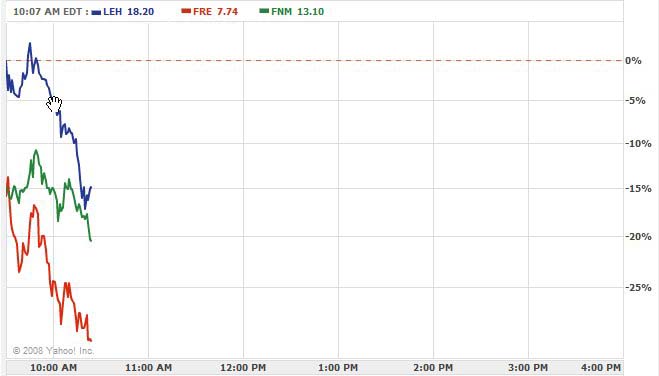
Yikes. And these are companies, sans LEH, that have the implicit backing of the US government?!?
|
|
| | | 513 | nerveclinic
ID: 5047110
Thu, Jul 10, 2008, 14:12
|
Link isn't working Bili.
|
|
| | | 514 | biliruben
ID: 52561217
Thu, Jul 10, 2008, 14:13
|
It's a pic, not a link. Right-click and view image, maybe? Just a graph of freddie, fannie and Lehman dropping like a rock this morning.
|
|
| | | 515 | Boxman
ID: 571114225
Thu, Jul 10, 2008, 19:13
|
The link didn't work earlier but it's fine now.
|
|
| | | 516 | biliruben
ID: 4911361723
Fri, Jul 11, 2008, 10:57
|
Talk of putting Fannie and Freddie in conservatorship. Their stock prices were cut in half again this morning. Former Feddie Poole calls them already insolvent. Very scary. They hold 5 trillion in loans, with very little in the way of cash.
|
|
| | | 517 | nerveclinic
ID: 5047110
Fri, Jul 11, 2008, 11:01
|
Vix slammed up from 25 to 27 at open and has climbed to 28. A nice big sell off today combined with a VIX that breaks through 30 would have me bottom picking.
We are getting lots of nice ingredients, really bad news from Fannie and Freddie, and Iran launching missiles. It's this kind of pessimism and fear that can help form the next bottom. (not that there might not be more retests later.)
We need to see VIX shoot above 30 though.
|
|
| | | 518 | nerveclinic
ID: 5047110
Fri, Jul 11, 2008, 12:06
|
12:05 PM
SP 1233 VIX 29
Not there yet.
|
|
| | | 519 | biliruben
ID: 52561217
Fri, Jul 11, 2008, 12:07
|
I stay away from round numbers, as they are herd-magnets. Pick 29 or 31 instead!
|
|
| | | 520 | nerveclinic
ID: 5047110
Fri, Jul 11, 2008, 13:25
|
Pick 29 or 31 instead!
Of the two I would prefer 31. If you look at the last two market bottoms in Jan and March the Vix actually spiked intra day from below 30 to around 37... that's a lot of fear.
|
|
| | | 522 | boikin
ID: 532592112
Fri, Jul 11, 2008, 13:52
|
Nerve and billi can i ask what your hypothesis is about volitlity index is that you guys are discussing? i have been reading allong and have gotten kind of lost.
|
|
| | | 523 | biliruben
ID: 52561217
Fri, Jul 11, 2008, 13:55
|
It's new to me. I thinking that "high volitility" = fear. The more fear, the greater the buying opportunities. Or something like that.
Am I close, Nerve?
|
|
| | | 524 | boikin
ID: 532592112
Fri, Jul 11, 2008, 15:30
|
Interesting, sounds like you guys are on to something. is there a comparitive of volitility and index graphs anywhere?
|
|
| | | 525 | biliruben
ID: 52561217
Fri, Jul 11, 2008, 17:27
|

|
|
| | | 526 | biliruben
ID: 52561217
Fri, Jul 11, 2008, 17:30
|
Campared to S&P:

|
|
| | | 527 | biliruben
ID: 52561217
Fri, Jul 11, 2008, 17:30
|
Looks like a bit of an inverse correlation.
|
|
| | | 528 | nerveclinic
ID: 5047110
Fri, Jul 11, 2008, 18:38
|
Boiken
Interesting, sounds like you guys are on to something. is there a comparitive of volitility and index graphs anywhere?
It's a pretty commonly followed indicator.
The VIX measures the number of investors buying puts which shows excessive fear and negativity. 30 isn't a magic number. It's more important that the indicator spikes. Theory being if this many people are "protecting" themselves, because they are "in fear", then at least a short term bottom is being placed.
It worked like a charm the last two market bottoms in Jan and March.
If you look at Bili's one year chart of ticker symbol VIX there are 4 "spikes".
The ones in August, Jan and March all marked short term market bottoms to the day. The one in November spiked a little before the actual bottom but close enough to make money.
I used the spikes in Jan and March to go all in.
Please note it's just a short term (weeks) indicator and it doesn't work 100% of the time but it's pretty accurate.
Also note am an amateur so take it all with a grain of salt.
|
|
| | | 529 | Boxman
ID: 571114225
Mon, Jul 14, 2008, 07:36
|
Fannie and Freddie must be in real dire straits (Hey, do the walk on life! - sorry couldn't resist) if they are doing a round of 3 billion in funding. 3 billion is a spit in their ocean and that's all they get out?
|
|
| | | 530 | boikin
ID: 532592112
Mon, Jul 14, 2008, 12:03
|
any thoughts on this article? it written against Obama, but i am more interested in the investor motivation mentioned in it, not who makes a better economic choice for president.
investor motivation
|
|
| | | 531 | Boxman
ID: 337352111
Mon, Jul 14, 2008, 12:30
|
i am more interested in the investor motivation mentioned in it, not who makes a better economic choice for president.
There are ways to make money regardless of whether Obama wins or not. The OMG OMG OMG talk about not being able to make bling bling when Obama wins (Yes I said when.) is defeatist whinery.
The investor motivation for me is that I deliberately primarily buy stocks that pay dividends (There have been and will continue to be exceptions to that for strategic purposes: recently FSLR, IPI, and V.) and that also have a history of increasing those dividend payments. A tax hike on dividends would hurt dividend paying stocks because investors like me may or may not be as likely to put $$$ into dividend paying vehicles.
Depending on the tax rate and the market conditions (i.e. The capital appreciation of the stock.) other investments like treasuries or munis could be looked to some (probably not me) as viable alternatives.
Another thing to consider is that rich people aren't the only ones that own stocks. Now that the pension is going extinct and the gov't limits the 401k to $15,500 per year and the investment choices in that plan usually are pathetic, the stock market is a nice place to put your money.
Raising the dividend and capital gains rates therefore would also be a tax hike on the middle class and aspiring upper class.
|
|
| | |
| | | 533 | biliruben
ID: 52561217
Mon, Jul 14, 2008, 14:50
|

"Cops get their money first."

"Buddy, can you spare a dime?"
|
|
| | | 534 | Boxman
ID: 337352111
Mon, Jul 14, 2008, 14:53
|
If you couldn't see the "IndyMac" sign on the front door you'd swear it was launch day for a videogame or for Beanie Babies.
|
|
| | | 535 | biliruben
ID: 52561217
Mon, Jul 14, 2008, 14:59
|
Is WAMU next? 26 billion in losses.
I'm a WAMU banker. Though I got 90% of my money out already, this is still my primary active checking account, just because it's such a pain to switch banks in this era of auto payments and direct deposit. I'm thinking of setting up a parallel account if I can figure out a way that I could instantly electronically transfer funds from one to the other. Anyone have experience with this? Right now it takes days using bill-pay, and the bank would be kaput before I could get it out.
|
|
| | | 536 | boikin
ID: 532592112
Mon, Jul 14, 2008, 16:09
|
I have had no problem using the paypal bank in transferring money back and forth though it was not huge sums of money.
|
|
| | | 537 | nerveclinic
ID: 5047110
Mon, Jul 14, 2008, 16:23
|
Is WAMU next? 26 billion in losses.
I literally just did a transfer of the balance in my checking account from WAMU to Fidelity. I hope I'm not to late, takes 4 days to transfer...not sure how fast the money exits.
Holding my breath.
|
|
| | | 538 | Boxman
ID: 337352111
Mon, Jul 14, 2008, 16:25
|
Try an e-bank like ING or E*Trade and link your checking to it.
If you're that worried about WaMu there's no shame in switching banks entirely. If that was my bank and I had that level of anxiety over it I would close it out and be done with it.
|
|
| | | 539 | Boxman
ID: 337352111
Mon, Jul 14, 2008, 16:32
|
this is still my primary active checking account, just because it's such a pain to switch banks in this era of auto payments and direct deposit.
What's a bigger pain: switching banks or waiting on FDIC while checks hit your account?
When I had an attempted ID theft on me thru Ebay and PayPal it took me a solid day to switch everything, but it was worth it to me.
|
|
| | | 540 | Boxman
ID: 571114225
Mon, Jul 14, 2008, 18:35
|
Cramer just lost a ton of credibility in my eyes today. He noted this in an article on CNBC.com.
Cramer also rejected the idea of bottom-fishing in this market. Wells Fargo and Washington Mutual might not even make it through this rough period, at least if the 1990 savings-and-loan crisis is an accurate model. In fact, Cramer urged investors to stay away until all the weak banks had gone under.
I'm watching his show and he says do not be surprised if Wells Fargo, JP Morgan and USB scoop up a few of the struggling banks.
Take your meds Cramer! The bipolarity is showing.
|
|
| | | 541 | nerveclinic
ID: 5047110
Tue, Jul 15, 2008, 01:24
|
If you're that worried about WaMu there's no shame in switching banks entirely. If that was my bank and I had that level of anxiety over it I would close it out and be done with it.
I certainly wouldn't feel shame but at the same time there are logistical problems since I live in the Middle East.
Try an e-bank like ING or E*Trade and link your checking to it.
I have Fidelity linked but to Billi's point it takes about 4 days to transfer. I doubt ING or E Trade would be any faster. Plus I am not completely confident in E Trade's solvency.
|
|
| | | 542 | nerveclinic
ID: 5047110
Tue, Jul 15, 2008, 01:28
|
Cramer just lost a ton of credibility in my eyes today....I'm watching his show and...
And why are you watching his show???
|
|
| | | 543 | Boxman
ID: 571114225
Tue, Jul 15, 2008, 06:18
|
And why are you watching his show???
Entertainment value mostly. It beats anything else on at that hour.
He contradicts himself constantly. Per his own contrarian strategy, which he has outlined several times in his books and on his show, he should be buying financials right now and selling ag and oil/gas stocks. You buy when they're beaten down and sell high.
That isn't what he's telling viewers. He always says to go with the "best of breed" in the hot sector.
In one of his books he has a cyclical investing chart that outlines what to buy and sell based on GDP growth levels. I looked it up for this post. Between 1% - 2% GDP levels (which are the estimates I've heard), according to him, people should be buying financials and high PE multiple tech stocks and selling healthcare.
He backs that up on his show whenever he takes a vacation and they run the canned episodes of his investing strategies.
Last week, he dedicated the whole week to which healthcare stocks you should be buying.
He also bashes buy and hold. But his contrarian strategy that is based on GDP growth swings is at least a semi-buy and hold strategy. It takes time for GDP growth to swing significantly. If you purely followed his strategy you wouldn't be holding stocks just for 6 months or even maybe a year.
I'm glad I watch it with a different scope than others. I can just imagine some people following him off a cliff.
|
|
| | | 544 | Pancho Villa
ID: 495272016
Tue, Jul 15, 2008, 12:06
|
Now that the pension is going extinct and the gov't limits the 401k to $15,500 per year and the investment choices in that plan usually are pathetic, the stock market is a nice place to put your money.
The stock market is a nice place to lose a bundle right now, as the S & P is precariously close to 1200 today with very little indication that there will be any kind of major turnaround in the near future.
For those who thought that Bush declaring an end to the off shore drilling moratorium yesterday would have a positive effect on the market(myself included), the fact that we are experiencing another prodigous drop today is very disconcerting.
I think the best hope now is that the markets will stabilize, which doesn't translate into a nice place to put your money, at least not right now.
The S&P was at 1000 in 2003, so annual growth based on that index is now less than 4%, about the same as you can get with a long term CD in today's market, although you could have locked into a much higher rate most anytime before 2008 without the stress and risk.
Boxman appears to have the time to research and buy individual stocks, but few people do, they end up in mutual funds tied to market index.
Last week I liquidated my mutual funds in favor of a 30 year AAA bond paying a guaranteed 6.3% annually.
When the market begins to perform with less volatility, I will move back in at some level, but I don't see that happening before 2009.
|
|
| | | 545 | Boxman
ID: 337352111
Tue, Jul 15, 2008, 13:08
|
The stock market is a nice place to lose a bundle right now, as the S & P is precariously close to 1200 today with very little indication that there will be any kind of major turnaround in the near future.
I won't disagree with that. My POV is that this is where you make money b/c dividend yields on stocks are high now and their value is low. When the market turns around you'll have locked into some companies at nice prices.
Boxman appears to have the time to research and buy individual stocks, but few people do, they end up in mutual funds tied to market index.
Last week I liquidated my mutual funds in favor of a 30 year AAA bond paying a guaranteed 6.3% annually.
There's nothing wrong with that. My only concern is what your after inflation return? I have the time because this is also a "hobby" of mine. Some guys play fantasy sports and collect baseball cards or work on cars, I do this.
|
|
| | | 546 | nerveclinic
ID: 5047110
Tue, Jul 15, 2008, 14:24
|
For those who thought that Bush declaring an end to the off shore drilling moratorium yesterday would have a positive effect on the market(myself included), the fact that we are experiencing another prodigous drop today is very disconcerting.
I think everyone is freaked out about Fannie and Freddie and bank closings to notice Bush's speech..
The S&P was at 1000 in 2003, so annual growth based on that index is now less than 4%, about the same as you can get with a long term CD in today's market, although you could have locked into a much higher rate most anytime before 2008 without the stress and risk.
Pancho you can't pick a 5 year period and say this is the trend. In the late 90's the market was going up close to 25% a year.
I don't blame you for caving at the moment but why 30 year bonds when they are at a cyclical low? If rates start moving up you will lose a portion of your principle if you pull out early to reinvest in stocks later. Unless you plan on holding for 30 years it's not logical.
If rates come down, and they may, can I suggest selling the 30 year bonds (If rates come down you will make money on principle) and instead buy a ladder of 1, 2, 3, 4, 5 year CD's (20% 0f the capital each). If you still are concerned with equities you just keep rolling over as the CD's mature. If rates go up you are cushioned. If you decide the time for stocks is right again it's easy to sell and get out.
If you are that stressing about a 20% loss in the index maybe you shouldn't be investing in stocks.
No one ever said the market goes up in a straight line. Over time it has always dramatically beat bonds though.
|
|
| | | 547 | Boxman
ID: 337352111
Tue, Jul 15, 2008, 14:36
|
I liquidated my mutual funds in favor of a 30 year AAA bond paying a guaranteed 6.3% annually.
What kind of bond? Muni? Corporate?
|
|
| | | 548 | biliruben
ID: 52561217
Tue, Jul 15, 2008, 16:09
|

|
|
| | | 549 | Boxman
ID: 337352111
Tue, Jul 15, 2008, 16:21
|
Think we've hit bottom now that the VIX was over 30?
|
|
| | | 550 | biliruben
ID: 52561217
Tue, Jul 15, 2008, 20:09
|
Bread and f'in circuses
ongressional Democrats are considering a second round of rebates to taxpayers, saying the benefits of the first checks sent to more than 100 million households this year are being eroded by rising energy prices.
``We will be proceeding with another stimulus package, and we once again hope we will work in a bipartisan way,'' House Speaker Nancy Pelosi said after House Democratic leaders met with a group of economists to discuss the spreading housing crisis and rising gas prices.
The answer is not more debt and consumerism.
If you put together a jobs program to rebuild our decaying infrastructure and improve roads and transit around the country, you'd at least get something for your 200 billion other than more Japanese widescreen TVs and I-phones.
Bread and circuses.
Pelosi. What a dick.
|
|
| | | 551 | Boxman
ID: 571114225
Tue, Jul 15, 2008, 20:14
|
She is a dick...and a moron.
The first stimulus as executed was a stupid idea. Invest the money into building alternative energy power plants like solar and wind. Create jobs and boost the economy that way.
|
|
| | | 552 | Pancho Villa
ID: 495272016
Tue, Jul 15, 2008, 20:54
|
#551
Stop the presses. Boxman and I are in full agreement.
In a related story, my $900 stimulus check arrived yesterday. Coincidentally, I'll be in Las Vegas next week at Circus!Circus! where my 83 year old aubt and uncle are playing in a bridge tournament. I'll also be visiting an old friend I haven't seen in 20+ years who I hooked up with thanks in part to post #11 here.
Speaking of "superweed," when I lived on the Big Island I played with Holy Smoke and the Smokettes, the island grower's favorite band. We used to play at the Pahoa Inn in the heart of the Puna District. Now lots of people have heard of Maui Wowie and Kona Gold, but Puna Buddah is far and away the most potent pot grown in the islands.
One night on break, a local grower induced me to take a hit of his private stash - one hit. I can personally attest that after that hit I wreaked havoc on the world of saxophone playing due to a case of cottonmouth that was incureable as well as a complete memory loss as to what notes constitute an eight bar one, four, five blues scale.
I believe that was the last toke I ever took - circa 1981.
Holy Smoke was Jim's band in Hawaii. The past decade or so he's been in Vegas performing as Jimmy Limo.
Not much of a singer, but very smooth on guitar. Some things never change. I plan on kicking his butt in golf in 115 degree heat! Might even throw a few dice while I'm there. Just doing my part for the economy.
|
|
| | | 553 | biliruben
ID: 4911361723
Wed, Jul 16, 2008, 00:17
|
Went to Vegas a few months ago. I took care of the boy during the day, played poker until the wee hours, after my wife got through the with the conference. Up 8 hundy in poker over maybe 20 hours, down 4 hundy in craps in maybe 20 minutes. I loves the dice, but they can be mean.
I actually don't think Pelosi is enough of a dick, but way too much of a moron.
|
|
| | | 554 | nerveclinic
ID: 5047110
Wed, Jul 16, 2008, 02:56
|
Think we've hit bottom now that the VIX was over 30?
As Billi mentioned, 30 is too round a number. The last few bottoms there was a spike in the VIX up to 34, 36. Big jump.
Today it just slipped quietly above 30 and meandered back down. Not the volatility spike I would hope for but a positive step in the right direction.
|
|
| | | 555 | Boxman
ID: 337352111
Wed, Jul 16, 2008, 09:56
|
WFC is encouraging so far today, topped estimates and hiked the dividend by 10%. It's up a little over 3 now I wonder if that'll hold today.
|
|
| | | 556 | nerveclinic
ID: 5047110
Thu, Jul 17, 2008, 10:09
|
I hope everyone noticed that the day after VIX cleared 30 we had at least a 1 day rally in the market.
It's nothing more then a short term indicator but there you go...
|
|
| | | 557 | Boxman
ID: 337352111
Thu, Jul 17, 2008, 10:20
|
WFC not only held over 3 is closed up around 6-2/3.
Interesting fact about Wells Fargo. If you owned the stock on or around May 17th 1989 it closed at 1.36 per share. Their new quarterly dividend annualizes at 1.36. You now have a 100% annual return on your money without factoring in splits (2:1 in 89, 93,97 and 06.) and capital appreciation. Not bad.
|
|
| | | 558 | Boxman
ID: 337352111
Thu, Jul 17, 2008, 13:56
|
Do you guys know any reliable websites that list share buyback plans of companies?
|
|
| | | 559 | nerveclinic
ID: 5047110
Thu, Jul 17, 2008, 17:10
|
130 was the first support level for oil. If it can hold below that tomorrow it's a good start. The second important level is 120, drop below that and hold and the move up in the market could be significant...of course we could be back to 145 tomorrow.
|
|
| | | 560 | nerveclinic
ID: 5047110
Mon, Jul 21, 2008, 10:08
|
Hulbert of Market Watch Poo Pooing the VIX over 30 significance.
link
|
|
| | | 561 | nerveclinic
ID: 5047110
Mon, Jul 21, 2008, 17:53
|
I'm guessing Jobs is very sick based on 1 sentence in conf call.
|
|
| | | 562 | Boxman
ID: 571114225
Mon, Jul 21, 2008, 18:16
|
Watch it drop like a stone in after hours and then shoot up on market open tomorrow if AAPL does adequate damage control.
I heard Jobs wasn't on the call so an analyst asked the magic question about his lack of attendance. The CFO said that Jobs' health is a "private matter".
|
|
| | | 563 | nerveclinic
ID: 5047110
Tue, Jul 22, 2008, 06:31
|
I heard Jobs wasn't on the call so an analyst asked the magic question about his lack of attendance.
Box Jobs hasn't been on conf calls in years. A misguided talking head on CNBC noted his absence and an exec from Apple called in on the air and pointed out that Jobs never attends the conf call. That having been said, after listening to te conference call, I am worried. I'm trying to decide how to react.
Here is what I posted to Motley Fool.
I actually listened to the call, I've listened to the last several calls and I've been long Apple for a year and a half now.
Yes all the positives listed above are encouraging. Yes they always guide lower and then beat.
I noticed a difference this time.
One big glaring concern is they are reducing margins for the remainder of 2008 and 2009 to 30%. This quarter gross margins fell 34.8 percent, down from 36.9 percent a year ago. It's not typical that they guide a 4.8% drop in Margins. That is atypical and is the first thing giving investors pause. No explanation was given for the drop except for a suggestion that it involves new products they can't talk about. Thanks for the help guys...
Lower margins could cause a contraction of PE multiples assuming there isn't a large increase in volume, and they didn't bother filling that part in on the call.
Next Steve Jobs health.
As I mentioned I was listening to the call, I was also hitting the refresh button on the stock price throughout the call. I was shocked by the blunt response concerning Job's health. I almost sold a large portion of shares at that moment knowing the price would go down.
Question from analyst concerning Jobs health is answered as follows... "Steve loves Apple. He serves at the pleasure of the board and has no plans to leave Apple. His health is a private matter."
I mean what kind of an arrogant response is that? After the Mac convention in June they claimed he had a common bug. Now they clam up?
Clearly something is wrong or they would have simply stated otherwise. They have a track record of witholding vital health information going back to Jobs earlier fight with cancer which wasn't reported until well after the fact.
I watched the price tank further immediately after the remark. It went down from there and never recovered. I am absolutely convinced it's at least a good part of why the stock tanked.
If something is wrong, perhaps the company will survive without him, and the future will be bright, etc. Those sentiments obviously will not keep the stock price up and whoever takes over will have to come in and prove it to investors with more then words. So far we don't know anything about a succession plan.
The bluntness of Apple's comments, in contrast to the early remark that he has a "bug" leads me to believe there is likely something seriously wrong with him. I may be wrong, but in the vacuum left by Apple's answer to the question, this kind of speculation is bound to occur.
Looks like the market agrees.
|
|
| | | 564 | Boldwin
ID: 406201020
Tue, Jul 22, 2008, 10:41
|
There is a crying need/oportunity for a real portable computer-phone, not just an I-phone and they are just the ones to fill that need. I find it hard to believe that moonshot expensive development cost isn't the reason for their projections.
To get a full function computer down to Iphone size has got to involve breakthu tech.
|
|
| | | 565 | Boldwin
ID: 406201020
Tue, Jul 22, 2008, 10:49
|
My son has an iphone and as much as I love it It just leaves me waiting and hungry for more functionality. I think they have created a great need and expectation and are moving to fill it.
The worst case senario [other than Jobs with a medical death sentence] would be Apple forsees worthy Iphone competitors entering the pipeline soon.
|
|
| | | 566 | nerveclinic
ID: 5047110
Tue, Jul 22, 2008, 12:03
|
I find it hard to believe that moonshot expensive development cost isn't the reason for their projections.
they have basically no debt and 21 billion in cash stock piled.
I'm relieved the stock stabilized today (so far) but still very nervous. I actually bought shares during the conf call at 155 before the comments about Jobs health. Almost turned around and sold them 10 minutes later.
|
|
| | | 567 | biliruben
ID: 4911361723
Tue, Jul 22, 2008, 12:44
|
There are already Iphone competitors.
|
|
| | | 568 | boikin
ID: 532592112
Tue, Jul 22, 2008, 13:24
|
i think the key word there was "worthy" iphone competitors.
|
|
| | | 569 | biliruben
ID: 52561217
Thu, Jul 24, 2008, 13:17
|

|
|
| | |
| | | 571 | biliruben
ID: 38751812
Thu, Aug 14, 2008, 14:24
|
I think the quants have hijacked my stock.

|
|
| | | 572 | biliruben
ID: 38751812
Thu, Aug 14, 2008, 17:14
|
That's just bizarre. I'm glad I only own a little bit of it, or that volatility would be the death of me. Up 25% for a brief second, then back to the starting point and beyond.
Do you think someone bought a couple million dollars of it by mistake?!?
|
|
| | | 573 | Boxman
ID: 571114225
Fri, Aug 15, 2008, 08:38
|
All hands on deck into AT&T yesterday. That 5% yield was too good to pass up.
|
|
| | | 574 | Boxman
ID: 571114225
Tue, Aug 19, 2008, 07:26
|
We've had some gold gurus post here before. Just curious what the take is on this?
Buying? Selling? Holding?
Savage Bear Market Coming for Gold
The slip in gold, which was joined by fellow precious metals platinum, silver and palladium, dragged it well below its all-time high of just over $1000 an ounce in March.
But that was predicatble, Hendry said.
Bull markets "of this variety, with the potential to trade higher, paradoxically can have these savage, and quite prolonged, bear market components, and I fear that is where we are headed," he said.
The "current markets could take gold as low as $600 or $550 per ounce," he added.
"I have greater comfort being in 10-year bonds than gold for the first time in ages," Hendry said.
How would a gold bear market impact the dollar? (I know we're off the gold standard, but I would think that a decrease in gold leads to lower inflation and a stronger dollar. No data to back that up, just opinion.)
|
|
| | | 575 | biliruben
Leader
ID: 589301110
Tue, Aug 19, 2008, 09:57
|
I think that you may have it backwards. Stronger dollar and lower inflation leads to less need for gold speculation, and you see gold go back down.
|
|
| | | 576 | nerveclinic
Leader
ID: 5047110
Thu, Sep 11, 2008, 07:43
|
Gold is now a bigger bear market then the stock market.
That doesn't mean it will last, just this moment in time.
Gold is now down almost 26% from it's high, while the SP 500 is down 22%.
That's how down markets are measured, peak to current level.
Hats off to Bldg 7 who got into gold very early, but look what has happened to people who jumped on the band wagon at the top. They are down worse then those who invested in the SP 500 at it's top. (At this moment in time anyway)
|
|
| | | 577 | Building 7
ID: 471052128
Thu, Sep 11, 2008, 10:09
|
The gold stocks are down even more than gold. The gold stock (XAU)/ gold ratio is at a 20 year low. It would have to rise 35% just to get the ratio back to historic levels. If you wait for the knife to stop falling, maybe aroung gold = 700. It would be a good time to jump in IMO. I plan on getting some GG calls out about 6 months.
Silver is even worse. Up over $20 per ounce, now $10.45. But , you can't really buy it at that price, due to a current shortage.
|
|
| | | 578 | Boldwin
ID: 34845818
Thu, Sep 11, 2008, 12:02
|
Oil is back to nearly $100 a barrel down from the recent @$150 region. Doesn't that pretty well explain the drop in gold prices?
Then someone explain what it's gonna take to see that per barrel price registering at the pump. By my calculations it should be south of $3 a gallon already.
|
|
| | | 579 | Pancho Villa
ID: 51546319
Mon, Sep 15, 2008, 08:54
|
Today could go down as Black Monday.
Lehman Brothers, Merrill Lynch and AIG all failing to some degree. Does the S&P drop below 1200?
|
|
| | | 580 | walk
ID: 181472714
Mon, Sep 15, 2008, 10:39
|
Lehman is unreal. A bankruptcy. I have a couple of colleagues there, I am trying to help them.
I have a very good friend at ML and an account there as well. I got one friend a job here at my new Euro IB. The synergy between ML and BofA is very strong. Good one there, but another incredible and sudden story (these two firms had negotiated previously though). Reports from the WSJ indicate that over the weekend, when Barclays and BofA bailed on Lehman, and they could not get any gov't help for Lehman or AIG, the focus became to avoid the next big casualty: So ML and BofA held side talks. Just amazing sudden events. A bankruptcy for 158 old Lehman, with 25,000 employees and a storied fixed income desk is unreal.
|
|
| | | 581 | walk
ID: 181472714
Mon, Sep 15, 2008, 10:46
|
Lehman Monday
Interesting blog to follow throughout the day. Here in a large Euro IB, where I am, midtown, halfway b/w Citi, JPM Chase, BofA, and then Wall st., it's just weird seeing these events.
|
|
| | | 582 | The Beezer
Dude
ID: 191202817
Mon, Sep 15, 2008, 17:43
|
I just don't get why BoA went and bought Merrill over the weekend. If they had held off a day, Merrill would have probably sold for around half what they paid. I'd be outraged if I was a shareholder at what BoA paid for Countrywide and Merrill.
|
|
| | | 583 | B7
ID: 174591519
Mon, Sep 15, 2008, 18:43
|
Bank of America is probably bankrupt, also.
|
|
| | | 584 | walk
ID: 22854919
Mon, Sep 15, 2008, 19:25
|
Beezer. That was likely part of the good faith bargaining...these guys are in close circles, and some are more decent than others. Jamie Dimon tried to get Bear for $2 a share -- he was really playing hard ball. I am not sure Ken Lewis is the same way. Plus, Merrill is much bigger than Bear and Thain used to be a very central player. Relationships play a part in these deals.
|
|
| | | 585 | The Beezer
Dude
ID: 191202817
Mon, Sep 15, 2008, 20:52
|
Thanks walk - that's a much more reasonable way of looking at things than what I was thinking.
I was working from home today and ended up leaving it on CNBC all day. Lots of blathering about whether the Fed will cut tomorrow. I just don't see that happening with all the focus the Fed has had on inflation. Of course, with oil falling below $100, perhaps it will be argued that isn't a worry anymore.
|
|
| | | 586 | biliruben
ID: 367402418
Mon, Sep 15, 2008, 20:54
|
Jesus. Fuk.
Out On an island and finally caught a signal.
Jesus fuk.
|
|
| | | 587 | walk
ID: 22854919
Mon, Sep 15, 2008, 22:47
|
Sure thing, Beez. At the end of the day, this is a big win for BofA...they have a well-rounded platform with a large nationwide consumer bank, a big mortgage arm with countrywide a few months back, and a huge and strong wealth management and brokerage arm with Merrill plus their entire investment bank (a BofA weakness). They got Merrill, a huge prize, and Merrill avoided being potentially taken by some private equity firm(s), and completely chewed up and broken apart. So, it's an unfortunate loss for ML ego-wise, but it could have been a lot worse.
I keep a lot of my savings with Merrill. I am not worried. Their entire wealth mgmt exec team will simply move over to BofA. They are even keeping the Merrill brand (strong brand).
JPMC got Bear very cheap, and with gov't assistance. That was a one time deal cos the gov't would have had to bail out Lehman, Merrill and AIG (as it is, they are helping out AIG), and who knows who else. JPMC was shrewd, but they still lack some of what BofA has now,with the brokerage house and nationwide consumer branch system. BofA's wealth mgmt is now even better. Makes me wonder even more about Citi...they fared the worst of the giants.
Crazy times...so sudden the demise of these long-time prestigious institutions. Too much investments in weird securities that could not be accounted for by oversight, which was lacking. I wonder how things will be in 2 years.
|
|
| | | 588 | Building 7
ID: 471052128
Tue, Sep 16, 2008, 09:19
|
Too much investments in weird securities that could not be accounted for by oversight, which was lacking.
Oversight by whom? You don't think they should be responsible for their own actions? And, again, where were the auditors? I have not looked it up, but I presume they received an unqualified audit report for their last annual audit. And less than a year later they are bankrupt. IMO, there is one of three things happening here:
1. The auditors should have recognized problems, and issued a qualified audit.
2. The auditing rules are bad with this mark to market nonsense and allow companies on the verge of bankruptcy to receive good audits.
3. Something happened between the audit and today that caused Lehman Brothers to go bankrupt.
My guess is number 2, or number 1. So, when the auditors audit another financial institution like Bank of America and say....nothing to see here folks, move along. Forgive me, if I don't exactly believe them.
|
|
| | | 589 | Taxman
ID: 3985420
Tue, Sep 16, 2008, 15:01
|
B-7
Holding a CPA ticket (also an attny) I whole heartedly agree with 1 & 2 above. I had hoped that Arthur Andersen (see Enron, Waste Management, Sunbeam and WorldCom for examples of companies filing bankruptcy within year of receiving unqualified opinions) had done for CPA's what Richard Nixon did for attnys. But the truth of the matter is that the large corporations "OWN" the external auditors (accounting firms), just as the own the congress and president of the United States (the ugly side of capitalism).
Use to be an attny joke re the answer to the question "How much is 2 + 2?" .."How much would you like it to be". Now applicable to CPA's as well, if not more so.
Mark to Market in my limited understanding of today's accounting has no reference to either historical cost (the cornerstone of accounting principlals) nor is there a provision (Reserve) for loss reflected in either BS or P&L. If I had any money, I'm thinking backyard and shovel!
see page 76 (pg 45 in Adobe Reader) for Earnst & Young "Unqualified Opinion"
If you are unsure about what an Unquailified Opiniom by the outside auditor means..see Analyzing the Auditor’s Statement: An Unqualified Opinion
|
|
| | | 590 | Building 7
ID: 174591519
Tue, Sep 16, 2008, 21:51
|
Yes, Taxman I am also an accountant. Although they don't use that title anymore where I work. I remember our Auditing 460 class. We spent a week or two going over the wording of an unqualified opinion word by word. And other opinions. Exciting stuff. Anyways, it is not pratical for individual shareholders to go look at the company's books. So, the auditors are entrusted to do it for them. They are failing miserably IMO. I'm embarrassed for my trade. And they are supposed to be among the best of our trade. I spit on their wingtips. They are probably still making more from "consulting work" for the company than they get paid for the audit. A conflict of interest that was supposed to go away after Enron. If Lehman Bros is bankrupt today. they were bankrupt on November 30, 2007 also, or else near bankrupt.
I'm surprised they let LB go bankrupt because now they will have to assign a value to their derivatives. 20 cents or 50 cents on the dollar. Whatever it is, it will screw up the mark to market scam they have going by assigning low market values to derivatives. It makes it tough to invest if you don't know if the company is really bankrupt or not. Who is going to do the work LB did for 100+ years. Is it going to go away? From the link above: $19 Billion in net revenues last year. $669 Billion in liabilities up from $484 Billion the year before. That doesn't sound good. Some other company is going to have a windfall if LB disappears.
|
|
| | | 591 | Perm Dude
ID: 3825168
Tue, Sep 16, 2008, 23:52
|
A John Stossel column from April which shows what an idiot he really is.
|
|
| | |
| | | 593 | Taxman
ID: 3985420
Wed, Sep 17, 2008, 00:13
|
and tell me how AIG deal announced in PD's post 591 is not a bailout??
|
|
| | | 594 | nerveclinic
Leader
ID: 5047110
Wed, Sep 17, 2008, 02:20
|
Post 588 leaves out a 4th possibility.
Sort of the opposite of 2. The auditing rules are bad with this mark to market nonsense and allow companies on the verge of bankruptcy to receive good audits.
It's possible the accountants are being so harsh, so conservative with the mark to market, they are speeding up the demise of some of these companies.
A lot of the marks to market are assuming the worst at this point. (The Biliburn equation, everything is worthless)
If your paper held is devalued enough, it could bankrupt you on paper even though we don't know yet how many people are actually going to walk away from their mortgage obligations in the end.
So the government gives this huge loan to AIG at an interest rate of libor plus 8.5%. They also take over 80% of the equity in the company.
While there are liquidity problems with AIG, they still have many areas of profitable business and the US government gets all of it if AIG defaults on the loan.
Of course when did the government go into the insurance business? I believe this is called socialism.
If the mortgage paper turns out to be better then the worst case scenario, the tax payer could make good money on this deal as they did with the Chrysler bailout.
Everyone is assuming apocalyptic levels of foreclosure and those marks are all baked into these various deals for the government.
So are the companies failing because the accountants were too lenient? Or because they are so strict?
|
|
| | | 595 | walk
ID: 6845166
Wed, Sep 17, 2008, 06:22
|
AIG is a bailout.
Barclay's just bought Lehman's IB for less than $2Bn. Amazing. Will come out to about what JPMC paid for Bear Stearns...Barclays' has been trying hard to get a presence on wall street, and now they have it. This will also save about 10k jobs. Better than nuthin'.
Tax: Oversight by regulators.
|
|
| | |
| | | 597 | Building 7
ID: 471052128
Wed, Sep 17, 2008, 09:20
|
When you have bankruptable items that are not on your balance sheet or income statement, the accounting rules are bad. This defies the basic tenets of accounting IMO.
So are the companies failing because the accountants were too lenient? Or because they are so strict?
Nerveclinic Ph.D. , you're an investor....which would you prefer?
|
|
| | | 598 | nerveclinic
Leader
ID: 5047110
Wed, Sep 17, 2008, 10:17
|
Nerveclinic Ph.D. , you're an investor....which would you prefer?
I'd like the marks to be reasonable. If I owned stock in one of these financials (Haven't owned a financial since a year ago August) I wouldn't want my investment to go down the drain because of extreme accounting practices that later turned out to be too conservative.
Maybe the marks are accurate, but that seems open to debate.
|
|
| | | 599 | nerveclinic
Leader
ID: 5047110
Wed, Sep 17, 2008, 10:18
|
VIX going over 30 for the third day in a row...can you say panic?
|
|
| | | 600 | Boldwin
ID: 9820164
Wed, Sep 17, 2008, 10:52
|
Of course when did the government go into the insurance business? I believe this is called socialism. - Nerve
Good point. Nothing to say it couldn't be privatized once it is stabilized. It would make a great conservative running point if the government doesn't.
|
|
| | | 601 | boikin
ID: 532592112
Wed, Sep 17, 2008, 11:11
|
Re:596 good read, i think it hints at the right idea in long run you need to let them fail. this reminds me of arguement they have been making about today children being to soft because they are never allowed to fail...Maybe short term the economy would be in bad shape but if you let a few of these giants fall and let the stock holders have there way with the ceos that led the companies there. In the long run things will be much better. If a lord failed to protect his lands he would end up being beheaded by a neighboring lord and his lands dispersed. He know this risk and he took it. If he did not like the risk he went into the clergy.
|
|
| | | 602 | Boldwin
ID: 9820164
Wed, Sep 17, 2008, 12:55
|
If it falls, quick, start looking for Jamie Gorelick, Mistress of DisasterThe result: shortly before 9/11, Gorelick's wall "specifically impeded the investigation into Zacarias Moussaoui", the so-called "20th hijacker."
At the time, an enraged FBI investigator wrote a memo to headquarters which included the sentence, 'Whatever has happened to this -- someday someone will die -- and wall or not -- the public will not understand why we were not more effective..."
The 2004 disclosure that Gorelick's service as a 9/11 Commissioner was the archetypical conflict-of-interest should have triggered a cacophony of complaints and demands for a new investigation. Instead, the mainstream media turned deaf and dumb and the controversy faded into the background.
Gorelick's "wall" wrapped a blindfold around America just when it needed its vision to stop the attacks that killed thousands and which sucked a half a trillion dollars out of the economy.
Where did Gorelick turn up next?
Though she had no training or experience in finance, Gorelick was appointed the Vice Chairman of Fannie Mae and served in the role from 1997 to 2003. During that six-year period, she earned over $26 million.
During Gorelick's tenure, FNMA suffered a $10 billion accounting scandal, an ominous harbinger of the firm's looming troubles. One of the falsified transactions helped FNMA hit earnings targets for 1998, which triggered bonuses for top executives including nearly $800,000 to Gorelick.
Put simply "Jamie Gorelick was one of the Fannie executives who benefited from inflated bonuses based on Enron-style accounting."
In 2002 Business Week interviewed Gorelick concerning the health of FNMA. She responded, "We believe we are managed safely. We are very pleased that Moody's gave us an A-minus in the area of bank financial strength -- without a reference to the government in any way. Fannie Mae is among the handful of top-quality institutions."
Less than a year later regulators "accused Fannie Mae of improper accounting to the tune of $9 billion in unrecorded losses."
Today, of course, FNMA is on taxpayer-funded life support, currently trading at 61 cents a share. And because it was thought to have been "managed safely" (Gorelick's words), many top-flight financial services companies held its stock.
Last week it was revealed that top insurer AIG was teetering on the precipice of disaster because, in part, it held $600 million in Fannie and Freddie. Roughly $4 billion in those stocks are held by insurers, according to rating agency A.M. Best.
In 1999 Fannie Mae announced that it would purchase $10B in CRA loans. In 2001 they reached that target as Ms. Gorelick announced that they would roll these into special security issues...
Yep, you guessed it. Gorelick also had a direct hand in the mortgage securitization debacle. I'm guessing we could link her to a few other catastrophes if we did the legwork. Where was she when the Hindenberg below up, for instance?
She is currently a law partner in the Washington office of WilmerHale and a non-executive director of the oilfield services provider Schlumberger Ltd. Good thing she is finally safely tucked away in a non-critical part of the economy like oil.
Investors, your headsup...find out what the heck she's doin at Schlumberger and invest accordingly...let me tweak that, consider selling short accordingly.
|
|
| | |
| | | 604 | walk
ID: 6845166
Wed, Sep 17, 2008, 21:23
|
Morgan Stanley and Wachovia may now merge.
link
|
|
| | | 605 | Building 7
ID: 174591519
Wed, Sep 17, 2008, 22:13
|
Good for them. Instead of two stocks going to < $1.00, we'll only have one. It's like rearranging the deck chairs on the Titanic.
|
|
| | |
| | | 607 | Boldwin
ID: 9820164
Thu, Sep 18, 2008, 19:24
|
Beware of touts.
|
|
| | | 608 | biliruben
Leader
ID: 589301110
Fri, Sep 19, 2008, 10:48
|
.GOV has apparently given up all pretense. Bailout everybody. Well, everybody who is, or was, rich.
You think printing a trillion to bail out the richie-riches might be inflationary.
|
|
| | | 609 | The Beezer
ID: 31756616
Fri, Sep 19, 2008, 11:03
|
Yeah, I'm pretty thoroughly disgusted. I thought we were making progress at the start of the week with Lehman being allowed to go to Chapter 11. Now I think we've blown past risking the stock market, the national economy, and the global economy and gone straight to putting the very solvency of the U.S. on the line.
It seems like people are still under the impression that if we just pull the right lever, we can somehow get out from this without anyone getting badly hurt. Well, that's just not possible. We've spent far beyond our means and we're trying to borrow more to pay back what we owe. At some point, things have to come back into balance and all we're doing is making the eventual snapback worse and worse.
|
|
| | | 610 | boikin
ID: 532592112
Fri, Sep 19, 2008, 11:06
|
It looks like there is only one way out of the this mess....A War and big one.
|
|
| | | 611 | biliruben
Leader
ID: 589301110
Fri, Sep 19, 2008, 12:26
|
This is simply a massive transfer of wealth from those without any substantial wealth and assets (stocks and homes), both present and far into the future, to those with substantial current wealth and assets.
Ain't socialism grand. Twisted reverse socialism, but socialism none-the-less.
I'm listening for the howls from the free-marketeers, but all I hear is cheers as their portfolios are buoyed. Hmmmm...
|
|
| | | 612 | The Beezer
ID: 31756616
Fri, Sep 19, 2008, 12:40
|
They're not even trying to give the appearance that they are taking action against those that profited enormously on the runup from these products. Where are the arrests? Where are the massive fines? Where are the revocations of charters of incorporation? I've heard more about investigations of gas stations raising prices by $0.50/gallon that of those that screwed over the entire country. I'm really upset about this!
|
|
| | | 613 | boikin
ID: 532592112
Fri, Sep 19, 2008, 12:40
|
This is simply a massive transfer of wealth from those without any substantial wealth and assets (stocks and homes), both present and far into the future, to those with substantial current wealth and assets
I think that is about right, I think the biggest problem i with whole thing is that we are going to give real assets to companies in exchange for paper assets. we might as well as given them a license to print money.
|
|
| | | 614 | nerveclinic
Leader
ID: 5047110
Sat, Sep 20, 2008, 04:08
|
I'm listening for the howls from the free-marketeers, but all I hear is cheers as their portfolios are buoyed. Hmmmm...
There's plenty of howling. I've seen the opposite. Maybe you are listening to the wrong free marketers.
I am a free marketer. I was much longer then I should have been given all I know. My portfolio went up close to 10% the past 2 days and I am angry, bitter and sad.
Anyone who was smart this week, either sitting on cash or shorting got burned badly and it's not right. People who made the wrong risk play are being rewarded
If you were legally (Not naked) short financials this week, you just got screwed by your government.
Shorting is part of the game and it is legal as long as shares are borrowed. Then the rules were changed in the middle of the night without warning.
It's like your at a casino playing black jack. Your hand is a 20, the dealer is showing a 2. You hold and then the dealer says, by the way, I am changing the rules, were are playing 22 now not 21.
That's what happened and it's wrong.
If it's your impression all the free marketers are happy about this you need to read some new sources. Try Minyanvile. Plenty of pissed of people over there.
The word socialism is being thrown around all over the place.
|
|
| | | 615 | biliruben
Leader
ID: 589301110
Sat, Sep 20, 2008, 09:08
|
Good. Of course, those are the bears. They complain about everything.
Somewhere up above, when Bernanke did a sneak 50 pt cut, I recall you telling me to stop whining and that the Fed actions were part of the game, or something to that effect. How is this different other than scale?
|
|
| | | 616 | Boldwin
ID: 9820164
Sat, Sep 20, 2008, 11:15
|
Musical chairs only with the new rule that the power elite get first choice of seats when music stops.
Great for pulling campaign contributions which makes the wheels go round.
|
|
| | | 617 | The Beezer
Dude
ID: 191202817
Sat, Sep 20, 2008, 11:34
|
Nerve 614: People who made the wrong risk play are being rewarded
Exactly right nerve.
I have a fixed rate mortgage and I'm sitting in CDs and cash outside of my 401(k) because I have a very low tolerance for risk. I guess I'm just a sucker that has to pony up because too many people thinks it's their God-given right to make 10+% on their money no matter what.
Shame on me for thinking that personal responsibility still mattered. Shame on me for thinking that taking risk sometimes means that you don't come out ahead. Shame on me for thinking that we would hold those responsible for this mess at a government, business, and individual level accountable for their actions.
But you know what? That's ok because people think that we'll do this and everything will be all right afterward. But that's not true at all, is it? I think it's clearer now than it ever has been that we need to prepare for some very dark times ahead, because when we finally end up paying for all this, it's going to be brutal.
|
|
| | | 618 | nerveclinic
Leader
ID: 5047110
Sun, Sep 21, 2008, 04:27
|
Somewhere up above, when Bernanke did a sneak 50 pt cut, I recall you telling me to stop whining and that the Fed actions were part of the game, or something to that effect. How is this different other than scale?
Absolutely incorrect analogy and I stand by my original post above.
The Fed is part of the system as everyone playing the game understands it. Part of the game, and everyone knows it, is inter-meeting cuts during emergencies.
It's so easy to understand, that for the most part (Accept for last week) the fed futures predictors do an excellent job guessing at rate changes.
The Fed's well known and transparent mandate is to A) Aid growth (Particularly as it relates to employment concerns. 2) Control inflation (And right or wrong they have been transparent for years to specify the core inflation not headline inflation rate.)
We know this so we can use predictive factors as a component of our investing strategy.
My point early was that you shouldn't be surprised by the rate cut given the huge threats to growth at the time and right or wrong the fact we are in an election year. Most people were surprised they didn't cut earlier, and given the severity of the economic conditions it still looks like the correct move in most economists opinions I hear interviewed on Bloomberg.
Having a meeting after market close and completely changing the rules of the game to outlaw shorting and announcing you are bailing out the housing market screwed people who made the right bet.
The only caveat is that perhaps the shorts, in this environment and in an election cycle should have anticipated drastic action as part of their investment strategy.
|
|
| | | 619 | nerveclinic
Leader
ID: 5047110
Sun, Sep 21, 2008, 04:57
|
This is simply a massive transfer of wealth from those without any substantial wealth and assets (stocks and homes), both present and far into the future, to those with substantial current wealth and assets.
While some of these comments may be a bit true, once again you are stating your thesis to fit your political agenda.
Who gets helped by these moves:
1) Anyone involved with the banks, home builders and financial institutes that are saved by this action including their stock holders (assuming the stocks hold up long term.)
2) People who were long the market. Although it remains to be seen if the rally holds long term or if it is a knee jerk reaction and short covering. I am seeing way too much optimism.
3) People who bought houses that never should have in the first place. (This is really shameful)
Who gets hurt:
1) Anyone who pays taxes.
2) Anyone who bought a house legitimately and is now bailing out their neighbor who acted irresponsibly.
3) People either short the market or on the sidelines.
Now let's examine your premise concerning who will suffer.
This is simply a massive transfer of wealth from those without any substantial wealth and assets (stocks and homes), both present and far into the future, to those with substantial current wealth and assets.
How will we transfer wealth away from people without stocks and homes? The only way this will happen is through increased tax rates. (Unless I misunderstand your point)
People who are poor or very low income already pay much lower taxes (if any) then the home owning middle class and above.
It's unlikely that any taxes raised will have a disproportionate weighting on them, more then likely new taxes will be raised on the middle class and particularly the wealthy.
So it's more accurate to say that the "responsible" wealthy and middle class will be transferring their wealth to the "irresponsible" wealthy and middle class...bankers, home owners that shouldn't be and people who were particularly long financials.
The other group getting hurt are the stock investors who acted responsibly and sat on the sidelines last week as well as people shorting.
As far as this helping stock holders in general I think the jury is out. There was a lot of short covering Thursday and Friday. The economic problems haven't all gone away. It remains to be seen if these actions really do help the overall market long term.
Also remember for every person buying a stock, there is a person selling a stock. The people who sold before these actions will be substantially more economically impacted then the "little guy" who owns no stock or house.
Do you really think the poor are going to be dramatically taxed to pay for this?
Maybe some in a less direct tax... less welfare, less social security, less medicare plug in any government program that helps the less well off there will be less money for these as we pay off the bills for this bail out.
Ultimately it is first the rich, then the upper middle class and finally the middle class who will pay for this bail out because they pay the bulk of the taxes and it is the tax bill that will transfer the wealth.
|
|
| | | 620 | Boldwin
ID: 9820164
Sun, Sep 21, 2008, 07:26
|
Remarkable how much the eyesight clears up when we take off the class warfare goggles.
|
|
| | |
| | | 622 | biliruben
Leader
ID: 589301110
Sun, Sep 21, 2008, 11:17
|
You are way too stock market-centric, Nerve.
This hurts everyone with a job, because the dollar they get paid is being diluted when you go print another trillion dollars. A vast pay cut.
It hurts everyone who pays taxes now and probably for the next 100 years, because that's how long we will be paying this off.
This hurts anyone who relies on the government infrastructure, such as roads, transit, parks, military etc..., because instead of spending our money on these things, we will be buying up crappy MBSs.
I submit this will not help distressed homeowners, though this remains to be seen. I just don't see how this is going to stem the decline in home prices and the increase in foreclosures. If you do, tell me how it will happen.
We all pay for this, but only the rich benefit.
|
|
| | | 623 | nerveclinic
Leader
ID: 5047110
Sun, Sep 21, 2008, 15:52
|
You are way too stock market-centric, Nerve.
Bili you're the one who used the stock market as the scale...those not in it would be most hurt.
The more taxes you pay, the more you will be hurt.
The big question is "how much will the government pay for this bad paper?" That still hasn't been spelled out. So far with all the bail outs the entity being bailed has been racked over the coals by the government. The losses will be lower to the tax payer as long as that continues.
The document that Paulson sent to congress today doesn't give any of the details on cents to the dollar for bad paper. If we acquire the paper at severly stressed prices it could dramatically limit the losses. Hopefully congress will take a hard look at that but I'm not holding my breath.
AIG has to pay back the loan at 11.5% or we take over the company. That's not bad terms at all for the tax payer.
There are actually economists out there saying there is money for the taxpayer to be made in this if the government plays their cards right.
We made money on Chrysler. We made money on the first RTC.
Let's hope the losses are contained with tough deals for this paper.
|
|
| | | 624 | nerveclinic
Leader
ID: 5047110
Sun, Sep 21, 2008, 16:11
|
PD post 621
Who is this guy?
But the more I look at this plan, the more wrongheaded it seems. But if I'm understanding this deal, the taxpayers are going to pony up close to a trillion dollars to take bad debts off the hands of financial institutions who were foolish enough to make the deals in the first place. And in exchange, I think the tax payers get nothing?
Um how could he be "understanding this deal" since the deal hasn't even been spelled out yet. Even the proposal just released to congress today doesn't spell out the terms.
There's no F'ing way the tax payer is "getting nothing"
The key will be the terms negotiated for the paper.
If we pay 100 cents on the dollar we are screwed.
ML sold their paper for .22 cents on the dollar, and managed to sell it, under highly stressed circumstances. That means the buyer felt he/she was getting a deal at .22 cents on the dollar.
We aren't giving a trillion dollars for nothing. We are buying subprime and alt A mortgages. The homes have value even if the properties are foreclosed on. So for Josh to say we are "getting nothing" shows a complete lack of understanding.
The key metric to watch is what we pay for the paper. If Paulson gives 100 cents to the dollar grab your ankles. If he gives 50% things start looking better. The key is the numbers.
Josh It was just a matter of selling them off. But here the point is to take these bad debts off these companies' hands so they can go back to being profitable businesses. This is moral hazard on steroids if I'm understanding this right.
Again we don't know the terms yet Josh.
Oh and I am posting as I read through this and low and behold someone explained to Josh exactly what I just said...
from Joshes post...Late Update: Mulling this more and listening to the insights in your emails, the key clearly is how much the government pays for these distressed assets. They may be bad debts. But that doesn't mean they have no value at all. Bought at the right prices and given time on the books -- which the government is uniquely in a position to allow them to do -- the government could even turn a profit on some of them. But the key is at what price they're bought and whose get bought.
Jeez I could have written that for Josh.
Do you get the idea the average Amerian has no clue what's going on?
Let's hope congress does...but what are the odds of that?
It's an ex Goldman Saks Chairman vs the Sheep.
|
|
| | | 625 | Perm Dude
ID: 37823219
Sun, Sep 21, 2008, 20:06
|
Let's hope congress does...but what are the odds of that?
Why would you think that an Administration which withholds information as a matter of course will give Congress any good information?
We don't know all the details of the deal (mostly because it is still being written), but we do know that the deal will take the bad debt from these companies in exchange for some money. The Treasury Sec was on Meet the Press this morning, pumping up this deal as needing to be done "right now" to prevent "the alternative." An alternative that was never spoken of, but (given the way this Administration works) we can presume involved nuclear or biological weapons in the hands of a Middle Eastern dictator.
Oh, and don't forget this nugget:
Decisions by the Secretary pursuant to the authority of this Act are non-reviewable and committed to agency discretion, and may not be reviewed by any court of law or any administrative agency.
Why should the federal government own the world's largest insurance company? This is all coming from a group of people who say that the federal government shouldn't be in the health care business (despite "the alternative" that we are already witnessing).
What we're hearing is that the government should pony up hundreds of billions of dollars to take bad debt off companies who willingly took it all on, because "the alternative" would be for those companies to face the risk. A recipe for more regulation couldn't be more clear if, indeed, the situation is as dire as is being painted.
|
|
| | | 626 | biliruben
Leader
ID: 589301110
Sun, Sep 21, 2008, 20:49
|
We did not make money on the first RTC, we lost more than a 100 billion.
Nobody can say how much the taxpayers will be on the hook for, but I have little doubt it will be the max. Nobody can say because it all depends on how much farther house prices fall. My guess is that they will fall another 10-20%, which means that on average, no mortgage holder will have any equity. None at all. Foreclosure city.
The reverse dutch auction is a horrendous idea. It won't get at the true value of the toxic waste, all it will do is make sure the taxpayer owns the worst, worthless portion first, then the next worst, mostly worthless stuff, then the next, etc...
The problem is that if we pay them what it's really worth, almost all the financial institutions will go bankrupt. That includes Citibank and WAMU I would guess. So the taxpayer is basically giving a trillion to morons who don't know how to run a business sensibly, and getting nothing in return but inflation, higher taxes and no money to spend on things we need.
My idea:
Toss the trillion and a massive infrastructure rebuilding program to get the construction workers back to work and paying their mortgages.
Hire all the back-office finance and mortgage wonks that lost their jobs to start actually trying to figure out what is in all these toxic securities and see if they are worth anything.
Hire the out of work Realtors to pump gas in Jersey.
Problem solved and you get the money to where it is both deserved and needed.
|
|
| | | 627 | Building 7
ID: 174591519
Sun, Sep 21, 2008, 20:54
|
I say let them go bankrupt. These are the same clowns that were saying everything was fine a month ago. Now it's the end of life as we know it. No loan will ever be made again in the USA unless this $700 Billion bailout is passed. A couple years ago these companies were making lots of money on fees to loan people money that couldn't pay it back. Did they offer to share any with me? No. Go away. IMO bankruptcy is a good thing. It's a necessary part of the capitalist system to rid the economy of malinvestments. Also as an incentive to not do something stupid or invest in something you do not understand. This bailout will also penalize gold and silver investors who could see this coming. Their day will come, though.
How about $699 Billion for the bailout and $1 Billion reward to capture Bin Laden dead or alive. So, if he's in a grave somewhere....you can dig him up, bring him in, and collect the cash.
|
|
| | | 628 | nerveclinic
Leader
ID: 5047110
Mon, Sep 22, 2008, 03:10
|
We did not make money on the first RTC, we lost more than a 100 billion.
Yeah you are right. 121 Billion.
I know I heard someone claim this weekend we had made money. Perhaps I didn't hear correctly.
|
|
| | | 629 | nerveclinic
Leader
ID: 5047110
Mon, Sep 22, 2008, 03:12
|
wow this is big...from NY Times.
The Federal Reserve, in an attempt to prevent the crisis on Wall Street from infecting its two premier institutions, took the extraordinary measure on Sunday night of agreeing to convert investment banks Morgan Stanley and Goldman Sachs Group Inc. into traditional bank holding companies.
|
|
| | | 630 | nerveclinic
Leader
ID: 5047110
Mon, Sep 22, 2008, 06:32
|
Concerning post 628, I suppose the economist being interviewed may have meant something different. Say the bad paper for the first RTC was 400 bil and we lost in the end 121 bil.
I guess he might of meant not all the paper was worthless...we made some of the money back on some of it.
|
|
| | | 631 | The Beezer
ID: 31756616
Mon, Sep 22, 2008, 06:56
|
The version of the bill I saw is unquestionably illegal. How can you have a provision in a bill saying that it is not reviewable by any court? I think the Supreme Court may differ with that view.
As stated above, the key question is how much will the SecTreas pay for the paper bought. It's not like they couldn't sell this paper, it's just they don't want to sell it for the price people with money want to pay. They don't want to sell it for that price because they'll then have a market price that everyone else will have to use, and that would mean just about everyone holding some of this paper would be insolvent. Thus, this will not help banks unless the government pays above the true value of these securities.
If the government were to start buying these next week, they would certainly almost overpay because every "official" estimate of the direction and impact of housing prices has been optimistic. Since nearly all of the Alt-A and Option ARM losses are still ahead, the value of these securities will continue to decline.
|
|
| | | 632 | Pancho Villa
ID: 51546319
Mon, Sep 22, 2008, 10:41
|
Japan to the rescue?
TOKYO (Dow Jones)--Japan's Mitsubishi UFJ Financial Group Inc. said Monday it will spend a maximum of $8.4 billion (Y900 billion) to buy a stake of between 10% and 20% in Morgan Stanley (MWD).
The deal was announced by the Japanese mega-bank at a press conference in Tokyo. MUFG said that its final stake size will depend on due diligence and an assessment of Morgan Stanley's book value.
It said it is seeking to establish a strategic partnership with Morgan Stanley and will consider dispatching at least one director to sit on the U.S. bank's board.
Along with Goldman Sachs Group Inc. (GS), Morgan Stanley is one of only two U.S. investment banks left standing independently in the wake of the credit crunch that has savaged the U.S. financial sector. The U.S. Federal Reserve agreed Monday to convert the two investment banks into traditional bank holding companies.
MUFG's investment marks the second significant investment by a Japanese company in a U.S. investment bank. Earlier Monday Nomura Holdings Inc. (8604.TO), Japan's largest brokerage house, agreed to pay $225 million for the Asian operations of failed Wall Street firm Lehman Brothers Holding Inc. (LEH), people familiar with the matter said.
To seal two such deals on the same day marks an important step in the rehabilitation of Japanese banks as a major force in international finance, having struggled for years under the weight of their own problem loans. Both MUFG and Nomura have expressed interest to build a global presence and had been looking at overseas opportunities in recent months.
Morgan Stanley was earlier in talks with U.S. bank Wachovia Corp. and China Investment Corp., China's sovereign wealth fund, which already holds a 9.9% in the Wall Street bank. But further investment by the CIC, which signaled over the weekend that it wouldn't buy another stake in Morgan Stanley, would be subject to lengthy regulatory approvals in both countries and could trigger political opposition in the U.S.
|
|
| | | 633 | boikin
ID: 532592112
Mon, Sep 22, 2008, 11:22
|
Can someone give me a reasonable expectation on what would happen if the government does not bail out the banks? It does not seem that it can be nearly as bad as they are claiming.
|
|
| | | 634 | Perm Dude
ID: 49822228
Mon, Sep 22, 2008, 11:55
|
These companies (which now include two foreign banks--why US taxpayers should take the bad debt of foreign banks I don't know. Oh wait, I do know--Phil Gramm is Vice-Chairman of UBS), want the government to pay them "fair market rates" for the debt, which is itself a scam. It isn't like there aren't buyers for the debt. What those banks want is more money than is being offered, and so they look to the government.
The US Treasury: The sucker of last resort.
|
|
| | | 635 | nerveclinic
Leader
ID: 5047110
Mon, Sep 22, 2008, 13:05
|
Boikin Can someone give me a reasonable expectation on what would happen if the government does not bail out the banks? It does not seem that it can be nearly as bad as they are claiming.
One of the biggest reasons being given is that there are so many external problems it would trigger. All these institutions have deals tied up with other institutions (Who are also in rough shape). Each time one goes bankrupt it effects all the others and threatens their solvency.
AIG on another level had myriad problems with external tie ups because of it's diverse business including insurance. Here just one small example: AIG insures 90% of the airplanes in the world. so if AIG goes bankrupt, what does that mean to those who are insured by them? That is just one of many side problems.
I'm not mentioning any of this to justify any action taken, I am just giving examples of what has been discussed.
|
|
| | | 636 | Myboyjack
Dude
ID: 014826271
Mon, Sep 22, 2008, 13:08
|
About right, a little more blood letting might have gotten this point across to maybe 10% of the population.
In the sudden rush to blame the crooks in DC and on Wall Street, we should first take a long look in the mirror. For two decades, we — as in we Americans — expected to buy homes, flip them, and walk away with thousands — without much thought about what might happen to the johnny-come-lately at the bottom of the pyramid when the game was finally up and housing prices cooled or crashed. Walking away from a mortgage on a house with negative equity was "smart;" putting someone in one who had no ability to come up with a down payment, monthly payments, taxes, and maintenance was "fair"; borrowing unduly against equity for cash expenditures was "understandable."
We deified the masters of hedge funds, derivatives, and subprime mortgages, forgetting that passé oil production, mining, farming, manufacturing, engineering and construction were the real sources of our material wealth.
We assumed mega-returns on our portfolios, without a thought what Wall Street did to get them, or the effect on others who needed to borrow at such high interest to run their businessess.
Ours became a culture that wanted larger cars but less drilling to fuel them, more stuff and more credit from — and more anger at — the Chinese; less taxes but even more government hand-outs; ever more electricity, but fewer icky coal and nuclear plants — and always more health-care, education-care, prescription drug-care, housing-care, and always less care how to pay for it.
So by all means let us prosecute the lawbreakers, finger-point at the enablers, lecture the stupid, but at least spare us the sanctimonious "they" did this to poor "us." If there were not a Senate Banking Chairman like Chris Dodd without shame cozing up to the creeps at Freddie Mac and Fannie Mae, or a Richard Fuld playing casino roulette with someone else's money, we would have had to invent them.
We should argue over the course of Paulson's unpleasant chemotherapy to deal with these symptoms of a metastasizing disease, but let us at least consider what were the catalysts for that deeper cancer.
|
|
| | | 637 | Boldwin
ID: 9820164
Mon, Sep 22, 2008, 14:16
|
The problem exploded when the ability of people to get liar loans got built into the price of homes. After that what choice did the most responsible of common men have but to sit the bubble out and rent? We are going to call everyone else guilty and irresponsible?
Then the problem got exacerbated when banks found they could so easily shift the risk to other investors and banks could immediately go out and commit the same mistake again.
I am far from a booster of red tape and regulation but you can't just allow everyone to keep a great big phony bubble on the books as a justification to do more of the same.
|
|
| | | 638 | DWetzel at library
ID: 168332212
Mon, Sep 22, 2008, 14:26
|
Here's the problem: so now the governement basically owns a bunch of mortgage paper that isn't worth the face value. And they're going to sell it to whoever they can that will come up with the most cash.
Who's that going to be? The same investment banks that they bought it from, for the most part. So they're going to be holding the same crappy mortgages, only the government will have basically given them free money in the process.
|
|
| | | 639 | Perm Dude
ID: 49822228
Mon, Sep 22, 2008, 14:29
|
I do think, of all those responsible, those people who obtained loans that they shouldn't have, by and large, paid the price: homes foreclosed, credit trashed, a lot of money spent that shouldn't have been.
The people who haven't paid any price are those at the top of the heap who we're thinking about bailing out.
|
|
| | | 640 | boikin
ID: 532592112
Mon, Sep 22, 2008, 14:54
|
One of the biggest reasons being given is that there are so many external problems it would trigger. All these institutions have deals tied up with other institutions (Who are also in rough shape). Each time one goes bankrupt it effects all the others and threatens their solvency.
I guess my question is what changed between yesterday and today or last month and today. I mean did they just wake up and realized that there paper was worthless? I mean theoretically couldn't they just keep on believing that there paper was worth something? As far as i can tell there has been no physical event to trigger this. I mean a cynic might even say that one company sees people getting bailed out by the government, they tell everyone the sky is falling and magically they pawn off items that no else wants on the government.
|
|
| | | 641 | Building 7
ID: 471052128
Mon, Sep 22, 2008, 14:56
|
Oil up $25 per barrel, gold up $30. Good job Lurch. They need to take Emperor Paulson and keep him in the backroom. Paulson does have a seat in the bunker, though. I'm talking the good bunker, not the Congressional one. Same as Cheney's bunker.
|
|
| | | 642 | nerveclinic
Leader
ID: 5047110
Tue, Sep 23, 2008, 11:14
|
Well they did it again on Bloomberg podcasts. This time while interviewing Arhur Levit former SEC Chairman. Repeating the same comment that the government turned a profit on the RTC.
The interviewer makes this statement:
Arthur the headline number that gets all the attention is the 700 billion dollar cost to taxpayers, but that's not really the real cost right? It's the difference between the 700 billion, if that number holds, and the money the government gets for the assets right?
And the government could turn a profit, that's what we learned from the Resolution Trust Corporation and the Chrysler Bail out."
Levit, again the former SEC chairman, answers him without correcting him.
This is the same thing I heard on a podcast last week.
How could they make that gross an error, and how could neither person being interviewed this week or last not correct it?
If you want to hear it, it was yesterday's podcast, which can be downloaded on I-tunes or Bloomberg and the dialogue comes in at the 8 minute mark.
|
|
| | | 643 | Building 7
ID: 471052128
Tue, Sep 23, 2008, 13:48
|
They want this bailout to pass. They'll say anything. Dividing the bailout amount by the population we get:
$700,000,000,000 / 300,000,000 = $2334 per person
My family owes $9336.
Are those in favor of the bailout still in favor of it if you had to write a check today?
|
|
| | | 644 | boikin
ID: 532592112
Tue, Sep 23, 2008, 13:55
|
Could we actually get poll of who is in favor of the bail out?
I vote against.
|
|
| | | 645 | Perm Dude
ID: 49822228
Tue, Sep 23, 2008, 16:25
|
David Kay Johnston with some clearheaded writing:
The Administration has scared the markets and some key legislative leaders, but it has not laid out a coherent, specific and compelling need for this enormous proposal, which is the equivalent of a one-time 55 percent income tax surcharge. (Instead the money will be borrowed, so ask from whom and how this much can be raised so quickly if the credit markets are nearly seized up with fear.)
A very good question: If there is no credit going around and this is what is driving the crisis, how does the government expect to pay for this? Obviously the expectation is that the governement will borrow the money. But if this were commercial paper we're talking about a serious downgrade given that the entity will be using the money to take on huge amounts of bad debt. How high will the government have to set an interest rate to borrow the money to take on this debt?
I think much of this credit squeeze is manufactured--an emotional overeaction by a drama queen industry hoping to get stroked back into dreamland through the infusion of billions of dollars into their pillows.
|
|
| | | 646 | boikin
ID: 532592112
Tue, Sep 23, 2008, 16:34
|
I think much of this credit squeeze is manufactured--an emotional overeaction by a drama queen industry hoping to get stroked back into dreamland through the infusion of billions of dollars into their pillows. every day that passes the more i think this is true.
|
|
| | |
| | | 648 | The Beezer
ID: 31756616
Tue, Sep 23, 2008, 17:49
|
I believe that the primary buyer of all the Treasuries issued to pay for this would likely be the very banks and other bailout recipients, which of course would defeat the ostensible reason for the bailout, which is to get lending going again. So I don't see that as viable either.
I'm still voting against, as I would only support a bailout if we were going to truly reform all the causes of this issue. This is the equivalent of getting a home equity loan to pay off credit card debt, but not changing the spendthrift ways that drove the need for the load in the first place.
|
|
| | |
| | | 650 | Building 7
ID: 174591519
Tue, Sep 23, 2008, 21:04
|
From some website called Roll Call
"White House Deputy Press Secretary Tony Fratto insisted that the plan was not slapped together and had been drawn up as a contingency over previous months and weeks by administration officials. He acknowledged lawmakers were getting only days to peruse it, but he said this should be enough."
So the plan's a couple months old? I wonder how they knew it was going to happen at all? And weren't they saying everything was under control during this same time period?
|
|
| | | 651 | Boldwin
ID: 548152320
Tue, Sep 23, 2008, 21:20
|
I'm just torn between the idea that they really are running so scared that they need to act radically and quickly...
...and the idea that they have to give away this money so quickly people can't digest it and build up resistnace to it in time.
|
|
| | | 652 | Building 7
ID: 174591519
Tue, Sep 23, 2008, 22:19
|
I'll wait for the final version to vote boikin. I'm sure it will be no, though.
I think they leaked some onerous provisions:
* No court or administrative unit can review it.
* Paulson only decides who gets bailed out and who does not.
* I forgot the others.
Now, they'll "negotiate these away" and claim they already made some massive concessions, and cannot concede anything else. Bargaining chips. And they never should have been in there in the 1st place. And it will probably work considering the blowhards in Congress and the stenographers in the media.
One more question for Lurch / Paulson......Can you show me the calculations whereby $700 Billion is the optimum amount for this bailout. Why not $300 Billion.....$950 Billion? How does providing more credt solve the problem of too much credit.
|
|
| | | 653 | Boldwin
ID: 548152320
Tue, Sep 23, 2008, 23:39
|
BTW there are also plans to bail out foreign banks doing business in the USA RE market.
So the globalists ship the jobs out, take our homes thru forclosure and send our tax dollars to their globalist buddies while inviting their globalist buddies to get their tentacles into our toll roads [Spain is a big player in this] so they can charge us everyday. They get America to fight the UN's battles, curse them for going and then send it's soldiers to international courts.
Exactly what don't the globalists think they can get away with? Really do a thot experiment and try and invent something too outrageous for them to pull.
America is starting to feel like a car being stripped under an elevated track in Chicago in a bad neighborhood.
|
|
| | | 654 | boikin
ID: 532592112
Wed, Sep 24, 2008, 11:09
|
Republican Study Committee response to the crisis? Re-privatize Fannie Mae and Freddie Mac, and a capital gains cut! maybe they have the right idea. you re privatize F's and if they can not stand let them fall, let them all fall and let the markets work out the mess, why should i trust the government to oversee a company any better than there current greedy leadership. If there is one thing the government is shown that they can not run a business. If the US was business our rivals would have bought us out years ago.
|
|
| | | 655 | Perm Dude
ID: 23829248
Wed, Sep 24, 2008, 11:51
|
I probably wasn't too clear in that post. Both Fannie Mae and Freddie Mac were private until September 8th. So the RSC isn't really offering any solution at all.
I do tend to agree with the 2008 GOP platform on the whole bailout question:
We do not support government bailouts of private institutions. Government interference in the markets exacerbates problems in the marketplace and causes the free market to take longer to correct itself. We believe in the free market as the best tool to sustained prosperity and opportunity for all. We encourage potential buyers to work in concert with the lending community to educate themselves about the responsibilities of purchasing a home, condo, or land.
|
|
| | | 656 | boikin
ID: 532592112
Wed, Sep 24, 2008, 15:25
|
I probably wasn't too clear in that post. Both Fannie Mae and Freddie Mac were private until September 8th. So the RSC isn't really offering any solution at all. I read it to mean that they should try and take back the the money and make them private again, maybe i misunderstood.
|
|
| | | 657 | Razor
ID: 545172413
Wed, Sep 24, 2008, 15:58
|
maybe they have the right idea. you re privatize F's and if they can not stand let them fall, let them all fall and let the markets work out the mess, why should i trust the government to oversee a company any better than there current greedy leadership. If there is one thing the government is shown that they can not run a business. If the US was business our rivals would have bought us out years ago.
I thought this theory that "the markets will sort it out" was done with, but I guess some folks are still trotting it out there. The government is best able to run the Macs because they are the only ones that have enough money to do so. Let the market sort it out? If they let that happened, they would have collapsed and sent the country into a depression.
|
|
| | | 658 | boikin
ID: 532592112
Wed, Sep 24, 2008, 16:34
|
I thought this theory that "the markets will sort it out" was done with, but I guess some folks are still trotting it out there. The government is best able to run the Macs because they are the only ones that have enough money to do so. Let the market sort it out? If they let that happened, they would have collapsed and sent the country into a depression.
I see no evidence that government can run anything. Secondly the government does not have the money they are just going to borrow the money, if you gave me a blank check i am sure i can run any company. thirdly i see no evidence that the sky is falling or going to fall.
|
|
| | | 659 | Perm Dude
ID: 23829248
Wed, Sep 24, 2008, 16:37
|
I agree. The only thing the government has going for it is the ability to borrow the money and a tepid interest in paying for it, neither of which would mean squat toward actually doing it.
I rather think the government runs a number of things well (the military, for instance). But they aren't in the business of taking on bad mortgage debt, nor should they be.
|
|
| | | 660 | boikin
ID: 532592112
Wed, Sep 24, 2008, 16:46
|
I rather think the government runs a number of things well (the military, for instance). well i guess that is sorta true they are good at killing people but not so much at the financial if you saw how they negotiated contracts, you would not want them running your company.
|
|
| | | 661 | Perm Dude
ID: 23829248
Wed, Sep 24, 2008, 16:47
|
Well, sure. But the government shouldn't be taking on this debt because the government shouldn't be spending taxpayer money doing it--not because of how it runs other things.
|
|
| | | 662 | Razor
ID: 545172413
Wed, Sep 24, 2008, 16:53
|
But they aren't in the business of taking on bad mortgage debt, nor should they be.
The government is in the business of making sure the economy does not collapse, though, is it not? Even as an ardent capitalist, I can accept some of the measures that have been taken to protect the economy from going into a significantly worse downward spiral. I think, in this case, the government having enough money to throw at the problem is the best solution is this was a problem of solvency rathern than a problem of inefficiency.
|
|
| | | 663 | Boldwin
ID: 58582413
Wed, Sep 24, 2008, 16:55
|
Razor
Long term the solution sure isn't socializing housing.
They are going to monetize this debt and inflate the dollar into peso territory so it isn't clear that it's the short term solution either.
Get out of dollars, people. Buy real assets while the dollar buys anything. Foreclosed property for example.
China may need our market but this is gonna effect the way they treat the dollar bigtime. I kinda expect to be hearing about petro-euros instead of petro-dollars sooner or later.
|
|
| | | 664 | Perm Dude
ID: 23829248
Wed, Sep 24, 2008, 17:09
|
The government is in the business of making sure the economy does not collapse, though, is it not?
Not really. It might be in their best interest to do what they can, but government is in business to protect rights, run the military, encourage economic activity, police fairness on many levels, regulate safety, etc etc.
The economy will not collapse if bankers are unable to get more than market share for debt they willingly took on. Let some fail (none of those companies are, as we speak, about to collapse).
This is about emotional stroking of the financial service industry, which runs on money and feelings.
I don't believe the dollar will collapse, but Baldwin is right about getting in now if you have cash (and the government has no cash, BTW). Even during the Great Depression those people who made out like crazy were the ones who had lots of cash & liquid assets and bought up industry, real estate, and stock on the cheap.
|
|
| | | 665 | Boldwin
ID: 58582413
Wed, Sep 24, 2008, 17:13
|
By the way, the next big topic is going to be the speech McCain made in 2006 in congress proposing Fannie Mae and Freddie Mac get the same regulation standards regular banks get. Mr. McCAIN. Mr. President, this week Fannie Mae’s regulator reported that the company’s quarterly reports of profit growth over the past few years were “illusions deliberately and systematically created” by the company’s senior management, which resulted in a $10.6 billion accounting scandal.
The Office of Federal Housing Enterprise Oversight’s report goes on to say that Fannie Mae employees deliberately and intentionally manipulated financial reports to hit earnings targets in order to trigger bonuses for senior executives. In the case of Franklin Raines, Fannie Mae’s former chief executive officer, OFHEO’s report shows that over half of Mr. Raines’ compensation for the 6 years through 2003 was directly tied to meeting earnings targets. The report of financial misconduct at Fannie Mae echoes the deeply troubling $5 billion profit restatement at Freddie Mac.
The OFHEO report also states that Fannie Mae used its political power to lobby Congress in an effort to interfere with the regulator’s examination of the company’s accounting problems. This report comes some weeks after Freddie Mac paid a record $3.8 million fine in a settlement with the Federal Election Commission and restated lobbying disclosure reports from 2004 to 2005. These are entities that have demonstrated over and over again that they are deeply in need of reform.
For years I have been concerned about the regulatory structure that governs Fannie Mae and Freddie Mac–known as Government-sponsored entities or GSEs–and the sheer magnitude of these companies and the role they play in the housing market. OFHEO’s report this week does nothing to ease these concerns. In fact, the report does quite the contrary. OFHEO’s report solidifies my view that the GSEs need to be reformed without delay.
I join as a cosponsor of the Federal Housing Enterprise Regulatory Reform Act of 2005, S. 190, to underscore my support for quick passage of GSE regulatory reform legislation. If Congress does not act, American taxpayers will continue to be exposed to the enormous risk that Fannie Mae and Freddie Mac pose to the housing market, the overall financial system, and the economy as a whole.
I urge my colleagues to support swift action on this GSE reform legislation PD will want to rush over to the Daily KOS where they are in full panic mode trying to spin this.
A few cliff notes so he can get started, AFAIK:
- McCain was one of 4 cosponsors.
- the bills were introduced days before the congress switched to DEM control. I haven't caught whether McCain got on board co-signing before or after the control switch.
- the bill and it's house twin were killed [in committee I believe] on a straight partyline vote reps for/dems against, the Dems arguing that this would make it harder for poor people to get loans. [aka people who can only get loans without ability to pay]
- The two FM/FM lobbyists PD is so excersized about working for McCain also were advising Obama during these three years.
- Rahmm Emanual who was Obama's earliest kingmakers at the national level was also chairman of the board at FM at the time.
|
|
| | | 666 | Boldwin
ID: 58582413
Wed, Sep 24, 2008, 17:15
|
and the government has no cash, BTW - PD
They can print up all you are willing to borrow.
|
|
| | | 667 | boikin
ID: 532592112
Wed, Sep 24, 2008, 17:15
|
Well said PD.
I think if there is any immanent disaster facing American it will be the long term effects of the bail out.
|
|
| | | 668 | Boldwin
ID: 58582413
Wed, Sep 24, 2008, 17:17
|
Source for McCain's precient speech.
Y'know maybe people should elect people who can see stuff like this coming and fix the problem before it becomes insurmountable.
|
|
| | | 669 | Boldwin
ID: 58582413
Wed, Sep 24, 2008, 17:19
|
Boikin
Of course if you are wrong we can always try selling pencils and apples on e-bay during the coming depression.
|
|
| | | 670 | Perm Dude
ID: 23829248
Wed, Sep 24, 2008, 17:25
|
2006 is ancient history for McCain. Just a week ago the economy was fine. Now McCain wants to suspend his campaign to deal with this. I don't think there is any doubt that sending both Senators (and their teams) back to Washington will politicize the process, not smooth it along.
As for the Federal Housing Enterprise Regulatory Reform Act of 2005 (which was sponsored by Sen Hagel), the bill never went to the floor, was never voted upon, and was re-introduced two years later (S.1100) which McCain couldn't be bothered to co-sponsor. So if you are going to bring up S.190 you'll also have to ask about McCain's silence on S.1100.
|
|
| | | 671 | boikin
ID: 532592112
Wed, Sep 24, 2008, 17:28
|
Boikin
Of course if you are wrong we can always try selling pencils and apples on e-bay during the coming depression.
or we can bail them out and ruin the country long term. The way i see it is that we can roll the dice and not bail them out or we can bail them out an guarantee us a worse future at the expense of the now. Honestly i can not see how this will lead to depression, maybe recesion but not a depression. I think people need to calm down and quit drinking the koolaid.
|
|
| | | 672 | boikin
ID: 532592112
Wed, Sep 24, 2008, 17:52
|
Prediction for the 2012 election, "i was for it be for i was against it" will be topic of debate.
|
|
| | | 673 | Boldwin
ID: 58582413
Wed, Sep 24, 2008, 17:58
|
PD
Well yeah, it was voted on in committee.
So if you are going to bring up S.190 you'll also have to ask about McCain's silence on S.1100.
And I knew that was the Dem spin control of the moment. That wouldn't have been a question if Dems hadn't stymied getting the FM's under control in 2006 after accounting scandals for bonus checks was revealed. Did the same lobbyists gushing cash to Obama with success for three years finally win over McCain with the same promise of campaign contributions? Possibly but purely speculation and again a mute point if they had listened to McCain originally.
|
|
| | | 674 | Perm Dude
ID: 23829248
Wed, Sep 24, 2008, 18:37
|
What are you talking about? Are you saying the Straight Talk Express was prevented from co-sponsoring the bill? Is this the kind of thing we can expect from a McCain presidency--mysterious lapses of attention followed by apologist blaming of the Dems for it?
|
|
| | | 675 | Building 7
ID: 174591519
Wed, Sep 24, 2008, 19:46
|
Why doesn't a Big Media reporter go to Franklin Raines and ask him:
"Are you prepared to return some of your multi-millions in bonuses in light of the fact that your company is now bankrupt and taxpayers are left holding the bag for billions. That's with a "B" Franklin. Also, they have restated earnings to where you never should have received those bonuses in the first place. In retrospect, it doesn't look like you did a very good job."
He can answer or not. It doesn't matter. Just get him squirming on camera. Put it on the 6:oo news.
One has to wonder why they do not do that. Sounds like a job for wearechange.org. They will have to do the work for Big Media again.
|
|
| | | 676 | Boldwin
ID: 58582413
Wed, Sep 24, 2008, 19:55
|
Just curious what you think FM got for all their cash to Dodd and Obama, the top two pigs in the feed lot?
You are aware that Raines was offering advice to Obama according to both Obama and Raines?
You figure if you shout loudest no one will notice that?
|
|
| | | 677 | Boldwin
ID: 58582413
Wed, Sep 24, 2008, 20:07
|
Before the Democrats' affirmative-action lending policies became an embarrassment, the Los Angeles Times reported that, starting in 1992, a majority-Democratic Congress "mandated that Fannie and Freddie increase their purchases of mortgages for low-income and medium-income borrowers. Operating under that requirement, Fannie Mae, in particular, has been aggressive and creative in stimulating minority gains."
Under Clinton, the entire federal government put massive pressure on banks to grant more mortgages to the poor and minorities. Clinton's secretary of housing and urban development, Andrew Cuomo, investigated Fannie Mae for racial discrimination and proposed that 50 percent of Fannie Mae's and Freddie Mac's portfolio be made up of loans to low- to moderate-income borrowers by the year 2001.
Instead of looking at "outdated criteria," such as the mortgage applicant's credit history and ability to make a down payment, banks were encouraged to consider nontraditional measures of credit-worthiness, such as having a good jump shot or having a missing child named "Caylee."
Threatening lawsuits, Clinton's Federal Reserve demanded that banks treat welfare payments and unemployment benefits as valid income sources to qualify for a mortgage. That isn't a joke – it's a fact.
When Democrats controlled both the executive and legislative branches, political correctness was given a veto over sound business practices.
In 1999, liberals were bragging about extending affirmative action to the financial sector. Los Angeles Times reporter Ron Brownstein hailed the Clinton administration's affirmative-action lending policies as one of the "hidden success stories" of the Clinton administration, saying that "black and Latino homeownership has surged to the highest level ever recorded."
Meanwhile, economists were screaming from the rooftops that the Democrats were forcing mortgage lenders to issue loans that would fail the moment the housing market slowed and deadbeat borrowers couldn't get out of their loans by selling their houses.
A decade later, the housing bubble burst and, as predicted, food-stamp-backed mortgages collapsed. Democrats set an affirmative-action time bomb, and now it's gone off.
In Bush's first year in office, the White House chief economist, N. Gregory Mankiw, warned that the government's "implicit subsidy" of Fannie Mae and Freddie Mac, combined with loans to unqualified borrowers, was creating a huge risk for the entire financial system.
Rep. Barney Frank denounced Mankiw, saying he had no "concern about housing." How dare you oppose suicidal loans to people who can't repay them! The New York Times reported that Fannie Mae and Freddie Mac were "under heavy assault by the Republicans," but these entities still had "important political allies" in the Democrats.
Now, at a cost of hundreds of billions of dollars, middle-class taxpayers are going to be forced to bail out the Democrats' two most important constituent groups: rich Wall Street bankers and welfare recipients.
Political correctness had already ruined education, sports, science and entertainment. But it took a Democratic president with a Democratic Congress for political correctness to wreck the financial industry - Ann Coulter
|
|
| | | 678 | Pancho Villa
ID: 51546319
Wed, Sep 24, 2008, 22:59
|
Thanks to Ann Coulter for clearing that up. For a while, I actually believed that some of those people who found themselves upside down with their mortgages were actually white. Rumor had it some of them were even Republicans.
We should also thank Ann for providing the percentages of welfare recipients who have defaulted on their mortgages which must be in the 80-90 percentile since middle-class taxpayers are going to be forced to bail out....welfare recipients.
I suppose we'll have to do our own research to find which economists were screaming from the rooftops that the Democrats were forcing mortgage lenders to issue loans that would fail the moment the housing market slowed and deadbeat borrowers couldn't get out of their loans by selling their houses, since Ann doesn't provide any names, dates or quotes. Surely there must be a plethora of quotes from Greenspan, Bernanke, Treasury, Commerce and Housing Secretaries to support this claim.
The strange thing is that, around here at least, homes in the poorer sections of town(under $150,000) are being bought up as soon as they go on the market by investors and turned into rental properties.
The projects where homes, entire subdivisions, have stalled; where developers have had to walk away leaving half-built houses or finished ones on the market for a year and a half are in the upscale range of $350,000 an up.
Leave it to Ann to set the record straight - it's all Clinton's fault. I was a bit suprised to learn that education, sports, science and entertainment are all ruined.
|
|
| | | 679 | Astade
ID: 488102222
Wed, Sep 24, 2008, 23:57
|
Without getting into an Ann Coulter debate (separate thread for that)- Boldwin, I encourage you to discuss the economic downturn without politicizing it and making it partisan. I say this because from my vantage point, a run-up including Republicans and Democrats contributed to this over the last 10+ years.
|
|
| | | 680 | Pancho Villa
ID: 51546319
Thu, Sep 25, 2008, 00:29
|
a run-up including Republicans and Democrats contributed to this over the last 10+ years.
Of course, even the almost as venemous as Coulter Michelle Malkin admits:
Thanks to lax Bush administration-approved policies allowing illegal aliens to use "matricula consular cards" and taxpayer identification numbers to open bank accounts, more forms of mortgage fraud have burgeoned. Moneylenders still have no access to a verification system to check Social Security numbers before approving loans.
Really? I've bought 5 houses in my life and every time there was verification up one side and down the other.
|
|
| | | 681 | Perm Dude
ID: 428422418
Thu, Sep 25, 2008, 00:36
|
I would think that, at minimum, a credit check would be made by those banks, which would bring to light people whose names & SSNs don't match.
There has been no mention in the media of any large number of illegal alients buying homes. Seems (at best) counterintuitive. Most illegals want to stay under the radar, and anectdotal evidence seems to suggest that many will stay under cover even at the risk of death (such as staying in the path of hurricanes).
|
|
| | | 682 | Boldwin
ID: 58582413
Thu, Sep 25, 2008, 01:30
|
Astade
I've made it abundantly clear that the power elite are in both parties and screwing things up. But that is no reason not to hold their feet to the fire for the exact thing for which those on each specific side of the matrix are guilty.
Are you certain that Pelosi would even consider it a negative even after seeing the results of the financial market meltdown, as long as poor people got more houses and those better off get socked for the bill?
If you on the left feel that lack of social security verification is a real problem in this area, I will happily blame power elites on the right who are judging from the record equally guilty of enabling illegal immigration for the benefit of the power elite who do not have our best interests at heart. Perhaps using the right's distaste for a national ID in this case. I haven't checked this issue to be sure.
The power elite just uses different strains on each side to move in a crooked path in their own direction not in line with either party.
|
|
| | | 683 | Astade
ID: 488102222
Thu, Sep 25, 2008, 02:15
|
Boldwin, While I appreciate your direct response I believe you are missing my fundamental point. Both parties are involved in this situation...while you claim you are holding both parties 'feet to the fire', as a reader it doesn't come across that way. Politics are definitely influencing the economic front, yet I don't see you (as verbose as you are) actually spending time posting about the ways to remediate the situation. I feel this thread has turned into a political debate as opposed to an economic discussion.
|
|
| | | 684 | Boldwin
ID: 58582413
Thu, Sep 25, 2008, 03:22
|
even the almost as venemous as Coulter Michelle Malkin - PV
The 'venom' is merely the bite of points so strong the left can't counter delivered without coddling politeness the left does not deserve or offer others.
|
|
| | | 685 | Boldwin
ID: 58582413
Thu, Sep 25, 2008, 04:52
|
Many of the bad seeds were sown 30 years ago by the Community Reinvestment Act of 1977.
As Harvard professor Hal S. Scott told a Heritage Foundation audience in 1995, "The Act can only be understood as pressuring banks to make non-market loans," a problem that he described as worsened by further Clinton administration regulations under the CRA. Scott went on to predict: "In the longer term, bank safety and soundness may be significantly eroded."
That was an understatement.
CRA started with a worthy-sounding goal: to enable low-income persons to buy a home of their own. So long as property values were rising, the risks of putting people in houses they couldn't afford remained dormant. But the bubble has burst.
While intact, the bubble empowered unscrupulous individuals. While cloaked in noble purpose, they processed loan papers for bad credit risks, knowing that Fannie Mae and Freddie Mac would buy the loans and take them off their hands. (Even after their recent takeovers, these institutions are still trumpeting their commitment to providing money for "affordable" housing, as they call it.)
What's at fault here was regulation, not deregulation. [well banks were regulated to make bad loans, FM/FM were encouraged to be irresponsible for political reasons and given toothless oversight on the way into the debacle - B]
Boston's Federal Reserve Branch led the way with a "manual" for lenders, which told them:
"Lack of credit history should not be seen as a negative factor";
"Accumulating enough savings to cover the various costs associated with a mortgage loan is often a significant barrier to homeownership by lower-income applicants. Lenders may wish to allow gifts, grants, or loans from relatives, nonprofit organizations, or municipal agencies to cover part of these costs," and
"Valid income sources [include] unemployment benefits."
The manual also reminded lenders that failure to loosen their standards could be a violation of federal equal opportunity laws, giving rise to actual damages plus punitive damages of up to $500,000.
The mortgage industry developed a term for many of the loans made under these standards – "liar loans," because falsehoods were readily accepted unquestioningly. Total lack of documentation from borrowers was rampant as well. A study from BasePoint Analytics earlier this year reported that as much as 70 percent of mortgage defaults involved fraudulent misrepresentations on loan applications.
But it didn't matter to those who snapped up the loans, re-packaged them and sold them to others. Now many institutions who bought them are holding "surprise packages" of unknown value.
Whatever else is done to fix the current mortgage crisis, the same mess could happen again unless this system is fixed.
Lending to bad credit risks isn't the only cause of the mortgage meltdown contaminating our economy, but not enough attention has been paid to the fact that government policies have encouraged lending to bad risks. Lenders faced government sanction if they didn't increase their lending to bad credit risks. Underwriting standards were weakened to comply with federal dictates.
Certainly, others deserve to share the blame – but the politicians who say they want to steer our economy to safety are also the group that steered it onto the shoals.
That's why every proposed solution needs to be studied carefully. It may be designed to solve the politicians' problems rather than the economy's. - Source Listening to Chris Dodd rake people over the coals, that he himself carefully lit and blew white hot, is especially difficult to listen to.
|
|
| | | 686 | Pancho Villa
ID: 51546319
Thu, Sep 25, 2008, 09:44
|
Certainly, others deserve to share the blame
Not according to Coulter.
But it took a Democratic president with a Democratic Congress for political correctness to wreck the financial industry - Ann Coulter
Where is the data necessary to support her claims? What percentage of bad paper and foreclosures can be linked to welfare recipients and illegal immigrants? What percentage of the glut of inventory is in poor neighborhoods, inventory that is virtually impossible to sell?
What percentage of bad loans were made to bad credit risks and what percentage of bad loans were made to good credit risks, but entirely more than they could afford, unless their houses continued to appreciate?
While bad loans to minorities and the poor is a contributing factor, it is ludicrous to conclude that this, and this alone is the root of the meltdown.
Ann Coulter begins with a premise - this entire mess is the Democrats' fault. Then she distorts history to come to her conclusion:
But it took a Democratic president with a Democratic Congress for political correctness to wreck the financial industry,
The statement is steeped in dishonesty unless it can be shown that the huge majority of bad loans and unmoveable inventory can be traced to Freddie /Fannie and underwriters in general approving loans to the poor and minorities. It's partisan koolaid that completely ignores all the facts. For a reality-based analysis from a conservative, try his one from Victor Davis Hanson
|
|
| | | 687 | boikin
ID: 532592112
Thu, Sep 25, 2008, 10:22
|
Great link PV. I have been trying to make this arguement for a while now that we complain about government behavior which is merely and reflection of our own. The sad part is that is probably only going to get worse, look at the next generation of Americans in school today, "the not allowed to fail generation". this country will never be able to catch up when you have college students assuming that they are going to get paid big money the day they graduate and if they don't, why worry i can go to grad school and just put off the inevitable. Then we have an older generation that thinks that they are owed something from the government for there years of toil. Where does it all end? We just go about assuming that somehow it will just work out, a deus ex machina, that will save the day. Why not start today, if these companies are in financial trouble then treat them like individual who is in trouble and put it up for auction. If the government can really make a profit on all this paper then put it up for auction. I am sure investors from around the world will flock in to part of this multibillion dollar auction.
|
|
| | | 688 | Perm Dude
ID: 8845258
Thu, Sep 25, 2008, 10:31
|
VDH's post is similar to MBJ's point in #636.
I do have to question, however, how many of those Clinton-era loans are contributing to the current crisis. Besides which, if GOP's current talking point is "Clinton made me loan money to these people!" then they really aren't bringing much to the table.
Ron Suskind has an interesting piece, talking about the good old days of 2002: The Crisis Last Time.
One question: It was just a few weeks ago that the government took over Freddie Mac and Fannie Mae (which holds or guarantees half the nation's mortgages). There has been no talk about how that change has affected this private industry crisis that I can find. Anyone read anything about this?
|
|
| | | 690 | Boldwin
ID: 58582413
Thu, Sep 25, 2008, 13:05
|
That right there is the worst piece VDH has ever written and demonstrates the terrible weakness conservatives have in underservedly handing out fairness to those who have never and will never shown you fairness.
If a bank was forced by the government to make a bad loan to someone who clearly could not pay it does not matter how greedy the borrower was. The system is made up of professionals who know better than to make that loan.
Liberals in the class warfare mode made it hazzardous to apply sane lending standards. Banks which did not make unsound loans were downgraded and penalized by witholding permissions for merging and expansion, and threatened with $500K fines and lawsuits for failing to hand out money to the uncreditworthy.
It was the same old urge to socialism at fault period. Hand out goodies to the poor knowing that the other classes would be forced to bail out Fannie Mae and Freddie Mac down the line.
Do the poor help elect robbinhood? Unfortunately yes but the average man really doesn't have much input on who gets nominated to run.
Just as in the scandal when congress and the president sold america out to China and no one could be prosecuted because every candidate had had his hand out for Chinese campaign contributions so there was no one left to throw stones. So too it will be found that everyone was taking FM/FM donations.
All that being said, hell no this is not a bipartisan scandal. The fundamental component was socialist tendency to unrealistic and unsustainable social spending. The bailout isn't going to solve anything until the socialists allow the banks to apply sound lending principles. We'll be doing a do-over in a few years unless that is changed.
|
|
| | | 691 | Boldwin
ID: 58582413
Thu, Sep 25, 2008, 13:09
|
The fundamental flaw in VDH's piece is similar to witnessing a mugging and then agreeing to spread the blame equally all around, mugger, mugged and bystander because, 'heck we're all too greedy'.
It's the mugger, and anyone who says otherwise is mistaken.
|
|
| | | 692 | Perm Dude
ID: 8845258
Thu, Sep 25, 2008, 13:14
|
Not exactly. It is like a store clerk who leaves the register open to go for a smoke. Sure, the thief is still guilty, but c'mon.
|
|
| | | 693 | Pancho Villa
ID: 51546319
Thu, Sep 25, 2008, 14:09
|
All that being said, hell no this is not a bipartisan scandal.
"Members, you and I will work together in the months ahead on other issues: productive farm policy -- (applause) -- a cleaner environment -- (applause) -- broader home ownership, especially among minorities --" - President Bush 2002 State of the Union address
"To insist on integrity in American business we passed tough reforms, and we are holding corporate criminals to account." - President Bush 2003 State of the Union address
"The pace of economic growth in the third quarter of 2003 was the fastest in nearly 20 years; new home construction, the highest in almost 20 years; home ownership rates, the highest ever." - President Bush 2004 State of the Union address
"raised homeownership to its highest level in history" - President Bush 2005 State of the Union address
"Our economy is healthy and vigorous, and growing faster than other major industrialized nations." - President Bush 2006 State of the Union address
"A future of hope and opportunity begins with a growing economy -- and that is what we have." - President Bush 2007 State of the Union address
"On housing, we must trust Americans with the responsibility of homeownership and empower them to weather turbulent times in the housing market. My administration brought together the HOPE NOW alliance, which is helping many struggling homeowners avoid foreclosure. And Congress can help even more. Tonight I ask you to pass legislation to reform Fannie Mae and Freddie Mac, modernize the Federal Housing Administration, and allow state housing agencies to issue tax-free bonds to help homeowners refinance their mortgages. (Applause.) These are difficult times for many American families, and by taking these steps, we can help more of them keep their homes." - President Bush 2008 State of the Union address
Not until his final State of the Union address does President Bush give anything more than a passing glance at the nation's housing and related credit issues, issues this board has been discussing in earnest for at least three years. Most years the President praises the state of home ownership in this country, even pointing to broader home ownership by minorities in 2002. If, as Ann Coulter claims,
economists were screaming from the rooftops that the Democrats were forcing mortgage lenders to issue loans that would fail the moment the housing market slowed and deadbeat borrowers couldn't get out of their loans by selling their houses
why was it not addressed by the President and his economic advisers? Why was it not addressed by 6 years of a Republican White House and Republican majority Congress? Why did the President praise the expanded home ownership by minorities? Where are the Ann(Monday Morning Quarterback) Coulter protestations prior to 2008?
But our friend Baldwin appears to be stuck on stupid on this issue. He's going to stick with the illusion that the crisis is based on banks being forced to make loans to minorities, rather than trying to understand a contributory element as opposed to a much larger flawed fundamental.
|
|
| | | 694 | boikin
ID: 532592112
Thu, Sep 25, 2008, 14:31
|
the crisis is based on banks being forced to make loans to minorities really? can we please move on? I mean really this is kind arguments you heard in the interwar period and look what the Germans did...
|
|
| | | 695 | Boldwin
ID: 58582413
Fri, Sep 26, 2008, 00:25
|
Some deals are more significant than others. Which explains why maybe this isn't a good time for anyone involved to be multitasking. Winging this one in error could be empire shattering.
|
|
| | | 696 | Boldwin
ID: 58582413
Fri, Sep 26, 2008, 00:31
|
can we please move on?
A better question than you realize. The damage to come is untold. Recovery is by no means garanteed.
But your' 'Oopsie, so we screwed the economy royally, but if you'll be so kind as to look the other way at least those of us responsible can be spared any embarrassment'... just doesn't work for me.
|
|
| | | 697 | Pancho Villa
ID: 51546319
Fri, Sep 26, 2008, 00:36
|
Since the economy is now the #1 issue, Republicans must be kicking themselves for not nominating Mitt Romney, a proven expert in the world of finance and a proven leader in re-structuring in the private sector.
Can you imagine Obama debating Romney on economic issues?
McCain and Palin are clueless(although that might resonate with lots of Americans). They'll probably make Obama look like he knows what he's talking about.
|
|
| | | 698 | Boldwin
ID: 58582413
Fri, Sep 26, 2008, 00:39
|
Rahm Emanuel will have him well coached at spinning the story least.
|
|
| | | 699 | Perm Dude
ID: 48482515
Fri, Sep 26, 2008, 04:00
|
|
|
| | | 700 | Building 7
ID: 471052128
Fri, Sep 26, 2008, 11:52
|
The Daily Show compares Bush's bailout speech with Iraq war speech. Shows why he won the emmy.
link
|
|
| | | 701 | boikin
ID: 532592112
Fri, Sep 26, 2008, 12:35
|
Has anyone seen any national polls on what the public thinks/wants on the bail out?
|
|
| | | 702 | Building 7
ID: 471052128
Fri, Sep 26, 2008, 13:44
|
type bailout poll into google. there are all kinds of them. Most look like people are opposed.
|
|
| | | 703 | Seattle Zen
ID: 49112418
Fri, Sep 26, 2008, 13:47
|
Yes,
I saw on CBS News last night that 16% thought the bailout was a good idea, 38% Bad idea, 42% didn't know/wanted more info.
The day before 33% thought the bailout was a good idea.
link
|
|
| | |
| | | 705 | Boldwin
ID: 58582413
Fri, Sep 26, 2008, 14:12
|
Now what percentage have a clue one way or another as to what would work, what is needed, what the problem even is?
It really is going to boil down to whether it is in the power elite's best interest to avoid a meltdown or if they are only in it for the bailout cash and buying opportunities.
The power elite made a killing in the S&L debacle and maybe they deliberately planned this one as well. Similarities should be examined.
|
|
| | | 706 | Perm Dude
ID: 54828269
Fri, Sep 26, 2008, 14:31
|
Now what percentage have a clue one way or another as to what would work, what is needed, what the problem even is?
Exactly. That's probably why the results are all over the place. I'm following this thing closely, and I don't think I have enough information to say whether it will be a good or bad thing. I think some aspects of it are better than what was first offered, but I'm still inclined to take the hardline Congressional GOP position on this and say "no deal."
McCain should have backed up his fellow GOP members and said the same.
|
|
| | | 707 | boikin
ID: 532592112
Fri, Sep 26, 2008, 14:57
|
I think my feelings roughly reflects yours PD. I think the whole thing smells fishy...I have been reading about these potential problems for about year or two now and boom here it is week before Congress leaves and we need 700billion. It plays out to me like either a) big business sees an easy way out of problem that really is not there or b) big business sees a way to save themselves from something that can not be stopped. I just do not understand were the out rage is. If Bush had come to congress asking to invade Iran and you have one week to decide or they are going to nuke us there would be no ounce of support.
McCain should have backed up his fellow GOP members and said the same. I agree completely. It probably would surely cost him the election but it would probably secure his legacy. On the flip side it upsets me that Obama the champion of the youth and future has been so quick to back the plan.
If you guys find other links on polls please post them. i find this whole subject extremely interesting and i am curios what the opinion is based on education because it seems the more educated the person is that i know the less in favor of it they are.
|
|
| | | 708 | The Beezer
Dude
ID: 191202817
Sat, Sep 27, 2008, 08:49
|
The articles I have read that talk about the email/faxes/phone calls into Congressional office have ranged from 90-1 against to 100-1 against (which is not the same as a poll/survey even of likely voters, granted). It seems disingenuous to me when any of the politicians in this mess that support the bailout say that they're doing it "for the American people". Note to Barney Frank, John McCain, Chris Dodd, and W.: if you were truly listening to the American people (at least those who know how to contract their Congresscritters), you would not be pushing this plan forward, so cut it out!
Thank goodness for the House Republicans actually listening to their constituents or this mess would have passed already. Even if this passes, the fact that so many people have woken up and spoken out against this on all sides of the aisle has been refreshing. Having said that, the only thing worse than a $700B bailout is a $700B bailout that won't work, so I'm hoping that this somehow doesn't get put in over the weekend so there is a pullback.
|
|
| | | 709 | Boldwin
ID: 58582413
Sun, Sep 28, 2008, 06:03
|
I just do not understand were the out rage is.
It's counterbalanced by fear of bank collapse and 'great depression'. Fear I might add that is not misplaced.
While the power elite are nothing if not manipulative, I struggle to see how they could have precisely timed these bank failures for this moment in time with a lame duck and election distraction and an unusually stupid and inexperienced set of Dem congressional leaders like Pelosi and Reid.
Then again when you countrol the Fed you can time just about anything economic.
The evidence is there of monumental opportunism. Big Oil prolly getting their drilling rights and Big Finance getting their socialist [or is it fascist?] bailout.
|
|
| | | 710 | Boldwin
ID: 58582413
Sun, Sep 28, 2008, 06:06
|
Perhaps someone should do an historic search for opportunism in the remaining months of two term lame duck presidents.
|
|
| | | 711 | Boldwin
ID: 58582413
Sun, Sep 28, 2008, 06:13
|
I hasten to point out that I 'get' the outrage.
That the left would tolerate soccialism to bail out the rich...
...and that the right would tolerate socialism to bail out the rich.
Amazing. Something must be done but saving this house of cards is above my paygrade.
|
|
| | | 712 | Boldwin
ID: 58582413
Sun, Sep 28, 2008, 06:53
|
And not my job description.
|
|
| | | 713 | Boldwin
ID: 58582413
Sun, Sep 28, 2008, 07:16
|
The last sentence in this just cracks me up.
|
|
| | | 714 | Building 7
ID: 174591519
Sun, Sep 28, 2008, 10:40
|
Tremendous use of the bold print feature in post #711.
|
|
| | | 715 | The Beezer
ID: 31756616
Mon, Sep 29, 2008, 17:39
|
Well, I'm happy that this bill was defeated. If this money is as desperately needed as Bernanke, Paulson, and the gang says it is, they won't mind giving away just about everything else to make this happen:
- prosecutions
- real equity positions
- real oversight and not just the Bush cabinet + Bernanke
- genuine reforms in the markets
If they are not willing to do these sorts of things, then maybe this wasn't as desperately needed as the original pitch stated. Now that we have the scare session out of the way, let's sit down like rational adults and think about what the right response is here.
|
|
| | | 716 | Astade
ID: 488102222
Mon, Sep 29, 2008, 18:15
|
...and the Dow drops 777pts
|
|
| | |
| | | 718 | Building 7
ID: 471052128
Wed, Oct 01, 2008, 13:53
|
I got to this sentence..... and on Monday, when the House Republicans brought down the bipartisan rescue package.....and I quit reading.
|
|
| | | 719 | Perm Dude
ID: 1291318
Wed, Oct 01, 2008, 15:09
|
But they did bring it down. They are proud of it, it fact.
|
|
| | | 720 | Boldwin
ID: 40850297
Wed, Oct 01, 2008, 15:19
|
I suppose that piece assumes Pelosi actually wants capitalism to survive. If you insist above all else that a marxist radical action rent-a-mob like Acorn must get 1.8 billion or no one gets anything that isn't entirely certain.
|
|
| | | 721 | Seattle Zen
ID: 358591721
Wed, Oct 01, 2008, 15:23
|
The more Baldy spits ACORN's name in vain, the more I'm starting to like them. Can't we make it $3 billion?
|
|
| | | 722 | Boldwin
ID: 40850297
Sat, Oct 04, 2008, 04:59
|
A Japanese precedent which may be instructive.
|
|
| | | 723 | Boldwin
ID: 40850297
Mon, Oct 06, 2008, 04:02
|
NYT on how FM/FM dug themselves in deeper and deeper.
|
|
| | | 724 | The Beezer
ID: 31756616
Tue, Oct 07, 2008, 16:34
|
Wow, S&P 500 below 1000, down 35% from 12 months ago. Who sees this break as a time to pick up stocks cheap, and who's headed to the sidelines and just watching like I am?
Uncle Ben looks like he's ready to cut now, and the stuff I'm reading is all over the map - anything from 50 at the next meeting to 100 along with all the other major central banks after they meet later in the week is possible. I personally think a coordinated cut is likely, but 100bps seems like a bit much even if the Aussies already jumped over that bar. 75 sounds about right, sometime over the weekend before Asian markets open Monday. Of course, I've been wrong before...
|
|
| | | 725 | biliruben
Leader
ID: 589301110
Tue, Oct 07, 2008, 23:03
|
I bought a particular stock today. But in general I'm keeping my powder dry. 2/3rd in cash.
|
|
| | | 726 | nerveclinic
Leader
ID: 5047110
Wed, Oct 08, 2008, 00:50
|
I'm reading is all over the map - anything from 50 at the next meeting to 100 along with all the other major central banks after they meet later in the week is possible.
Most of the economists I hear interviewed on Bloomberg don't think a rate cut will make any difference. The problem isn't the cost of the money, the problem is the banks are unwilling to lend.
There is so much distrust in the banking system that even if the rate was taken to zero, there are few banks willing or able to lend at any rate. You don't want to lend money to a fellow bank if you are afraid they may be the next WAMU.
Also consumer loans have dried up, not just because the banks are worried about a customers credit worthiness, but more so because the banks need the capital themselves to survive.
The next stage in the "bailout" that we will probably hear about is the "recapitalization" of banks. The banks are in such bad shape that they don't have the money to lend out. They are desperately hoarding any capital they have to survive. This s what's locking up the credit markets.
The bailout may have take some of the bad loans off the banks books, but it won't do enough to recapitalize the banks.
So the point becomes, what good is a 50 basis point or even 100 basis point cut, if the banks are unwilling or unable to lend money at any rate?
I'm hearing this same point from many of the worlds economists.
I continue to listen to the Bloomberg pod-casts on a daily basis. (most days about 2 hours worth) I can't say enough about the wealth of information on this crisis they have contained as they interview some of the top economists in the world.
If you are interested you can subscribe to them for free, using I-tunes. The pod-casts are titled "Bloomberg on the Economy" (My favorite of the two) and "Bloomberg First Word".
|
|
| | | 727 | Perm Dude
ID: 57922710
Wed, Oct 08, 2008, 01:06
|
I agree with pretty much everything on that, nerve, but the bailout is more than just taking the bad loans off the banks' books. The government will be paying money for those loans, at "market value," which will inject money into the system. Enough to free up some credit? I dunno. As I noted before, finance runs on emotion and money. But it might be enough to free up credit for the highest credit-worthy borrowers, which might keep things from completely tanking.
|
|
| | | 728 | Boldwin
ID: 40850297
Wed, Oct 08, 2008, 03:59
|
I am not remotely following this as close as some of you guys but didn't I hear the Fed was actually directly loaning to certain industries [Ford, GM perhaps] just to start convincing the markets and lenders that the Fed would do whatever it takes to free things up?
|
|
| | | 729 | nerveclinic
Leader
ID: 5047110
Wed, Oct 08, 2008, 04:06
|
The government will be paying money for those loans, at "market value," which will inject money into the system. Enough to free up some credit? I dunno. As I noted before, finance runs on emotion and money.
PD most of the economists I hear discuss this think it will at best provide very minor liquidity. The bailout served more the purpose of just keeping more of these big banks from going under, rather then being any kind of a real fix.
We'll see. One thing I have learned about economists in the last year, if there are 10 in a room there are 10 seperate opinions and only one of the 10 will be right.
|
|
| | | 730 | Boldwin
ID: 40850297
Wed, Oct 08, 2008, 04:13
|
Also the powers allowed under the bailout are very broad and have only begun to be implimented. Don't jump off any ledges on early news 'it' isn't working. And for sure don't judge this by Wall street's reaction. What exactly is our best window on the credit situation? I'm still looking for that to get a handle on this but I know the stock market isn't it.
|
|
| | | 731 | Boldwin
ID: 40850297
Wed, Oct 08, 2008, 04:27
|
I guess this was a pre-bailout bailout but addressing the same situation.
If banks see these guys are going to get a lifeline anyway perhaps some banks will step in with loans.
Against my antipathy for the power elites like the Ford family, I still have to admit that the public reaction to central industry players like that, folding over some freak credit situation would be terrible. Run-on-the-banks is the real enemy. Fear itself. Can you imagine the reaction to 'America's big three folded this week'?
We managed to get a home loan thru for someone last month. I'm not sure what that means? And to someone with recovering credit to boot! I don't know if we just beat this thing in the nick of time or if it means some aspects of this thing are overstated.
|
|
| | | 732 | Boldwin
ID: 40850297
Wed, Oct 08, 2008, 04:34
|
[We have nothing to fear but]Fear itself. - of course this was a reference to FDR's famous depression era 'Fireside Chat' TV show.
|
|
| | | 733 | Boldwin
ID: 40850297
Wed, Oct 08, 2008, 04:43
|
I found the government measures discussed here to be germane.
|
|
| | | 734 | Building 7
ID: 174591519
Wed, Oct 08, 2008, 09:09
|
Retirement account as of Monday: 60% Fixed, 30% Fixed-Plus, 10% Natural Resources trust.
Personal account: gold and silver mining stocks, Infrastructure stocks, some physical gold and silver . They appear to becoming scarcer. And the spot price is a joke.
|
|
| | | 735 | biliruben
Leader
ID: 589301110
Wed, Oct 08, 2008, 09:19
|
Scarcer. How scarcer?
You should get a bump from the fear money running to it, but that bump only lasts as long as the fear does.
|
|
| | |
| | | 737 | boikin
ID: 532592112
Wed, Oct 08, 2008, 10:47
|
B7 really interesting stuff, i have never thought of Ebay as market analyzation tool.
|
|
| | | 738 | The Beezer
Dude
ID: 191202817
Wed, Oct 08, 2008, 20:04
|
Thanks for the pointer to those podcasts, nerve. I'll have to add that to my education on this stuff. Agreed that the cutting doesn't really do any good - it's just when bullets are left in the gun and the monster is still coming, it's hard to resist using them even if they don't work.
|
|
| | |
| | | 740 | Boxman
ID: 571114225
Fri, Oct 10, 2008, 10:59
|
I deliberately haven't posted here in a while as the trolls, drug addicted and the uninformed (mostly coming from the left or those that lay a false claim to "leaning left") have run roughshot over this place and quite frankly it isn't worth saving by myself. They haven't seemed to have lifted their legs and peed on this thread. Most likely because it is above their "pay grade"; a familiar phrase to liberals these days if they've been reading the gospel according to Barack Obama.
I wanted to weigh in on the what's been going on in the economy and the alleged bailout by the government.
700 billion eh? Let's just assume for a moment that we had that kind of money to throw around. Would the best utilization of it really be to provide money to banks who have proven they cannot manage it? It's akin to given a drunk more booze or Tree a keyboard isn't it?
If the market needs liquidity and the libor lending spread to shrink, why not pump up specific banks (let's not pretend the gov't hasn't played favorites before) with that cash for a fee and let the people who know how to manage money do so.
Shouldn't big banks who cannot manage their money fail? No different than any other industry. I'm still waiting for massive failing in the home builder industry. I don't see how supply is going to get under control unless the home builders fold or we see a drastic uptick in population.
If anyone thinks 700 billion is the magic number I believe they are sorely mistaken. We are talking about trillions of dollars in mortgages here. We not take 200 billion of that 700 and invest it into solar, wind, tide, and geo thermal energy which will create jobs and perhaps help people keep their homes that way.
There's a lot of talk about changing the mark-to-market accounting rules. This sounds a lot like changing the way runs are scored in a baseball game just because you're losing.
A few weeks ago I was at an investors conference in Chicago and about a half dozen of us got around a table during a break and talked about the downturn. We're all drooling. You see some really great companies out there as solid value plays and you can't help but buy them. There was a guy who day traded nothing but options, but said that for the first time in a long time he took his proceeds from puts primarily and was buying stocks to increase his permanent base.
Good luck to most of you (Boldwin, Madman, and Nerveclinic mainly) in this market. Keep your nerves strong and look for value plays and companies with low debt holdings.
God Bless.
|
|
| | | 741 | DWetzel at work
ID: 278201415
Fri, Oct 10, 2008, 11:28
|
If not for the random personal sniping, this would have been a really good post.
|
|
| | | 742 | Boldwin
ID: 5937910
Fri, Oct 10, 2008, 13:02
|
Interesting.
I would only add at this time...
Let's just assume for a moment that we had that kind of money to throw around
They can print as many trillion as they want to, which doesn't mean anyone else in the world will take that lying down.
They are going to monetize this so...
That may be the whole point of this excersize. Just a buying opportunity for the power elite. Negligible interest rates and anyone who can snap up tangible assets at basement prices is golden assuming they can weather the storm.
Any comments on the coming/present/historic relationship of interest rates and inflation? How does this square with the great depression? Other historic depressions?
|
|
| | | 743 | Boxman
ID: 571114225
Fri, Oct 10, 2008, 16:03
|
Any comments on the coming/present/historic relationship of interest rates and inflation?.
Inflation isn't a factor right now with oil at $8x.00 per barrel coming off a high from $147. There's a gold rush going on right now because folks are scared of stocks and think that inflation is coming as part of the healing process. I think that part is correct. We cannot have a 1.5% base interest rate and expect there to be no inflation once we rise from the bottom. This $700 billion raping of the taxpayer is going to weaken the dollar further in the long run which will only exacerbate inflation. If anyone believes the BS the politicians say about possibly making money from this, I can only pity you if you believe it. The politicians will either spend those recouped expenses on new spending or there won't be a profit at all. Short term I wouldn't worry about inflation. Long term, yeah.
How does this square with the great depression? Other historic depressions?
I firmly believe there isn't a depression coming. I predict that this will be the most painful "recession" without perhaps reaching the economic definition of two consecutive quarters of negative growth.
This time around we have FDIC, SPIC, and other items that have created a stronger social safety net right from the beginning of this problem. I don't believe FDIC has ever allowed an insured dime to fail so the runs on IndyMac and the other banks by 99% of the people were fear based only.
What I see as a negative big difference between The Great Depression and what we have now is that FDR & Co. were able to spend spend spend to put the country to work. We had a different national debt structure back then. Wouldn't it be nice to actually have 1 trillion laying around that the government could go, "OK, every bridge, road, and alternative energy power plant that can be repaired or built will." If they did that today you'd have a dollar similar to a pre-World War II Deutschemark and I hope you had a good wheel barrel because it'd be worth more than the money in it.
What else plays a factor is that cheaper oil is not translating in concert with cheaper gas at the pump. Gas by me is still $3.60 a gallon off a peak of about $4.20. Oil was $147 and now it's $78. Why isn't gas roughly near $2? The oil companies now know people will pay high prices for gas and the cheaper commodity price isn't being passed on to the consumer.
(As I finished typing this, the market closed and oil is now under $78 per barrel.)
|
|
| | | 744 | Perm Dude
ID: 19929108
Fri, Oct 10, 2008, 16:12
|
Good post. Part of the price drops for oil is that the dollar has gained strength lately. In this area (NE PA) gas has dropped quite a bit--down to $3.31 in a couple of places.
|
|
| | | 745 | Razor
ID: 545172413
Fri, Oct 10, 2008, 16:39
|
Hey, wasn't Boxman one of the guys who said oil prices were tied to Obama's likelihood to enter the White House?
Hilarious.
|
|
| | | 746 | Pancho Villa
ID: 495272016
Fri, Oct 10, 2008, 16:48
|
This is probably going to sound like a stupid question, but here goes:
The claim is that X trillion of wealth has disappeared in the past 8 days(or more the past year since the DOW hit its record above 14,000).
However, when stock is sold, the seller then has the proceeds from the sale, even if they have taken a loss. These proceeds are usually re-invested in another vehicle, either a cash investment(CD, money market, traditional savings account), or bonds, T-bills, real estate, commodities, annuities, etc.
So has x amount of wealth actually been wiped out or re-distributed?
Granted, it's different in the housing sector where depreciating properties have caused an actual loss of wealth, but has it been determined what percentage of that lost wealth can be attributed to the broader market?
|
|
| | | 747 | Boldwin
ID: 5937910
Fri, Oct 10, 2008, 16:59
|
I suspect the reason gas went down is that the price of a barrel of oil is half what it was recently. That and that the Texas refineries are surely reopened by now.
|
|
| | | 748 | Boldwin
ID: 5937910
Fri, Oct 10, 2008, 17:09
|
If anyone believes the BS the politicians say about possibly making money from this, I can only pity you if you believe it.
I conveniently failed to point that out when explaining that the Housing Trust Fund from which Pelosi expects to slip billions to Acorn, La Raza and her other pet liberal organizations is purported to come from profits when the bailout operation privatizes these aquisitions down the road.
If Boxman and I can figure out how unlikely it is that they turn a profit I don't know why liberals were so adamant about that provision. Either it's not entirely based on profits, they mean to cook the books or the left is more deluded than we thot.
|
|
| | | 749 | Boxman
ID: 571114225
Fri, Oct 10, 2008, 17:45
|
Either it's not entirely based on profits, they mean to cook the books or the left is more deluded than we thot.
Watch the mark-to-market accounting standard change once the fed starts buying these assets.
This is also a power grab by the government that has business doing so. They now have the main retirement vehicle for a lot of people (SS), their healthcare in retirement (Medicare), they desperately want to socialize healthcare for all, and now they are grabbing the paper that backs up your house. McCain even now wants the treasury to buy up your mortgage and renegotiate its terms with you if you're in trouble.
OK, so they've got our retirement, healthcare, and our home. Do we have the ability as people to do anything for ourselves anymore?
These measures though are cheered. However, pull over an Arab guy in an airport and liberals start yelling, "POLICE STATE! POLICE STATE!"
|
|
| | | 750 | Boxman
ID: 571114225
Fri, Oct 10, 2008, 17:49
|
This is also a power grab by the government that has business doing so.
Should be, "has no business doing so."
Anyone else here concerned that the government is in violation of it's own Sarbanes-Oxley standards that it beset on businesses?
How is it not a conflict of interest if you have the market on its knees, buying housing assets, and then being the sole source of power to value those assets from a balance sheet perspective? Then, who is really going to audit the government's books and say, "Well Uncle Sam, the Jones house is really only worth 100k, not the 250k you claim."
|
|
| | | 751 | Boldwin
ID: 5937910
Fri, Oct 10, 2008, 18:19
|
Why does this google entry tickle me so?Paper Profit Paper Loss - Definition by InvesTerms Financial Glossary
Cramer Recommends Visa Visa Inc. (NYSE: V) shares fell today despite a positive recommendation by CNBC's Jim Cramer on his Mad Money Lightning Round.
|
|
| | | 752 | Boxman
ID: 571114225
Fri, Oct 10, 2008, 20:08
|
US Plans Recapitalization Plan For Financial Firms
The decision not to seek voting rights is an important one. Banks are considered reluctant to give the government that sort of power as a shareholder. By avoiding the issue, the government is increasing its chance of obtaining broad industry acceptance, analysts say.
Note the term "shareholder".
Financial institutions are notoriously good dividend payers. While the gov't will not have voting rights in this plan, will they gain dividend income? Another conflict of interest here, will the government tax itself on the dividend income it may receive as a result of this? Who will benefit from those proceeds? Will the gov't return the dividend monies back to the taxpayer or will we just pee it away on pork?
When Warren Buffett recently invested 5 billion in Goldman and GE, he got perpetually preferred shares with a 10% yield; not too shabby in the slightest. I'm just wondering what sort of deal Uncle Sam can swing if he invests say 15 billion into Morgan Stanley?
The trading impacts of this cannot be overstated. Woe to the short sellers of institutions the government takes a shareholder stake in. While short selling may be legal (for now), it'll certainly turn into one of those "unwritten rules" that you dare not short something Uncle Sam invests in for fear of what he'll do right back to you.
|
|
| | | 753 | Boldwin
ID: 5937910
Sat, Oct 11, 2008, 10:47
|
Who will benefit from those proceeds? Will the gov't return the dividend monies back to the taxpayer or will we just pee it away on pork?
- Boxman
Why wouldn't it be used to offset losses in other areas of the bailout?
When the government bailed out the S&L's they prolly were less of a loss than it appeared at the time but it was still a net money losing proposition.
Sure hope the language of the Housing Trust Fund involves actual net profits from the entire bailout, and not just proceeds from the minority of 'government investments' that turn a profit.
|
|
| | | 754 | Boldwin
ID: 5937910
Sat, Oct 11, 2008, 15:42
|
They can afford to pay these now. Should have been discussed before they were let into the WTO.
|
|
| | | 755 | Boldwin
ID: 5937910
Sat, Oct 11, 2008, 16:35
|
National security implications
China has spent the past year in a massive year long cyber assult on World Bank gaining access to the greatest repository of information on the world's economy.
The USA has two implacable foes in the world. Just read what Chinese military leaders have to say about 9/11. Google that up. Just listen to Al Qeada and wonder what economy impact tools their financial backer Saudi Arabia has at their disposal.
These players start jerking the economy around at the wrong time, and they are in a position to do so, it's going to be difficult.
|
|
| | | 756 | Boxman
ID: 571114225
Mon, Oct 13, 2008, 18:22
|
The value investors ruled the day today since the bond market was limited as a result of Columbus Day. Watch for a pullback tomorrow. Two weeks from now, look at a DOW chart with a beginning date of today's closing/tomorrow's opening number. If it's an uptrend I'll be mostly convinced we're working our way out of it; otherwise we'll know today was a value play only.
The October calls/puts also expire this Friday so there's going to be some added volatility in trading this week. A fresh week after the October options expire plus this week along with other economic factors like the worldwide bailout should paint us a picture. Let's see if we like it.
|
|
| | | 757 | Boldwin
ID: 44916136
Mon, Oct 13, 2008, 22:09
|
I've spent more time looking into the spectacular drop in the price of a barrel of oil.
The first thot that struck me was 'I wonder if the suspension in short selling applies to the commodities market.' I'm still double checking that but apparently not. What does seem to be happening is that hedge funds are selling commodities. They need to get liquid in a hurry? They are selling anticipating further drops due to global recession fears??
|
|
| | | 758 | Boxman
ID: 571114225
Tue, Oct 14, 2008, 06:13
|
The first thot that struck me was 'I wonder if the suspension in short selling applies to the commodities market.' I'm still double checking that but apparently not.
As I understand it the ban on short selling only applied to financial related stocks picked by the fed.
What does seem to be happening is that hedge funds are selling commodities. They need to get liquid in a hurry? They are selling anticipating further drops due to global recession fears??
You're on to something. Hedge funds are having customers withdrawal funds on a massive level thus causing a fire sale and an oversold market as a result.
Hedge funds aren't the only ones selling commodities either. They probably have the biggest stick yet there are commodity based ETFs and ETNs that let anyone invest in commodities.
|
|
| | | 759 | Boxman
ID: 571114225
Tue, Oct 14, 2008, 06:22
|
More Details On The Chosen Financial Institutions
At least Paulsen read my earlier post asking to invest only in specific strong banks. :)
After the purchase of preferred stock in nine large banks, the program is expected to be expanded to many others. Among the initial banks participating will be all of the country's largest institutions, including Citigroup Inc., Wells Fargo & Co., JPMorgan Chase & Co., Bank of America Corp. and Morgan Stanley, said one official, with each institution expected to receive billions of dollars in return for the sale to the government of preferred shares.
|
|
| | | 760 | Boxman
ID: 571114225
Tue, Oct 14, 2008, 06:38
|
Forgot to include this...
The government invests $250 billion - The shares will be senior preferred stock according to a CNBC analyst last night. (No yield info yet.)
Warren Buffett invests $10 - The shares are perpetually preferred with a 10% yield.
If Warren Buffett and the gov't invest in the same company, his shares would've outranked the gov'ts.
Maybe Obama is right, make Warren Buffett the Secretary of the Treasury.
(Further proof by the way that gov't doesn't know everything or even anything.)
|
|
| | | 761 | Boxman
ID: 337352111
Tue, Oct 14, 2008, 10:43
|
More details on the $250 billion injection into the banks:
US Outlines New Initiatives To Unfreeze Credit Markets
Revised Rescue Plan at a Glance
US Treasury will buy up to $250 billion in senior preferred, nonvoting shares in financial institutions.
Treasury says maximum purchase amount will be $25 billion per institution.
Treasury sets deadline of Nov 14 for banks to participate in equity purchase program.
Treasury says preferred shares to pay 5 percent a year for first 5 years, 9 percent after 5 years.
Treasury says firms in program must adopt Treasury's standards executive pay, corporate governance.
Treasury says for firms in program, compensation for top execs won't be tax deductible above $500,000.
Buffett cut a deal twice as sweet (10% vs. our 5%); yeah gov't is the answer.
|
|
| | | 762 | Perm Dude
ID: 11935149
Tue, Oct 14, 2008, 10:49
|
I've been reading a bit about this (and will post later). Gordon Brown is looking like a genius, and making the US look like they don't know what they are doing. As we know, the key to mitigating the damage from financial collapse is decisive and quick action by the government or central bank (sometimes any action--indecision is the killer).
It is interesting that Paulson has decided that the way to do it is to follow the UK's lead and, essentially, partially-federalize banks through stock purchase. But at least they are trying tin inject capital into the markets.
In the meantime, Bush should do what Clinton did and request that the federal agencies accelerate spending to inject some liquidity into the marketplace in the goods & services area.
|
|
| | | 763 | Boldwin
ID: 44916136
Tue, Oct 14, 2008, 13:27
|
Boxman
I am not quite so mercenary when it comes to maximizing returns from those banks. Defer high payouts till 3 and more years out, fine, but I can see a justification for limiting returns early on. The purpose is getting them on their feet, not bleeding them for all they are worth.
|
|
| | | 764 | Building 7
ID: 471052128
Tue, Oct 14, 2008, 13:30
|
Gordon Brown sold over half of his nation's gold supply for $250 an ounce. I wouldn't be too quick to call him a genius.
The last projection I saw for the 2009 federal deficit was 2 Trillion dollars vs. around 400 billion or so the last few years. This money doesn't just come out of nowhere.
|
|
| | | 765 | Boldwin
ID: 44916136
Tue, Oct 14, 2008, 13:35
|
Gordon Brown sold over half of his nation's gold supply for $250 an ounce. I wouldn't be too quick to call him a genius. - B7 with a sledge hammer
PD is a contrary indicator.
|
|
| | | 766 | Building 7
ID: 471052128
Tue, Oct 14, 2008, 13:44
|
I'm wondering how he got elected after that blunder.
|
|
| | | 767 | Perm Dude
ID: 11935149
Tue, Oct 14, 2008, 13:52
|
A goldbug takes a bite!
This money doesn't just come out of nowhere.
No kidding. We know where Brown got his money--at least he's paying cash upfront. What is the use of gold being held by a country except in cases of emergency (like this one). You'd have him hold onto it?
The markets have largely stableized based upon the news coming out of Europe, led by the UK. Decisive action with imperfect choices.
|
|
| | | 768 | Building 7
ID: 471052128
Tue, Oct 14, 2008, 14:04
|
Iceland is wishing they had some gold right now.
He sold it at a 30 year low. He could have got $850 today. Was the "emergency" in 2001 bigger than this one?
It's so your currency is backed by something other than a printing press. Yes, me and the entire population of England think it would have been a good idea for him to hold onto it.
|
|
| | | 769 | Perm Dude
ID: 11935149
Tue, Oct 14, 2008, 14:29
|
Gold isn't there to make the country money. You are confusing personal and country-wide reasons for holding gold.
I don't recall, frankly, the reasons for the sale of the gold at the time--I'll have to do more digging around. You're right the prices have gone up (in fact, Brown sold, as I recall, at the bottom of a price trough).
|
|
| | | 770 | Boldwin
ID: 44916136
Tue, Oct 14, 2008, 14:45
|
Gold isn't there to make the country money, it's there to make intricately printed rectangles into real money.
|
|
| | | 771 | Perm Dude
ID: 11935149
Tue, Oct 14, 2008, 14:50
|
Sure, but the full faith and credit of the country counts for a lot as well. It is all that is holding up US currency.
|
|
| | | 772 | Boldwin
ID: 44916136
Tue, Oct 14, 2008, 14:53
|
Blame Nixon.
|
|
| | | 773 | Boxman
ID: 337352111
Tue, Oct 14, 2008, 15:28
|
Boldwin: I am not quite so mercenary when it comes to maximizing returns from those banks. Defer high payouts till 3 and more years out, fine, but I can see a justification for limiting returns early on. The purpose is getting them on their feet, not bleeding them for all they are worth.
Fair, but these are bedrock institutions that while their stock has been clobbered have survived this turmoil and even acquired or have attempted to acquire others. I am against this bailout, but if the taxpayer got a better return or even a comparable one to a private investor like Buffett then I'd be less stern about the whole thing.
Buffett values his money at 10% per annum, our gov't values our money at 5% per annum. It speaks volumes IMO. We can get better than 5% on our own by buying the already existing preferred stocks of many of the institutions involved in this capital injection.
Honestly, the gov't should refund the money to us (citizens), mandate that we buy preferreds in these companies with it, tax it, and we could stimulate the economy with our interest proceeds.
Gordon Brown sold over half of his nation's gold supply for $250 an ounce. I wouldn't be too quick to call him a genius. - B7 with a sledge hammer
Word.
PD: Gold isn't there to make the country money. You are confusing personal and country-wide reasons for holding gold.
Making the currency stronger and increasing purchasing power does in fact make the country and it's citizens money doesn't it?
|
|
| | | 774 | Perm Dude
ID: 11935149
Tue, Oct 14, 2008, 15:32
|
In a vaccuum, sure. So does keeping all your money in the bank. But in an emergency you take out the money. And sometimes you take it out because you need to do something else with it to make yourself financially stronger.
Again: I dunno what Brown sold the gold for (I simply don't recall). But once the currency is uncoupled from the gold then there is no reason not to allow for the gold to be used in other ways, as needed. In fact, if the gold isn't being used to back currency, it is doing absolutely nothing for the country.
|
|
| | | 775 | Boxman
ID: 337352111
Tue, Oct 14, 2008, 15:44
|
In fact, if the gold isn't being used to back currency, it is doing absolutely nothing for the country.
When Gordon Brown used it the way he did, he did do something for the country. The problem is that he sold low; a common error and cause that makes people lose money in investments which is what gold for England was at the point, an investment since it no longer backed their currency.
Yet. Gold could have been used to back England's currency should they have decided. That isn't an option anymore given that Brown had a yard sale with it.
C'mon, you've got to admit that $250 an ounce was pathetic. Admittedly, I know nothing about gold compared to the "gold diggers" in this forum and I wouldn't know where to stand in a gold standard vs. non-gold standard debate. What I do know is that I have a gold stock as a hedge in my portfolio and an all too common mistake made with investments is that when the chips are down people sell too low.
Was England out of options to raise that capital?
|
|
| | | 776 | sarge33rd
ID: 99331714
Tue, Oct 14, 2008, 16:51
|
this may not be the right place for this, but it seems the most appropriate:
GMAC just notified all its dealers, that beginning tomorrow; all credit applicants scoring LESS than 700, will be declined. Minimum score for GMAC financing is now 700+.
|
|
| | | 777 | Boxman
ID: 337352111
Tue, Oct 14, 2008, 17:10
|
From your experience what % of applicants will be accepted or declined based on those new standards? What were the old standards?
|
|
| | | 778 | sarge33rd
ID: 99331714
Tue, Oct 14, 2008, 17:15
|
75-80% will be declined.
I've lost 3 or 4 lenders entirely in the past year and have another opne going away at the end of the month. I made this past pay period, less than 20% of what I made the same 2 weeks the year before. I've been drawing down on my savings monthly for the past 4 months, just to cash flow household bills, and at the current rate...come end of Dec, I wont have the cash for my January rent.
Local Pontiac-GMC-Buick dealer, has sold 2 new cars so far this month. (That as of yesterday.)
Next 6 months, will either see auto/motorcycle/RV dealerships close at an astounding rate, or a miraculous recovery. One or the other is virtually inevitable.
|
|
| | | 779 | Building 7
ID: 174591519
Tue, Oct 14, 2008, 18:49
|
That doesn't sound too good, Sarge. I hope it all works out.
Brown sold his gold because he thought it was a barborous relic.
The U.S. is backed by 291 million ounces of gold, most of it supposedly at Ft. Knox. Germany has the second most.
|
|
| | | 780 | Pancho Villa
ID: 51546319
Tue, Oct 14, 2008, 19:13
|
Brown sold his gold because he thought it was a barborous relic.
An idea which isn't all that outrageous. You can't eat it, drive it, burn it, build a house with it, dig a ditch or build a dam with it, bomb a country with it or make pornos with it.
Other than filling teeth and making jewelry, it's intrisic value is questionable.
It's like religion, based on faith.
|
|
| | | 781 | Pancho Villa
ID: 51546319
Tue, Oct 14, 2008, 19:27
|
My new strategy:
If you had purchased $1,000 of Delta Air Lines stock one year ago, you would have $49 left.
With Fannie Mae, you would have $2.50 left of the original $1,000.
With AIG, you would have less than $15 left.
But, if you had purchased $1,000 worth of beer one year ago, drunk all of the beer, then turned in the cans for the aluminum recycling
REFUND, you would have $214 cash.
Based on the above, the best current investment advice is to drink heavily and recycle.
It's called the 401-Keg
|
|
| | | 782 | astade
ID: 2896519
Tue, Oct 14, 2008, 22:19
|
Pancho Villa, The intrinsic value of Gold is also tied to its resistance to corrosion and its low resistivity (read: electronics). In a highly technological world it's not longer about the gold fillings or jewelry aspects.
|
|
| | | 783 | Boldwin
ID: 44916136
Tue, Oct 14, 2008, 22:29
|
An interesting motivator, especially considering the source.
|
|
| | | 784 | Building 7
ID: 174591519
Tue, Oct 14, 2008, 22:45
|
From the link in #783, Congressman Brad Sherman D - Calif:
"Many of us were told in private conversations, that if we didn't pass this bill on Monday, the sky would fall, the market would drop two or three thousand points, another couple thousand the second day, and a few members were even told that there would be martial law in America if we voted no," he said on the House floor Oct. 2.
In a country where the press is not controlled by 4 or 5 big corporations......this would be newsworthy.
|
|
| | | 785 | sarge33rd
ID: 76442923
Wed, Oct 15, 2008, 09:21
|
re my post in 778, a little clarification may be wise here.
My job is one which under normal circumstances, pays in the area of 10k/m +/-. There is another in my store subordinate to me who is in his first year of doing this,(and he is doing well FTR), and he should normally earn in the 5k/m range at this stage and his levels of production. However, with our current inability to obtain adequate financing, we will both earn a combined income in the 60k range for the year.
Looking at the composite reports from our 20 group, I'd surmise that some 80% of the stores are experiencing the same declining ability to obtain adequate financing for their stores customers. Now, the 19 other stores in our 20 group, are scattered across the country, CA, WA, AL, AK, FL, TN, IA, AZ, PA and NM are all represented.
Those 20% NOT experiencing this decline, are in smaller markets. Meaning to me, they have small town local banks, who were not exposed on a national level to the mortgage fiasco, and are therefore still quite fundamentally sound and still extending credit to local buyers.
Given that we have lost entirely, 3 national lenders so far and another we are losing at the end of the month, and given that it appears the vast majority of large market dealers are experiencing the same difficulties, and adding in the recent announcement by GMAC; I'd not be surprised to see at LEAST 1:4 dealerships (auto/motorcycle/RV), close shop and leave 30+ people unemployed for each one, before the end of 2009. This, unless some dramatic turn-around happens first.
|
|
| | | 786 | boikin
ID: 532592112
Wed, Oct 15, 2008, 09:37
|
Sarge is this accross the board for all car dealerships or are some faring better than others, brandwise?
|
|
| | | 787 | Madman
ID: 230542010
Wed, Oct 15, 2008, 09:50
|
PD -- Gordon Brown is looking like a genius, and making the US look like they don't know what they are doing. ... It is interesting that Paulson has decided that the way to do it is to follow the UK's lead and, essentially, partially-federalize banks through stock purchase. But at least they are trying tin inject capital into the markets.
I agree that we look like we don't know what we are doing. I suspect that's because we truly don't know what we are doing. Too many self-inconsistent statements and actions to believe otherwise.
I, too, don't know how to get out of this mess. But I would caution against calling the capitalization scheme a "genius" solution ... some points to ponder:
1) Banks have had virtually unlimited access to the Fed over the past few weeks, and still haven't lent,
2) Paulson is pleading with these companies to do something with the new money, but there is no way to push credit upstream,
3) I suspect -- but don't have stats to support -- that lending opportunities are drying up; the demand is shrinking, making this recapitalization too late in some sense, but perhaps it never would have been soon enough in another,
4) They are giving cash to banks while allowing dividend payments. This is truly bizarre. Granted, dividends won't "increase", but this means that many weak banks will use taxpayer cash to pay dividends rather than lend,
5) All of this was foreseeable after the Fannie/Freddie crashes, which wiped out much Tier I capital. We are just *now* doing something about this?
6) Why are we getting preferred stock? I suspect it has to do with regulatory restrictions ... we need to bolster Tier I capital and this transaction will do it. However, it is absolutely bizarre that the Fed and Treasury -- who make up the regulatory rules -- are bending over backward trying to keep them intact.
7) This latest deal is perhaps better than anything else they've proposed, but this is excessively faint praise. I wouldn't call anyone a "genius" for this. There were other options, just not ones as palatable to Wall Streeters, I suspect. A lot of this should have been internally discussed/pre-planned after Bear Stearns (when Bernanke warned Paulson, I believe); the Fed over-estimated their ability to contain Lehman's fallout. And what the heck any of us were thinking after Fannie/Freddie, I dunno.
In the longer-term, I'm very worried about the response to this crisis. This has two factets. The first is decomposing why this happened. The work I've found most persuasive on this issue has been Kling at Econlog. He and others are pointing out the role of regulatory arbitrage and the gamesmanship involved with Basel capital requirements.
This is a tiny minority view, with the majority of the focus on the "lack of regulation" of derivatives which caused counter-party risk. Instead, I think he would ask, why did these derivative markets exist in the first place? Because regulators accepted the "insurance" schemes from the finance establishment. The root problem isn't that those schemes were executed in a non-transparent way; the root problem is that our regulatory structure encouraged the creation of an inherently unstable risk management system.
This doesn't mean we need "no" regulation. But it does mean this is a much harder nut to crack than most would have us believe.
The second facet of my long-run concern is is with government intervention in the housing sector. This is inevitable, and I'm not fighting it for the moment. But I will point out that Fannie and Freddie have been mismanaged for decades. If you believe there were regulatory oversight problems in the private sector, those oversight problems were magnified in the GSE's. Worse, we put the GSE's in a special category which caused risk in the rest of the sector. My concern here is that we will next do to the rest of the market what we did to the GSE's. Specifically, once this settles down, we'll have government back insufficient capital requirements for "social goods" such as access to credit to buy a car, a home, a Walden Pond. We'll have a maze of regulations which will encourage smart actuaries and CFA's and MBA's to find all sorts of little loopholes to maximize profits or even, possibly, to augment the return to an elite group of stockholders/executives. And the seeds of Meltdown 9.0 will be sown. Alternatively, we could create a zombified banking system. We're walking a tightrope here. In constrast, I would like regulation that supports prudent management rather than regulation that hinders it-1. I am skeptical that an oligarchy can build such a thing.
-1 For example, regulators should acknowledge that traditional 30-year fixed mortgages with 20% down are likely less risky than BB tranches bought by company X who paid fees to Lehman Brothers to put them together and who bought "insurance" from AIG to upgrade the security to AAA via credit default swaps while AIG, in turn, got regulators to buy into the idea that they were themselves insured because they could always short-sell company X's stock. This "AAA" security owned by Company X -- composed from all sorts of crap mortgages originated by who knows for homes purchased in who knows where -- could be total crap and if it is, the only thing protecting the market is the fact that company X's stock will crash. Ahem, sorry, I meant to say AIG was using "dynamic hedging" -- the fancy words are critical to turning a crappy idea into a good one. And, wouldn't you know it, Company X now only owns safe "AAA" securities, meaning they can go and lend a bunch more because they are only investing in the safest of safe assets. All the while, the "AAA" security itself could be total crap and this would be likely true even if there is a "regulated" exchange that allows you to fill in some of those unknowns (although it *might* wake AIG up to the fact it would need to charge more for their CDS's that upgraded the security and other companies *might* be less willing to put as much risk onto a single company like AIG). (this story is admittedly a bit extreme, but I think it captures the nuts of the risk problem)
|
|
| | | 788 | Perm Dude
ID: 38912158
Wed, Oct 15, 2008, 09:58
|
I want to read through your post again, but two points:
-the "genius" tag is for Gordon Brown, not Paulson. The one who weakly follows the leader isn't going to get the praise. And Gordon Brown isn't under the same regulatory schemes the US is under.
-I suspect -- but don't have stats to support -- that lending opportunities are drying up I think that the scare in the possibility of lack of future credit means that many companies aren't even asking for lines of credit as they were previously. This is a good thing, IMO. Companies which demonstrate a flexiblity in what they ask and believe they need in financially are companies smart enough to not ask for too much credit in the future.
|
|
| | | 789 | sarge33rd
ID: 99331714
Wed, Oct 15, 2008, 10:17
|
re 786...boikin; Honda/Toyota "seem" to be fairing better than most. VW/Suzuki/KIA/Hyundai/Chevy/Ford/Chrysler etc etc etc are ALL hurting. Odd thing too, the perception is still there in the buying public that "Honda and Toyota make a more reliable car", yet Ford, Hyundai et al have surpassed them according to JD Powers in more than a few models.
Honestly, I'd suggest that somewhere in the vicinity of 70% of all dealerships are experiencing these financing "challenges". (Again, I think your small market dealers are still doing well thru City-State Bank of Smallville, but those leaning to the national lenders, are getting crunched hard.
That local Pontiac-GMC-Buick dealership here with 2 new cars out as of close of business Monday, needs to sell 30-40 new cars and an equal number of used, to pretty much break even. I'd guess their red ink this month, unless something really odd and highly favorable happens, to exceed 6 figures. Can't run numbers like those for very long.
Bill Heard Chevrolet recently closed down all 13 locations. (ENTIRELY different matter here. Heard was the worlds largest Chevy dealer and probably one of the most crooked dealers out there, according to many I know in the industry, with MASSIVE consumer complaints across four or five states and Federal inquiries being made as well.) That left some 4,000 people out of work. Doubtless, some of them were directly involved in the shenanigans that resulted in those closings, but obviously most were not. So Chevy just lost its largest retail sales outlet(s). Now combine that loss, with GMACs announcement and you can see where major trouble is brewing for one of our major domestic manufacturers. How many people will THAT leave unemployed, and what will be the ripple affect of those folks not being able to pay their bills??????
I'm afraid we're standing 1/2 way down a mountain slope, watching an avalanche begin just a couple thousand yards above us. There isnt going to be anywhere to run, and even if there were, you wont be able to run fast enough to avoid it anyway.
|
|
| | | 790 | Boldwin
ID: 44916136
Wed, Oct 15, 2008, 16:02
|
The Janesville plant in Wisc. producing Tahoes and Silverados is closing very soon it was announced. You really have to worry about the cumulative effect of inevitable stories like that.
You can all have your fun calling me chicken little in a tin foil hat, but I've cut my personal bills in nearly a half in expectation of this. Time will tell if I bit the bullet too hard.
|
|
| | | 791 | Perm Dude
ID: 159361515
Wed, Oct 15, 2008, 16:38
|
We don't mention your hat for financial reasons.
I myself have paid off my mortgage, paid off and cut up all our credit cards, and have essentially tied things down here. There are probably a lot of us, Baldwin, who have taken this opportunity to get their fiscal houses in order and the cumulative effect will be a good one I think.
|
|
| | | 792 | Boxman
ID: 337352111
Wed, Oct 15, 2008, 17:15
|
You can all have your fun calling me chicken little in a tin foil hat, but I've cut my personal bills in nearly a half in expectation of this. Time will tell if I bit the bullet too hard.
Are you in the auto industry or just expecting massive economic problems on the scale of the Depression? What's your take?
My wife is nervous about having our money (not all) tied up in stocks. I reminded her about 2001-2004 and to just be calm and realize economies like this happen, even in America.
|
|
| | | 793 | Perm Dude
ID: 159361515
Wed, Oct 15, 2008, 17:18
|
Long term you should be fine. But you'd be even finer by taking your money before stocks bottom out and put them into something making money.
|
|
| | | 794 | Boldwin
ID: 44916136
Wed, Oct 15, 2008, 17:26
|
If they can prevent a run on the banks and complete utter terror gripping everyone, then I expect merely a very deep recession of 2.5 years.
It's a house of cards tho, completely undermined. The tools at their disposal are many and powerful. The task requires the wisdom of Solomon.
Even if the experts have the requisite wisdom and good fortune to play it right, they would then have to do it with the drag on the economy of extra socialism I forsee being imposed.
All in all I am quite sanguine about the economy's chances.
As much as I hate the steps I had to take to simplify my life, I am liking the decision more every day.
|
|
| | | 795 | Boldwin
ID: 44916136
Wed, Oct 15, 2008, 17:35
|
463 Boldwin
ID: 85241823
Fri, Jun 27, 2008, 02:31
I ran across this unverified comment. If it's true then it's a real wtf realization...
Russia has 500B in reserves and 343B in debt - they could pay it all off today. Meanwhile US has 70B in reserves and 12.25T in debt (2007 numbers).
Simplify your lives, people.
|
|
| | | 796 | boikin
ID: 532592112
Wed, Oct 15, 2008, 17:49
|
I am confused about the logic of simplifying my life. Shouldn't i just running up the CC buying all i can while i still have buying power and just walking away from the debt that they will never be able to collect?
It seems that everyone is painting a pretty bleak picture for the future and i for the most part agree that things will never be as good as they were but i think that comes from world population dynamics as much as bad economic decisions. I also think there is little to much panic response which breeds more panic. Looking back at the 87 crash for since of historic reference it was interesting to see that 20 years later and they still have good explanation for what happened. how can one predict the future when they can not even explain the past. IMO it looks to me that irrationality is causing things fall just it caused things to rise out of control. And in the long run the things will be better if things are allowed collapse a bit maybe rationality will finally set in.
|
|
| | | 797 | Perm Dude
ID: 159361515
Thu, Oct 16, 2008, 00:09
|
Given the tougher changes in bankruptcy laws with the 2005 law, it is now very difficult to get cc debt discharged. And when recovery starts happening those with good credit scores will start getting lines while those with low scores (particularly those who try to skip out on huge amounts of unsecured debt) will get crumbs, or none at all.
Banks aren't going to keep giving out money to known risks,
The result for you will be rejected loan requests (or much higher interest rates on the loans you are approved for).
|
|
| | | 798 | boikin
ID: 532592112
Thu, Oct 16, 2008, 09:27
|
PD, i see your point i guess i was coming from what if your credit is not that great to start with now and/or if you are not going to have much money in the future you are not going to be able to afford a new credit card anyways.
This brings up another question, does anyone believe that CC defaults will begin dramatically rising? Secondly how will this effect things? the CC industry has been getting rich off people running up debt and then paying the minimums.
|
|
| | | 799 | Boldwin
ID: 44916136
Thu, Oct 16, 2008, 10:08
|
The difficulty dischaging CC debts thru bankruptcy has been greatly exagerated afaik. They just want you to think that. If anyone can prove otherwise please do so.
|
|
| | | 800 | Perm Dude
ID: 41935169
Thu, Oct 16, 2008, 10:45
|
B: The 1995 law made it *much* more difficult to claim Chapter 7 bankruptcy (virtually all consumer cases are referred to a judge who will make the determination of Chapter 7 or Chapter 13). Debts in Chapter 13, by and large, are not discharged.
In the "good old days" a consumer might run up a lot of credit card debt, file Chapter 7 and have most of it simply discharged. In Chapter 13, the debt is restructured as part of a payment plan in which penalties might be waived and interest lowered, but the principle stays there.
While Chapter 7 still exists, the route to it has been severely restricted.
|
|
| | | 801 | nerveclinic
Leader
ID: 5047110
Thu, Oct 16, 2008, 14:32
|
Madman
1) Banks have had virtually unlimited access to the Fed over the past few weeks, and still haven't lent,
That's because they would have to lend to another bank that they are afraid may wind up like Lehman the day after they make the loan. Which means the lending bank has to eat the loss.
They are too concerned with preserving their own capital/survival to lend.
2) Paulson is pleading with these companies to do something with the new money, but there is no way to push credit upstream,
not when you are worried the bank you are lending to may go belly up.
3) I suspect -- but don't have stats to support -- that lending opportunities are drying up; the demand is shrinking, making this recapitalization too late in some sense, but perhaps it never would have been soon enough in another,
I would guess while demand is shrinking, it still out weighs supply. (See Sarge's posts)
4) They are giving cash to banks while allowing dividend payments. This is truly bizarre. Granted, dividends won't "increase", but this means that many weak banks will use taxpayer cash to pay dividends rather than lend,
Not that bizarre. Part of what they are trying to do is keep the stock prices of the banks from collapsing since issuing of new equity is likely key to the survival. If they stop dividend payments (And they may yet) more investors will jump ship.
5) All of this was foreseeable after the Fannie/Freddie crashes, which wiped out much Tier I capital. We are just *now* doing something about this?
Look how hard it was to get congress behind it before Armageddon, perhaps they needed the panic to grease the wheels.
6) Why are we getting preferred stock? I suspect it has to do with regulatory restrictions ... we need to bolster Tier I capital and this transaction will do it. However, it is absolutely bizarre that the Fed and Treasury -- who make up the regulatory rules -- are bending over backward trying to keep them intact.
I'm not sure why it would be "regulatory restrictions". I think we are getting preferred shares to protect the tax payers investment and not reward those invested in the "moral hazard" common shares? Preferred shares are just a better deal for Warren Buffet, Abu Dhabi SWF or in this case the American tax payer.
I'm not making any of these answers as blind belief, just plausible explanations in the MSBM sense (Main stream business media)
|
|
| | | 802 | nerveclinic
Leader
ID: 5047110
Thu, Oct 16, 2008, 14:56
|
Long term you should be fine. But you'd be even finer by taking your money before stocks bottom out and put them into something making money.
Easier said then done PD. I took it all out in 2000 as I've told everyone ad nauseum and put it back in, in 2003. I was feeling pretty smart.
The same genius (Brinker) who told me to take it out in 2000 told me to keep it in this year, so for the most part I did, and now he/we are eating some serious crow.
Should have listened to Bili (And a lot of economists I was listening to) instead of Brinker.
It's a great feeling going to cash at the start of something like this (I know from 2000)
Russia has 500B in reserves and 343B in debt - they could pay it all off today. Meanwhile US has 70B in reserves and 12.25T in debt (2007 numbers).
Not quite as simple as this equation. This doesn't take into account the net value of the entire USA GNP compared to Russia's, a bit of an over sight.
Never the less a valid observation.
|
|
| | | 803 | nerveclinic
ID: 36536204
Thu, Oct 16, 2008, 15:29
|
Baldwin You can all have your fun calling me chicken little in a tin foil hat, but I've cut my personal bills in nearly a half in expectation of this. Time will tell if I bit the bullet too hard. Simplify your lives people...As much as I hate the steps I had to take to simplify my life, I am liking the decision more every day....
******************************
Your a bit late Baldy
Minyanville Jan 8th 2008...
As Kevin Depew recently wrote, “If the 90s were about wealth, accumulation and consumption, 2008 will continue the mean reversion toward something altogether more austere, if not more sensible. Debt reduction and the rejection of (and guilt projection toward) materialism will continue what began in 2006 and 2007 as meditations on not just doing more with less, but doing less... period.”
Miny has been all over this for the better part of a year.
I should have listened to their "All cash call".
|
|
| | | 804 | Boldwin
ID: 44916136
Thu, Oct 16, 2008, 17:55
|
I would think just the demand for seasonal borrowing would be larger than the available lending. In business some investments/retooling/restocking just cannot be put off without dire consequences.
|
|
| | | 805 | sarge33rd
ID: 76442923
Thu, Oct 16, 2008, 22:38
|
With little credit, there is limited buying capacity. With limited buying capacity, there is limited consumer spending. Limit that, and the wheels of this nations economy will turn v-e-r-y s-l-o-w-l-y. Now with lessened purchasing, you need less manufacturing. This leads to lay-offs and further erodes consumer spending, further driving down the need for goods/services, even further reducing consumer spending.
I dont have a clue where it ends, begins or even is headed. But what I fear, and I hope like hell I'm wrong,....I fear 1929 all over again.
|
|
| | | 806 | Perm Dude
ID: 41935169
Thu, Oct 16, 2008, 22:46
|
Part of the reason 1929 happened is that the federal government stood aside and didn't do anything (and why not--it wasn't the place of government to do anything). By the time FDR got in and starting pumping money into the economy, the economy was already tanked.
As Madman points out above, though, it is hard to throw money upstream. So, ironically, by nationalizing some banks (partially or fully), government bankers will be able to direct more money to be lent, easing the credit shortage.
At least, that's the theory. And timing is everything.
|
|
| | | 807 | nerveclinic
Leader
ID: 5047110
Thu, Oct 16, 2008, 22:50
|
Sarge good luck, hopefully things get better soon.
The measures being taken now should start to free some credit up over the next few weeks. Keep us updated.
If it's any consolation, there are almost no economists, even the most pessimistic, who think we are in 1929 let alone 73-74. (although there are a few in the 73-74 camp - Japan 90's camp)
|
|
| | | 808 | biliruben
Leader
ID: 589301110
Thu, Oct 16, 2008, 22:59
|
Interesting post, Madman. I've been reading Calculated Risk which has been trumpeting the regulation line much earlier than most, but hasn't focused as much on the swaps and capital requirements. I'll have to get up to speed on Kling.
It's pretty obvious that the Hedgies and other opaque institutions have been playing fast and loose with untested "insurance", which might have worked as a one-off situation but threatens the system en-mass when they all try it at once and the counter-parties go belly up.
It's hard to time these things, and my I'm still long way too much of my long-term assets. I figure it's no time to lock in my losses, however. I'm awfully tempted to engage a larger portion of my stack of cash that I've set aside for our future house purchase, as this is probably the opportunity of a lifetime to buy as the hedgies have to unwind their positions, but that probably is excessively risky.
I value my marriage. ;)
I do feel pretty smart for selling the house in the spring and sitting on cash, but I have to admit it's 95% luck combined with fortuitous circumstance.
I think we'll see a bounce as the panic selling subsides, but then settle into a protracted bear market for a few years. I hope to sell my remaining positions after the bounce, buy a sharply discounted house, and settle in to a strict budget, with fixed costs and slowly increasing incomes for the next 30 years, jamming my retirement and the boy's college fund while stocks are beaten down, and retire comfortably. Knock on wood.
|
|
| | | 809 | Building 7
ID: 471052128
Fri, Oct 17, 2008, 09:51
|
When one party in a special performance contract fails financially the OTC derivative moves from notional value to full value.
Wall Street Journal:
"Lehman Looks to Unwind Derivatives Trades
LEHMAN bankruptcy attorneys sorting thru 1.5 mil derivatives trades involving 8,000 counter-parties.
Lehman Brothers Holdings Inc.'s legal and financial advisers said Thursday they plan to hire about 200 professionals to help settle the more than 1 million derivatives trades the investment bank entered into before it collapsed last month.
Lehman attorney Harvey Miller said at a court hearing that advisers are working around the clock to understand Lehman's transactions in the wake of the "chaos" that resulted from its Sept. 15 bankruptcy filing, the largest ever in U.S. history.
Much of their work will focus on wading through about 1.5 million derivatives trades involving 8,000 counterparties. Lehman's chief restructuring officer Bryan Marsal of turnaround firm Alvarez & Marsal said about 210 financial professionals will be hired to unwind those trades.
Mr. Miller credited Mr. Marsal for his work so far, saying he has "brought order to this chaos." Alvarez & Marsal has 144 employees working on the Lehman matter along with 165 Lehman employees still working at the bank."
Me:.....Lehman's auditors apparently understood it completely though as they gave them an unqualified audit (No problems whatsoever) less than eight months before they went bankrupt. And the bond rating companies probably gave them good ratings for far too long.
|
|
| | | 810 | boikin
ID: 532592112
Fri, Oct 17, 2008, 09:58
|
Lehman Brothers Holdings Inc.'s legal and financial advisers said Thursday they plan to hire about 200 professionals to help settle the more than 1 million derivatives trades the investment bank entered into before it collapsed last month. this maybe a dumb question but how does one engange in over a million transactions in month that is more that 34k a day? From my understanding each contract is one time deal how so you come up with 34k day worth one time items?
|
|
| | | 811 | biliruben
Leader
ID: 589301110
Fri, Oct 17, 2008, 10:10
|
Read Buffett's 2003 letter. Extracting Berkshire from derivatives took years and was exceedingly expensive.
|
|
| | | 812 | Building 7
ID: 471052128
Fri, Oct 17, 2008, 12:40
|
one million or 1.5 million deriviatives is the total outstanding on 9/15 when they went bankrupt. not the monthly total. it's still a huge amount. Each one with varying terms and conditions and assumptions. I'd be interested in seeing some examples of them. The notional value of all derivatives is ~$32 trillion or something. The full value is a number in the ....get this....Quadrillions.
|
|
| | | 813 | sarge33rd
ID: 99331714
Fri, Oct 17, 2008, 13:00
|
I cant speak intelligently to the macro-economics, but in the case of individuals, this is becoming FAR too commonplace in my day-to-day work efforts:
Fella came in last month to buy a new Honda Big Red in a camo config. We didnt have one yet but had one 'on the way'. We got him approved thru GE Money Bank (the bank behind the Honda CC) and he said he'd be back when we got it in. Well, we got it yesterday and this morning, he came in to get it. Except....
Since he hadnt used the CC he got 30 days ago, GE closed the account. When we reapplied, he was declined. Same resault through FUNnancing, Honda Financial (installment), and my local Credit Union. Seems that even though his score is higher this month than it was last month, qualifications have tightened in the past 30 days, sufficiently that he no longer qualifies for a loan for the unit.
FTR, fella owns his home w/no mortagage. 48 years in residance.
28 years on the same job,
88k annual income
Credit Score: 683 auto-adjusted beacon
Downpayment: $4,000
and I was unable to secure a 10k loan for him, even via the manufacturers financing.
THAT, is where we are today.
|
|
| | | 814 | nerveclinic
Leader
ID: 5047110
Sat, Oct 18, 2008, 03:29
|
THAT, is where we are today.
Sarge I don't think your story above will last. We can't function under those circumstances.
We are still stuck in the middle of one of the biggest credit crises in our history. Everything is locked up right now.
As soon as we get through this phase I think you'll see that customer getting his loan.
|
|
| | | 815 | biliruben
Leader
ID: 589301110
Sat, Oct 18, 2008, 09:49
|
As I read someplace yesterday, the story of recessions is that the only people who can get a loan are the ones that don't need it.
|
|
| | | 816 | sarge33rd
ID: 99331714
Sat, Oct 18, 2008, 11:49
|
you may or may not be right NC, but over the past 90 or so days, this has gone from beeing an every-other-week occurance, to an almost daily one. For my part, I dont arrange financing, I dont have a pay-check. And it isnt just 'me'. Its everyone who does what I do for a living. And we're just the tip of this particular iceberg.
Big ticket items sales, from ATVs to appliances to trucks to electronics...are stale at best in terms of inventory turns. F&I types in dealerships, sales people in those same dealerships, manufacturing laborers at those plants, Loan Officers at the banks, product sales reps to dealerships/retailers, shippers, warehouse workers......no inventory turn, no business. No business, no sustained employment.
This catastrophic circle, is beginning to encompass a HUGE and diverse array of the labor pool. Thats going to have an eqaully huge and devastating result in retail sales. I for ex, dont anticipate extra Christmas help beyond 50% or so of what is normally added for the season. No need for the additional labor costs, when sales will be flat. Hate to sound doom-n-gloom, but every passing day makes me more and more 'antsy'. Doesnt help that last month, was the first month in almost 120, that this particular store ran red ink. We'd been nudging closer and closer to that for several months now, and unfortuantely last month it happened. Now think about that for a minute. We sell toys essentially and we're right next to the largest military installation in the country. 19-25 year olds galore, with contracted incomes, and we cant sell motorcycles right now. So extrapolate that across the country, to other stores with a far less 'inevitably friendly' environment/market demography; and where does that leave everyone else????
|
|
| | | 817 | Madman
ID: 230542010
Mon, Oct 20, 2008, 09:45
|
An interesting article for the banking geeks on the difficulties getting the injection of capital to actually count as capital ... WashPost. We clearly want this capital to count as Tier I. This is a failure of the Feds to lead, similar to Katrina, although this particular problem is mostly within the federal government itself ... getting the FDIC, OTS, OCC and SEC all on this same page is apparently more difficult than I hard thought at first.
I do wish someone would be able to answer the question: how much of this would have been avoided if Fannie / Freddie stock hadn't collapsed.
Nerve/Sarge -- I agree that demand may still be outstripping supply ... but I worry that every day the supply is constricted like this, demand shrinks. Dunno. There are a few reasons to hope that we'll get through this better than feared ... stickiness in the employment market is the main one, decentralization of some banking functions is another. Although that's where Sarge's last story is very sobering. Not sure why the local credit union would be locking that guy up.
Almost makes me want to offer the guy a loan myself ;)
br808 -- sounds like you played it pretty well. Your story also emphasizes to me how regional certain aspects of this story are. A house across the street from ours & similar to ours was on the market for just a couple of weeks and sold at a price 30% above where we bought ours 4 years ago. That's off the market peak, granted. And the local market has yet to be hit by the removal of a national headquarters (Alltel). Nevertheless, sitting out the housing market down here wouldn't be close to paying for itself yet ... although we aren't at the bottom yet, either.
I think this is one reason why people in my neck of the woods are pretty livid about this whole thing. We didn't profit from the upsurge, but will eventually be caught on the downdraft, regardless, either through higher taxes, less access to credit, or higher banking fees.
Sarge -- you following the Chrysler/GM merger rumors? Would that have any impact on you guys? Although you'll have to survive the coming dealer purge first, I know.
|
|
| | | 818 | sarge33rd
ID: 76442923
Mon, Oct 20, 2008, 10:00
|
It could/would impact us, to the extent that it impacts the credit market as a whole, and the labor market in a more long-term sense. GM surrenders GMAC, and I dont see GMAC being so friendly toward financing GM products. That hurts us locally in that 2 of our 3 largest dealerships in terms of employees, are GM stores.
The only real reason I can see for GM wanting Chrysler, is for the Jeep division. The rest of it, could be set aside and wither on the vine. That of course, leads to major layoffs and an entirely new set of problems.
|
|
| | | 819 | biliruben
Leader
ID: 589301110
Mon, Oct 20, 2008, 10:34
|
MM - I think the story with fannie and freddie was when not if. I assumed a gov't takeover at some point, but my guess was mid-2009. They were just too thinly capitalized, given the enormous portfolio. The extra risk they were forced to shoulder in 2005-7 due to political pressure didn't help, but once prices started to slide they were likely doomed at some point no matter what.
Seattle is a strange market as well. We weren't quite as bubbly as the other coastal cities. Probably 2.5x over 10 years vs 3x for LA, SF, SD. We are just starting to see declines. We sold maybe 5% off-peak, and we are just seeing double digits YOY. Of course the nicer neighborhoods closer in are holding up better, and that's where we would hope to buy. We will definitely be over-paying, but there is more to life than money, and limbo is tough on the family. So we will probably start making offers in the next 3 months and see 10-20% declines in the house we buy after we move in. There are much larger pessimists out there talking 80% off-peak, but I'm not one of them. If I were, I'd insist we rent for a few years.
You blogging these days?
|
|
| | | 820 | Boldwin
ID: 44916136
Mon, Oct 20, 2008, 16:29
|
Bili
If I were you I would soooo be renting till we reach the bottom.
|
|
| | |
| | | 822 | Boxman
ID: 571114225
Mon, Oct 20, 2008, 19:43
|
Not to take the stock thread off topic BUT :)
Pepsi is looking awfully good right now. I bought more when they lowered their earnings guidance and increased my holdings at 54.85 per share a week ago. It's at a 3 year low. The analysts have also been downgrading it lately so the downswing should continue for at least the short term. I'm guessing it'll be cheap for a while. IIRC, the WSJ options activity showed heavy put buying today so the street thinks this thing will go lower. I'll be buying in increments.
It's not exactly like one of the top (if not THE top) snack food company is going to disappear overnight. Their brands are too strong.
Also, Dr. Pepper is trading solo right now and is no longer part of Cadburry-Schweppes. I love that stock and am playing both sides of my theorized Pepsi takeover of Dr. Pepper. Pepsi hasn't made a really sexy acquisition in a while.
They've been making piddly little acquisitions in other markets, but nothing close to the Quaker one years ago. If organic growth is expected to contract or hold ground, I would look for this company to grow via acquisitions and Dr. Pepper would be a nice one.
Dr. Pepper is a $5.5 billion company. Pepsi is $88.2 billion. They could swallow them whole and gain a strategic advantage on Coke.
Pepsi also trades at 16.17 times earnings compared to Coke's 18.06 times so it's a cheaper stock with a more diverse portfolio of products.
|
|
| | | 823 | boikin
ID: 532592112
Tue, Oct 21, 2008, 09:13
|
I love that stock and am playing both sides of my theorized Pepsi takeover of Dr. Pepper. Pepsi hasn't made a really sexy acquisition in a while. as a loyal Dr. Pepper drinker and die hard hater of pepsi, i sure hope this does not happen.
|
|
| | | 824 | walk
ID: 181472714
Tue, Oct 21, 2008, 09:41
|
"Retirement letter" from a known hedge fund manager. Could belong in the "Things that make you go WTF?" thread. Good, unreal reading.
Buh-Bye and Smoke Up
|
|
| | | 825 | biliruben
Leader
ID: 589301110
Tue, Oct 21, 2008, 09:50
|
I read that yesterday, Walk. Too good!
|
|
| | | 826 | Perm Dude
ID: 109562010
Tue, Oct 21, 2008, 10:06
|
One nice benefit of the whole thing: Gas prices are falling off the table. With the credit squeeze, the dollar is strongly rising against other currencies. The price of oil is dropping as a result. We just fell to $2.95/gallon here.
|
|
| | | 827 | walk
ID: 181472714
Tue, Oct 21, 2008, 10:16
|
Yeah, I saw gas at $2.75 on Sunday in northern NJ.
|
|
| | | 828 | Madman
ID: 230542010
Wed, Oct 22, 2008, 13:55
|
br 819 -- keep meaning to blog, but have trouble scrounging the time. Hypothetical Mean over at wordpress, for whatever it is worth.
My point about Fannie/Freddie was about the way banks recognized Fannie/Freddie equity against their capital requirements. When Fannie/Freddie collapsed, it is my understanding that it wiped out hundreds of billions of Tier I capital, which immediately led to a capitalization problem even of those institutions not directly involved in CDS or mortgage markets. Could be wrong. I'm referencing a comment by Merton during a Harvard roundtable a few weeks ago. I thought I had to be wrong until very recently; now I'm not so sure. What gave me doubt was the seemingly unconcerned Fed and Treasury, even with the $700b buyout. I'm just now hearing about issues trying to rebuild Tier I capital through the recapitalization process. Totally bizarre time-lag if my original interpretation of events is correct.
If there's one thing that I think we need to reconsider after this crisis, it's Basel II. The capital requirement formulas are a common denominator among all the world's banks, and also a primary reason why the CDS market existed in the first place, and why securitization was so popular. I, like Kling (I think), believe that the supposed efficiencies of securitization were as much an improved ability to effectively circumvent formulaic rules as they were true gains to the allocation of capital. But I need to read more Shiller on this (he's a big fan of securitization).
That's one reason why I reject the main narratives of the Left and the Right on the issue. Worldwide, regulators bought into the idea that these instruments were sufficiently protective and warranted their categorization against minimum capital requirements. Although we can fix this particular instance of regulatory mistakes, we won't be able to predict the next round of myopic mistakes. And the Basel II framework encourages formulaic manipulation of capital requirements ...
Not sure I have a better answer. For life insurance, we are going to "principles based reserving" to guard against risk, but there are a bazillion problems with that, too.
This leads to my principles for recovery: recognize that these runs and crises will happen from time to time. Instead of eliminating their occurance, concentrate on limiting their damage when they do occur. This means a more flexible institutional structure, especially in the regulatory structure. Less overlap and redundancy which impedes corrective actions and creates unnecessary barriers between those who know about growing problems and those who can do something about them.
|
|
| | | 829 | nerveclinic
Leader
ID: 5047110
Thu, Oct 23, 2008, 00:02
|
it is my understanding that it wiped out hundreds of billions of Tier I capital, which immediately led to a capitalization problem even of those institutions not directly involved in CDS or mortgage markets
I think you are referring to the fact that there were a lot of entities, including the Chinese in particular and various other foreign concerns, who owned either Freddie/Fannie stock or bonds (Not their CDS or mortgage paper.)
|
|
| | | 831 | Madman
ID: 43923621
Thu, Oct 23, 2008, 00:16
|
Nerve 829 -- exactly. But for banks, it is especially problematic. One blog: Seeking Alpha:
Under the risk-based capital rules, national banks may carry agency preferreds at a 20 percent risk weighting (pdf file), while state-chartered banks and OTS-regulated savings associations must apply a 100 percent risk weighting. This means that banks only have to hold 1.6% or 8% capital against their investments (or should we say ‘speculation’?) in Fannie and Freddie preferred stock. This compares to 8% that must be held against senior commercial loans, which have a much more favorable risk profile than any equity, and dollar for dollar capital requirements for other preferred or common stock.
|
|
| | | 832 | Madman
ID: 43923621
Thu, Oct 23, 2008, 00:20
|
I should correct 828 ... The Tier I capital decline from Fannie/Freddie was directly in the 30-40b range ... but this gets leveraged within the banking system, multiplying the impact of that to the hundreds of billions in credit supported by that capital.
Perhaps. I'm not enough of an expert in this to say for sure, I'm just expressing frustration at the professional economists for not giving us details on what seems like an obvious problem / issue.
|
|
| | | 833 | nerveclinic
Leader
ID: 5047110
Thu, Oct 23, 2008, 13:35
|
Perhaps. I'm not enough of an expert in this to say for sure, I'm just expressing frustration at the professional economists for not giving us details on what seems like an obvious problem / issue.
Have you listened to the Bloomberg podcasts at all? There has been lots of great detail, especially from the economists that aren't affiliated with an investment banking entity.
The academic economists have been pretty detailed there. Nouriel Rubini has been particularly prescient and 40 minute in depth interviews with him have been the norm.
I am addicted and listen to all of the podcasts every day.
Sick I know...where's my ipod?
|
|
| | | 834 | Boxman
ID: 571114225
Mon, Oct 27, 2008, 20:22
|
Sarge #813: Just to back up your post I wanted to tell you about my car experience today.
I just came home from one of the most agonizing car buying experiences of my life. The Mrs. needed a "new" car because the tranny on the old one went out and the new tranny was worth more than the car. (I'm more cheesed about how long I was there than anything else.)
She found a couple of cars at Carmax.com so we went there. We got there at 1pm CST. It's now 7pm CST and we've been home for 15 minutes. It's perverse how I felt that I needed to post here to get it off my chest.
I have to admit I was impressed with the deal we got. For 14k (plus 1.5k for an 18 month warranty) we got a 2004 Durango Magnum with the Hemi V-8 with 30k miles on it. Not by choice but by coincidence the thing is loaded; DVD player, AWD, ABS, leather interior, etc.
So we go to the financing part of our sordid tale. My FICO score is north of 700 and if its below 725 I'd launch an investigation. Hers is probably the same although admittedly I don't stalk it like I do mine. Like we do all things we put it in both of our names.
The best % offer we got was 8.9% via Car Max financing for 60 months. I told the guy to lookup our family history and if he found a car loan that actually made it maturity without being paid off early I'd buy him dinner. He laughed and said that the credit market is horrible and there wasn't anything he could do. I have a friend at a credit union who I called that said he could beat that by almost 2 points so we're handling it via the credit union.
|
|
| | | 835 | Boldwin
ID: 2962619
Mon, Oct 27, 2008, 22:16
|
Less overlap and redundancy which impedes corrective actions and creates unnecessary barriers between those who know about growing problems and those who can do something about them. - Madman
Actually watching Barney Frank berate the regulator telling him FM/FM were ticking time bombs, I just do not understand why you suspect it is unduly partisan to believe that the barrier to doing something and the ones who could do something were one and the same party.
|
|
| | | 836 | Boldwin
ID: 2962619
Mon, Oct 27, 2008, 22:35
|
Major kudos for discovering that blog tho, Madman.
|
|
| | | 837 | Boldwin
ID: 2962619
Mon, Oct 27, 2008, 23:03
|
From Madman's link:[Speaking of banks using FM/FM prefered stock as equity securing the soundness of the holder...-B]
Efectively, what is considered equity at the level of the GSEs is in fact highly leveraged debt when you look at the financial system as a whole. This is hardly a recipe for safety and soundness. Ouch, highly leveraged debt, the stuff great depressions are made of.Encouraging banks to invest in the two GSEs preferreds and then making them take a write-off won’t help restore confidence in regulators.
---------------------------
$36 billion of writedowns decreases banks’ lending capacity by at least $450 billion. This is part of the credit crunch solution?Investors who can tolerate some spread volatility can lock in the spread and profit from liquidity-seeking banks’ indiscriminate selling. Is this the ultimate contrarian investment advice? Mmm mmm, gotta get me some Fannie Mae/Freddie Mac prefereds...LOL.
I recommend two spoonfuls of Drambuie while reading this blog and don't call your broker until tomorrow morning.
|
|
| | | 838 | boikin
ID: 532592112
Mon, Nov 03, 2008, 17:21
|
I just relized that after tommorrow, the internet will no longer look like it is being brought to you by Obama. I have to think that there is going to be large drop off in internet ad revenues. I wonder if it will be enough to effect anything.
|
|
| | | 839 | Building 7
ID: 1103028
Mon, Nov 10, 2008, 20:27
|
Some of the headlines at bloomberg.com this morning:
•AIG Bailout Swells to $150 Billion as Insurer Reports Fourth Straight Loss
•U.S. Stock Futures Rise on China Stimulus Plan, G-20 Call for Lower Rates
•Fannie Mae Posts Record $29 Billion Quarterly Loss After Asset Writedowns
•Gendell, Scholes Are Losers as Hedge Funds Slide for Fifth Straight Month
•Believing in Estimates Means S&P 500 Rallies Record 20% Before 2008 Closes
•Circuit City Files for Bankruptcy Amid Competition From Best Buy, Wal-Mart
•Deutsche Post Will Eliminate 9,500 More Jobs in U.S., Scale Back DHL Unit
•Fed Refuses to Identify Recipients of $2 Trillion Emergency Loans to Banks
Things are lovely out there. That last one is my favorite.
|
|
| | | 840 | Perm Dude
ID: 4810261014
Mon, Nov 10, 2008, 20:34
|
Good find. This last bailout is going to really bite us all in the ass. There appears to be no real accountability at all--it is like we're throwing money at the Iraqi Treasury and no one know where it is really going.
|
|
| | | 841 | jedman
Dude
ID: 315192219
Mon, Nov 10, 2008, 21:41
|
How much more of this might we see from the bailout?
http://www.bostonherald.com/business/general/view.bg?articleid=1131453&srvc=business&position=recent
I tried the insert a link thing, but I am on an Apple Laptop. Is that the problem?
|
|
| | | 842 | Building 7
ID: 1103028
Mon, Nov 10, 2008, 22:38
|
Banks gain big tax breaks atop bailout billions
There you go. The apple should not be a problem. Just copy and paste the web address into the insert a link thing.
The Treasury and Fed are out of control. Now they're passing tax laws. And the fed loans out $2 trillion and the public is not allowed to know who to or what the collateral is. The total budget for the federal government is $3 trillion. And this AIG will never go away. Too big to fail garbage. Weren't they the ones that went to the sauna? If they know they're too big to fail, why should they even try? They can just come back in a couple months for more. These bailouts will never end. When a dynasty comes to an end, the last thing to happen is the ones in charge loot the treasury.
|
|
| | |
| | | 844 | Baldwin
ID: 201045320
Mon, Nov 10, 2008, 23:14
|
Here you go.
|
|
| | | 845 | Boxman
ID: 337352111
Tue, Nov 11, 2008, 09:06
|
This last bailout is going to really bite us all in the ass.
Which one is that?
These bailouts are going to lead to dire inflation which will only be placated by higher interest rates. Then because money becomes expensive again I'm guessing that we'll see higher unemployment.
We desperately need a strong internally driven alternative energy initiative (with significant government funding) that includes the auto industry, DOE & DOD, fuel pump infrastructure, and power plants. If we can create jobs that way perhaps we can weather the unemployment storm that the upcoming higher interest rates and inflation could cause.
|
|
| | | 846 | Building 7
ID: 471052128
Tue, Nov 11, 2008, 09:56
|
This short article pretty much sums up my thoughts on the current financial crisis. In fact it is a must read, and I have never said that before.
|
|
| | | 847 | Baldwin
ID: 351024115
Tue, Nov 11, 2008, 11:32
|
Outstanding find, B7, just outstanding.
Among many...but might also trigger mass capital flight by foreign governments and investors who suddenly come to realize that you've screwed them? There is a large shoe just waiting to drop. I've mentioned it off and on for several years. The phrase Saudi sovereign investments rings especially ominously.
|
|
| | | 848 | Boxman
ID: 337352111
Tue, Nov 11, 2008, 12:23
|
Wow.
What really makes the article hit home is that CNBC has been reporting that Tim Geithner is a favorite to be either Treasury Secretary or play a vital role in the Obama Administration.
|
|
| | |
| | | 850 | Boxman
ID: 337352111
Thu, Jan 08, 2009, 14:16
|
On the way home yesterday I was listening to CNBC. Dylan Rattigan was interviewing someone from the Chicago Options Exchange and he was asking how their IPO was going.
Isn't this already public? Do I need to clean out my ears? Maybe I misheard who he was interviewing? It sounded like an interesting opportunity given the high options volume.
|
|
| | | 851 | Perm Dude
ID: 15032818
Thu, Jan 08, 2009, 22:48
|
From B7's link:
How do 'ya like all them spinning plates Ben? Do 'ya think you can keep 'em all in the air, or will the first one fall and take out the rest?
President-Elect Obama is no dummy, and if we're going to have that sort of dislocation I'm quite certain he wants George Bush to be the one who has his hands all over it - as well he should, given that this is his administration and Treasury Department, along with his Fed Chairman, that has created the mess in the first place.
I put the odds of the plates falling within the next two months - and possibly within the next couple of weeks - at one chance in three.
This is a great letter, mostly because it reminds me of just how incompetent this Bush Administration has been, on so many levels.
But putting that aside for a moment, I think that the writer has two points that are actually at odds with each other a bit. Either the bailouts are a waste because there is still plenty of money being spent needlessly at Wall Street companies (which I agree, to a large degree), or failed confidence in the US Treasury will cause things to fail, including Wall Street.
That all said, we need these kind of sobering letters. Lord knows we had enough of "Just go out and buy stuff."
|
|
| | |
| | |
| | | 854 | biliruben
Leader
ID: 589301110
Mon, Jan 12, 2009, 01:28
|
sweet.
|
|
| | |
| | | 856 | boikin
ID: 532592112
Mon, Jan 26, 2009, 12:31
|
Question: What investment advice would you give someone who said they found they had some extra money to invest, given the current economic enviorment?
|
|
| | | 857 | Baldwin
ID: 13057258
Mon, Jan 26, 2009, 15:11
|
Tangible assets. Foreclosed houses free of the bubble penalty, if you are sure you have the bubble portion of the price knocked off. Distressed' sales. Buy real tangible assests that people cannot or will not live without. Sorry for the vulture tinge to it, but these cycles are designed by and for vultures.
Most people of a similar mindset to my usual would say gold and point out that it has never been worth nothing but there's a first time for everything and I am nervous about how inflated it already is.
|
|
| | | 858 | Baldwin
ID: 13057258
Mon, Jan 26, 2009, 15:15
|
Other people would recommend being liquid so you can buy back into the market at the bottom wherever that is. History has seen too many instances of people needing a bushel barrel full of hyper-inflated currency to buy a loaf of bread, to make that a truly safe option IMO.
|
|
| | | 859 | Perm Dude
ID: 570352611
Mon, Jan 26, 2009, 15:19
|
I agree with Baldwin, but I would park the money in a short term CD of some sort, so at least you are getting some interest in the meantime.
Many banks offer a 90-day CD, with penalties waived if you keep the money in at least 30 days.
Now is the perfect time to buy a home (and or property) and sit on it.
|
|
| | | 860 | nerveclinic
Leader
ID: 05047110
Mon, Jan 26, 2009, 15:22
|
History has seen too many instances of people needing a bushel barrel full of hyper-inflated currency to buy a loaf of bread, to make that a truly safe option IMO.
If you are really worried about needing a wheel barral of cash to buy bread why not just take this windfall and go blow it in Vegas? Or buying gold would make sense.
Maybe you haven't noticed, not only are we not inflating, last month we deflated. Where are all the people who were screaming that the FED was causing inflation now that we have a negative number?
As for investment advice I'm done giving it because what the F do I know?
|
|
| | | 861 | Baldwin
ID: 13057258
Mon, Jan 26, 2009, 15:39
|
1) They aren't reporting the real inflation number, M3 anymore.
2) They will most assuredly print an avalanche of paper bills to fight this thing. I know Nouriel Rubini has discussed deflation in the last month while the gears are frozen, but when all those stabilization packages get handed out, he'll be discussing the next situation, not today's snapshot.
|
|
| | | 862 | boikin
ID: 532592112
Mon, Jan 26, 2009, 15:53
|
what other ways are there to fight inflation with out investing in say gold? Do you think it would be advantageous at this point to invest in over seas markets and if so which ones? Or is this just a bad idea?
|
|
| | | 863 | Perm Dude
ID: 570352611
Mon, Jan 26, 2009, 15:57
|
M3 isn't a measure of inflation, but a measure of the money supply. And it is very easy to locate from sources which compile the information from public domain sources.
|
|
| | | 864 | Baldwin
ID: 13057258
Mon, Jan 26, 2009, 17:02
|
The fed discontinued releasing M3, thus the following quote from a Nouriel Rubini's blogging section of his corporate blog."the Fed discontinued M3" So why?the Board of Governors of the Federal Reserve discontinued publishing data on M3 (which contain all data on M1 + M2 =M3) on March 23, 2006...
The M3 went up an annualized 9.4 percent back in 2006 in the first quarter and 17.2 percent by the fourth quarter. Why would the Fed want to deal with it when it could bury it? [now that they no longer release it, therefore now exists... - B] ...with the phony bailout. We’ll be once again bailing out the M3 types, not the M1s or M2s, when the derivative bomb hits. [piece written Oct 27, 2008 - B] And, after paying the “hidden inflation tax” [M3 -B] we’re [the rest of the economy, M1 and M2 - B] being served up deflation, recession and a “once in a lifetime economic tsunami” for dessert.
if you wonder what the Chinese have been doing with all the extra bucks, they’ve been buying back our debt, that is in the form of US government Treasuries. In doing that, they’re actually loaning us the money to buy more stuff. So, the big reason to stop publicly tracking M3 was not to advertise that fact.
M3 also included balances in institutional money funds, repurchase liabilities issued by depository institutions and Eurodollars held by US residents at foreign branches of US banks, in fact at all banks in the United Kingdom and Canada.
In other words, M3 tracked what the fat cats were doing with their bucks. You have to think, why would the Fed do this? Of all three categories, M3 was your best bet to track inflation, i.e., to monitor what the Free-Market’s “Invisible Hand” was picking from your pocket through inflation, sometimes called “the hidden tax” because that’s just what it is. Also from that link, a nice roundup of the usual suspects, both responsible for this 'November Surprise' and placed in charge of the nation's response to the crisis.The disaster dream team
New York Federal Reserve Bank President, Timothy Geithner, ex Henry “China Opener” Kissinger’s protégé. Then there’s Goldman sacker John Alexander Thain; Dr. Gerald Corrigan, chairman of Goldman Sachs Counterparty Risk Management Policy Group, actually in charge of creating the risks and fiascos; BlackRock’s former manager of $1.2 trillion in assets, Ralph L. Schlosstein; BlackRock CEO and co-founder Larry Fink, who pioneered mortgage-backed securities (let’s hear it for this genius); John Pickel, president of the International Swaps and Derivatives Association. So there you have it in a nutshell. The globalist power elite, whose money managers sent us circling the toilet, and who are left in charge of steering the titanic, get their bailout early...
Printing presses humming to fill their pockets and inflate the [undisclosed] money supply
...while the rest of us get to fight for life boat seats off the titanic and less dollars floating around our portion of the economy.
|
|
| | | 865 | Perm Dude
ID: 570352611
Mon, Jan 26, 2009, 17:19
|
It may be true, it might not be true. There is a lot of conspiracy theorists working late into the night on their keyboards about it.
The information, however, isn't gone, but is rather easy to calculate, in fact.
And you have to ask yourself why the government would try to hide something in a hampfisted way such as no longer reporting the information (particularly when the M3 number can be calculated). If I were trying to hide something, I'd make it seem transparent but fudge the numbers themselves.
But there I go, slapping back at the lifeblood of those freedom fighting theorists again...
|
|
| | | 866 | Baldwin
ID: 13057258
Mon, Jan 26, 2009, 17:25
|
Also interesting...British economist, Peter Warburton, may have been the first to put it together comprehensively, with his 2001 essay, “The Debasement of World Currency: It Is Inflation, But Not as We Know It,” which you can find here:
Warburton argued that the Western central banks meant to deprive the world of any standard by which their enormously inflationary policies could be quantified.
|
|
| | | 867 | Baldwin
ID: 13057258
Mon, Jan 26, 2009, 18:19
|
Good stuffAnd Antal Fekete, an economist dedicated to the gold standard, wrote a year ago what struck me as an excellent essay on the underlying purpose of derivatives, which are heavily involved in the gold price suppression scheme as well as the interest rate suppression scheme: to siphon away from real goods the vast increase in the world money supply.
____________________________________
“There are no markets anymore, just interventions.” Because government interventions in markets are now so pervasive, I don’t think we have much of an idea of how anything would be fairly priced. The only thing I think we know is that Western central bank gold reserves, the crucial mechanism for market rigging, will be exhausted, likely within our lifetimes, at which point we may begin to discover market prices again
|
|
| | | 868 | Baldwin
ID: 13057258
Mon, Jan 26, 2009, 18:31
|
If I were trying to hide something, I'd make it seem transparent but fudge the numbers themselves. - PD
The power elite hide things in plain sight confident that their dealings won't be mentioned in polite company such as the grey lady, and people who do mention them will be called kooks by people, present company included, who think that their heads being buried at their feet makes them reality based.
Sure you can find an approximation of M3 on some 'gold standard' supporter's site, whom you will not treat charitably, naturally, and it will not get the attention it deserves.
|
|
| | | 869 | Building 7
ID: 3111252013
Mon, Jan 26, 2009, 20:26
|
what other ways are there to fight inflation with out investing in say gold?
You could buy a gold mining company stock. Or a call on their stock. Or buy warrants. Or silver, or platinum, and those mining companies. Or food or a six month supply of toilet paper. Anything you have room to store, because the next time you go to buy it, it's going to cost more.
Do you think it would be advantageous at this point to invest in over seas markets and if so which ones? Or is this just a bad idea?
I bet Iceland is pretty cheap right now. Not sure if they have a country fund.
|
|
| | | 870 | biliruben
Leader
ID: 589301110
Mon, Jan 26, 2009, 20:34
|
Nothing is safe. Gold in massively inflated, and essentially has no intrinsic value. Yeah, it's purdy, but STFW. Dollars or Dinars - only as good as the government backing them. The US, present opinions not withstanding, is probably the country I would have the most confidence in. Houses and cars are massively depreciating assets.
Just invest your money in someone who has a desire and opportunity to make something or serve a function needed and profitable with it and hope they can execute. Then at least you can feel good about playing capitalism properly, even if you lose.
|
|
| | | 871 | Baldwin
ID: 13057258
Mon, Jan 26, 2009, 23:52
|
Back when we were doing that poliboard virtual stock portfolio competition, the only stock that kept earning massively for me was the best gold mining stock in the world. That company was so grossly overvalued eventually that the company was doing backflips trying to invent new ways to be worthy of all that. The fundamentals just didn't make sense but there it was rising like a hot air balloon on fire.
|
|
| | |
| | | 873 | Perm Dude
ID: 22043278
Tue, Jan 27, 2009, 13:10
|
Despite Obama outreach, it looks like the GOP will vote down the stimulus bill no matter what.
They'll nitpick it to death, then vote "no" in the end. Doesn't sound like a good reason for Dems to compromise if the GOP members aren't willing to vote for it in the end. Essentially, they want Obama to own the stimulus bill and hang it on him.
I'm not so sure that the GOP really has any political courage anymore, but I can't blame them too much on this. They simply can't bring themselves to work on a bill with which they disagree, and are doubling down on a long-lasting economic downturn in the hopes of blaming it all on the Dems and riding that to political victory.
Hmmm. Maybe I can blame them after all.
|
|
| | | 874 | jedman
ID: 552262217
Tue, Jan 27, 2009, 13:43
|
If the bill is so good, why wouldn't Obama want all the credit for it and be able to point at the stupid Republicans who didn't vote for it?
I don't really understand why he needs to worry about Republican support, doesn't he have all the votes he needs to pass it?
|
|
| | | 875 | Pancho Villa
ID: 51546319
Tue, Jan 27, 2009, 13:52
|
The GOP should oppose the stimulus plan in its current form, as much of the spending is based on social wish lists.
The House bill, which is likely to be voted on next week, would bring the state more than $11 billion in healthcare and education money that could go directly to reducing the deficit through mid-2010, state officials learned Thursday night.
"This takes a big bite out of the state's budget gap," said Jean Ross, executive director of the California Budget Project, a Sacramento-based think tank. "It is better news than many of us had anticipated."
The money would come from the $825-billion stimulus package that President Barack Obama has made a top priority. The package would also increase spending in California into 2011 for various federal programs, such as job training and food stamps.
Health care? Education? Job training? Food stamps?
Somebody pleases explain to me how sinking money into food stamps stimulates the economy. Or health care, education or job training for that matter.
The best way to stimulate the economy is to clean up the housing debacle.
All of Obama's social programs need to be back-burnered until the economy is turned around, or at a minimum dealt with separately.
|
|
| | | 876 | jedman
ID: 552262217
Tue, Jan 27, 2009, 13:58
|
That is the point I made in the President Obama thread. So much of this stimulus package is pork and not stimulus. Why vote for something you are absolutely opposed to? More and more I am reading of people who think this package is just not going to work. I am familiar with conservative sites, so maybe somebody who absolutely thinks this package is the best we can do can point me to a site that can tell me why.
|
|
| | | 877 | Perm Dude
ID: 22043278
Tue, Jan 27, 2009, 14:10
|
Food stamps, like it or not, are likely to be spent right away. Money for the housing crisis (although I'm not sure what form that would take) would take a bit of time.
The problem with housing is extremely tight credit. That's unlikely to get resolved except through more money flowing.
jedman: There is absolutely no difference between "stimulus" and "pork." None. One person's stimulus (for example, a new exchange on a local highway) is pork for someone in another state.
|
|
| | | 878 | Pancho Villa
ID: 51546319
Tue, Jan 27, 2009, 14:45
|
Food stamps, like it or not, are likely to be spent right away.
From my link in #875:
The package would also increase spending in California into 2011 for various federal programs, such as job training and food stamps.
Increasing food stamps into 2011 doesn't sound like right away to me. It sounds more like a perpetuation of the welfare state.
The objective should be to get people to work so they can feed themselves instead of finding ways for the state to feed people.
Obama dropping the family planning spending in the stimulus was a good step. Hopefully Republicans can be effective in convincing Obama to eliminate these other social programs that have no business in a stimulus package.
|
|
| | | 879 | Perm Dude
ID: 22043278
Tue, Jan 27, 2009, 14:50
|
Increasing food stamps now through 2011 means it starts now, then ends in 2 years. That is pretty much the definition of up-front spending. And yes, that is right away.
|
|
| | | 880 | Pancho Villa
ID: 51546319
Tue, Jan 27, 2009, 16:04
|
If you really think that increasing food stamps is a realistic way to stimulate the economy, I don't know what how to counter except to say I think it's preposterous.
Are you implying it will increase the need for more supermarkets, employees to work them, as well as increased business for food processors and agriculture?
That's an incredible stretch.
Food stamps should be provided as temporary help in emergency situations, not as a lifestyle component which serves to undermine the national work ethic.
|
|
| | | 881 | Pancho Villa
ID: 51546319
Tue, Jan 27, 2009, 16:25
|
Additionally, instead of fallaciously calling this a stimulus bill, in the case of California at least, let's call it what it really is - a bailout.
From the link in #875:
Most of the money that California could use to whittle down its deficit would come in the form of healthcare spending. According to an analysis by the Washington, D.C.-based Center for Budget and Policy Priorities, California's Medi-Cal healthcare program for the poor would get a $7.3-billion boost through the coming state fiscal year. The money is intended to keep states from cutting the programs as they struggle with ballooning deficits.
The state is also positioned to receive nearly $4 billion in education spending. Budget analysts said that money can also be used by state officials to help limit cuts in existing school programs.
"It will be a huge help to us in resolving our current fiscal problems," state Senate President Pro Tem Darrell Steinberg (D-Sacramento) said.
$7.3 billion in health care and nearly $4 billion in education spending.
Compare that to the money proposed that will actually stimulate employment.
In addition to the funds that would help cut the deficit, California would receive about $2.8 billion for highway projects[jobs] and about $950 million for transit[jobs] under the measure, according to the House Transportation and Infrastructure Committee.
The House bill would also provide California with $435 million for clean-water projects[jobs], such as those aimed at preventing beach pollution. There would also be $45 million in energy assistance to help low-income families pay home heating and air-conditioning bills.[jo....huh?]
Air-conditioning bills? Mankind managed to survive thousands of years without air-conditioning, and now it's to be provided by the state under the mask of an economic stimulus bill? To quote John McEnroe,
"You can not be serious."
|
|
| | | 882 | Perm Dude
ID: 22043278
Tue, Jan 27, 2009, 16:26
|
If you really think that increasing food stamps is a realistic way to stimulate the economy, I don't know what how to counter except to say I think it's preposterous.
As a small part of a larger package, limited in time: Yes. A 10% increase in food stamps will help feed the poor. You want to make sure the nation's work ethic isn't undermined? Provide more jobs. Don't take it out on food stamps.
|
|
| | | 883 | Biliruben via ifyone
ID: 101111315
Tue, Jan 27, 2009, 20:01
|
Health care and education spending is more about job
preservation than job creation. With massive deficits, states are
going to have start laying off people in droves at the exact time
you want to preserve as many jobs as possible.
|
|
| | | 884 | WTC Building 7
ID: 567492817
Tue, Jan 27, 2009, 23:34
|
In the past, these stimulus packages were pretty much direct checks to citizens. I'm not sure why the don't put this other stuff in another bill.
I wouldn't give them $1000. I would give every person $250,000. That would stimulate the economy. People could pay off their loans. Buy a new car, a big screen, etc. Problem solved.
|
|
| | | 885 | boikin
ID: 532592112
Wed, Jan 28, 2009, 10:30
|
I see nothing wrong with food stamps as part of the stimulus, though I am not sure how the bill is written but i would rather see 10% more people be eligible for food stamps then increasing the amount that people get already.
billi what is "ifyone"?
|
|
| | | 886 | Perm Dude
ID: 22043278
Wed, Jan 28, 2009, 10:33
|
#884: Heh. Talk about hyper inflation!
|
|
| | | 887 | Perm Dude
ID: 22043278
Wed, Jan 28, 2009, 10:36
|
One of my critiques of the last stimulus bill under Bush/Cheney was that the direct payments really weren't going to be spent on goods and services much (which was its stated intent). With many people in debt and the housing crisis looming (at that time), I felt the money would just be used to pay debt like credit cards and mortgages.
Well, it seems to me that is exactly what needs to be done right now--get money flowing from the people to the banks, where it can be used to generate new loans.
|
|
| | | 888 | boikin
ID: 532592112
Wed, Jan 28, 2009, 10:40
|
Well, it seems to me that is exactly what needs to be done right now--get money flowing from the people to the banks, where it can be used to generate new loans.
I am not sure if this is what you are getting at but it is kind of intriguing idea instead of giving the banks money directly give it to the people and those in debt would hopefully use to pay off debt those not in debt would either spend the money or deposit in banks.
|
|
| | | 889 | biliruben
Leader
ID: 589301110
Wed, Jan 28, 2009, 11:01
|
ifyone=iphone. Reliability isn't it's strong suit.
We are going to be in a world of hurt for at least a few years going forward.
I think all we can do is try and keep the financial infrastructure from completely disintegrating and make sure the pain for those at the bottom isn't too acute. My guess is 15-20 trillion evaporates, between personal assets and corporate worth, no matter what we do. We are probably That doesn't include all the evaporating credit on top of that. The government can't replace it all. All we can do is try to soften the blow and try and fck the culprits as much as possible, to avoid the moral hazard.
If can hold everything together so the when we are ready for a recovery there are still rails that will lead us out of the the pit, then I call that a success.
|
|
| | | 890 | boikin
ID: 532592112
Wed, Jan 28, 2009, 11:05
|
I think all we can do is try and keep the financial infrastructure from completely disintegrating and make sure the pain for those at the bottom isn't too acute.
the question is not the ones at the bottom, it is ones in the middle what is going to happen to them?
|
|
| | | 891 | Perm Dude
ID: 22043278
Wed, Jan 28, 2009, 11:16
|
#888: Exactly. More of a smart bomb than a cluster bomb. So to speak.
This economy is complicated enough that we should seek more direct ways to get things done when possible.
|
|
| | | 892 | Baldwin
ID: 1904278
Wed, Jan 28, 2009, 15:35
|
I very very rarely emmbed the whole YouTube as I did in #872. Do not miss it. Very rich goodness in that one.
|
|
| | | 893 | Baldwin
ID: 3112216
Mon, Feb 02, 2009, 23:42
|
Fired Fannie Mae employee arraigned on the charge of planting a virus meant to destroy Fannie Mae records.
|
|
| | | 894 | Building 7
ID: 471052128
Thu, Feb 05, 2009, 13:58
|
New Ron Paul legislation before the US House of Representatives, February 4, 2009, introducing the The Federal Reserve Board Abolition Act, H.R. 833.
Madame Speaker, I rise to introduce legislation to restore financial stability to America’s economy by abolishing the Federal Reserve. Since the creation of the Federal Reserve, middle and working-class Americans have been victimized by a boom-and-bust monetary policy. In addition, most Americans have suffered a steadily eroding purchasing power because of the Federal Reserve’s inflationary policies. This represents a real, if hidden, tax imposed on the American people.
From the Great Depression, to the stagflation of the seventies, to the current economic crisis caused by the housing bubble, every economic downturn suffered by this country over the past century can be traced to Federal Reserve policy. The Fed has followed a consistent policy of flooding the economy with easy money, leading to a misallocation of resources and an artificial “boom” followed by a recession or depression when the Fed-created bubble bursts.
With a stable currency, American exporters will no longer be held hostage to an erratic monetary policy. Stabilizing the currency will also give Americans new incentives to save as they will no longer have to fear inflation eroding their savings. Those members concerned about increasing America’s exports or the low rate of savings should be enthusiastic supporters of this legislation.
Though the Federal Reserve policy harms the average American, it benefits those in a position to take advantage of the cycles in monetary policy. The main beneficiaries are those who receive access to artificially inflated money and/or credit before the inflationary effects of the policy impact the entire economy. Federal Reserve policies also benefit big spending politicians who use the inflated currency created by the Fed to hide the true costs of the welfare-warfare state. It is time for Congress to put the interests of the American people ahead of special interests and their own appetite for big government.
Abolishing the Federal Reserve will allow Congress to reassert its constitutional authority over monetary policy. The United States Constitution grants to Congress the authority to coin money and regulate the value of the currency. The Constitution does not give Congress the authority to delegate control over monetary policy to a central bank. Furthermore, the Constitution certainly does not empower the federal government to erode the American standard of living via an inflationary monetary policy.
In fact, Congress’ constitutional mandate regarding monetary policy should only permit currency backed by stable commodities such as silver and gold to be used as legal tender. Therefore, abolishing the Federal Reserve and returning to a constitutional system will enable America to return to the type of monetary system envisioned by our nation’s founders: one where the value of money is consistent because it is tied to a commodity such as gold. Such a monetary system is the basis of a true free-market economy.
In conclusion, Mr. Speaker, I urge my colleagues to stand up for working Americans by putting an end to the manipulation of the money supply which erodes Americans’ standard of living, enlarges big government, and enriches well-connected elites, by cosponsoring my legislation to abolish the Federal Reserve.
Me: I am in favor of this legislation.
|
|
| | | 895 | Perm Dude
ID: 6151512
Thu, Feb 05, 2009, 14:02
|
Hasn't this been introduced in virtually every Congress?
|
|
| | | 896 | Building 7
ID: 471052128
Thu, Feb 05, 2009, 15:49
|
Probably every year that Ron Paul has been in there.
|
|
| | | 897 | nerveclinic
Leader
ID: 05047110
Thu, Feb 05, 2009, 17:51
|
Sorry B7 this is the sentence that really scares me, and to see that Ron Paul is so simple minded he would state it...
Abolishing the Federal Reserve will allow Congress to reassert its constitutional authority over monetary policy.
2 issues.
1) It scares me to consider the fact the fools in congress might have even more control over the countries purse strings.
They don't understand the economy. They don't understand finance, they don't understand fiscal responsibility, they love pork. Why does Ron Paul and his supporters have a hard on to put those IDIOTS in control???
2) They haven't given up constitutional authority. The members of the Federal reserve are appointed, and controlled by the President and serve at his pleasure and The chairman is subject to Senate confirmation to a four-year term. HOW IS THAT GIVING UP CONSTITUTIONAL AUTHORITY?
It's such a glaring red herring its embarrassing. If these "members of congress" Paul speaks of are so smart, and capable, won't they pick the right Fed members?
Congress holds periodic hearings and questions the motives of he Federal Reserve. If they are so smart, and want control, why don't they put people in charge of the Federal reserve that see things their way?
I'll tell you why. They haven't got a fricken clue.
So what will they accomplish by abolishing the Fed and taking complete control themselves? More chaos? Bigger swings in the economy? Why does Ron Paul think our screwed up congress can handle running the economy?
Please understand, I am not suggesting the Fed reserve has our best interests at heart. I am just questioning why Paul thinks congress would do better and why he thinks congress doesn't have control when they CONTROL THE FEDERAL RESERVE and approve members?
|
|
| | | 898 | nerveclinic
Leader
ID: 05047110
Thu, Feb 05, 2009, 17:54
|
And even if Paul's points are correct, the problem isn't the "Federal reserve", the problem is that congress, who has the authority to approve or defeat the appointees, is bringing in the wrong people.
|
|
| | | 899 | Baldwin
ID: 3112216
Thu, Feb 05, 2009, 18:13
|
There goes your libertarian cred.
Yeah, the Fed is the problem.
|
|
| | | 900 | Building 7
ID: 70243116
Thu, Feb 05, 2009, 19:59
|
I'm going to put nerve down as a NO on HR 833.
I think Dr. Paul's main concern is that the federal reserve is unconstitutional. He's big on that. So am I.
"Abolishing the Federal Reserve will allow Congress to reassert its constitutional authority over monetary policy. The United States Constitution grants to Congress the authority to coin money and regulate the value of the currency. The Constitution does not give Congress the authority to delegate control over monetary policy to a central bank. Furthermore, the Constitution certainly does not empower the federal government to erode the American standard of living via an inflationary monetary policy.
In fact, Congress’ constitutional mandate regarding monetary policy should only permit currency backed by stable commodities such as silver and gold to be used as legal tender. Therefore, abolishing the Federal Reserve and returning to a constitutional system will enable America to return to the type of monetary system envisioned by our nation’s founders: one where the value of money is consistent because it is tied to a commodity such as gold. Such a monetary system is the basis of a true free-market economy."
Why we would want to farm out our monetary policy to a 3rd party is beyond me. If they had repealed the federal reserve 20 years ago, we would be at least $30 trillion less in unpayable debt. That's $400,000 for my family. And we would not be facing the greatest economic crisis since the great Depression, also caused by the federal reserve and admitted to by Bernanke.
I'm guessing the people in Iceland and Zimbabwe(not looking up spelling) and soon England maybe, are wishing their currency had been backed by gold.
|
|
| | | 901 | nerveclinic
Leader
ID: 05047110
Fri, Feb 06, 2009, 02:53
|
Again I am not sticking up for the Fed, but the points being made aren't valid.
You didn't answer any of my points B7.
Why we would want to farm out our monetary policy to a 3rd party is beyond me. and Abolishing the Federal Reserve will allow Congress to reassert its constitutional authority over monetary policy.
1) How is it "Farmed out"? when they are appointed by the President, approved by congress and required to testify in front of congress twice a year. How is that FARMED OUT?
2) Who do you want to formulate monetary policy? The idiots in congress?
3) Congress and the President are in charge of the military also, but they don't run it, they hire military experts and then have them testify as oversight. How is that different???
If congress is going to "Take back Authority" who is going to "formulate policy"?
How do you see this working. Can you explain it?
Ok we have no Fed. Now what? Who runs things? How do they run them? Discuss.
You repeated this same points in your last post without answering my questions above.
I have no problem with saying the Fed is not the best way to handle our monetary system, as long as the points being made are valid, but to say congress is "giving up authority", when they approve and over see on an ongoing basis is just anti intellectual.
The TARP program had to be approved by congress, Bernake had to plead for the money. The stimulus plan funds will be approved by the congress.
The gold standard was abolished because during time of war it prevented the government from raising enough capital to fight the war.
Since the gold standard was abolished we've had the best economy IN THE HISTORY OF THE WORLD!!!
OK we are having major problems now but economies have always run in cycles. We've had bigger economic problems WHEN A GOLD STANDARD WAS IN PLACE including depressions.
Is the deficit too high? Yes among other things we shouldn't have spent trillions of dollars on a pointless war in Iraq.
Again I have no problem with people coming up with alternatives to the Fed, or being against the Fed, but if you are going to make those arguments at least use facts and not rote phrases that get repeated over and over like they mean something when there is no substance behind them.
If there is no Fed there must be some entity in it's place to oversee monetary policy. Where's the beef? Just say "Gold Standard" and that explains everything. England used all their gold to fight WW2...then what?
Who does Ron Paul think will steer our economy?
His fellow Pork loving idiot congressmen?
Answers please?
|
|
| | | 902 | nerveclinic
Leader
ID: 05047110
Fri, Feb 06, 2009, 03:07
|
Let's look at the current crisis. Did the evil Fed cause it all?
Some Causes:
1) Repeal of the Glass-Steagall Act BY REPUBLICAN CONGRESS and signed into law by DEMOCRATIC PRESIDENT BILL CLINTON. using their constitutional authority brilliantly.
2) Failure to regulate derivatives using their constitutional authority brilliantly.
3) Banks giving out sub prime loans to unqualified applicants again something congress could have regulated but didn't again using their constitutional authority brilliantly.
So if these brilliant minds failed so miserably in helping create the current crisis how is giving them even more control over the economy going to help?
Trust me I know there is plenty of blame due to the Fed in this crisis also.
|
|
| | | 903 | nerveclinic
Leader
ID: 05047110
Fri, Feb 06, 2009, 05:43
|
B7 answer a question for me.
Would you feel good about congress running our complex economy?
Do you want people with no background in economics to be making the decisions about the economy?
Do you want politicians who have never met a pork barrel project they don't like make all the decisions about the economy?
I am saying this in all sincerity, no sarcasm, I don't really understand who you want to run the economy? Politicians rather then the economists who are doing it now?
I've been into conspiracy theory as my main political belief since the late 80's. I've heard people railing against the Fed that whole time. I don't have to be convinced that some of the concerns are true, but no one ever seems to be able to tell me what exactly they want except to say "gold standard", like that explains it.
We had a completely seperate thread for this because this thread's supposed to be about the stock market but no one was really able to explain what they believed in, in any kind of a coherent erudite way when we did.
|
|
| | | 904 | Building 7
ID: 70243116
Fri, Feb 06, 2009, 22:54
|
I’m not big on these homework assignments. And this looks like a big one. I’ll try to answer some of your questions, though.
1) How is it "Farmed out"? when they are appointed by the President, approved by congress and required to testify in front of congress twice a year. How is that FARMED OUT?
Compared to the system in place before the Fed, it is unconstitutionally farmed out.
2) Who do you want to formulate monetary policy? The idiots in congress?
The United States Constitution grants to Congress the authority to coin money and regulate the value of the currency. It’s not that its up to me what I want, it’s what is right. I doubt Congress could do much worse than the fed has. Somehow the nation survived for 120 years before the fed, when inflation was pretty much non-existent. Until the bankers engineered the panic of 1907 to scare people into creating the fed.
3) Congress and the President are in charge of the military also, but they don't run it, they hire military experts and then have them testify as oversight. How is that different???
Three question marks on that one. The president is the commander in chief. He runs the military. Obviously, he does not run all aspects of an operation involving a million people.
If congress is going to "Take back Authority" who is going to "formulate policy"?
Formulate what policy? The government needs to get out of the way. The best economies are those with the least government interference. Adam Smith….invisible hand. Interest rates should be determined by the market. Similar to wheat and copper.
How do you see this working. Can you explain it?
See above
Ok we have no Fed. Now what? Who runs things? How do they run them? Discuss.
Going from a fed who screwed things up to no fed will not be easy. They’ll have to back the currency with gold or silver and set an exchange price. They are going to eventually have to do that whether they eliminate the fed or not IMO. The American people run the economy. You want some entity to run the economy. I do not. Is this communism or some kind of dictatorship. Quit asking that.
You repeated this same points in your last post without answering my questions above.
Didn’t know I was supposed to.
I have no problem with saying the Fed is not the best way to handle our monetary system, as long as the points being made are valid, but to say congress is "giving up authority", when they approve and over see on an ongoing basis is just anti intellectual.
If you think being directly in charge of something is the same as the Senate approving someone every four years and that person checking in twice a year to answer some questions, then you are just anti correct. The House has no say. And the states ratified the Constitution with Congress control of currency. They did not ratify the fed. Leave your kids with a new babysitter and see if that is not giving up authority instead of directly watching them yourselves.
The TARP program had to be approved by congress, Bernake had to plead for the money. The stimulus plan funds will be approved by the congress.
I agree with that.
The gold standard was abolished because during time of war it prevented the government from raising enough capital to fight the war.
So, under the gold standard there will be less wars. That’s one of the better points for the gold standard.
Since the gold standard was abolished we've had the best economy IN THE HISTORY OF THE WORLD!!!
Capitals and 3 explanation points. That may have happened anyways. We’ve also run up the biggest unpayable debt in the world. Over $50 Trillion under US GAAP. Pay that off and see how the economy is doing.
OK we are having major problems now but economies have always run in cycles. We've had bigger economic problems WHEN A GOLD STANDARD WAS IN PLACE including depressions.
I don’t think that’s true.The Great depression was the biggest and that was caused by the fed. This current one will be first or second.
Is the deficit too high? Yes among other things we shouldn't have spent trillions of dollars on a pointless war in Iraq.
Again I have no problem with people coming up with alternatives to the Fed, or being against the Fed, but if you are going to make those arguments at least use facts and not rote phrases that get repeated over and over like they mean something when there is no substance behind them.
I don't know that I've done that, but I’ll post how I want and you can post how you want.
If there is no Fed there must be some entity in it's place to oversee monetary policy. Where's the beef?
Congress. The free market.
Just say "Gold Standard" and that explains everything. England used all their gold to fight WW2...then what?
That’s not true either. Gordon Brown sold off a big chunk of gold in 1999 or so. This was discussed earlier in this thread. Watch and see what happens to England.
Who does Ron Paul think will steer our economy?
.
The American people.
His fellow Pork loving idiot congressmen?
Answers please?
I don't care if anybody believes me or not. Unlike some posters, I don't feel the need to "win" every thread. I would not include you in that group, except for this topic maybe. Or if that is not possible, to get in the last word on those threads.
Alan Greenspan's reputation is diminishing monthly, just as I predicted.
|
|
| | | 905 | Building 7
ID: 70243116
Sat, Feb 07, 2009, 08:56
|
I hope I was able to answer some of your questions or enlighten other readers on a murky subject. I’m not sure there is a right answer. Now I have some questions for you:
The dollar is worth 3% of what it was when the fed was created. Inflation has wiped out 97% of the value of the dollar. They have failed at their mission. Why should we continue? At what point should we pull the plug? At 1%, 0.5%?
Our system of un-backed paper money has resulted in the nation being over $50 trillion in debt. That’s over $150,000 for every person in the country. This would not have been possible under the gold standard. What is your plan for paying that back?
The history of un-backed paper currency has been perfect. Every one has become worthless. The average length is 30-40 years. Please explain why this will not happen to the dollar.
Ron Paul, the fomer Liberterian candidate for president, thinks the federal reserve act of 1913 is unconstitutional. What do you think?
The fed is arguably responsible for the following: The Great Depression, World War 1, World War 2, Dotcom bubble, Housing Bubble, 1929, 1987 stock market crashes, numerous recessions, booms, and busts. Please explain how Congress would have done worse.
|
|
| | | 906 | Perm Dude
ID: 35143622
Sat, Feb 07, 2009, 09:09
|
We've only been "unbacked" since the 1970's.
The problem in this whole thing is that there isn't a history upon which to draw. Economics itself as a science is only about 100 years old or so. Liberterians like yourself like to set yourself up as having some kind of big picture history upon which to draw, but it is all a fiction.
Are you right? Maybe. But you don't have the data upon which to make the conclusions that are self-evident to you.
Meanwhile, Obama caps executive pay for those getting bailout money. Smart move by Obama.
|
|
| | |
| | | 908 | nerveclinic
Leader
ID: 05047110
Sat, Feb 07, 2009, 11:52
|
Well I don't want to go through line by line again. I'm also not trying to make this "I think the Fed is Great, I really support them".
Our basic disagreements come down to these point.
You think the congress has given up their constitutional authority over the monetary system.
I believe that since the President appoints the Fed and Fed Govenors and they are approved by congress and are required to testify twice a year and can be removed at any time... that they are simply using the Fed, who are some of the brightest economic minds in the country, to run monetary policy.
You want congress to run the economy. I prefer they hire economists and carefully oversee what they are doing.
You say all our problems are caused by having given up the gold standard, that there were never these problems before the Fed. Well that's just a false statement. We had a major, 23 year depression for example in 1873. There were recession type events throughout the 1800's.
So if you get that so wrong, how vaild is your entire premise?
You say 50 Trillion debt but the figure I hear is closer to 12 Trillion or so. Why don't you blame the congress and Presidents? they are running current account deficits every year.
As much as you complain, we've had the best economy in the history of the world during the last 50 years. I know you say it's smoke and mirrors, well can we get some more?
Are we in a mess right now? Yup. Is part of the blame due to the Fed lowering interest rates and keeping them down too long? Probably. You have to point to congresses mistakes also. Then there's the America people buying houses they can't afford. Then there's the derivatives and how badly they were rated by the rating agencies and how they weren't regulated.
It's not that I don't have my own suspicions about the Fed, and conspiracies, I just don't buy they are the only problem and the gold standard is the only solution. If for no other reason because the vast majority of economists do not want us back on a gold standard and they are smarter then me. I also don't hear them calling for the abolition of the Fed and I don't ever hear them say it's "unconstitutional".
|
|
| | | 909 | nerveclinic
Leader
ID: 05047110
Sat, Feb 07, 2009, 14:49
|
Baldwin
I'm trying to figure out why you posted that video on January 27th, post 872.
It's almost funny. All the things he says are about to happen have reversed... weaker dollar, $10 a gallon gas. Did you listen to what the guy was saying before you posted it? He sounds like the opposite of a prophet.
|
|
| | | 910 | Building 7
ID: 70243116
Sat, Feb 07, 2009, 20:48
|
You want congress to run the economy.
You must not have read post #904.
You say all our problems are caused by having given up the gold standard, that there were never these problems before the Fed. Well that's just a false statement.
I didn't say that.
So if you get that so wrong, how vaild is your entire premise?
I didn't get that so wrong, so my premise is back in action.
You say 50 Trillion debt but the figure I hear is closer to 12 Trillion or so. Why don't you blame the congress and Presidents? they are running current account deficits every year.
~50 trillion is the US GAAP number. 12 trillion is the cash number. I voted against the people in Congress. I rarely vote for an incumbant for federal office. I think they suck.
That new bank idea in post #907 seems like a no-brainer to me. There must be some reason to keep the insolvant banks alive. Derivative explosion out of control or something. Lobbying money. I can't believe the ones in charge have not heard of this new bank idea.
|
|
| | | 911 | Perm Dude
ID: 35143622
Sat, Feb 07, 2009, 21:08
|
Given your last few posts, I'm sure you'll understand when I ask you to clarify who, exactly, you mean by "the ones in charge."
|
|
| | | 912 | Building 7
ID: 70243116
Sat, Feb 07, 2009, 23:08
|
Whoever currently has the power to put the new bank plan into motion or to quit throwing money at insolvent banks.
|
|
| | | 913 | Razor
ID: 32138722
Thu, Feb 12, 2009, 17:06
|
So, does anyone still believe in Reaganomics? I mean, when the heads of the biggest banks in the US go before Congress and ask for more regulation, then isn't that a small signal that perhaps the market is incapable of self-regulation?
|
|
| | | 914 | boikin
ID: 532592112
Thu, Feb 12, 2009, 17:27
|
No it just means that banks will do whatever it takes to save themselves, if that means saying they need regulation. Don't worry they will be back saying they do not need regulation in a few years.
I still do, for the most part...
|
|
| | | 915 | Building 7
ID: 471052128
Fri, Feb 20, 2009, 10:00
|
The United States: The Largest Ponzi Scheme in the World
Exceprts: "Greenspan backs nationalization," says a headline.
Well, that does it for us here at The Daily Reckoning . If Greenspan is in favor of it, we're against it. No one man bears more responsibility for the present worldwide financial crisis and coming depression that Alan Greenspan.
The Fed's job is to take the punchbowl away when the party gets too wild, said former Fed chairman William McChesney Martin. Greenspan did no such thing. As soon as the party began to quiet down and people began fumbling for their car keys, Greenspan added more rum to the punch and turned up the music. By the time the credit cops finally shut it down, people were dancing on tabletops all over the world.
And now, poor Mr. Obama has to deal with the headaches.
..........................................
"Congress collects a lot of funds through taxes. But not nearly enough to pay for all the spending. It's not even close. So will Congress raise taxes? And do it during a recession? I don't think so. Herbert Hoover tried that in 1930. Didn't work too well.
"What about the federal government borrowing? OK, it borrows a lot. But can it borrow even more? Trillions of dollars? From whom? Who has an extra trillion dollars lying around that they want to loan the U.S.? Will China and the oil-exporting nations continue to buy up U.S. Treasury paper? If so, with what? Chinese exports are down. Oil income is way down as well. (Oil is selling at $34 per barrel today.) So good luck with borrowing.
"That leaves the U.S. government with only one choice. The U.S. is about to embark on the greatest currency-creating binge in modern history (excluding that of Zimbabwe, perhaps.) A lot of that trillion dollars is going to come right out of nothing. The Fed is just going to monetize the debt. So we'll have new dollars chasing the same amount of goods. That's the basic definition of inflation.
|
|
| | | 916 | Perm Dude
ID: 571562410
Tue, Feb 24, 2009, 17:29
|
Grading Cramer
Bottom line: Jim Cramer's accuracy in forecasting overall stock market behavior is a little below average. Confidence in this conclusion is moderate.
|
|
| | | 917 | Boxman
ID: 571114225
Tue, Feb 24, 2009, 19:55
|
The interesting thing about Cramer is that he contradicts himself constantly. One of my favorites is his position on gold stocks. I've read enough of his books to know that he wants you to have 5 stocks in your portfolio of different sectors of equal weights. He also does a segment every week called "Am I Diversified?" where he outlines this. Yet I've heard him say constantly that you should have 5% of your portfolio in a gold play.
He also says that a common mistake (and I agree with this statement) is that investors buy high and sell low. The problem is he usually advises you to chase whatever bull sector is out there whether its oil or ag or something else. This strategy is a good one to do options with (like a call with a put as insurance) but its asking to get you clobbered with stock. So you're chasing a bubble sector higher but then when that bubble pops, unless you're an expert market timer i.e. a billionaire or you've got limit sell orders you've disciplined yourself with, you will get annihilated.
|
|
| | |
| | | 919 | jedman
ID: 552262217
Thu, Mar 05, 2009, 13:52
|
Absolutely priceless! Thanks for sharing PD.
|
|
| | | 920 | biliruben
ID: 461142511
Wed, Mar 18, 2009, 18:02
|
Man. I wish we were still in August 07!
Anyway, great quote, from Nassim Taleb, the author of "Black Swan".
``We refused to touch credit default swaps,'' Taleb said. ``It would be like buying insurance on the Titanic from someone on the Titanic.''
Essentially, you are insuring against the possibility of a return to the dark ages. Who's going to pay you if in the dark ages, and if they did, in what currency, and what would it be worth?
Really puts an exclamation point on the absurdities in hedging and mis-pricing of risk that went on over the last decade.
|
|
| | | 921 | Baldwin
ID: 10258919
Wed, Mar 18, 2009, 19:30
|
Sometimes 'the best and the brightest' aren't.
|
|
| | | 922 | Building 7
ID: 471052128
Mon, Apr 27, 2009, 17:18
|
In testimony to New York Attorney General Andrew Cuomo, BankofAmerica head Ken Lewis explained why he never informed his shareholders about Merrill's huge losses before completing the takeover: Then-Treasury Secretary Hank Paulson ordered him not to.
If Lewis went ahead and disclosed Merrill's losses anyway, Paulson would have had him fired, along with the entire board of directors. Lewis said Paulson forced him to choose between the government and his shareholders.
Oh, and this order came "at the request" of Fed Chief Ben Bernanke.
Paulson and Bernanke have both issued denials. So someone's lying here. If Lewis is lying, he committed perjury. If Lewis is telling the truth, Paulson essentially ordered him to break the law by not disclosing "materially significant" financial hits to the shareholders.
This Paulson dude should be in jail for multiple reasons. Has anybody seen him since January.
|
|
| | | 923 | Perm Dude
ID: 73352713
Mon, Apr 27, 2009, 17:35
|
Wow. Even if true, Lewis chose his own job over his fiduciary duty.
|
|
| | | 924 | biliruben
ID: 461142511
Mon, Apr 27, 2009, 18:24
|

What Icelanders now think think of unfettered capitalism.
These are pics of the hotshot young bankers who wiped out the country and fled.
|
|
| | | 925 | Mith
ID: 2894309
Tue, May 05, 2009, 10:10
|
Steve bensen:
Using the Dow as some kind of financial approval rating for the president doesn't make any sense, no matter which direction the indexes are headed.
|
|
| | | 926 | Building 7
ID: 471052128
Thu, May 07, 2009, 14:26
|
New York Fed Chairman’s Ties to Goldman Raise Questions
By KATE KELLY and JON HILSENRATH
* MAY 4, 2009 - Wall Street Journal
The Federal Reserve Bank of New York shaped Washington’s response to the financial crisis late last year, which buoyed Goldman Sachs Group Inc. and other Wall Street firms. Goldman received speedy approval to become a bank holding company in September and a $10 billion capital injection soon after.
During that time, the New York Fed’s chairman, Stephen Friedman, sat on Goldman’s board and had a large holding in Goldman stock, which because of Goldman’s new status as a bank holding company was a violation of Federal Reserve policy.
The New York Fed asked for a waiver, which, after about 2½ months, the Fed granted. While it was weighing the request, Mr. Friedman bought 37,300 more Goldman shares in December. They’ve since risen $1.7 million in value.
Mr. Friedman also was overseeing the search for a new president of the New York Fed, an officer who has a critical role in setting monetary policy at the Federal Reserve. The choice was a former Goldman executive.
The case illustrates what a tangle of overlapping interests can arise at a hybrid institution like the New York Federal Reserve Bank, especially as the U.S. government, in addressing the financial and economic turmoil, grows ever more deeply enmeshed in American business and banking.
------------------------------------
What a cesspool.
|
|
| | | 927 | biliruben
ID: 461142511
Thu, May 07, 2009, 15:24
|
Former Goldman execs are littered throughout the regulatory and political sphere.
On the one hand, they are generally pretty smart and knowledgeable.
On the other hand, they have an obvious bias.
|
|
| | | 928 | boikin
ID: 532592112
Thu, May 07, 2009, 15:30
|
On the one hand, they are generally pretty smart and knowledgeable.
hmmmm and that is why they had to get bailed out....
|
|
| | |
| | | 930 | biliruben
ID: 461142511
Thu, May 07, 2009, 15:35
|
The direct bailout was a comparative pittance, and they claim to want to pay it back now (and the only reason they took it was it was good form).
The indirect looting of AIG before it's fall was the bigger bucks. Brilliant.
They and JPM are the only 2 biggies I hear that will pass the stress test.
|
|
| | | 931 | biliruben
ID: 461142511
Thu, May 07, 2009, 16:58
|
Maybe it wasn't all Dodd and Frank after all.
It is of course a pleasure to be with you today. I was born in Boston, and I am proud of it. And I have lived 24 years in Austin—and I’m proud of that.
Leader Armey spoke to you of his admiration for Austrian economics. I can’t resist telling you that when the Vienna Economics Institute celebrated its centennial, many years ago, they invited, as their keynote speaker, my father [John Kenneth Galbraith]. The leading economists of the Austrian school—including von Hayek and von Haberler—returned for the occasion. And so my father took a moment to reflect on the economic triumphs of the Austrian Republic since the war, which, he said, “would not have been possible without the contribution of these men.” They nodded—briefly—until it dawned on them what he meant. They’d all left the country in the 1930s.
My own economics is American: genus Institutionalist; species: Galbraithian.
This is a panel on the crisis. Mr. Moderator, you ask what is the root cause? My reply is in three parts.
First, an idea. The idea that capitalism, for all its considerable virtues, is inherently self-stabilizing, that government and private business are adversaries rather than partners; the idea that freedom without responsibility is a viable business principle; the idea that regulation, in financial matters especially, can be dispensed with. We tried it, and we see the result.
Second, a person. It would not be right to blame any single person for these events, but if I had to choose one to name it would be a Texan, our own distinguished former Senator Phil Gramm. I’d cite specifically the repeal of the Glass-Steagall Act—the Gramm-Leach-Bliley Act—in 1999, after which it took less than a decade to reproduce all the pathologies that Glass-Steagall had been enacted to deal with in 1933. I’d also cite the Commodity Futures Modernization Act, slipped into an 11,000-page appropriations bill in December 2000 as Congress was adjourning following Bush v. Gore. This measure deregulated energy futures trading, enabling Enron and legitimating credit-default swaps, and creating a massive vector for the transmission of financial risk throughout the global system. When the Washington Post caught up with me at an airport in Parkersburg, West Virginia, a year ago to ask for a comment on Gramm’s role, I said very quickly that he was “the sorcerer’s apprentice of financial instability and disaster.” They put that on the front page. I do have to give Gramm some credit: When the Post called him up and read that to him, he said, “I deny it.”
Third, a policy. This was the abandonment of state responsibility for financial regulation: the regulation of mortgage originations, of underwriting, and of securitization. This abandonment was not subtle: The first head of the Office of Thrift Supervision in the George W. Bush administration came to a press conference on one occasion with a stack of copies of the Federal Register and a chainsaw. A chainsaw. The message was clear. And it led to the explosion of liars’ loans, neutron loans (which destroy people but leave buildings intact), and toxic waste. That these were terms of art in finance tells you what you need to know.
-James K. Galbraith
|
|
| | | 932 | boikin
ID: 532592112
Thu, May 07, 2009, 17:33
|
you forgot this part:
Armey had begun his remarks by noting that his rule in life was “never trust anyone from Austin or Boston,”
|
|
| | | 933 | biliruben
ID: 461142511
Thu, May 07, 2009, 17:55
|
Thanks!
Otherwise that first bit doesn't make a whole heck of a lot of sense, does it.
|
|
| | |
| | | 935 | Building 7
ID: 9329258
Sat, May 09, 2009, 09:14
|
Stress tests are a sham
In a related story, the fox has done a stress test on the henhouse. It passed.
|
|
| | | 936 | Perm Dude
ID: 28456910
Sat, May 09, 2009, 11:59
|
As I pointed out a month ago in the Obama thread. None of the stress test results are a surprise, and haven't been for weeks.
|
|
| | | 937 | Building 7
ID: 9329258
Sat, May 09, 2009, 16:11
|
The stress test results just came out a couple days ago. But you are correct, the stress test reslts being a sham is not a surprise.
|
|
| | | 938 | biliruben
ID: 461142511
Tue, Jun 02, 2009, 14:11
|
Reagan did it.
“This bill is the most important legislation for financial institutions in the last 50 years. It provides a long-term solution for troubled thrift institutions. ... All in all, I think we hit the jackpot.” So declared Ronald Reagan in 1982, as he signed the Garn-St. Germain Depository Institutions Act.
He was, as it happened, wrong about solving the problems of the thrifts. On the contrary, the bill turned the modest-sized troubles of savings-and-loan institutions into an utter catastrophe. But he was right about the legislation’s significance. And as for that jackpot — well, it finally came more than 25 years later, in the form of the worst economic crisis since the Great Depression.
----
The immediate effect of Garn-St. Germain, as I said, was to turn the thrifts from a problem into a catastrophe. The S.& L. crisis has been written out of the Reagan hagiography, but the fact is that deregulation in effect gave the industry — whose deposits were federally insured — a license to gamble with taxpayers’ money, at best, or simply to loot it, at worst. By the time the government closed the books on the affair, taxpayers had lost $130 billion, back when that was a lot of money.
But there was also a longer-term effect. Reagan-era legislative changes essentially ended New Deal restrictions on mortgage lending — restrictions that, in particular, limited the ability of families to buy homes without putting a significant amount of money down.
These restrictions were put in place in the 1930s by political leaders who had just experienced a terrible financial crisis, and were trying to prevent another. But by 1980 the memory of the Depression had faded. Government, declared Reagan, is the problem, not the solution; the magic of the marketplace must be set free. And so the precautionary rules were scrapped.
Another hit to Baldwin's love of Reagan and deregulation and his hatred of Barney Frank.
|
|
| | | 939 | Boldwin
ID: 133532810
Tue, Jun 02, 2009, 17:09
|
No one can catch the devil in every detail.
The vultures sure came out of the woodwork, and by no means limited to any one party. Every connected corrupt politician had his hand stuck in that cookie jar up to his shoulders.
BTW Bili, his love of the occult corroded that patina far more efectively for me.
|
|
| | | 940 | Biliruben on iffyone
ID: 52052916
Tue, Jun 02, 2009, 17:56
|
Ronnie loved the occult? I knew nancy consulted her astrologer,
but did t know he bought into it.
Who is your favorite politi ian?
|
|
| | | 941 | Boldwin
ID: 133532810
Wed, Jun 03, 2009, 05:47
|
The ones whose lips don't move.
|
|
| | | 942 | Perm Dude
ID: 154552311
Wed, Jun 10, 2009, 11:46
|
I'm putting this here mostly because Boxman (RIP) spent so much time talking up Wells Fargo:
Riding the stagecoach to hell.
|
|
| | | 943 | Bauxman
ID: 24551015
Wed, Jun 10, 2009, 16:06
|
I don't recall saying that Wells Fargo was a just organization so what are you trying to get at with 942?
|
|
| | |
| | | 945 | Boldwin
ID: 26451820
Wed, Jun 17, 2009, 20:13
|
The guy I respect most [in economic predictions] leans towards predicting double-dip recession. As I have earlier around here.
|
|
| | | 946 | Perm Dude
ID: 154552311
Fri, Jul 10, 2009, 20:09
|
Jobless claims take a dip.
Good news. Hard to tell, at this point, if this is a sign of recovery or not. But good news is good news.
|
|
| | | 947 | Building 7
ID: 475442619
Sat, Jul 11, 2009, 01:06
|
Losing 565,000 jobs last week is not good news.
|
|
| | | 948 | Boldwin
ID: 467910
Sat, Jul 11, 2009, 05:12
|
You mean PD didn't cut-n-paste the points in that link that B7 and I might think are the most pertinent? He only spun the story his way?
Even tho he pulled back from the brink of a completely rosy picture, if I were like the slandering liberals around here I would be spending the next 30 posts calling PD a proven liar over something that innocuous.
But my debating positions aren't so weak that I have to resort to that kind of reckless and mendacious tactic.
|
|
| | | 949 | DWetzel
ID: 33337117
Sat, Jul 11, 2009, 09:25
|
There is only one rational response to this drivel:
L
O
L
|
|
| | | 950 | sarge33rd
ID: 13647119
Sat, Jul 11, 2009, 10:48
|
well, re jobless....been out of work since Nov, finally got a job offer and start Monday. Maybe this means we can have hot dogs with our mac-n-cheese again.
Car/Bike/Boat/RV biz has been virtually annihilated. Look for another 5,000 plus dealerships to close their doors between now and the end of 2010.
|
|
| | | 951 | Perm Dude
ID: 154552311
Sat, Jul 11, 2009, 12:04
|
Baldwin has just lost it. Linked to a story and made a comment. No lying, Baldwin. I realize that the term "lying" has lost its meaning for you, but for the rest of us the metamorphosis into taking on the characterizations of the worst of your perceived enemies has been interesting. You sure you aren't George W. Bush?
B7: Good news is good news. The number of claims is dropping, not rising. With most all families in some economic crisis, we take good news where we can.
|
|
| | | 952 | Perm Dude
ID: 154552311
Sat, Jul 11, 2009, 12:51
|
Some more not-bad news.
The real bug-a-boo is jobs. The lack of jobs will wipe away any short term recovery efforts, IMO.
|
|
| | | 953 | Building 7
ID: 475442619
Sat, Jul 11, 2009, 15:47
|
Unemployment offices were closed on Friday
This morning the market spiked based on the "better than expected unemployment numbers"; initial jobless claims 565,000 instead of 603,000 expected.
But let's not forget that this is still a half-million people who filed unemployment last week, never mind that Friday was the "legal" July 4th holiday and the unemployment offices were closed!
So we had a 4 day week instead of a 5 day one, and yet people jump up and down and scream "green shoots!"
Someone needs to remind people that when you remove 20% of the reportable days from a week, you shrink the reportable number by 20% or so too (less whatever behavioral shift has people showing up the previous day.)
Rick Santelli threw the appropriate amount of cold water on this report, given that continuing claims are now up to 6.88 million - up more than 170,000 over estimates!
As I have repeatedly said, continuing claims are what count - it is not whether you lose your job, it is whether you can find a new one. If the answer is no, the continuing claims number will continue to ramp even though the "initial claims" number comes down.
The answer is "no" to the question of "if you get laid off, can you find a new job."
Don't listen to the fools - there is no "green shoot" in that report.
----------------------------
Maybe it's not such good news.
|
|
| | | 954 | Perm Dude
ID: 154552311
Sat, Jul 11, 2009, 16:44
|
Good points, B7.
There will be a ton of economic information to shift through, but as I mentioned above the job reports are the key to it all. If unemployment continues to plateau then everything else can pretty much be discounted.
|
|
| | | 955 | Boldwin
ID: 467910
Sun, Jul 12, 2009, 10:06
|
Initial jobless claims are different than unemployment. Unemployment can grow while initial claims decrease. If the unemployed are getting hired slower than people are getting hired obviously. Simple unemployment figures can be misleading too, when people give up looking.
Initial jobless claims' plateauing, and unemployment plateauing are two different things.
|
|
| | |
| | | 957 | Perm Dude
ID: 154552311
Sun, Jul 12, 2009, 10:45
|
#955: That's a very good point. A similar point has been made elsewhere about unemployment numbers, which only measure those looking for work and filing claims. Luckily, for number-harvesting reasons, some of the stimulus money is going to the states to extend unemployment benefits some more weeks but discouraged workers often just aren't measured.
|
|
| | | 958 | Perm Dude
ID: 154552311
Sun, Jul 12, 2009, 10:46
|
I guess this thread is the "economic news" thread. So it is probably worth noting that GM is now out of bankruptcy.
|
|
| | | 959 | Perm Dude
ID: 154552311
Fri, Jul 31, 2009, 13:26
|
American economic output declined less than expected last quarter.
A 1% contraction only. The linked article is more optimistic than I am, mostly because I don't like playing the expectation game (where the news is driven not by the hard numbers, but how those numbers match to the expected numbers).
But the hard number isn't bad news.
|
|
| | | 960 | sarge33rd
ID: 17681812
Wed, Aug 12, 2009, 15:50
|
Productivity up...income down
Can't tell a lot form the statistics included in the article; but personally...
hrs are up 20-25%/wk (from 55 to 65-70)
Income is now monthly, a tad less than it was weekly.
Gonna be a long haul to any sort of recovery; if the labor (consumer) isn't able to go out and spend a few $$ here and there.
|
|
| | | 961 | nerveclinic
Leader
ID: 05047110
Wed, Aug 12, 2009, 16:23
|
Punch bowl is gone Sarge...wasn't reality.
|
|
| | | 962 | biliruben
ID: 461142511
Wed, Aug 12, 2009, 16:44
|
Geez. Kick a guy when he's down, why dontcha.
He's lost his income, now you are taking his hope.
|
|
| | | 963 | sarge33rd
ID: 17681812
Wed, Aug 12, 2009, 17:45
|
I'd be inclined to believe, that the "Cash for Clunkers" program, is going to drive no less than 500 dealerships out of business.
You asked, We listened
When the dealership is forced to absorb the $4,500 or $3,500 negative cash flow PER VEHICLE, this will put them "out of trust" in a real hurry with the lender holding their "floor plan" financing. (New car dealerships don't own the inventory. Once sold, they generally have 224 to 48 hrs to pay the note on that new car. With $3,500 to $4,500 cash flow shortfall times however many they have done, they won;t have the cash on hand to pay off the new cars they have sold.)
With the Govt stating the dealerships can not hold consumers liable for the cash shortfall if the Govt denies the claim (which could happen real fast if they don;t allocate more money to the program), AND requiring immediate delivery of the new vehicle along with destruction of the "clunker"......the dealers will be left holding worthless IOUs essentially.
With many dealerships reporting that they have executed 100 plus of these deals, that's a $450,000 cash short fall. If we assume 10 dealerships per state on avg...that's where I get my forecast of 500 more bankrupted dealerships. Another 30,000 plus people out of work. This on top of the more than 1,000 dealerships which closed last year, and the more than 60,000 now un/under-employed dealership personnel.
|
|
| | | 964 | Perm Dude
ID: 154552311
Wed, Aug 12, 2009, 17:49
|
The cash flow is certainly a problem. And I understand some of that problem has to do with the computer database the government set up is extremely slow and clunky, making data entry to start the process very labor intensive.
But I'm having a hard time believing that a dealer would willingly take on enough debt to drive themselves out of business. Dealers are not forced to make any sale. If they don't think they'll get paid back quickly enough from the government, I doubt that they would make the sale.
|
|
| | | 965 | sarge33rd
ID: 17681812
Wed, Aug 12, 2009, 18:13
|
With consumer attitudes the way they are?
Dealerships have little to no choice....either take the chance on getting funded in time; or slit your throat with the consumer once the recovery is underway.
I already know for a fact, a dz dealerships that are going to go bust because of this if they dont get funded within the next 10-12 days...tops.
The Govt has NEVER been quick to pay. When I travelled in the Army, their were multiple businesses that would not accept the Govt CC for my expenses, because of the time delay they would experience in getting funded. They required that I pay up front, then I chase for reimbursement later. Generally took anywhere from 2 to 3 months to get my expense money back. Dealerships, don't have 2 to 3 months. They have MAYBE, 2 to 3 weeks.
|
|
| | | 966 | Perm Dude
ID: 154552311
Wed, Aug 12, 2009, 18:18
|
If dealers choose to give out more money than they should to stay in business, then I've got no real sympathy for them, sorry. Nobody is forcing them to do the deal, and if they are unwilling to turn down customers (who, if they did the deal, would drive them out of business) then they deserve it.
You're right--the government doesn't pay quickly. This shouldn't be a surprise to dealerships either.
|
|
| | | 967 | sarge33rd
ID: 17681812
Wed, Aug 12, 2009, 18:38
|
good gawd PD....the public blasts dealers for being money grubbing whores; when in fact they border on bankruptcy half the time.
With virtually every dealership in the country advertising the C4C deals, you tell me what would be the outcry if a dealership did those deals yesterday and then didnt do them today? Where would that store be, when all the smoke clears?
Blast the dealers under normal market conditions, and now blast them under the most dire conditions they have ever witnessed. Isn't that just typical of the American consumer?
|
|
| | | 968 | boikin
ID: 532592112
Fri, Aug 21, 2009, 12:03
|
Interesting stuff, makes you have to wonder:
Are the rich getting poorer?
In 2007, the top one ten-thousandth of households took home 6 percent of the nation’s income , up from 0.9 percent in 1977. It was the highest such level since at least 1913, the first year for which the I.R.S. has data.
The top 1 percent of earners took home 23.5 percent of income, up from 9 percent three decades earlier.
|
|
| | | 969 | Razor
ID: 507101910
Fri, Aug 21, 2009, 12:14
|
Well, this should come as no surprise. When so many types of investments either plummet or stagnate, then of course wealth will decline. Cash and bonds didn't decline, but interest rates are so low that they did not appreciate much either. And everything else, especially real estate and stocks, tanked.
|
|
| | | 970 | biliruben
ID: 461142511
Fri, Aug 21, 2009, 12:21
|
I bloody well hope so.
Stocks and RE have taken a massive hit. Only the most prescient or fraudulent of the wealthy would have been able to side-step that disaster.
I doubt it will have significant impact on the income and wealth disparities, however.
I have no idea how corporate titans can drive their 10th Bentley or visit their 10th vacation home and enjoy it, knowing that many of their employees are having trouble feeding their children, given the decline in living-wage jobs.
It must be some peculiar sort of mental illness - their brains missing the piece that produces feelings of shame, sympathy and remorse.
|
|
| | | 972 | Boldwin
ID: 297312110
Fri, Aug 21, 2009, 14:01
|
Typical liberal 'thinking'.
They are using every brain cell figuring out how to keep their businesses afloat so all their employees aren't unemployed in a depression.
A far cry better than Bili and company beating him to a pulp and generously offering to put his employees on welfare. As soon as they find another rich guy to rob to pay for the welfare.
|
|
| | | 973 | boikin
ID: 532592112
Fri, Aug 21, 2009, 14:02
|
I am surprised no one commented to exert i posted.
|
|
| | | 974 | biliruben
ID: 461142511
Fri, Aug 21, 2009, 14:17
|
I read the article last night, Boikin. I'm not sure what an exert is, but if you are talking about the statistics about the uber-rich getting uber-richer, yeah, appalling. We had pretty much whipped hunger in the country 30 years ago, but it's making a strong comeback.
When we see profits, salaries and incomes sky-rocket at the top and fail to feed and clothe families at the bottom, something is seriously wrong.
|
|
| | | 975 | Boldwin
ID: 26451820
Fri, Aug 21, 2009, 20:52
|
We had pretty much whipped hunger in the country 30 years ago, but it's making a strong comeback. Let me get this straight, you actually think the 'Great Society' was a success?
|
|
| | | 976 | sarge33rd
ID: 17681812
Mon, Aug 31, 2009, 17:56
|
NC I gotta ask.....with Disney buying Marvel and Marvel shooting up to $48/share....did you hold a fair amount of what you bought in the $23/share range and then place a sell order today?
|
|
| | | 977 | biliruben
ID: 461142511
Mon, Aug 31, 2009, 18:02
|
Let me get this straight, you actually think the 'Great Society' was a success?
I have no idea. I wasn't alive then, and don't have any good metric for what the great society was trying to achieve.
I was just reading some statistics on malnutrition in the US. Poor people don't have enough good food to eat now. They did then. Pretty simple.
|
|
| | | 978 | Boldwin
ID: 07362823
Mon, Aug 31, 2009, 18:42
|
The 'war on poverty' was a striking failure and complete waste of tax dollars. There were poor people and starvation then and there are poor people and starvation now.
The only difference is that there is now a dependent class who feel entitled to a free lunch.
|
|
| | | 979 | Perm Dude
ID: 154552311
Mon, Aug 31, 2009, 19:46
|
In some areas, bili, the war on poverty was very successful. Poverty rates were cut across the board, particularly during those times the war was actively being fought.
Head Start and other programs helped quite a bit.
Other programs were hit or miss, as you might expect.
The Great Society was different from the War on Poverty, however.
|
|
| | | 980 | Seattle Zen
ID: 238441010
Sat, Sep 19, 2009, 16:27
|

|
|
| | | 981 | Boldwin
ID: 308291912
Sat, Sep 19, 2009, 17:49
|
Just how much were 'they' willing to risk, to get Obama elected? Everything.
Start at the 2 minute mark.
So just who were 'they' who withdrew $500 billion in one hour?
Don't hold your breath waiting for the MSM to ferret that out.
|
|
| | | 982 | Building 7
Leader
ID: 171572711
Fri, Jul 16, 2010, 16:25
|
It looks like some bloggers at zerohedge.com have captured a screenshot of Tim Geithner's computer desktop. link
|
|
| | | 983 | Perm Dude
ID: 5510572522
Fri, Jul 16, 2010, 16:28
|
heh.
|
|
| | | 984 | Boldwin
ID: 216211713
Sat, Jul 17, 2010, 14:21
|
That is really rich.
|
|
| | | 985 | Building 7
Leader
ID: 171572711
Sun, Sep 26, 2010, 09:16
|
Gold Bull Strong as U.S. Fed Stuck at Permanent 0% Interest Rate
Here's a new article by Jim Willie. If you want to hear what's really going on with global finances, you can read this alternate point of view. Excerpts:
Apart from the structural and foreign angles, the US is stuck with a 0% policy. The USFed has no Exit Strategy at their avail, precisely what the Jackass has stated for over a year. It cannot manage any change, as sharp knives, machetes, and guillotines await on the other side of the monetary doorway. The present 0% road to ruin is fixed, as the USFed cannot change course from it. This is simple to see, with eyes open and mind turning. That excludes the majority of US economists, whose eyes are transfixed on mindless measures like inflation expectations and whose mental gears stopped turning years ago. They are locked in the Keynesian aberrations within the paper money dungeon. They do not comprehend sound money. They do not comprehend legitimate income. They do not comprehend the importance of industry. They do not comprehend the lethal nature of debt burdens. They are fully committed to ruin. They do show signs recently of awakening to their helpless helm devoid of tools, even awakening to the systemic failure they have wrought.
...........................
Beware of extreme events in hidden form. Like a bank failure. Like the friction between the Chinese Govt and Japanese Govt. Like the lost control of the gold & silver prices, which could reveal empty inventory vaults at the COMEX & LBMA. Like the incorrect perception sometime by the USFed of rampant sales (a run) of USTreasurys. Incidents in a systemic failure climate can grow out of control, cause ripple events, and lead to a string of breakdowns much like the assassination of Archduke Ferdinand of the Austro-Hungarian Empire almost 100 years ago. The failure of Bank of America would qualify. Bear in mind that the short position for gold at the COMEX & LBMA is roughly equal to the entire earth potential of future gold mining. Bear in mind that the short position for silver at the COMEX & LBMA is roughly equal to twice the global annual production. A short squeeze is just around the corner for the precious metals, better described as money in metal form. It will cause fireworks and bank failures, maybe even clumsy attempts to confiscate gold & silver by the wrecked USGovt. Bring it on! Nothing would please the Jackass more than a bunch of corrupt half-blind insolvent bank nazis trying and failing to confiscate gold, thus revealing its value at multiples of the current artificial price levels.
|
|
| | | 986 | Boldwin
ID: 28857268
Sun, Sep 26, 2010, 10:08
|
Someone notify PD that conventional wisdom has been challenged.
|
|
| | | 987 | Perm Dude
ID: 5510572522
Sun, Sep 26, 2010, 10:13
|
Its always being challenged. Usually by arguments not worth making...
Gold is up when the economy is down? Wow--next you'll see a post that the sky is blue.
|
|
| | | 988 | biliruben
ID: 34435239
Sun, Sep 26, 2010, 10:49
|
Heh.
"Beware idiots talking like oracles in the third person."
I'll tolerate it from the Fed because I have to.
So The Jackasses' testable prediction is silver prices will spike then recede... some time...? Soon?
|
|
| | | 989 | Building 7
Leader
ID: 171572711
Sun, Sep 26, 2010, 12:57
|
At $21.46 per ounce, Silver is at a 30 year high. If you have a $10 roll of quarters from 1964 or before, it is worth $153 in any condition. I think the Jackass is predicting $80 silver from another article.
|
|
| | | 990 | Perm Dude
ID: 5510572522
Sun, Sep 26, 2010, 13:42
|
Sounds like a good time to sell.
|
|
| | | 991 | Hunt Building 7
Leader
ID: 171572711
Mon, Sep 27, 2010, 13:32
|
That's been you're recommendation since it was below $7. Short term you may be right. Long-term No.
|
|
| | | 992 | Building 7
Leader
ID: 171572711
Wed, Dec 08, 2010, 12:31
|
Jon Stewart Destroys Bernanke In Four Minutes
|
|
| | | 993 | Perm Dude
ID: 5510572522
Sun, Jan 02, 2011, 00:44
|
Gold about to bubble?
I think the rise is gold has been fueled by speculation for some time. The rises simply aren't sustainable.
|
|
| | | 994 | Building 7
Leader
ID: 171572711
Sun, Jan 02, 2011, 08:10
|
Based on your track record, a prudent investor would read your advice and do the opposite. That actually applies to a lot of topics....ha.
990...Sounds like a good time to sell....9/26 silver $21.46...Today, silver $30.91.
The biggest bubble of all is the U S Treasury bond market.
|
|
| | | 995 | Pancho Villa
ID: 597172916
Sun, Jan 02, 2011, 09:47
|
Gold had a good year. Silver even better. Copper had the best year. That makes sense, since copper is a metal that actually has intrinsic value.
This is especially telling because neither copper nor silver have saturated advertising campaigns and celebrity hawkers like gold.
I'm also a bit confused that the promotion of gold is spearheaded by those who regard themselves as "patriots."
It would seem to me that the patriotic investment would be in government and municipal bonds, which help keep taxes lower while improving infrastructure and, in many cases, providing jobs, especially in the case of muni bonds. But as we enter 2011, there's widespread fear that the muni bond market is in serious trouble.
That means that if the muni bond for your sewer system defaults, there will need to be a huge increase in local taxes in order for that sewer system to remain solvent. For those of us hooked up to a public system and enjoy indoor plumbing, that's something to consider. Those who have a private septic system can disregard, but you'll still have to endure the tax increase.
|
|
| | | 996 | Perm Dude
ID: 5510572522
Sun, Jan 02, 2011, 09:52
|
#994: T-bills are backed by the full faith and protection of the US government. According to the article (did you read it?) people are buying gold now not as a protection but in the hopes that others will buy as well. It is speculative.
I get it--some institutions and individuals buy metals during times of high inflation. But this reason makes no sense in a low-inflation economy (and, in some areas, we are in a deflationary period).
This is a bubble.
|
|
| | | 997 | Building 7
Leader
ID: 171572711
Fri, Jan 07, 2011, 09:13
|
The Real Reason Paul Volcker Wants Out by Jeff Berwick at kitco.com. Excerpt:
In 2010 the US government paid $414 billion in interest expenses. Considering the US had approximately $13 trillion in "official" debt in 2010 that implies a 3.1% interest rate. At what interest rate would interest payments on current debt outstrip the current government income (minus social security taxes) of $1.44 trillion? 11.1%.
Ben Bernanke must somehow keep interest rates below 11.1% or 100% of the US Government's income will be paid solely to interest costs rendering the Government insolvent.
The problem is if he holds interest rates at artificially low levels much longer the US dollar will go into hyperinflation.
Paul Volcker had two options: Hold interest rates artificially low and destroy the US dollar in a hyperinflation or allow the market to achieve its natural interest rate level (which ended up being nearly 16%) and allow the game to continue on a while longer.
Ben Bernanke also has two options: Hold interest rates artificially low and destroy the US dollar in a hyperinflation or allow the markets to achieve its natural interest rate and bankrupt the US Government, destroying the dollar.
Both of Bernanke's options end up in the destruction of the US dollar.
No wonder Volcker didn't want to be around to have his picture taken on the day that happens.
|
|
| | | 998 | biliruben
ID: 34820210
Fri, Jan 07, 2011, 09:29
|
There is no evidence of hyper-inflation worries in the long-term bond markets.
There is no chance the US government would ever pay double digit interest.
Berwick is a simpleton.
|
|
| | | 999 | Pancho Villa
ID: 597172916
Fri, Jan 07, 2011, 10:00
|
Volcker didn't want to be around to have his picture taken on the day that happens.
Volker is 83. How much longer does anyone expect him to be around having his picture taken as a viable economist? At what age is he allowed to retire because he's really old, as opposed to retreating because of gloom and doom predictions?
|
|
| | | 1000 | boikin
ID: 532592112
Fri, Jan 07, 2011, 15:20
|
There is no chance the US government would ever pay double digit interest.
you mean in the future or ever, because they did in the early 80's.
|
|
| | | 1001 | Boldwin
ID: 34016715
Fri, Jan 07, 2011, 16:16
|
All good points but this leaves out that he might not want to be around when the world decides to no longer use the dollar as the world reserve currency/oil currency.
Soon and bad for us in a major way. Maybe this year.
|
|
| | | 1002 | biliruben
ID: 358252515
Fri, Jan 07, 2011, 18:15
|
I'll take that bet. What odds will yo give me?
Boikin-obviously if inflation is running double-digits, interest rates will also go that direction.
Since I see no evidence of the former, I wont expect the latter. This is all in the medium term. Once Palin elected all bets are off.
I'd charge her 20%, and still feel a little shaky about loaning her money.
|
|
| | | 1003 | Perm Dude
ID: 5510572522
Fri, Jan 07, 2011, 23:07
|
Inflation certainly isn't a problem for the short or medium term, that's for sure.
|
|
| | | 1004 | nerveclinic
ID: 01154411
Mon, Jan 10, 2011, 16:33
|
Both of Bernanke's options end up in the destruction of the US dollar.
What makes you think that isn't the desired solution to the debt problem?
If we pay back the Chinese trillions at 1/4 the value.....
There is no evidence of hyper-inflation worries in the long-term bond markets.
Is it possible that is because the federal reserve is buying up excess debt right now? (printing money) Because they are. Bond market rates don't go up until there is no one buying and right now the Federal Reserve is buying.
|
|
| | | 1005 | biliruben
ID: 358252515
Tue, Jan 11, 2011, 17:15
|
I guess.
Except they were low before they starting buying too.
|
|
| | | 1006 | nerveclinic
ID: 01154411
Wed, Jan 12, 2011, 09:01
|
Except they were low before they starting buying too.
That's because we were in an extreme panic mode, virtual fear of depression, and people were trying to get their hands on US Bonds as a safe haven tool. There was such a demand and shortage of supply the bonds were able to go at almost flat.
As that fear drys up, the Fed has been stepping in and buying US debt. Some call this printing money.
There is a concept out there that they plan to inflate their way out of the debt problem. That's why the Chinese became so concerned when they saw what the fed was doing.
|
|
| | | 1008 | biliruben
ID: 34435239
Wed, Jan 12, 2011, 09:22
|
600 billion is a pretty small sum in the bond markets. This alone would not be close to enough quell inflation.
The Chinese have been keeping their currency artificially low in comparison to the dollar by buying US currency in order to keep their economy blazing hot. They are just much more consistent at it and doing it in much larger quantities. Of course they are now seeing inflation problems as a consequence. They are just a little pissed we are trying to in some measure counteract that, fix the trade imbalance and decrease our unemployment rate.
We are doing it on far too small a scale to possibly compete, however.
|
|
| | | 1009 | Building 7
Leader
ID: 171572711
Wed, Jan 12, 2011, 11:28
|
Don't worry, there will be a QE 3 and so on , up to QE10, since Bernanke thinks unemployment may be a problem for 5 years. QE3 = Creating money out of thin air, round 3......in normal English.
|
|
| | | 1010 | biliruben
ID: 358252515
Wed, Jan 12, 2011, 12:50
|
I'm not a big fan of QE, but its better than nothing. I am not as confident as you that bernanke or anyone else give a damn about the widespread suffering and long-term damage to our society and economy that perpetually high unemployment is causing. At least they don't appear to care enough to vocally counter the "pain is necessary" moronosphere. I would lay 50-50 odds we have seen the last of the QE.
|
|
| | | 1011 | nerveclinic
ID: 01154411
Thu, Jan 13, 2011, 17:23
|
600 billion is a pretty small sum in the bond markets. This alone would not be close to enough quell inflation.
I didn't say it was keeping inflation down.
It is keeping down interest rates on treasuries. If the Fed wasn't buying the unwanted treasuries (At these rates), which is creating demand, they would have to raise interest rates to get others to buy. So the interest rate is being kept artificially low. I don't think that is even disputed.
So you were siting interest rates as evidence the markets are not worried about inflation and I am saying the real reason is the Fed is manufacturing low interest rate demand.
|
|
| | | 1012 | Perm Dude
ID: 5510572522
Thu, Jan 13, 2011, 17:47
|
So the interest rate is being kept artificially low
I think the only dispute would be the use of the word "artificially."
|
|
| | | 1013 | Building 7
Leader
ID: 171572711
Tue, Feb 22, 2011, 13:44
|
Why Isn't Wall Street in Jail? by Matt Taibbi at rollingstone.com.
Over drinks at a bar on a dreary, snowy night in Washington this past month, a former Senate investigator laughed as he polished off his beer.
"Everything's ****ed up, and nobody goes to jail," he said. "That's your whole story right there. Hell, you don't even have to write the rest of it. Just write that."
I put down my notebook. "Just that?"
"That's right," he said, signaling to the waitress for the check. "Everything's ****ed up, and nobody goes to jail. You can end the piece right there."
Not a single executive who ran the companies that cooked up and cashed in on the phony financial boom — an industrywide scam that involved the mass sale of mismarked, fraudulent mortgage-backed securities — has ever been convicted. Their names by now are familiar to even the most casual Middle American news consumer: companies like AIG, Goldman Sachs, Lehman Brothers, JP Morgan Chase, Bank of America and Morgan Stanley. Most of these firms were directly involved in elaborate fraud and theft. Lehman Brothers hid billions in loans from its investors. Bank of America lied about billions in bonuses. Goldman Sachs failed to tell clients how it put together the born-to-lose toxic mortgage deals it was selling. What's more, many of these companies had corporate chieftains whose actions cost investors billions — from AIG derivatives chief Joe Cassano, who assured investors they would not lose even "one dollar" just months before his unit imploded, to the $263 million in compensation that former Lehman chief Dick "The Gorilla" Fuld conveniently failed to disclose. Yet not one of them has faced time behind bars.
|
|
| | | 1014 | DWetzel
ID: 278201415
Wed, Feb 23, 2011, 17:45
|
Probably not exactly the right spot, but still pretty darn awesome.
|
|
| | | 1015 | biliruben
ID: 81382416
Mon, Jul 07, 2014, 09:42
|
With S&P and fresh highs, is it safe to butt this thread?
I'd forgotten all about the 1536 vs. 1336 bet.
We are currently at 1984 and the low was somewhere frighteningly close to 666 a little over 5 years ago.
1984. 666. If you are a numerologist, go make some money!
|
|
| | | 1016 | Gator
ID: 13521231
Mon, Jul 07, 2014, 11:48
|
Right, it is always a good idea to jump on a bubble before it burst.
|
|
| | | 1017 | Perm Dude
ID: 431013412
Mon, Jul 07, 2014, 12:04
|
That's right--we are always on the edge of Obamarmageddon. So long as you only listen to the Right wing meme machine.
|
|
| | |
| | | 1019 | biliruben
ID: 561162511
Mon, Jul 07, 2014, 13:47
|
Right, it is always a good idea to jump on a bubble before it burst.
It's much better to sit on the sidelines and fondle your two gold-eagles, rubbing them together and moaning, as your net-worth spills slowly onto the floor in sprinkles of gold dust.
|
|
| | | 1020 | biliruben
ID: 561162511
Wed, Jul 09, 2014, 16:32
|
1018 is hilarious.
Prius's should come with a "Lightning Bolt Mod". Give those "rigs" a jolt, and show 'em how enviroweenies harness mother nature.
|
|
| | | 1021 | Boldwin
ID: 54641010
Thu, Jul 10, 2014, 19:37
|
Blame it on algorithm buying or pump-n-dumpers or who knows what else, money laundering...who knows but This Penny Stock went from 6 cents to $16 and nearly 5 billion in market capitalization in less than a month.
One employee, no website, disconnected phone, no revenue.
|
|
| | | 1022 | biliruben
ID: 28420307
Wed, Feb 04, 2015, 00:11
|

Different this time? Or just a another v-shaped recovery?
I am guessing (and gambling on) the later. Price was just too tasty at $44.
|
|
| | | 1023 | nerveclinic
ID: 42105017
Fri, Feb 06, 2015, 17:58
|
How are you buying in Bili?
What is your oil trade? I am looking for one
|
|
| | | 1024 | Perm Dude
ID: 431013412
Sat, Feb 07, 2015, 10:43
|
Hard to resist at that price. Though I believe it will drop down a bit more, it certainly will bounce above that, at some point. Perhaps by a lot.
|
|
| | | 1025 | biliruben
ID: 81382416
Sat, Feb 07, 2015, 10:54
|
Yeah, as long as you keep a medium-term view and don't panic if it hits 25, I don't see how you can screw it up.
Of course, I've been wrong before and commodities are tricky and not for the faint of heart. More easily manipulated via government intervention or by a big player.
That's how we have an advantage on the institutional guy with a shorter-term horizon. I think.
|
|
| | | 1026 | biliruben
ID: 105572020
Mon, Feb 09, 2015, 11:57
|
So nerve expressed concern about the oil double-short I bought, and how well it reflects the actual price fluctuations of oil. I am also interested. I'll attempt to track how well proshares does here, unless, I get too bored or sell.
Bought UCO on 1/28/15 at $6.75. It is currently at $9.46, for a gain of 40.1%
WTI was at about $44.75 and is currently at $53.32, for a gain of 19.2%.
Times 2 (as its a double long) 38.4%.
I may be a bit off in what oil was going for, but not by much.
Looks like proshares is doing a pretty good job of emulating the price of oil so far...
|
|
| | |
| | | 1028 | Boldwin
ID: 510591420
Tue, Feb 10, 2015, 22:18
|
[*not implying the price of oil will track the economy. I really don't know how that will play out.]
|
|
| | | 1029 | Boldwin
ID: 510591420
Tue, Feb 10, 2015, 22:22
|
8/...then again, an oil glut combined with a massive economy slowdown...can't be good for the price of oil. If anyone can see how it would be, I'd be fascinated.
|
|
| | | 1030 | Perm Dude
ID: 431013412
Tue, Feb 10, 2015, 22:24
|
I have no real confidence in Zero Hedge, who have taken their readers to the cleaners time after time by surrounding conspiracy theory posts with ads pumping gold and silver.
They are Glenn Beck, if Glenn Beck used a pseudonym.
|
|
| | | 1031 | biliruben
ID: 28420307
Tue, Feb 10, 2015, 22:26
|
If you can't handle a bear market, you should be investing in taco stands or something.
Of course there is going to be a market downturn. maybe 10%, maybe 60%. Who knows. It's whether you can resist the urge to sell at the bottom that counts.
Both you and Tyler are confused about what VIX measures, BTW.
|
|
| | | 1032 | biliruben
ID: 28420307
Tue, Feb 10, 2015, 22:28
|
And the market and the economy don't go in tandem.
|
|
| | | 1033 | Boldwin
ID: 510591420
Tue, Feb 10, 2015, 22:33
|
Commodities...and by extension the economy. You've got to be kidding me or yourself if you think you understand the markets better than he does.
|
|
| | | 1034 | biliruben
ID: 28420307
Tue, Feb 10, 2015, 22:36
|
All I'm saying is that VIX measures volatility.
And durden's like a bad fortune teller, talking in cryptic rhyme to have plausible deniability.
Listen to his voodoo at your portfolio's risk.
|
|
| | | 1035 | biliruben
ID: 28420307
Tue, Feb 10, 2015, 22:48
|
You realize over the last 6 years, the market has gone up over 150%, right?
Was Mr. Fight club saying go all-in on stocks, or did he cryptically scare you into staying on the sidelines. and invest in a depreciating shiny metal?
|
|
| | | 1036 | Boldwin
ID: 510591420
Tue, Feb 10, 2015, 23:02
|
Ok, This specifically addresses your oil play. So you can have something to crow about when you out-think Zerohedge and the big banks betting against the price of oil. Really I'll be happy...thrilled...to be wrong if the crashing oil industry derivatives don't crash the economy. As it is I'm just grateful for every extra month it doesn't.Most of the time, very few people ever actually read the things that the big banks write for their clients. But in recent months, a lot of these bankers are issuing such ominous warnings that you would think that they have started to write for The Economic Collapse Blog. Of course we have seen this happen before. Just before the financial crisis of 2008, a lot of people at the big banks started to get spooked, and now we are beginning to see an atmosphere of fear spread on Wall Street once again. Nobody is quite sure what is going to happen next, but an increasing number of experts are starting to agree that it won’t be good.
Let’s start with oil. Over the past couple of weeks, we have seen a nice rally for the price of oil. It has bounced back into the low 50s, which is still a catastrophically low level, but it has many hoping for a rebound to a range that will be healthy for the global economy.
Unfortunately, many of the experts at the big banks are now anticipating that the exact opposite will happen instead. For example, Citibank says that we could see the price of oil go as low as 20 dollars this year…
The recent rally in crude prices looks more like a head-fake than a sustainable turning point — The drop in US rig count, continuing cuts in upstream capex, the reading of technical charts, and investor short position-covering sustained the end-January 8.1% jump in Brent and 5.8% jump in WTI into the first week of February.
Short-term market factors are more bearish, pointing to more price pressure for the next couple of months and beyond — Not only is the market oversupplied, but the consequent inventory build looks likely to continue toward storage tank tops. As on-land storage fills and covers the carry of the monthly spreads at ~$0.75/bbl, the forward curve has to steepen to accommodate a monthly carry closer to $1.20, putting downward pressure on prompt prices. As floating storage reaches its limits, there should be downward price pressure to shut in production.
The oil market should bottom sometime between the end of Q1 and beginning of Q2 at a significantly lower price level in the $40 range — after which markets should start to balance, first with an end to inventory builds and later on with a period of sustained inventory draws. It’s impossible to call a bottom point, which could, as a result of oversupply and the economics of storage, fall well below $40 a barrel for WTI, perhaps as low as the $20 range for a while.
Even though rigs are shutting down at a pace that we have not seen since the last recession, overall global supply still significantly exceeds overall global demand. Barclays analyst Michael Cohen recently told CNBC that at this point the total amount of excess supply is still in the neighborhood of a million barrels per day…
[The following comes directly from the Bank for International Settlements…]
“Against this background of high debt, a fall in the price of oil weakens the balance sheets of producers and tightens credit conditions, potentially exacerbating the price drop as a result of sales of oil assets, for example, more production is sold forward,” BIS said.
"Second, in flow terms, a lower price of oil reduces cash flows and increases the risk of liquidity shortfalls in which firms are unable to meet interest payments. Debt service requirements may induce continued physical production of oil to maintain cash flows, delaying the reduction in supply in the market.”
---
In the end, a lot of these energy companies are going to go belly up if the price of oil does not rise significantly this year. And any financial institutions that are exposed to the debt of these companies or to energy derivatives will likely be in a great deal of distress as well.
Meanwhile, the overall global economy continues to slow down.
On Monday, we learned that the Baltic Dry Index has dropped to the lowest level ever. Not even during the darkest depths of the last recession did it drop this low. The Baltic Dry Index being one of the most useful stats for prediction purposes that there is.
But let's all hope and pray bili knows better. $44 does seem so safe and low, doesn't it? If only systems stayed stable and we could afford normal linear thinking and ignore the blinking red indicators.
|
|
| | | 1037 | biliruben
ID: 28420307
Tue, Feb 10, 2015, 23:17
|
As I mentioned, previously, if it goes 25, I'm still staying long. That's the advantage that someone like us has over institutional investors, who have to answer short-term calls.
Betting less than 5% of your holdings that oil will sometime in the next 2-3 years get back somewhere in the neighborhood of 80?
I'm in. Especially when the equities market is looking so overvalued. This is not money that I could have likely found a surer upside bet with. This is money I would have kept in cash.
The question I have now is how to best make the bet. Nerve has me nervous I can't trust proshares to make the option bets for me, so I may have to do some research and make those option bets myself.
|
|
| | | 1038 | Perm Dude
ID: 431013412
Wed, Feb 11, 2015, 00:32
|
Oil is down because SA continues to overproduce in order to punish Putin, combined with the record-setting oil production in the US (thanks, Obama!). Hard to tell when either of these will ease, but I'd guess early this summer those oil numbers should start consistently bumping higher and higher.
Zero Hedge will get my respect when they get something consistently right. They are far too heavy on the conspiracy theory mindset as a guide to investment--practically a recipe for bubble-making. You'd have lost your fortune several times over simply by following their over-hyped BUY GOLD! advice since they began in 2009.
|
|
| | | 1039 | Boldwin
ID: 510591420
Wed, Feb 11, 2015, 02:34
|
|
|
| | | 1040 | Boldwin
ID: 510591420
Wed, Feb 11, 2015, 02:38
|
SA can no longer price enforce even if they wanted to. There is way too much oil production in the world atm and they would hardly be missed if they cut off the spigot entirely. I doubt if they would make a $25 price blip if they were embargoed.
|
|
| | | 1041 | Perm Dude
ID: 431013412
Wed, Feb 11, 2015, 10:32
|
They are doing the opposite of price enforcement right now, despite other OPEC nations telling them to rein it in. When they finally do dial it back, it will be with a relief for those other nations, and Russia in particular. There will be little holding back price spikes at that point.
This will affect the US only a little, as our production remains high and likely will for the near future. But other countries won't be so lucky.
|
|
| | | 1042 | nerveclinic
ID: 8832812
Tue, Mar 17, 2015, 16:10
|
Baldwin you watch CNBC?
That's like the Fox news of Business news.
|
|
| | | 1043 | nerveclinic
ID: 8832812
Tue, Mar 17, 2015, 16:19
|
PD Post 1038
They are not over producing, they are just doing the same as usual at a time when demand is down (EU and China slumps) and the USA is a new powerful producer.
Other OPEC countries want an agreement with KSA to cut back production from "normal" but they are saying no because it costs them $5 a barrel to pull it out of existing desert wells.
Some have speculated they are doing it to punish Russia, but why does Saudi really care about Russia? (Support of Syria, eh maybe) other speculation is they are pressuring Iran to sign a strong Nuclear Arms deal with USA that will assure the Iranians cannot build a bomb.
Still again just that they can pump oil out of the ground super cheap and they want to drown out weaker players who have much higher costs so they will keep dominate market share.
Baldwin 1040 there is only about a million barrel excess a day currently. KSA and other OPEC nations could easily cut back that much and almost overnight start to raise the price of oil, but as long as KSA (And Russia) refuses the rest of OPEC are powerless to do it on their own.
|
|
| | | 1044 | nerveclinic
ID: 8832812
Tue, Mar 17, 2015, 16:26
|
I should clarify when I say they can cut back the 1 million a day it will only do so much because yes there is so much excess supply between new USA production and decreased world demand due to economic conditions...but KSA could make a difference, they are just making a conscious decision not to.
|
|
| | | 1045 | Perm Dude
ID: 431013412
Tue, Mar 17, 2015, 16:42
|
The Syrian support is exactly why SA is punishing Russia. They have been sending money and weapons to the rebels for months--it is a classic proxy war.
The fact that the oil prices also hurts Iran is a bonus for them.
|
|
|
|