|
| Posted by: Boldwin
- [292351810] Sat, Mar 20, 2010, 08:03
Here the code is broken.
This is set up in an attempt to build a broad-based consensus for tax-hikes.
We've already seen the wild carefree 'spend our way out of a depression'. Then in launching this commission, Obama says this with a straight face:"Without action," the President said, "the accumulated weight ... of ever-increasing debt, will hobble our economy, it will cloud our future, and it will saddle every child in America with an intolerable burden." Incredibly, the President made these statements with a straight face, as though fully expecting his audience to believe that it is he alone who is standing against the bad habits of extravagant spending in Washington.
Stephen Moore at the Wall Street Journal was one of the few in the press who noted the patent absurdity of the Debt Commission announcement, observing that on that very same day "President Obama called for another $50 billion to $100 billion stimulus plan (and concomitant increase in the deficit)."
"It says a lot about Washington that almost no one got the irony of those paired announcements," Moore remarked. The reality, of course, is that plenty of folks in Washington — in the political realm as well as in the media — "got" what Moore refers to as "irony" (but which is really blatant mendacity and deception). The truth is that President Obama, like many previous occupants of the White House, as well as most of his former colleagues in the Congress — both Democrat and Republican — knows that it's become an obligatory ritual for politicians to declaim and denounce budget deficits, and to profess concern about indenturing our children's children with ever greater debt burdens, while continuing merrily on their spendthrift ways piling more debt on top of debt. In the Washington Wonderland they inhabit, words do not have any relationship to actions. This is so because the Washington press corps and their national counterparts aid and abet this deception, both by failing to point out the incongruity between the politicians' words and actions, as well by actively promoting the ever-proliferating government programs that are being financed by ever-larger deficits. Obama's actions make it clear this is not a signal Washington intends to spend less. Instead it's to address it from the other end as if giving a drunken sailor more money was the answer.
What this means is that the 'Cloward-Piven strategy' is to be enabled and accelerated. He's only got so much time. |
| | | 1 | Pancho Villa
ID: 29118157
Sat, Mar 20, 2010, 09:50
|
What this means is that the 'Cloward-Piven strategy' is to be enabled and accelerated
No it doesn't. The disconnect between announcing a new round of government stimulus spending and the Cloward-Piven Strategy is astounding, and presented only as a distraction.
Did you mean to start a thread about the debt commission, its pros and cons and possibilities of successfully attaining its stated goals? If so, why stray so far from the subject with the last sentence?
I realize many people are so steeped in negativity that they fail to take certain truths into consideration, but you might want to consider the accuracy of this article by Howard Gold in Marketwatch. Face it, the government saved us.
It's impossible to speculate what would have occurred without TARP and the stimulus, but refusing to consider the positive outcomes, at least so far, is to not tell the entire story. And pointing out the positive conditions that this country has experienced economically in the past year doesn't mean we're out of the woods either.
It's hard to take someone seriously when they're on record not just disagreeing with Obama, but using everything he proposes as evidence of a marxist takeover of the country, which is what the Cloward-Piven Strategy refernce is intended to do.
A debt commission is a necessary step in putting this country on a sound economic future. It's something all Americans should support instead of branding it a failure and applying devious intentions to it before its ever convened.
|
|
| | | 2 | Perm Dude
ID: 5510572522
Sat, Mar 20, 2010, 10:02
|
The Right no longer is interested in policy discussions, PV. It is all window dressing toward discussing political strategy strengths & weaknesses.
You're right: Every sane economist understands that this incredibly unpopular program saved jobs, companies, and our economy from falling even deeper into the well. But (again) the Right isn't interested in doing anything other than short-term political strategizing.
|
|
| | | 3 | weykool
Leader
ID: 41750315
Sat, Mar 20, 2010, 10:23
|
I looked up short-term strategizing in the dictionary and all I could find were 1000's of Obama and Clinton quotes decrying how bad the economy was in order to win an election.
In the case of Clinton he was lying as the economy was much better than he claiming.
In Obama's case it only served to make a bad economy worse.
Before Domocrats criticize the splinter in Republican eyes they should remove the log from their own eyes first.
|
|
| | | 4 | Perm Dude
ID: 5510572522
Sat, Mar 20, 2010, 10:34
|
Are you saying the economy wasn't bad, weykool? Or that economists across the political spectrum are wrong about the effects of the stimulus programs?
Blaming Democrats for the GOP's ongoing actions tells me that there really is no defense for it.
|
|
| | | 5 | Mattinglyinthehall
ID: 37838313
Sat, Mar 20, 2010, 10:39
|
Riiigght. The economy has gotten much worse since January 2009.
|
|
| | | 6 | Mattinglyinthehall
ID: 37838313
Sat, Mar 20, 2010, 10:41
|
Look at how terrible the stock market has been:

|
|
| | | 7 | Mattinglyinthehall
ID: 37838313
Sat, Mar 20, 2010, 10:43
|
And look at how much worse the rate of job loss has been under Obama:

|
|
| | | 8 | Mattinglyinthehall
ID: 37838313
Sat, Mar 20, 2010, 10:45
|
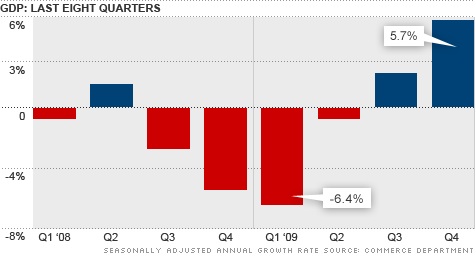
And look at the GDP trend - scary stuff here:
|
|
| | | 9 | Pancho Villa
ID: 29118157
Sat, Mar 20, 2010, 10:50
|
Weycool, the thread is titled Debt Commission.
You're right that both parties are guilty of using economic conditions to boloster their political fortunes. But that's not the point, or at least it shouldn't be.
Why is it so hard to find common ground in our political system anymore?
Is this country's debt a serious problem that should be addressed? If we all agree the answer is yes, is forming a commission to explore ways and means to reduce that debt a bad thing? Why? Have we become so cynical that we're opposed to good ideas because.....because...well, just because?
|
|
| | | 10 | Mattinglyinthehall
ID: 37838313
Sat, Mar 20, 2010, 10:50
|
What source does weykool depend on for his economics news? G. Gordon Liddy's Rosland Capial Gold commercials?
|
|
| | | 11 | Frick
ID: 723887
Sat, Mar 20, 2010, 10:57
|
Why is it so hard to find a middle ground? Both sides yell and point the finger at the other side and claim that everything the other side does is wrong and aimed at blaming the other side. This thread is proof of that.
It also doesn't help that the majority of people yell and speak in absolutes to make their point. I personally just filter out those voices which makes it awfully quite most of the time. The yelling and absolutes is everywhere: sports, politics, opinion. Anyone who is very good at something is suddenly the best ever, until they have a minor lapse and then they are awful or scum.
|
|
| | |
| | | 13 | Tree
ID: 248472317
Sat, Mar 20, 2010, 11:07
|
Both sides yell and point the finger at the other side and claim that everything the other side does is wrong and aimed at blaming the other side. This thread is proof of that.
no, this thread is not proof of that.
this thread shows that some people from one side of the aisle believe there is some sort of code and conspiracy at work, and that some 45-year-old political strategy and theory is at work to make this country a worse place.
it also shows that some people from another side of the aisle using data, statistics, and variable information to make an argument that the other side isn't basing their beliefs on reality.
there's a real, discernible difference in those two methods.
|
|
| | | 14 | Frick
ID: 723887
Sat, Mar 20, 2010, 11:38
|
The Right no longer is interested in policy discussions, PV. It is all window dressing toward discussing political strategy strengths & weaknesses.
You're right: Every sane economist understands that this incredibly unpopular program saved jobs, companies, and our economy from falling even deeper into the well. But (again) the Right isn't interested in doing anything other than short-term political strategizing.
So every single Republican is has no interest in policy discussions. And there isn't a single sane economist that disagrees with the effectiveness of the stimulus package. I doubt that is true.
I appreciate the improvement in the name calling and flaming, but every thread seems to dissolve into finger pointing and blaming the other side.
I don't disagree that the liberal posters here in general tend to offer facts, but there are conservative posters that do also, there are just fewer of them. As far as a real discernable difference? I disagree, it all depends on the color of the glasses you're wearing.
|
|
| | | 15 | Mattinglyinthehall
ID: 37838313
Sat, Mar 20, 2010, 11:48
|
it all depends on the color of the glasses you're wearing.
Of course this is true to an extent. But it is also pretty close to ostensibly false that Obama has made "the economy" "worse" by any overreaching standard.
Sorry if I react poorly to horseshit.
|
|
| | | 16 | Tree
ID: 248472317
Sat, Mar 20, 2010, 12:13
|
I don't disagree that the liberal posters here in general tend to offer facts, but there are conservative posters that do also, there are just fewer of them.
pretty much every conservative poster here that used facts to back up their points have long since vanished. now we get fear, lies, name-calling, and distortions.
|
|
| | | 17 | sarge33rd
ID: 280311620
Sat, Mar 20, 2010, 12:14
|
Stephen Moore at the Wall Street Journal was one of the few in the press who noted the patent absurdity of the Debt Commission announcement, observing that on that very same day "President Obama called for another $50 billion to $100 billion stimulus plan (and concomitant increase in the deficit)."
Ironic isn't it? The WSJ, no friend of the Left's, credited the Obama Stimulus as SAVING the economy, many many weeks ago.
|
|
| | | 18 | Frick
ID: 723887
Sat, Mar 20, 2010, 12:38
|
I didn't say state an opinion on the effectiveness of the stimulus package. I said I doubted that there wasn't a sane economist who didn't believe it was effective.
And Weykool's comment never mentioned the effectiveness of the stimulus. His comment was about Clinton's and Obama's comments on state of the economy prior to their election.
|
|
| | | 19 | Mattinglyinthehall
ID: 37838313
Sat, Mar 20, 2010, 13:02
|
weykool can defend his statement if he wants. But if you're right and his intended claim was that "short-term strategizing" (or "decrying how bad the economy was", as he described the term) is what he believes "only served to make a bad economy worse", that's some comicly blatant selective outrage.
It wasn't Obama who demanded that a presidential debate be put on hold so that he could rush back to Washington to "deal with" the economy. And it isn't Obama who has collected huge avertising revenues from companies which tout gold as a hedge against a weak dollar, looming inflation and "the worst economic crisis since the Great Depression".
|
|
| | | 20 | Boldwin
ID: 292351810
Sat, Mar 20, 2010, 20:59
|
I would love to say, all we have to do is watch whether this commission advocates higher taxes or lower spending.
Unfortunately they have found ways of rigging the CBO figures. They can't work with anything but what you give them. Garbage in/Garbage out. I don't know how you can be more tranparently deceptive than telling the CBO to score ten years of taxes and six years of program costs. Heck, why didn't Obama just ask the CBO to score five years of taxes in this plan and only the first year of the program? The MSM woulda lapped that up too. Do that with every Dem program from now on and claim we'll solve the budget problem in five years.
Anyway what is gonna happen is false CBO figures will be presented to make it look like progress is being made on the spending side and Phonies like Alan Simpson will be found to drag the Republicans into going along with tax hikes ignoring how damaging high taxes are to the economy and counterintiutively the harm they do to tax revenues.
|
|
| | | 21 | Perm Dude
ID: 5510572522
Sat, Mar 20, 2010, 21:44
|
I'll take a stab, though I can't promise he'll read it:
The CBO scores ten years out. The majority of the program (and its costs) begin in 4 years.
10 - 4 = ?
|
|
| | | 22 | Boldwin
ID: 292351810
Sat, Mar 20, 2010, 23:08
|
What part of 'the taxes start immediately' don't you understand?
|
|
| | | 23 | Perm Dude
ID: 5510572522
Sat, Mar 20, 2010, 23:23
|
What part of "program costs" aren't you clear on?
Call them fees, or taxes--it doesn't matter. That portion is measuring something completely different.
The program costs are the costs associated with the running of the actual program. If that doesn't start for four years, guess when the accrual of those costs begin then?
This isn't hard, once you let go of the idea that you have to stretch the meaning of things in order to make Barack Obama look bad every time you post.
|
|
| | | 24 | Tree
ID: 248472317
Sun, Mar 21, 2010, 00:09
|
The program costs are the costs associated with the running of the actual program.
per Baldwin, that depends on whether the program is run by a Conservative or someone else.
|
|
| | | 25 | Boldwin
ID: 292351810
Sun, Mar 21, 2010, 07:19
|
PD
Of course expenditures are the opposite side of the balance sheet to taxes.
If six years of expenditures were balance equally by six years of taxes then the program would be revenue neutral.
This thing is being passed under the false premise that it is.
|
|
| | | 26 | Mith
ID: 58136177
Sun, Mar 21, 2010, 09:32
|
The tax cuts for small businesses start in the first year. As do pre-existing condition coverage, prohibiting insurers from dropping people when they get sick and dependant coverage up to 26.
|
|
| | | 27 | Perm Dude
ID: 5510572522
Sun, Mar 21, 2010, 09:55
|
Perhaps in anticipation of your objection, Boldwin, the CBO scored the bill an additional ten years out.
|
|
| | | 28 | Pancho Villa
ID: 29118157
Sun, Mar 21, 2010, 10:02
|
I thought this thread was about the debt commission. I'm still waiting for a coherent defense connecting the debt commission, which has yet to be formed, to the Cloward/Piven strategy.
|
|
| | | 29 | Tree
ID: 248472317
Sun, Mar 21, 2010, 10:04
|
I'm still waiting for a coherent defense...
it's been about 2 years since you got one of those from the OP, so i wouldn't hold your breath.
|
|
| | | 30 | Boldwin
ID: 292351810
Sun, Mar 21, 2010, 13:50
|
If the Debt Commission were legitimate it would reverse the Cloward-Piven strategy assault America has been suffering under for 50 years. When it doesn't you'll find out that it's real purpose is to prolong and put a good face on that strategy even in the face of a depression.
|
|
| | | 31 | Boldwin
ID: 362262121
Mon, Mar 22, 2010, 21:54
|
This misplaced discussion occurred in the Healthcare thread necessitating cross-post:
-------
The VAT is the solution the Debt Commission is going to come up with. - B7
One of many future taps drilled into we, the money tree.
The phony republicans on the commission will also decide to give Obama bipartisan cover just as the healthcare summit was designed to give the appearance of...
...for embracing the idea of carbon taxes. In otherwords Alan Simpson, the crusty cantancerous conservative sounding phony will cheerlead for Obama raising energy costs for Americans thru the roof in the name of deficit reduction.
Besides the deliberate marxist damage to the free market system it is also another avenue to spread the big government tax increases out among multiple non-income tax vehicles. An Illinois signature move.
|
|
| | | 32 | Perm Dude
ID: 5510572522
Wed, Nov 10, 2010, 16:43
|
Debt Commission issues reports
Lots of buzz about this on the inter tubes. Haven't read it myself, but thought you guys might want the link in the meantime.
|
|
| | | 33 | boikin
ID: 532592112
Wed, Nov 10, 2010, 17:28
|
Looks like a lot of good ideas, for better or worse it reads a lot like business plan designed to turn around a struggling company.
|
|
| | |
| | | 35 | Boldwin
ID: 471028117
Thu, Nov 11, 2010, 10:36
|
Who are you and what have you done with PV?
|
|
| | | 36 | Razor
ID: 57854118
Thu, Nov 11, 2010, 10:45
|
I think they began by floating out some of the most shocking ideas, like dropping the income tax rate by double digits and doing away with the mortgage interest deduction. Doing away with loopholes would help capture taxes from the top bracket that has otherwise gone unclaimed. As far as taxes go, I'm all for simplifying the tax code so long as the net result is not less taxes or a significant shift of the tax burden one way or another.
|
|
| | | 37 | walk
ID: 517172117
Thu, Nov 11, 2010, 14:04
|
GOP and Facts
Speaking of not relying on facts... just an opinion piece about facts though. I know this happens on both sides, but def not the same level of magnitude.
|
|
| | | 38 | weykool
ID: 138481617
Thu, Nov 11, 2010, 15:41
|
Excellent article PV.
Very scary that 50% of Americans pay no income taxes, while 50% get all or most of their income from the federal government.
How can you balance a budget when half will be for and half will be against whatever proposal is put forward?
|
|
| | | 39 | Perm Dude
ID: 5510572522
Thu, Nov 11, 2010, 16:00
|
That is a good piece. And I agree with wk.
But this simply isn't true: First, no one ever reduces government in good times, when we are far better able to limit spending, and the public needs less assistance.
That is exactly what Bill Clinton did. And we can do it again.
|
|
| | | 40 | Boldwin
ID: 471028117
Thu, Nov 11, 2010, 17:53
|
First, no one ever reduces government in good times
That is exactly what Bill Clinton did. And we can do it again.
1] These aren't good times.
2] That is what the first 'Tea Party' congress, public rejection of government take-over of medicine, did. So yeah, there's a chance this much harder task might be accomplished.
|
|
| | | 41 | Perm Dude
ID: 5510572522
Thu, Nov 11, 2010, 18:14
|
Read the article before commenting, please. That way you'll be less likely to comment on comments by losing the context, as you just did.
|
|
| | | 42 | Boldwin
ID: 471028117
Thu, Nov 11, 2010, 22:49
|
I was responding to your own outlandish claims in #39, not the links.
|
|
| | | 43 | Boldwin
ID: 471028117
Thu, Nov 11, 2010, 22:55
|
BTW, now that Axelrod has conceded that Obama will have to go along with the complete 'Bush tax cuts' extention, will they be called the 'Obama tax cuts' or will you finally admit the House controls the purse strings? Including the spending cuts during Clinton's era?
|
|
| | | 44 | DWetzel
ID: 33337117
Thu, Nov 11, 2010, 23:30
|
I imagine that if good things happen, you'll call them the Bush tax cuts, and if bad things happen, you'll call them the Obama tax cuts.
It's a much trickier call for you right now, of course. You should probably wait a few years before you commit to anything.
|
|
| | | 45 | Boldwin
ID: 471028117
Thu, Nov 11, 2010, 23:33
|
BTW that WSJ blogger comment...Palin attacked the Federal Reserve’s monetary policy, which is about as far over her head as she ever wants to get, and showed profound ignorance on inflation. She said anyone who’d gone shopping lately would know that “grocery prices have risen significantly over the past year.” A Journal blogger then noted that food and beverage inflation was practically nonexistent for the past year — the lowest on record — and that Palin was having some trouble with reading comprehension. ...Has been fisked and obliterated by Palin herself...Mr. Reddy takes aim at this. He writes: “Grocery prices haven’t risen all that significantly, in fact.” Really? That’s odd, because just last Thursday, November 4, I read an article in Mr. Reddy’s own Wall Street Journal titled “Food Sellers Grit Teeth, Raise Prices: Packagers and Supermarkets Pressured to Pass Along Rising Costs, Even as Consumers Pinch Pennies.”
The article noted that “an inflationary tide is beginning to ripple through America's supermarkets and restaurants…Prices of staples including milk, beef, coffee, cocoa and sugar have risen sharply in recent months.”
Now I realize I’m just a former governor and current housewife from Alaska, but even humble folks like me can read the newspaper. I’m surprised a prestigious reporter for the Wall Street Journal doesn’t.
- Sarah Palin
|
|
| | | 46 | Pancho Villa
ID: 597172916
Fri, Nov 12, 2010, 00:31
|
Hmmm, it's possible the fisking and the obliteration are in the eyes of the beholder.
Palin - “grocery prices have risen significantly over the past year.”
WSJ article - “an inflationary tide is beginning to ripple through America's supermarkets and restaurants…Prices of staples including milk, beef, coffee, cocoa and sugar have risen sharply in recent months.”
Now , in #45, the following are bolded:
an inflationary tide
have risen sharply
but, if one were to bold the words which follow:
is beginning to ripple
in recent months
"Is beginning" and "in recent months[a beginning would indicate maybe 2 months]" does not translate to "significantly over the past year."
And is any body still buying the "current housewife from Alaska" and "humble folks like me" bullshit from this jet-setting media whore, besides Boldwin?
|
|
| | | 47 | biliruben
ID: 34820210
Fri, Nov 12, 2010, 00:33
|
She said anyone who’d gone shopping lately would know that “grocery prices have risen significantly over the past year.”
Grocery prices have risen 1.3% in the last year, one of the lowest years on record.
|
|
| | | 48 | Seattle Zen
Leader
ID: 055343019
Fri, Nov 12, 2010, 00:40
|
now that Axelrod has conceded that Obama will have to go along with the complete 'Bush tax cuts' extention
Since when did you start believing David Axelrod? Nothing is done, don't count your chickens, I don't think it's happening.
|
|
| | | 49 | Perm Dude
ID: 5510572522
Fri, Nov 12, 2010, 01:02
|
Man, I can't believe Baldwin would bring up Sarah Palin's big mistake about food prices. She took something completely out of context, extrapolated a tiny recent price increase into the future, and blamed it all on Obama.
See that little increase at the end? That's what she's talking out of her ass about. Yes--if that line continues into the future as is, she's right. But she's wrong on the facts. Food prices have been flat or have decreased by pretty much every measure over anything going back more than a few months.
Notice something missing from the second quote in #45? No? What do you think the ellipses are hiding? Here's the full sentence:
"An inflationary tide is beginning to ripple through America’s supermarkets and restaurants, threatening to end the tamest year of food pricing in nearly two decades."
The very sentence she cites disproves her point. So to make it, she just replaces the part that disproves her point with ellipses--viola! Instant conservative talking point!
|
|
| | | 50 | Boldwin
ID: 471028117
Fri, Nov 12, 2010, 01:56
|
She was talking about he market's reaction to the announcement of QE2.
How long ago was it?
Do you think that wasn't gonna be inflationary?
|
|
| | |
| | | 52 | Perm Dude
ID: 5510572522
Fri, Nov 12, 2010, 02:10
|
You can't get there from here.
She can't take food pricing out of context in order to make such an economic prediction (and it is a prediction, not an analysis). Her handlers have left her looking rather silly about the whole thing, and her follow-ups trying to make it sound like she didn't take anything out of context just makes it worse.
Even reading her full remarks (which boil down to: "What's to stop them from printing more and more and more money? Then we'll all be screwed!") doesn't do anything more than lay her unfounded fears out there in an area she's clearly not intellectually comfortable being in.
No, inflation is not a problem right now--in fact, food pricing is at very low levels right now because of deflation. And it isn't likely to be a problem for the near future so long as interest rates (including prime rates which are controlled by the same Fed she's ham-fistedly trying to criticize for actions they have yet to take) remain at historic lows.
|
|
| | | 53 | Boldwin
ID: 471028117
Fri, Nov 12, 2010, 02:47
|
Yeah taking one tenth of your chips back from your creditors, paying off your big spending debt with funny money you just printed up does tend to rile people up, and not just grocery shoppers.
It also is a way to distract people from the fact that business loves the new congress and responds favorably. QE1 was a complete failure so don't buy the idea this one helped the economy.
Oh, and China really does not like QE2 [nor our carrier group near Taiwan]
"Nice city you got there, Los Angeles. I'm not sayin notin', all I'm sayin is tings can happen, bad tings"
|
|
| | | 54 | Boldwin
ID: 471028117
Fri, Nov 12, 2010, 03:18
|
PD
Only one correct concept in that #52. Yes we are in a temp deflationary period but that is not business cycle related but rather financial confidence crisis related. The feds' normal business cycle tools do not work in this case.
QE2 is still unavoidably inflationary. It is by definition and literal fact inflating the money supply. Denying that makes you look silly and out of your league.
|
|
| | | 55 | weykool
Leader
ID: 41750315
Fri, Nov 12, 2010, 03:34
|
PD
If you are going to call out Palin for her remarks you need to make sure you are accurate yourself.
Just because the line is going down doesnt make it deflationary.
Any line that is still above the blue 0 line is still inflationary.
While there may be a few months were prices dropped slightly (About 1-2% ave.) it still doesnt make up for an entire year of 4-5% inflation.
Prices are still higher overall.
In addition do we know which items the inflation rate is based on and how that compares to what items are being purchased by Palin that could have led to her comment?
|
|
| | | 56 | Perm Dude
ID: 5510572522
Fri, Nov 12, 2010, 08:51
|
weykool, yes, but you are making comments without, seemingly, even checking context yourself.
it still doesnt make up for an entire year of 4-5% inflation.
Your point is actually reading it backwards a bit. Food pricing has been been relatively flat for a long time now, despite the most recent uptick Palin's speechwriters are trying to make her exploit.
In addition do we know which items the inflation rate is based on and how that compares to what items are being purchased by Palin that could have led to her comment?
Yes, we do. Easily found on the internet, in fact. I don't mean this to make it sound as sharp as it might, but most of this information I've pointed out is fact-based and fairly easily verified.
#54: QE2 is still unavoidably inflationary. It is by definition and literal fact inflating the money supply. Denying that makes you look silly and out of your league.
I don't have any idea what you are saying here. Neither do you. Have you posted on QE2 here in the past--before Palin told you what to say, in other words? You know that QE is not actually printing money, but moving money around quite a bit. I don't deny there are inflationary pressures with the trick, but inflation, in an economy which is tracking only a bit above attritional replacement in many areas, is not a problem right now.
The Fed cannot spike the market any more with interest rate cuts, so this particular move is expected to have a number of positive benefits despite its risks.
Remember what both the interest rate drops and QE does: Tries to increase the available money for banks to lend, which helps businesses. A flat or contracting money supply means fewer lending opportunities are being offered, hurting many businesses (including small businesses) because borrowing opportunities have vanished.
Included in the positives is a stock market spike and increased tax receipts.
|
|
| | |
| | | 58 | Boldwin
ID: 471028117
Fri, Nov 12, 2010, 10:21
|
Payoff quote from that link:Quantitative easing is just printing money. This cannot help the economy recover and in many ways makes the economy and the dollar more unstable. It certainly is a bad deal for consumers, retirees and savers. The only beneficiaries are large multinational exporters, dealers in government bonds and securities, and money managers with inside information. Economic recovery will occur not because of quantitative easing, but in spite of it. And I knew that before Palin said it. While you are still obfuscating it or just not getting it.
|
|
| | | 59 | Perm Dude
ID: 5510572522
Fri, Nov 12, 2010, 10:46
|
It is called "printing money" but lots of things are called that--it doesn't actually make it so. Dropping the prime rate, for example. Certain investments, etc.
The "payoff quote" is an opinion, with the only assertion demonstratively false, sorry.
|
|
| | | 60 | Boldwin
ID: 471028117
Fri, Nov 12, 2010, 10:54
|
You obviously don't understand the first thing about how the money money supply grows. Quit blowing smoke. This conversation is over.
|
|
| | | 61 | Tree, not at home
ID: 18342816
Fri, Nov 12, 2010, 11:40
|
You obviously don't understand the first thing about how the money money supply grows.
to quote the great Antoine Dodson - "Obviously..."
Quit blowing smoke. This conversation is over.
so sayeth the shepherd.
|
|
| | | 62 | DWetzel
ID: 278201415
Fri, Nov 12, 2010, 11:45
|
"This conversation is over."
Promises, promises.
|
|
| | | 63 | Perm Dude
ID: 5510572522
Fri, Nov 12, 2010, 12:19
|
Heh. I think this was over the moment one of us accepted Palin as an economic expert worth quoting un-ironically.
The theoretical fear of inflation in a steady (some would say contracting) economy are overblown. Though I'll admit it isn't altogether different from the shrieks to get out budget balanced by slashing jobs during a recession.
Anyone (literally, anyone) who thinks that a growing economy doesn't need more money to operate is in no position to give out basic economic opinions. Let alone, present them as factually based.
|
|
| | | 64 | Building 7
Leader
ID: 171572711
Fri, Nov 12, 2010, 13:35
|
Quantatative easing is Fed-Speak for printing money. These clowns at the Fed continue to use Fed-Speak. This is a language created for their own use, where they think they can speak above people. It makes them feel important. It gives them the aura of superiority. The commoners will have to rely on translators to decode what the Fed says. Unless they use normal English, their use of the term Quantative Easing is open to interpretation by the common folk. And IMO it means printing money out of thin air.
|
|
| | | 65 | boikin
ID: 532592112
Fri, Nov 12, 2010, 14:58
|
Anyone (literally, anyone) who thinks that a growing economy doesn't need more money to operate is in no position to give out basic economic opinions. Let alone, present them as factually based.
really? how does the Chinese make their economy grow? there are other ways increase operating funds besides printing it. based on your theory above no company would be able to grow with out their own money printing machine.
|
|
| | | 66 | Perm Dude
ID: 5510572522
Fri, Nov 12, 2010, 15:11
|
An economy which is larger needs more money. This is clear, right? If the money supply stayed the same while the economy grows, money becomes scarce, interest rates rise (because money is more valuable) and loans start drying up.
In this particular economy, we are in a flat (and in some areas, a deflationary) economy. There is not only no real inflationary danger, but some inflationary pressure needs to be brought to bear in order to spur the credit markets. Lee Adler lays out some of the other results of QE2 position that the Fed is taking up.
Nearly all of the alarmist articles I've seen as a result of the Fed announcement skip over (deliberately, or not) the current state of the economy, preferring to lecture us as though our economy was some sort of textbook case. Might as well add, to the end of all their sentences, "...all other things being equal." Which they are not. Virtually no one criticizing the plan (that I've found) even mentions the fact that the prime rate is at a historic low, and has been so for some time.
I've maintained that there is some risk of inflation but the risk is very low. And while the very low prime rate takes out the Fed's primary weapon for spurring credit market churning, it also lowers the risk of inflation for the buyups they are doing.
|
|
| | | 67 | boikin
ID: 532592112
Fri, Nov 12, 2010, 16:06
|
An economy which is larger needs more money. This is clear, right? If the money supply stayed the same while the economy grows, money becomes scarce, interest rates rise (because money is more valuable) and loans start drying up.
yes to a degree money supply should keep up with population growth but besides that it not necessary. Increasing the money supply beyond that only creates inflation. money becomes scared for 4 main reasons, 1) it is being destroy, 2) people are saving it, 3) more people are moving into the economy, or 4) it is being shipped out of the economy. Notice a growing economy is not one of the causes. In cases 2 and 4 printing more money leads to inflation.
|
|
| | | 68 | Perm Dude
ID: 5510572522
Fri, Nov 12, 2010, 16:14
|
No, money supply should keep up with economic growth, not population growth. Big distinction!
And there is a lot more slippage than you are giving the economy credit for needing. Because of bank reserve amounts in the US, banks have to keep a certain amount of money on hand always. QE2 will increase excess reserves, giving the banks more money to lend, particularly in this credit crunch.
My point, to make it more clear, is that there is virtually no risk from this action leading to inflation to a level to be a problem. Inflation, by itself, is not really a problem (just like unemployment being more than zero is not a problem--only when it rises to high or very quickly). There seems to be some unnatural fear of "inflation" without context here.
Also to be clear, there is no actual printing of more money going on. The amount of currency in the market is not changing. Part of the problem with calling this "printing money" is the belief that the Fed is actually making more currency. That is not happening.
|
|
| | | 69 | boikin
ID: 532592112
Fri, Nov 12, 2010, 16:30
|
No, money supply should keep up with economic growth, not population growth.
that is just wrong, if the goal to keep inflation near zero.
Inflation, by itself, is not really a problem (just like unemployment being more than zero is not a problem--only when it rises to high or very quickly). There seems to be some unnatural fear of "inflation" without context here.
i will agree to this for the most part.
What fed is trying to do is increase the money supply by changing (2) and getting people to save less. As for them printing money idea maybe to some extent, i have not read the full details on how the accounting works on the program so I am not sure either way.
on a side note banks are not lending i think more out of fear then lack of resources.
|
|
| | | 70 | Boldwin
ID: 571051214
Fri, Nov 12, 2010, 16:38
|
OMG - No, money supply should keep up with economic growth, not population growth. - PD
So let's inflate it a trillion during a period of virtually no growth then. Listen to yourself.
|
|
| | | 71 | Herr Building 7
Leader
ID: 171572711
Fri, Nov 12, 2010, 17:00
|
"With all due respect, U.S. policy is clueless."
-Wolfgang Schaeuble German Finance Minister Nov 5, 2010 ......in response to QE2.
|
|
| | | 72 | Perm Dude
ID: 5510572522
Fri, Nov 12, 2010, 17:16
|
#70: Do a simple thought exercise: take a trillion dollar/year economy with 6% unemployment, prime at 4.25%.
Then take one with $14 trillion/year size, with the same unemployment and prime numbers. Which one do you think will have the bigger money supply?
And you would have this larger money supply, in response to a larger actual economy, be a threat?
A large increase in the money supply has inflationary pressure, yes. With all other things being equal. The problem is that you've stopped thinking past that first point.
|
|
| | | 73 | Boldwin
ID: 571051214
Fri, Nov 12, 2010, 17:22
|
Actually while I think the proximate cause of QE2 is to offer a plausible excuse to claim business' happiness with the election, for something Obama did...
...I think the ultimate cause was correcting for a steering error. Up to now the result of lowering interest to zero while raising credit requirements has been that banks are just using that free loan and buying T-bills for their tiny returns with it instead on spurring the economy.
Hard to see who benefits from that game other than making the bank appear more sound.
So Obama is trying to undo that dynamic is my working hypothesis.
|
|
| | | 74 | Boldwin
ID: 571051214
Fri, Nov 12, 2010, 17:31
|
But really I don't see how this changes the bank's incentive. This just raises the profit of that bank game.
|
|
| | | 75 | Boldwin
ID: 571051214
Fri, Nov 12, 2010, 17:37
|
Maybe this is just another and steathier bank bailout. Could he really be that worried about them or that beholden to them?
|
|
| | | 76 | Boldwin
ID: 571051214
Fri, Nov 12, 2010, 17:42
|
MaybeBut there is one distinct benefit of such a policy – it alters the composition of bank balance sheets. At the end of the day it’s really just an asset swap and a transfer of risk via bond duration or bond type. The kicker here, is that if you’re a bad bank with a few trillion dollars in bad mortgage paper you’re delighted if a AAA rated entity comes in and swaps those assets out with their highly rated paper. This is exactly what the Fed did in 2009 and make no mistake – it was hugely successful in clearing the credit markets and altering the composition of bank balance sheets. This was Mr. Bernanke’s goal after all. He was simply trying to clear the credit markets and improve the banking system and he believed that would ultimately fix the problems in the US economy. Unfortunately, he misdiagnosed a household balance sheet recession as a banking crisis. QE1 provided liquidity in the credit markets and it gave the banks some much needed breathing room. Unfortunately, the impact on the real economy was far more muted.
I think Ben Bernanke knows all of this. He has added $1T in reserves to the banks already and it hasn’t resulted in a surge in borrowing or self sustaining economy recovery. It doesn’t take a genius to understand that adding another trillion won’t change anything either. If there is low demand for apples putting more apples on the shelves does not improve the apples salesman’s ability to sell more apples.
But Mr. Bernanke is seeing the same thing that I am seeing. He sees a weak economy and a housing market that appears to be rolling over again. Knowing that the banks are extremely fragile here and understanding that there is absolutely no political will for another bailout Mr. Bernanke is creating his own bailout by bypassing Congress.
|
|
| | | 77 | biliruben
ID: 34820210
Sat, Nov 13, 2010, 10:16
|
I don't agree on most of these things, but I do agree on getting rid of the mortgage interest deduction.
And I have a pretty nasty mortgage.
It provides all the wrong incentives, simply increases the price of houses, help the rich disproportionally to buy bigger and bigger McMansions and 131 billion is a lot of money.
|
|
| | | 78 | Perm Dude
ID: 5510572522
Sat, Nov 13, 2010, 12:37
|
#74: That is actually kinda funny (I'm not making fun of you here at all, it is just that you've switched sides to being a liberal on the issue of bank profitability and motive).
There is no incentive for the rich to put money into businesses or other areas of the economy by cutting their taxes either (i.e. allowing them to keep more money in their pockets). The idea behind QE2 and cutting taxes for the rich is actually very similar: Give a little financial breathing room to those with the opportunity and know-how to get the economy going (but who are a little squeezed on the "means" side").
The problem with wealthy individuals is that this is more more diffuse--they have many more incentives that putting that money to work in a business.
That first paragraph in #76 is pretty much on-line with what Adler pointed out in my link in #66.
|
|
| | | 79 | Boldwin
ID: 571051214
Sat, Nov 13, 2010, 20:02
|
it is just that you've switched sides to being a liberal on the issue of bank profitability and motive) - PD
Not in the least. This is just the ultimate example of central planners disasterously messing up the natural communication signals of the market.
|
|
| | | 80 | Perm Dude
ID: 5510572522
Sat, Nov 13, 2010, 20:42
|
Letting the banks keep more of their money is central planners messing up? I think you don't understand what this is actually doing.
|
|
| | | 81 | Boldwin
ID: 571051214
Sun, Nov 14, 2010, 02:52
|
It's destroying the recovery to prevent a bank meltdown. Hard to believe this was well intentioned given Rahm's 'never waste a crisis' statement, but then with this much under water RE and bad paper Tier One securities, who knows just how shaky it is. Aint no recovery if most banks fold.
|
|
| | | 82 | Building 7
Leader
ID: 171572711
Mon, Nov 15, 2010, 13:27
|
Quantatative Easing Explained
|
|
| | | 83 | weykool
ID: 138481617
Mon, Nov 15, 2010, 13:49
|
It provides all the wrong incentives, simply increases the price of houses, help the rich disproportionally to buy bigger and bigger McMansions and 131 billion is a lot of money.
Wrong.
There are limits to the mortgage deduction.
I know class warfare is one of the hallmark attacks used by the left but in this case the mortgage deduction is clearly a middle class tax deduction.
We can only hope that Americans are not stupid enough to fall for the "lower rates in exchange for your deduction" only to see the rates go back up for the next crisis.
|
|
| | | 84 | boikin
ID: 532592112
Mon, Nov 15, 2010, 14:19
|
Re 82: good stuff. I wonder why no has ever pointed out that mild deflation is not not bad thing or more precisely that deflation less that a few % points is actually mentally equivalent to equilibrium?
|
|
| | | 85 | biliruben
ID: 34820210
Tue, Nov 16, 2010, 00:37
|
Wrong.
There are limits to the mortgage deduction.
I know class warfare is one of the hallmark attacks used by the left but in this case the mortgage deduction is clearly a middle class tax deduction.
Not true. With my first mortgage, I couldn't even claim the deduction because it wasn't enough for me to itemize. The standard deduction was a better deal.
It wasn't until we had two decent salaries that we and we upgraded to a much nicer house that we were able to capitalize on it.
If it doesn't help first-time homeowners, it is not a deduction for the middle class. In fact, it inflates housing prices and jabs first-time homeowners up the nether-regions twice over. They are paying higher taxes to subsidize people upgrading to McMansions.
Stupid tax break.
|
|
| | | 86 | Frick
ID: 21016718
Tue, Nov 16, 2010, 08:25
|
Bili, there are limits on the mortgage interest deduction, you can only deduct interest up to $1M on your principle and secondary homes. That's a pretty high amount, but I can think of only 1 year where I didn't itemize and my mortgage is a fraction of the limit (the benefit of living in BFE.) It might not make sense to itemize just for the mortgage exemption, but I bet it is rare that a person has a child and a mortgage and it isn't beneficial to itemize. Either by itself might not be enough, but combined it doesn't take much of a mortgage to push you over the standard deduction.
|
|
| | | 87 | Razor
ID: 57854118
Tue, Nov 16, 2010, 09:20
|
I'm a first-time homeowner as of this year. I'll let you know in a couple months if and how the deduction affects my taxes.
|
|
| | | 88 | biliruben
ID: 34820210
Tue, Nov 16, 2010, 10:16
|
Our state doesn't have an income tax, so it's really hard to get over the standard deduction unless you have a fat mortgage. I do have a kid.
A million dollar mortgage is not middle class mortgage. That's over $6000/mo mortgage payment.
|
|
| | | 89 | Frick
ID: 21016718
Tue, Nov 16, 2010, 10:45
|
I agree that a $1M mortgage is not middle class, but there are parts of the country where a $500k mortgage is not a McMansion. I wouldn't have a problem with lowering the cap or to put a cap on income similar to the student loan interest cap.
|
|
| | | 90 | weykool
Leader
ID: 41750315
Tue, Nov 16, 2010, 10:58
|
Frick, we need to be really clear with Bili because he is desperately clinging to his "McMansion Myth".
The $1M limitation is is on the amount of the loan and not the deduction.
A 6% loan on $1M amounts to a $60k deduction.
The after tax benefit at 40% tax rate comes to 24K.
But somehow the rich are magically taking 24K and buying McMansions.
Bili, Are you really going to try and make the argument that the mortgage deduction hasn't benefited the middle class based on you personally not being able to benefit from it?
Perhaps you were not middle class?????
Lets do the math:
The standard deduction the past few years has been just under 11K witch comes to about a $900 a month.
This assumes you paid no state income taxes, no real estate taxes, and made zero charitable contributions.
The typical American middle class taxpayer who gets paid twice a month uses one paycheck to pay for housing and the other paycheck for the rest of their expenses.
This would mean after tax income of $1,800/mo which would make the gross/pretax income less than 25K/yr.......NOT middle class.
So now that you have used the mortgage deduction to move into the middle class you want to deny that same opportunity for other Americans?
You are correct on one point that the mortgage deduction increases the price of homes.
Which also means if you take away the deduction it will further decrease the prices of homes.
At a time when foreclosures are at such a high level is it really wise further decrease the value of American homes?
Brilliant idea...lets get rid of the mortgage deduction, put more Americans upside down in their homes, add more bad loans to the banks that have these mortgages on their books so the government can spend more money on another bailout.
|
|
| | | 91 | Perm Dude
ID: 5510572522
Tue, Nov 16, 2010, 11:09
|
I don't think anyone is buying a home with the mortgage deduction in mind.
When Britain was considering the same thing (getting rid of the tax deduction for mortgage interest) the same arguments were being made. When they ended that deduction, there was virtually no change in the market. Home ownership has stayed the same (and, in fact, is about the same as the US).
I don't think taxpayers need to foot the bill for home ownership which, in the end, isn't actually doing very much promotion.
|
|
| | | 92 | boikin
ID: 532592112
Tue, Nov 16, 2010, 11:11
|
The typical American middle class taxpayer who gets paid twice a month uses one paycheck to pay for housing and the other paycheck for the rest of their expenses.
spending 50% your income on housing is not what one would call a wise decision, this is what leads people into foreclosure. By your math:
This would mean after tax income of $1,800/mo which would make the gross/pretax income less than 25K/yr.......NOT middle class.
lets say a more reasonable 30% of your income on housing you get a number of 42K a year which puts you in the middle class. just to define middle class as the middle 50% of the population your income would be roughly: $23K - 80K with median being 45K. So actually 25k/yr is middle class.
|
|
| | | 93 | Razor
ID: 57854118
Tue, Nov 16, 2010, 11:28
|
I don't think anyone is buying a home with the mortgage deduction in mind.
I don't think that's accurate. In the calculations I did on the benefits of owning vs. renting, the deduction was certainly in the equation.
And $500K is a pricepoint met by only the affluent everywhere for most of the country. $500K buys a very nice house in a very nice in-town neighborhood in Atlanta or a gigantic house in the suburbs. It's pretty much that or better way in a 750 mile radius.
|
|
| | | 94 | Perm Dude
ID: 5510572522
Tue, Nov 16, 2010, 11:30
|
You certainly wouldn't get a loan these days with that much going to housing!
|
|
| | | 95 | Pancho Villa
ID: 597172916
Tue, Nov 16, 2010, 11:33
|
32% of income is the going rate for mortgage, insurance, utilities and property tax.
|
|
| | | 96 | weykool
ID: 138481617
Tue, Nov 16, 2010, 12:12
|
If we use the 30-32% of income going to housing (Living in California it inst uncommon for that percentage to be higher) you still only have an income of roughly 36K.
Sorry Boikin but that is not the definition of middle class.
We give the Earned Income Tax Credit (EITC) to low income families based on:
$43,279 ($48,279 married filing jointly) with three or more qualifying children
$40,295 ($45,295 married filing jointly) with two qualifying children
$35,463 ($40,463 married filing jointly) with one qualifying child
$13,440 ($18,440 married filing jointly) with no qualifying children
Based on the information Bili provided I have bolded his situation.
And PD...please tell me you are not going to argue against basic economic principles that the mortgage deduction has no affect on the housing prices.
Of course you are going to call it a subsidy when you have been brainwashed to think that the government is entitled to all of your income and we are just so lucky if they allow us to keep some of it.
The bottom line is I like most taxpaying Amreicans pay far to much in taxes already and the commission needs to be looking into cutting spending and not trying to tweak the formula to take more money for an already overtaxed population.
|
|
| | | 97 | biliruben
ID: 358252515
Tue, Nov 16, 2010, 13:12
|
50% of your income ?!? We are half that, and zhit's tight.
Only "real estate professionals", who are keeping closer track of their bottom line than yours would ever advise dti that high.
What do you do again, mr. kool?
|
|
| | | 99 | boikin
ID: 532592112
Tue, Nov 16, 2010, 13:17
|
Weykool what is the definition of middle class then? I gave you the numbers for the middle 50% of America if that is not the middle class then tell me what in the world the middle class is?
|
|
| | | 100 | Perm Dude
ID: 5510572522
Tue, Nov 16, 2010, 13:40
|
#96: I'm only pointing out that in England, when they eliminated the mortgage interest deduction, there was no effect on the market. This isn't theoretical stuff here. Their ownership rates remain the same as the US. As do other countries in which there is no mortgage interest deduction.
If the deduction is there to spur home ownership (why?) you have to wonder why we would keep it if it wasn't showing actual higher ownership levels.
Of course you are going to call it a subsidy when you have been brainwashed...
You understand what we are talking about, right? That someone owes X dollars in taxes to the government, but some of them can pay less because some of their home loan interest can be deducted. This means that the government gets less in taxes than it is owed as a result.
You understand this, yes? That the government agrees to take less in taxes so that the loan holder has more money to pay the interest on their home loan?
This is just about the definition of a subsidy. Do you have a better one?
|
|
| | | 101 | Tree
ID: 4010381517
Tue, Nov 16, 2010, 13:45
|
without taking into effect location, dependents, and so forth, isn't it difficult to determined "middle class" and so forth?
|
|
| | | 102 | boikin
ID: 532592112
Tue, Nov 16, 2010, 13:52
|
I made generalization for the whole country clearly those numbers could change if I am in Massachusetts or California or Mississippi..., but the general numbers give you a feel of what middle class means.
|
|
| | | 103 | weykool
ID: 138481617
Tue, Nov 16, 2010, 16:20
|
Tree, I think you are absolutely correct.
There is no hard and fast definition of middle class.
Accoring to answers.com:
n.
The socioeconomic class between the working class and the upper class, usually including professionals, highly skilled laborers, and lower and middle management.
And Investopedia:
The word "middle" may be misleading in that it suggests that those in the middle class have earnings within the middle of the population's income distribution, which may not be the case.
Perhaps it is like pornography, I might not be able to define it, but I know when I see it....and I dont see 24K anywhere close to middle class.
Notwithstanding Bili's anecdotal situation the vast majority of the middle class is able to deduct their mortgage interest and have benefited because of it.
I couldn't care less about arguing the minutiae of the effects or if it should be allowed.
Bili made a really stupid comment that it only allowed the rich to build bigger McMansions, which I have clearly been shown to be false.
|
|
| | | 104 | Tree, not at home
ID: 3910441615
Tue, Nov 16, 2010, 16:44
|
and I dont see 24K anywhere close to middle class.
we agree.
to me, 24k is damned close to poverty. again, it depends on circumstances such as those i mentioned above, but 24k is far from middle class.
|
|
| | | 105 | biliruben
ID: 358252515
Tue, Nov 16, 2010, 17:35
|
If someone making 24k takes out a mortgage anywhere close to where they would reap substantial benefit from the mortgage interest deduction, they will almost certainly end up in foreclosure.
Let's run through some ballpark scenarios, shall we?
I'll base this on spending 33% of houshold gross income on housing for a married couple -the max I would recommend a typical borrower spend:
36k income,$1000/ mo rent, benefit - $0
36k income $200k mortgage, $1000/mo payment (plus 250 taxes and insurance) benefit -$0
72k income, $2000/mo rent - benefit $0
72k income, $400k mortgage, $2000/mo payment (plus 500) - benefit (beyond standard deduction) - $7000
200k income, million dollar mortgage, $5000(+1000)/mo mortgage - benefit ~ $40,000 a year.
Who's this tax break for again?
72 income $400k mortgage
|
|
| | | 106 | biliruben
ID: 358252515
Tue, Nov 16, 2010, 17:45
|
And this assumes a 4.5% interest rate, which is the only way someone making 72k could possibly get into that much house.
|
|
| | | 107 | Seattle Zen
ID: 10732616
Tue, Nov 16, 2010, 17:53
|
Bili made a really stupid comment that it only allowed the rich to build bigger McMansions, which I have clearly been shown to be false.
When someone states that they have shown something to be "clearly" false, generally the opposite is true. Yep, weykool, you are clearly what I had in mind :)
|
|
| | | 108 | biliruben
ID: 358252515
Tue, Nov 16, 2010, 18:04
|
In addition, the benefit dissipates over time as you pay more principal and less interest, almost daring you to double down and upgrade to the McMansion instead of paying off your mortgage
|
|
| | | 109 | biliruben
ID: 358252515
Tue, Nov 16, 2010, 18:32
|
Though I don't dispute pd's assertion that the uk didnt see any decline, housing prices are pretty sticky on the way down, and if occured during the recent runup any effects of elimination might have been masked or delayed.
If you do some searches, I've been calling for this particular tax-breaks removal since 2004. I agree that this might not be the best time, but you could grandfather current mortgages and sunset it in 2015 or something, softening the blow, if any.
|
|
| | | 110 | Boldwin
ID: 3610451619
Tue, Nov 16, 2010, 20:45
|
Tax code is far from my strong suit but even if the mortgage deduction considered all by itself appears to be of no benefit, I am guessing that, unless you have large medical bills for the year, you won't be able to itemize without that mortgage deduction added so it is still the route to tax savings.
|
|
| | | 111 | biliruben
ID: 358252515
Tue, Nov 16, 2010, 22:10
|
No doubt. If you have substantial other deductions, it is much more relevant. They threshold for medical expenses is quite high however, iirc. I've never been able to declare any medical.
|
|
| | | 112 | Perm Dude
ID: 5510572522
Tue, Nov 16, 2010, 22:33
|
Which makes it far more likely to be utilized by those in the higher tax brackets. Those who make more money are more likely to itemize rather than getting the standard deduction.
In other words, the people actually utilizing the mortgage interest deduction on their federal taxes are those less likely to actually need it.
|
|
| | | 113 | Building 7
Leader
ID: 171572711
Tue, Nov 16, 2010, 22:43
|
If you cannot take the mortgage interest deduction and the corresponding real estate taxes; you're probably not gonna itemize. And if you're not going to be able to itemize, you will be less inclined to make charitable contributions. I never thought it was fair that people who own a house can writeoff charitable contributions, and renters cannot.
|
|
| | | 114 | Perm Dude
ID: 5510572522
Tue, Nov 16, 2010, 22:51
|
Renters can. They are just less likely to do so. And (by and large) don't make charitable contributions large enough to make a difference. what they can do is get the standard deduction.
Those that itemize are not able to take that standard deduction, and have to pay the time and expense involved in itemizing (which is, at times, a very real cost). Often, the standard deduction works for people--no harm in that.
|
|
| | | 115 | biliruben
ID: 34820210
Tue, Nov 16, 2010, 23:17
|
I agree with B7. It's absurd to have two sets of rules - one for the rich and one for the poor.
In those circumstances, the poor, or even the middle class, end up screwed.
|
|
| | | 116 | weykool
Leader
ID: 41750315
Wed, Nov 17, 2010, 04:22
|
Before we get all weepy about the the rules favoring the rich a little perspective is in order.
Most low income taxpayers will not get a benefit from a mortgage deduction because for the most part they pay little to NO income taxes.
The rich are hit with a very punitive progressive tax system.
I used the examples posted in #105.
36k income $200k mortgage, $1000/mo payment (plus 250 taxes and insurance) benefit -$0
72k income, $400k mortgage, $2000/mo payment (plus 500) - benefit (beyond standard deduction) - $7000
200k income, million dollar mortgage, $5000(+1000)/mo mortgage - benefit ~ $40,000 a year.
Income ....... ….. 36,000.00 ….. 72,000.00 ….. 200,000.00
Mortgage Interest ….. (12,000.00) ….. (24,000.00) ….. (60,000.00)
Taxes ....... ….. (3,000.00) ….. (6,000.00) ….. (12,000.00)
Contibutions ….. (1,000.00) ….. (2,000.00) ….. (5,000.00)
Exemptions (3x3,650) ….. (10,950.00) ….. (10,950.00) ….. (10,950.00)
Taxable Income ….. 9,050.00 ….. 29,050.00 ….. 112,050.00
Income Tax ….. 905.00 ….. 3,520.00 ….. 20,375.00
Tax as a % of Income ….. 2.51% ….. 4.89% ….. 10.19%
My apologies that the columns not lining up make it difficult to read.
Comparing the low income to the middle income, the tax increased by a factor of 4 even though the income only doubled.
The taxes paid by the highest income was almost 6 times higher than the middle income even though the income was less than 3 times the amount.
|
|
| | | 117 | biliruben
ID: 34820210
Wed, Nov 17, 2010, 09:29
|
Yes we have a mildly progressive tax system. I concur.
Should I assume because you are changing the subject, you are conceding the previous point that the mortgage interest deduction benefits those with higher incomes far, far more than lower incomes?
|
|
| | | 118 | boikin
ID: 532592112
Wed, Nov 17, 2010, 09:48
|
Perhaps it is like pornography, I might not be able to define it, but I know when I see it....and I dont see 24K anywhere close to middle class.
I think the term you should actually be using is Bourgeoisie.
|
|
| | | 119 | Frick
ID: 5310541617
Wed, Nov 17, 2010, 09:59
|
Don't all deductions benefit higher incomes more due to our progressive tax system?
Isn't the idea behind the mortgage interest deduction is that home owners and purchases are a large driver of the economy? And the incentive of the deduction was to encourage home ownership and help improve/grow the economy in general.
|
|
| | | 120 | biliruben
ID: 34820210
Wed, Nov 17, 2010, 10:06
|
I think that's how it is sold, yes.
I don't think it helps improve and grow the economy in a long-term sustainable way. I think we had some unsustainable building for about a decade, and now we have 4.5-5 million empty homes.
It may or may not encourage home ownership. At this point, I am not certain that's an admirable goal, however. I think there may be a percentage of our population who are better off renting. Both because it's better for them and because it's better for society as a whole.
I suggest we may have already reached, then exceeded the level of home-ownership our society and sustain in a healthy way, maybe back at around turn of the century (2000ish):

|
|
| | | 121 | Razor
ID: 57854118
Wed, Nov 17, 2010, 10:10
|
I think the point being made here is that while the deduction is supposed to encourage home ownership, the primary beneficiaries are not marginal purchasers, but those who have more than enough to purchase. I think biliruben is right that like the Bush tax cuts, this was sold as a middle-class tax cut but disproportionately benefits the rich. Wouldn't be that big of a deal if we weren't a trillion a year in the hole. I'll be interested to see how the debt commission approaches budget balancing. Much to the chagrin of the current GOP and Democratic leadership (save President Obama), it will have to be a combination of tax increases and social service reductions.
|
|
| | | 122 | biliruben
ID: 34820210
Wed, Nov 17, 2010, 10:13
|
Any way for a moderator to shrink down that graph to a more reasonable size? Or I can do it and repost?
|
|
| | | 123 | Razor
ID: 57854118
Wed, Nov 17, 2010, 11:11
|
|
|
| | | 124 | biliruben
ID: 358252515
Wed, Nov 17, 2010, 11:23
|
Thanks man. Now can you double it? ;)
Unfortunatly, I'm now iPhone only, and won't be able to do anything with that post til tomorrow.
|
|
| | | 125 | Perm Dude
ID: 5510572522
Thu, Nov 18, 2010, 17:19
|
re: 117/119: One of the reasons the tax code isn't more progressive is that the deductions are specifically tied to economic activities that those in the higher tax brackets are able to do.
I've been looking a bit at the Bipartisan Policy Center's debt reduction plan (the Tax Policy Center's down-and-dirty analysis is here). By eliminating nearly all deductions and tweaking a few other places (replacing home mortgage interest deduction with a targeted credit instead) the result is a far more progressive tax code--and one in which things are much more clear as well.
Deductions, by and large, are just small loopholes for taxpayers with the means and opportunity to utilize them. I'm liking what I'm seeing from that plan.
|
|
| | | 126 | weykool
ID: 138481617
Thu, Nov 18, 2010, 19:57
|
Deductions, by and large, are just small loopholes for taxpayers with the means and opportunity to utilize them.
Not entirely true.
For middle class taxpayers...yes.
But for married taxpayers making more than $166,800 the itemized deductions are phazed out.
Rich taxpayers are only able to deduct 20% of all their itemized deductions, and that is after the mortgage deduction is limited.
It is not a "loophole" to itemize.
Itemize deductions were specifically put into the tax code as a method to calulate tax liability.
A loophole is something put into the code by mistake.
I have not seen the plan but any plan that starts with new methods to take more taxes from taxpayers without them noticing is not a good plan.
Taxes are already out of control.
Give the government another $1 of tax revenue and they will find a way to spend $2.
Come up with a plan to hold the line on spening increases until the economy catches up with the current spending and you would have a plan that just might work.
|
|
| | | 127 | Perm Dude
ID: 5510572522
Thu, Nov 18, 2010, 20:22
|
Itemize deductions were specifically put into the tax code as a method to calulate tax liability.
I really don't know what you mean here.
Individual deductions are things Congress does to spur certain economic activity.
Rich taxpayers are only able to deduct 20% of all their itemized deductions, and that is after the mortgage deduction is limited.
That's not exactly true, but those making over $166,000/year do have some limitations on deductions. Nevertheless, reducing the tax rates for everyone while getting rid of most deductions is probably something only an accountant would be against.
I have not seen the plan...
Take a look at it, then. Plans which simply the tax code, making it more fair and transparent are a good thing. Regardless of what Congress does with the money.
|
|
| | | 128 | weykool
ID: 138481617
Thu, Nov 18, 2010, 20:41
|
"Not exactly true"?
"Some limitations"?
Wrong on both counts.
If you dont believe me take a look at the form.
Losing 80% of your itemized deductions is a lot more than "some limitations".
In case you didnt get your latest copy of the class warfare hand book the rich is considered $250K.
The figure most often cited when Dems want to want to raise taxes "on the rich" is "this increase only applies to incomes over $250K.
I would have no problem getting rid of all itemized deductions.
-Get rid of all itemized deductions.
-Come up with one rair tax rate that applies to all taxpayers equally.
-Lock that rate into law that would require 3/4 vote to change and Im 100% on board.
|
|
| | | 129 | Perm Dude
ID: 5510572522
Fri, Nov 19, 2010, 01:27
|
There is no need to be confrontational. Maybe you should take a deep breath (or ten) before posting. Seriously.
Wrong on both counts.
So all I have to do is prove just one point, yes? There is no limit on medical deductions because you made over $166,000 a year. Done.
I really don't know what you mean by your comments about "class warfare" et al. You sound all ginned up and ready to yell at someone. Are my posts "class warfare?" Basically, I posted your last point (except the part about 75% needed to change the tax code) already. And yet you seem of the belief that you are insulted enough by my posting to write an angry response.
Perhaps you might look to see where we agree before reacting to the things we don't.
|
|
| | | 130 | Seattle Zen
Leader
ID: 055343019
Wed, Nov 24, 2010, 13:14
|
Debt commision member Rep. Jan Schakowski has a counter proposal to the Chairmens' debt reduction plan.
Huffington Post synopsis.
Here's how a blogger summarizes her proposal:
Here’s what the Schakowsky plan does do:
* Cuts $120.7 billion from the defense budget, largely by following the recommendations of the bipartisan Strategic Defense Task Force.
* Eliminates some of the most egregious corporate tax breaks, including a tax subsidy for mergers and acquisitions and deductibility of interest payments on corporate debt.
* Closes loopholes that allow corporate executives to avoid tax on compensation over $1 million a year.
* Eliminates the cap on on earnings subject to payroll tax on the employer side, and raises it back to 90% on the employee side.
* Carries health care reform forward by creating a public option to compete with private insurance providers, and
* Requiring Medicare to use its bargaining power to negotiate better drug prices.
He left off my favorite item, she proposes to tax capital gains as ordinary income! Woo Hoo! I've advocated that for over twenty years. That would generate $88 billion dollars of the $450 billion of deficit reduction and simply the tax code profoundly. Blogger's review of her plan.
Here is her plan, it's only seven pages long, but you have to read it sideways.
Her plan is full of great ideas: cap and trade, executive compensation taxes, reduction in farm subsidies, estate tax reform and Social Security tax cap elimination. This woman rocks!
|
|
|
|